zenpundit.com » 2008

Archive for 2008

Recommended Reading

Tuesday, March 25th, 2008

Top Billing! The Strategist – “The Persian Expedition

What a great book.  Of the students and associates of Socrates, Xenophon was the one who kept a foot pragmatically grounded in reality, something that cannot always be said of Plato, who was admittedly a much greater philosopher, or of Critias.

On the death of Arthur C. ClarkWizards of OzChicago Boyz, The Glittering Eye, Soob, Whirledview, Kingdaddy, Armchair Generalist

When blogfriends unite, I take note.

On “Anonymous” – Global  Guerillas, Coming Anarchy 

I’d say this is emergent 5GW.

SWJ Blog – “An Outsider’s Perspective

This one is already in circulation so I’m just piling on.

That’s it!

Fisking McCaffrey’s Futurism

Monday, March 24th, 2008

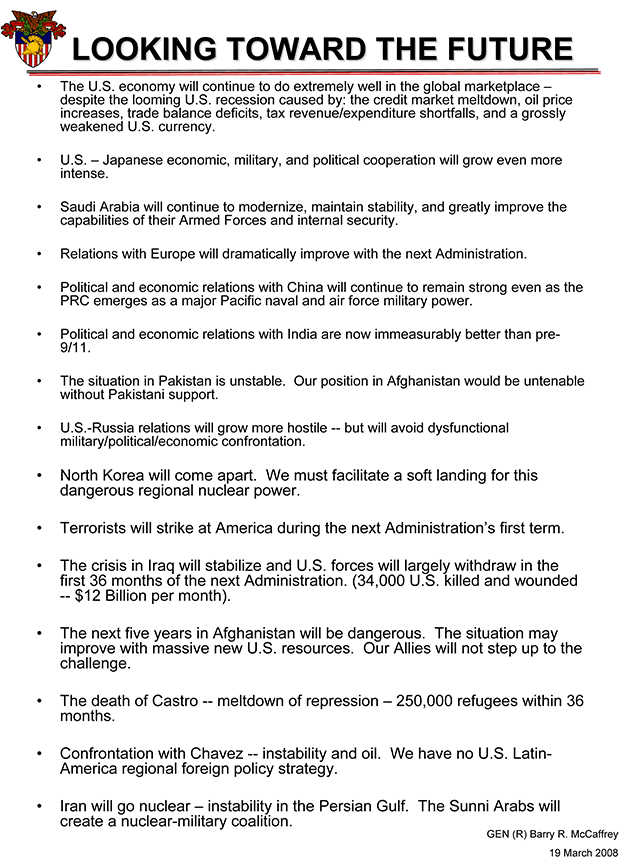
Yesterday, The SWJ Blog ( and blogfriends on Twitter, one of whom characterized it as “weak”) aleted me to a futurist slide by General Barry McCaffrey with his predictions of potential national security events faced by the United States in the near term. I’m certain this was in the context of a much larger presentation, given to a specific group with stated policy concerns; unfortunately, those particulars are unknown to me:

futurism.gif

My commentary:

First of all, one notes the number of “safe” predictions in the sense that none of these represent even the likeliest of outliers much less scenarios representing true, statistical rarity, “Gray Swans”. There’s a certain probalistic logic to doing so – the status quo more often than not in any given scenario will continue uninterrupted except by minor adjustments. On at least half of this list, given the breadth and/or vagueness, I’m certain that McCaffrey will be able in five years to say that he was more right then wrong. Unfortunately, the narrow number of domains from which he is extrapolating – nothing on cutting edge tech, applied science, the environment, macrodemographics, religious fundamentalism or interesting “intersectional” possibilities – leaves  policy makers with a vision that may be more susceptible to a Black Swan event than before by reinforcing previously held expectations.

Sidebar: I’d love to see Art Hutchinson, Tom Barnett, John Robb , Michael Tanji and the gents at Kent’s Imperative also critique the slide.

Now, in fairness, to the good General, a few of his bullet points are more interesting than others. I think McCaffrey’s called a hard landing for Cuba correctly unless Raul Castro has a secret admiration for Deng Xiaoping and the comprehension of economics to execute a Deng-like transition. It will be difficult for Cuba to really open up without the economic logic of the American market and favorable asylum policies for Cubans immediately kicking in as it did for the East Germans when the other Soviet bloc states ceased cooperating with Honecker’s repressive policies. With Chavez too, I think General McCaffrey is correct given that there is a little remarked friction between Venezuela the oil producer and America the refiner of Venezuelan oil ( refining capacity is itself a choke point along with oil production nor is all crude created equal; some is more expensive to refine than others). Finally, the temptation for al Qaida to “send a message” to the new administration and create downstream political effects may prove well-nigh overwhelming; it may even override their present policy of waiting until to pull off a catastropic level act of terror.

How do you see it ? Comments, questions, rants are all welcome.

New! Vandergriff’s Adaptive Thinking Blog & Cameron’s Cognitive Mapping Blog

Sunday, March 23rd, 2008

Military education reformer and author Don Vandergriff has joined the blogosphere and  he is off to a nice start:

First of all, my hat’s off to anyone that ventures out and participates in something like the adaptability conference. It takes moral courage to admit, “maybe I can get better, let’s see what happens here.” More compliments to the person’s organization if the organization was willing to support and encourage its people to get better. Too many organizations focus on the short term profit and simply don’t want to lose control of its people, don’t take the opportunity to make a long term investment in making its people more competent and confident. These attributes are the hallmark of adaptability.

I use a series of different games and scenario based education to involve the students (or participants) in the discussion about how to evolve adaptability in themselves and in their organization. The students end up doing the talking and usually solving or finding the answers to their questions. Each and every time any group does these exercises, they assume that I, as the facilitator, limit what they can do, like asking question to broaden their assumptions and courses of actions, and that I will always say no if they do ask a question, like “can we have more time.”

I will leave you with this thought, after doing this approach with games and getting similar results from audiences the past 50 times, why do students box themselves in? What does that tell us about ourselves and our organizations, when we always assume the negative? How does this limit our “evolutionary adaptability”?

Facilitation is the skill that separates the great teacher, who leaves an intellectual legacy in the form of students whose worldviews they have been profoundly impacted, from the scholar who is merely competent in the classroom. The latter knows their field while the former knows how to elicit students to think about the field in a deep and meaningful way.

Not all “star” scholars are great facilitators because that skill requires a good deal of self-restraint to guide students to the point where they can make the leap to discovery and comprehension on their own ( genuine learning, in other words). A high tolerance for failure and error is required because students will initially go down well-trod blind alleys ( well trod to the instructor, not to the students – this is a perspective that academics frequently overlook) before realizing that they need to generate alternative solutions. Facilitation, unlike pontification, keeps students cognitively active and on-task with timely re-direction or adaptively ( modeling for the students) takes advantage of a student insight to create a learning moment for the larger group.

I look forward to reading more in this vein from Major Vandergriff in the future ( Hat tip to DNI )

Charles Cameron, who already blogs in his area of professional expertise at Forensic Theology, has added Hipbone Out Loud to his arsenal:

Understanding is modeling, mapping.

In this blog, I want to capture the glimpses I have of an extraordinary world, each glimpse being a tiny area of a vast map – certainly more sophisticated than any individual can generate with data visualization tools and modeling software, perhaps more complicated than a single culture can grasp as a collective – but important, as it is the matrix in which our individual and cultural life-maps fall.

You will find I favor quotes and anecdotes as nodes in my personal style of mapping – which lacks the benefits of quantitative modeling, the precision with which feedback loops can be tracked, but more than compensates in my view, since it includes emotion, human identification, tone of voice.

The grand map I envision skitters across the so-styled “Cartesian divide” between mind and brain. It is not and cannot be limited to the “external” world, it is not and cannot be limited to the quantifiable, it locates powerful tugs on behavior within imagination and powerful tugs on vision within hard, solid fact.

Doubts in the mind and runs on the market may correlate closely across the divide, and we ignore the impacts of hope, fear, anger and insight at our peril.

I’ve featured the writing of Charles Cameron here before because he produces posts rich in both complexity and depth, generating intriguing horizontal-thinking patterns that would have easily escaped my attention.  This another blog that I’ll be checking frequently.
The Last Doughboy

Saturday, March 22nd, 2008

I meant to note this at the time of publication but America now has only one surviving veteran of the First World War, Frank  Buckles, age 107:

Now there is only one. When Harry Richard Lucas died recently, Frank Buckles was left as the only American soldier who can recount his personal experience in World War I. He is the last surviving American World War I veteran. The Great War, as it was once known, is receding into ancient history, an era as distant from us today as the Civil War or the American Revolution.But every war lingers, long after the last soldier has died. Generations hence, the ghosts still speak to us, even if we no longer acknowledge the voices. Look no further than our current travails in the Middle East, in large measure a result of the political consequences of World War I, which created the political boundaries of those tribal regions. And in an echo of the current presidential debate, Americans in 1917 were passionately divided about being drawn into a European conflict we had little direct stake in, arguably less than we have in Iraq today.

When Mr. Buckles went ” Over There” the nation was still more agrarian than urban and both the Civil War and Slavery remained within living memory, neither the electric light nor running water were taken for granted and motion pictures were silent. The changes that Frank Buckles has seen in his lifetime surpass that of most 500 year periods in history.

WWI had been overshadowed for decades by the sheer enormity of it’s larger and more lethal sequel, the Second World War but historians are coming to see the Great War as a watershed in modern history, the tipping point at which the twentieth century went unpredictably, horribly, wrong.  John Keegan elegantly writes of the war, despite having been “curiously civilized”, cutting down a generation like stalks of wheat and twisting the survivors, turning them against the liberal and rational civilization of the Enlightenment. The war’s unprecedented slaughter desensitized Europeans to violence and cultivated widespread disillusionment with the traditional order, leaving a spiritual and political vacumn that would be filled by the malevolent dynamism of Fascism and Communism.

For practical purposes, that “Lost Generation” is now gone and the “Greatest Generation” that had to fight WWII and “finish the job” is going fast. Let’s hope the hard lessons they learned do not pass from memory along with them.

Deep Understanding

Friday, March 21st, 2008

Michael Tanji points to this report by RAND to explain why the IC isn’t demonstrating any.

Part of the problem, I will hazard is a guess, is legacy security and pesonnel policies. “Deep understanding” of cultural-political variables of foreign societies requires a mix of academic historical, linguistic and social science expertise coupled with extensive “in-country” experience. Ideally, in the same analyst but failing that at least within the same analytical team. Aside from the collector-analyst division which could stand some erasure, many of the most useful sort of moldable, raw, talent – children of native speakers and Americans with extensive experience living overseas – have a difficult time getting through the clearance process.

Then, once these folks are in, cultivation of a strategic perspective – which includes synthesis, intuition and imagination and a long time horizon alongside analysis – have to become a priority over narrow analytical-reductionism and a “presentist” mindset. We have guys who do the latter already, they’re called journalists and the best of them do it very well. The IC should be playing at another level.


Switch to our mobile site

