zenpundit.com » 2011

Archive for 2011

The Human Face of War, a second review

Wednesday, November 16th, 2011

[by J. Scott Shipman]

images-1.jpeg

The Human Face of War by Jim Storr 

[Zen reviewed this book earlier here. I had forgotten that I wrote a rather long review at Amazon after finishing in January 2010. Perhaps Storr will gain a wider audience as a result.]

Mr. Storr’s The Human Face of War will be I predict, a book studied by military professionals (and smart policy makers) for years to come. Using straightforward prose, Mr. Storr seeks to provide a philosophical approach to war—as he says, “In practice we are concerned so much with war as with waging it.” Storr goes on to differentiate between war and warfare; where war is an “issue” with history and warfare dedicated to methods/methodology. Storr rejects notion that war is art or science, and prefers instead to embrace pragmatism and limited empiricism. He points out correctly: “Pragmatism has obvious application to warfare. A significant aspect of warfare is `a process of trial and error; seeing what wins and exploiting it.” Storr continues that “empiricism is not just trial and error: it is a logical process based on structuring observed facts.” What “works” will suggest a way ahead. 

Storr uses broad themes of what has worked and what has not worked in military history by explaining the nature of combat and tools and models available to the practitioner. He uses Clausewitz’s “dialectic of aims and means” in conjunction with Systems Theory to describe the holistic nature of military units; where effective/efficient output is dependent on input—where a good outcome is “winning” (as Storr repeatedly observes throughout the book, armies aren’t paid to come in second). Hence, organization of military units is fundamental; efficient/effective organizations are more likely to succeed. He observes: “Cohesion and collective performance indicate the whole is greater than the sum of the parts. There is a systemic effect, and we should see armed forces as systems.” 

Storr is a proponent of forcing decision making to the folks on the ground using brief and succinct communications. His chapter on Commanding the Battle is excellent. Storr advocates lean command staff’s and dispersed decision making. “We should employ the best brains in small groups, rather than try to assemble a collective brain.” He points out that “when staff numbers are reduced, the effectiveness of HQ improves.” “Reducing staff numbers would increase speed with which they could get things done.” [Amazingly, Storr quotes a work from 1998 that reports a typical Western division commander has 600 people supporting!—and that number has, I’m sure increased in 10 years.] He concludes this excellent chapter making a distinction between technology and the human factor: “…the future is not digital: it’s human. What is needed is things that bind talents together as a team, not more bandwidth…given time, resources, open minds and not much money we could revolutionize land tactical command. The key problems are human, cultural and institutional.” 

Storr asserts that successful modern commanders are most likely intuitive thinkers and possess the ability to learn from experience. He suggests further the “tendency to learn is more critical. It implies a tendency to reflect on experience and to learn from it, to maximize the benefit of the experience.” This tendency is key to the development of “skills”. He encourages a “permissive man-management regime that allows those who can learn rapidly from their experience to do so.” At the opposite end, Storr makes clear the unsuitability of many leaders who use bullying tactics and fear to motivate. 

Storr concludes by observing that “institutional conservatism” inhibits armed forces from improving significantly during times of peace; that “the current size and shape of Western armies reflect issues that are not primarily related to warfighting effectiveness.” He insists that doctrine should be explicit, relevant,(descriptive and where appropriate, prescriptive), coherent, and practical. The short tours common in western armies harm team integrity—which is “huge”. Innovation is vital, and in many cases military members aren’t with a unit long enough to have the experience necessary to truly innovate. Storr advocates “experience is the best way to achieve practical coordination and overcome the fog of war, as long as the experience gained is positive.” He discourages the common use of lieutenant-colonels in jobs where a captain or major could function/thrive/learn; as these junior officers will have less experience when they are promoted and will have probably developed the habit of “referring decisions upwards, and hence develop little initiative.” 

According the Storr, the “human” aspect of war should take prevalence over technology. He acknowledges the utility of technology, but asks the reader to “…pause and look for a moment at the Vietnam War, which suggests that superior technology is not always the deciding factor.” [9-11 is illustrative of this point on the “terror” side; determination and box cutters wreaked havoc.] 

My review does not do justice to the wealth of information, insight, and counsel in Storr’s book and I quote him frequently because his style is better than a summary. This book was aimed at a narrow audience, hence the high price. When I began, I was concerned about Storr’ opinions concerning John Boyd’s OODA loop; but in late 2009 I rejected Boyd’s deterministic underpinnings of OODA—Storr’s pragmatic and partial empiricism makes more sense. OODA remains, in my humble opinion, a valuable and versatile methodology in both the military/law enforcement and business arenas. 

This book is highly recommended; particularly for junior officers and NCO’s—the price is high, but what you will gain will be worth the cost.

UPDATE 11.17.2011: Jim Storr contacted me and confirmed the issue of a paperback for about $40.
Striking Iran — response to Cheryl

Wednesday, November 16th, 2011

[ by Charles Cameron — Khamenei fatwa against Iranian nukes: its existence, documentation, flexibility, authority, background ]

.

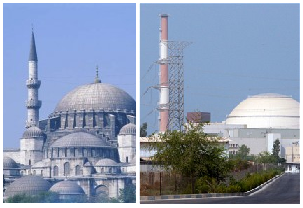
bushehr-and-mosque.png

any resemblance between the New Mosque in Istambul, Turkey (left), and the nuclear facility at Bushehr, Iran (right), is purely circumstantial

1.

Blog-friend Cheryl Rofer of The Nuclear Diner and Phronesisaical raised some questions in her comment on a post of mine, and I’d like to respond to the degree that I am able. Cheryl wrote:

On that fatwa against nuclear weapons: it just doesn’t seem to be available anywhere. I haven’t looked today, but I have previously, as have others, and it’s not on the interwebs, or seemingly anywhere else.

I agree that it’s an important part of the entire situation, if it exists. One would want to know how far its influence goes in the Iranian government and among the Iranian public.

Conversely, one might want to know why it’s so unavailable. Was it the view of one person, removed by others? Politically unsound for other reasons?

2.

Hi, Cheryl:

I’ve seen a fatwa referenced, but haven’t seen a text (and wouldn’t be able to read it if I did).

I wonder whether the word “fatwa” is being used somewhat loosely here, to refer to a statement by the Supreme Authority, for the guidance of the faithful, but perhaps not issued as a fatwa as such.

Iran’s Statement at IAEA Emergency Meeting describes it as a fatwa, and this AhlulBayt News Agency report calls it a fatwa in the bulleted headline, but refers to it in the “box” as “Imam Khemenei’s [sic] message to the conference on nuclear disarmament in Tehran, that declared weapons of mass destruction as haram (unlawful)” and states that it “was registered as an official UN document on Thursday.”

So that might be one place to look…

3.

Whether or not the text of a formal fatwa exists, Ayatollah Ali Khamenei has certainly stated his views on the topic himself and through his emissaries on numerous occasions. Thus Kamal Kharrazi, who was Iran’s Minister of Foreign Affairs at the time, wrote in January 2004 (New Perspectives Quarterly):

Iran’s supreme leader, Ayatollah Khamenei, has reiterated on several occasions a fatwa prohibiting the production, stockpiling and use of nuclear weapons. He repeated his fatwa most recently in an address Nov. 25. Given the importance of the fatwa institution in Shiite Islam, the broad significance of this should not be underestimated.

Some of Khamenei’s statements were listed in this November 2004 Radio Free Europe / Radio Liberty Iran Report:

In a 5 November commentary in the “Los Angeles Times,” Iranian Ambassador to the United Nations Mohammad Javad Zarif referred to “serious ideological restrictions against weapons of mass destruction, including a religious decree issued by Ayatollah Ali Khamenei, the leader of the Islamic Republic of Iran, prohibiting the development and use of nuclear weapons.”

“We believe that the use of nuclear weapons is religiously forbidden,” Foreign Ministry spokesman Hamid Reza Assefi said on 12 September according to state television. “This is the leader’s fatwa [religious decree].”

“The religious verdict of our leader is that using weapons of mass destruction is forbidden, is ‘haram’ [‘unlawful’ in Islam],” Supreme National Security Council official Hussein Musavian said in an 11 September interview that appeared in the 12 September “Financial Times.” “For Iranians, this verdict is much more important than the NPT [Nuclear Non-Proliferation Treaty].”

More than one year ago, on 25 October 2003, Supreme National Security Council Secretary Hojatoleslam Hassan Rohani told students at Shahrud Industrial University that Khamenei believes nuclear weapons are religiously illegal, IRNA reported.

One can have reservations about Khamenei’s ability to legitimately issue a religious decree, given his questionable theological standing. Nevertheless, as Supreme Leader and commander-in-chief of the armed forces he can ban or permit anything he wants.

4.

Juan Cole addressed the matter of Khamenei’s “ability to legitimately issue a religious decree” in his October 2009 Salon piece, Does Iran really want the bomb?

I was on an email list where someone expressed suspicion of Supreme Leader Ali Khamenei’s 2005 fatwa against the possession and use of nuclear weapons by an Islamic state.

One suggestion was that Khamenei is not a real Shiite jurisprudent and has eschewed having followers inside Iran. But, no, Khamenei is a mujtahid or independent jurist and has the standing to issue a fatwa or considered ruling on the law.. A mujtahid may always decline to accept muqallidun or followers, which Khamenei appears to have done for Iranian nationals, without that affecting his legitimate right to issue fatwas. The theory of ijtihad or independent jurisprudential reasoning holds that the law inheres in the reasoning processes of the jurisprudent; whether the jurisprudent has followers or not is irrelevant to the discovery of the law in a particular instance. Moreover, as rahbar or supreme leader,, Khamenei’s pronouncements on such matters might even be seen as a hukm or standing command. Finally, since he sets policy on such matters, what difference, in any case, would it make what exact jurisprudential standing his fatwas enjoy?

The only real question is whether he is lying and insincere.

5.

As to whether it is strange that no published text of a fatwa under his name exists, Mehdi Khalaji writes (in Michael Eisenstadt and Mehdi Khalaji, Nuclear Fatwa: Religion and Politics in Iran’s Proliferation Strategy, a very detailed MERIP Policy Focus offering from this September):

Interestingly, no written texts exist for the Supreme Leader’s fatwas, though Shiite juridical tradition grants equal weight to an oral and written legal opinions-a phenomenon to be discussed further in the next section.

and again:

As such, even though Ayatollah Khamenei has produced no written record on the religious prohibitions pertaining to nuclear weapons, his verbal statements on the subject are considered his religious opinions, or fatwas, and therefore binding on believers.

[ see also Cole above on hukm ]

6.

Khalaji also suggests that Khamenei’s more recent statements have been more flexible, and indeed that it is not uncommon for jurisprudents to change their minds (and “opinions”):

Supreme Leader Khamenei has stated that the production, stockpiling, and use of nuclear weapons are forbidden under Islam. But his recent language on the subject has become more equivocal, emphasizing only the prohibition on their use and not on their production or stockpiling. And should the needs of the Islamic Republic or the Muslim umma change, requiring the use of nuclear weapons, the Supreme Leader could just as well alter his position in response. This means that, ultimately, the Islamic Republic is unconstrained — even by religious doctrine — as it moves toward the possible production and storing of nuclear weapons.

7.

An example of a more recent statement of this sort would be the one reported in this VOA piece from February 2011:

Iran’s Supreme Leader Ayatollah Ali Khamenei christened a new, Iranian-built warship, as a military band honored him on the ship’s deck. Addressing a crowd of military commanders after the ceremony, he told them that “Islam is opposed to nuclear weapons and that Tehran is not working to build them.”

8.

Putting this in context, Cole in the Salon piece I quoted above suggests that Khamenei may be going for “latency” rather than “possession” – latency having the power of a threat, but not trespassing the limits of actual development allowed under treaty:

Latency is the possession of a nuclear energy program and of reactors, which would allow the production of an atomic bomb on short notice if an extreme danger to national autonomy reared its ugly head. Nuclear latency is sometimes called the ‘Japan option,’ because given its sophisticated scientific establishment and enormous economy, Japan could clearly produce a nuclear weapon on short notice if its government decided to mount a crash program.

9.

As to the question of how far the influence of Khamenei’s opinions go, Khalaji writes:

Iranian nuclear decision-making, therefore, bears the significant imprint of one man’s personality and politics — an imprint that may be unaffected by the will of other men, the decisions of other institutions, or, most ironically, the legal scruples or moral dictates of his own religion.

10.

Timothy Furnish, whose paper A Western View on Iran’s WMD Goal: Nuclearizing the Eschaton, or Pre-Stocking the Mahdi’s Arsenal? also explores the matter with background and in considerable detail, suggests that it is more likely that “Tehran … finds its potential nuclear policy fettered by Qom “:

But the preponderance of evidence — Islamic history in general, specific Shi`i traditions and teachings as well as modern religio-political discourse in Iran – indicates, rather, that the rationality and spirituality of Iranian Mahdism is holding at bay its undeniable jihad aspect. Tehran thus, ironically, finds its potential nuclear policy fettered by Qom: mainstream Shi`i theology does not support violence (nuclear or conventional) in order to precipitate the return of the 12th Imam; furthermore, employing nuclear weapons is verboten in the Mahdi’s absence — except, perhaps, under the rubric of defensive jihad, were Iran itself to be attacked or invaded. Seen in this light, the Islamic Republic’s pursuit of nuclear weapons falls from the overly-alarmist apocalyptic register into a more mundane, and manageable, geopolitical one.

Coming from Dr Furnish, that says a great deal.

10.

And that’s what I have, Cheryl, all.  I’m happy to learn more…

Two Announcements

Tuesday, November 15th, 2011

First, Pragati now has my review of Storming the World Stage posted online:

A Jihad for All Seasons 

PDF version in the post here.

Secondly, if you are a user of Kindle and an avid reader of zenpundit.com, you are now able to subscribe to ZP on your Kindle.

This was in response to a reader request, so perhaps there is more interest out there for this option. I hadn’t considered it before, but it is easy to do, so if you are a blogger, you might want to sign your blog up as well. Can’t hurt.

Striking Iran: Two Games and a World – Pt 2

Tuesday, November 15th, 2011

[ by Charles Cameron board game and board-room simulation of an Israeli strike on Iran ]

.

nyt-osiraq.png

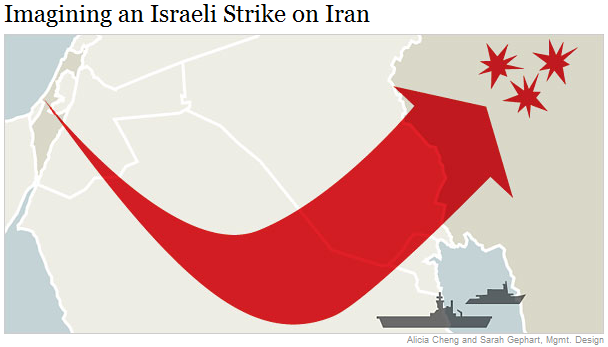
[graphic & headline from the New York Times]

[continuing from part I]

5.

Osiraq Redux

Karim Sadjadpour described a very different style of game in Foreign Policy just one day after Michael Peck’s description of Persian Incursion. It was conducted by the Brookings Saban Center, and also written up by Kenneth Pollack in the Center’s Middle East Memo of February 2010, and by David Sanger at the New York Times.

Here is Pollack’s description of the structure of the Brookings game:

The simulation was conducted as a three-move game with three separate country teams. One team represented a hypothetical American National Security Council, a second team represented a hypothetical Israeli cabinet, and a third team represented a hypothetical Iranian Supreme National Security Council.

As a scholar of religion, I would be tempted to add, after the manner of the Athanasian Creed, “Yet there are not three hypotheticals but one hypothetical.”

More:

The U.S. team consisted of approximately ten members, all of whom had served in senior positions in the U.S. government and U.S. military. The Israel team consisted of a half dozen American experts on Israel with close ties to Israeli decision-makers, and who, in some cases, had spent considerable time in Israel. Some members of the Israel team had also served in the U.S. government. The Iran team consisted of a half-dozen American experts on Iran, some of whom had lived and/or traveled extensively in Iran, are of Iranian extraction, and/or had served in the U.S. government with responsibility for Iran.

This game begins with an Israeli strike – that is to say, the strike itself is not what is gamed here: the game is designed to be “a day-long simulation of the diplomatic and military fallout that could result from an Israeli military strike against the Iranian nuclear program.” Again, I will not rehearse nor comment in much detail on what has been reported of play, both in Pollack’s official Brookings report on the game and in Sadjadpour’s account, noting only that the Brookings game features a response from Hizbollah which (as Michael Peck noted) was lacking in the board game.

6.

Differences of style

What interests me is the difference in style between the two games, the two approaches:

  • The emphasis on the initial strike in Persian Incursion focuses that game more tightly on questions of materiel and logistics, while the Brookings game naturally puts greater emphasis on the responses of individuals and groups. And I’d suggest that the structures of the two games in some sense parallels that distinction:
  • The board game is played by two players, typically experienced grognards, wargame hobbyists or designers, often with military backgrounds. Their skill is in decision-making in the context of such games, and Larry Bond has provided them with an exhaustively-researched briefing on the issues he considered salient.
  • The board-room sim is played by a couple of dozen players, each of them already possessing their own highly detailed “takes” on the specific aspects of the game their voices will “represent”.

One might say that Persian Incursion is an entertainment and the Brookings game a high-level albeit informal strategic deliberation — but that comparison fails to account for the detailed research that has gone into PI — and the Harpoon gaming system which underlies it. Both games are serious attempts, at the limit of human imagination, to figure out — to “game” — one specific, now perhaps looming, future.

Taking both games with equal seriousness, then, we can say that both players of PI have Larry Bond and his two associates (in the form of those booklets, maps, target specs and so forth) as their intel resources, whereas the Brookings game features the combined (cooperating and competing) intelligences of the two dozen or so participants.  That’s not quite crowdsourcing, as is the Naval Postgraduate School‘s ongoing MMOWGLI anti-piracy game, but it is polyphonicit allows and attends to a variety of voices…

Of course, if those various voices are selected in such a way that they form too much of a “choir” or “chorus” this advantage is diminished: there’s no great benefit to hearing a dozen or two versions of group-think. And while the individual voices in a group may in fact propose usefully distinct ideas, there’s always the possibility that some key factor or factors will be overlooked, because a single world-view is operating where a true polyphony would require a deeper and richer diversity.

Is Persian Incursion more practical, having a greater emphasis on actual force projection? Is Osiraq Redux more realistic, having a wider set of expertises to draw on?

7.

Omnium gatherum

For the sake of completeness, I should mention that a game not unlike the Brookings game of 2009 was played by a similarly qualified group at the behest of the Atlantic magazine in 2004, as reported by James Fallows. I was particularly intrigued by this piece because Mike Mazaar, with whom I once collaborated briefly, was playing SecDef.

What I’d hope for from ZP’s readers would be some discussion of these two different approaches to gaming, and of gaming itself– along with scenario planning — as a means of exploring possible futures where the impact downstream may be considerable.

The piece of the puzzle that I fear may be missing from both games, as those who know me will have guessed, is the potential influence of messianism — from the Israeli / Judaic, the U.S. / Christian Zionist, and the Iranian / Mahdist sides. But then I generally expect the seriousness of millennial aspirations to be discounted, and try to keep track of those things accordingly myself.

Three puzzle pieces that I would find relevant would be:

(i) the Ayatollah Khamenei‘s fatwa “that the production, stockpiling and use of nuclear weapons are forbidden under Islam and that the Islamic Republic of Iran shall never acquire these weapons”;

(ii) Timothy Furnish‘s observation:

The Leader of the Islamic Republic of Iran, Ayatollah Ali Khamenei has issued the Fatwa My own study of both geopolitics and of Shi`i traditions on the 12th Imam leads me to conclude that the clerical regime does NOT believe in nuking Israel (or anyone else), because while the Mahdi will return at a time of great violence and upheaval, there is no Shi`i teaching that creating such bloodshed would induce Allah to send him. Also, I think the ayatollahs are crazy like foxes, not literally crazy-and they know full-well what would be the Israeli (and perhaps American ) response to any use of nuclear weapons against Israel. The Mahdi would not be happy to return and rule over a radioactive wasteland..

For more detail, see also Furnish’s A Western View on Iran’s WMD Goal: Nuclearizing the Eschaton, or Pre-Stocking the Mahdi’s Arsenal?

and (iii) Benjamin Netanyahu‘s statement in opening the Knesset:

Our policy is guided by two main principles: the first is “if someone comes to kill you, rise up and kill him first,” and the second is “if anyone harms us, his blood is on his own hands.”

The first is “im ba l’hargekha, hashkem l’hargo” — a well-worn phrase that can be found in the Talmud and derives from Exodus; I’m unsure whether the second — “If anyone harms us, his blood is on his own hands” — comes from a Talmudic source, or whether it is an abbreviated restatement of Ezekiel 33 1-9.

8.

Some trivia for good measure…

As Michael Peck points out, the game’s graphic designers write Persian Incursion using a faux-Devanagari script more properly associated with Sanskrit and Hindu sources than Iranian Shi’ism…a minor pity, that.

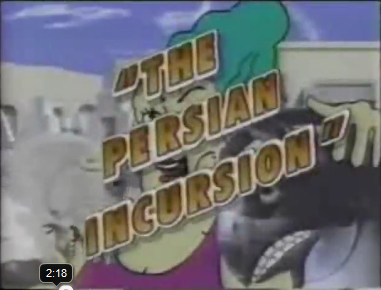
And ha! — I’m left wondering whether the title, Persian Incursion, came to Larry Bond or his crew out of the ethers — or whether someone had been watching…

persian-incursion-carmen-sandiego.png

Where in the World is Carmen Sandiego, Season 5, Episode 39?

GMTA?

Striking Iran: Two Games and a World – Pt 1

Tuesday, November 15th, 2011

[ by Charles Cameron — board game and board-room simulation of an Israeli strike on Iran ]

.

persian-incursion.png

1.

We suppose we can game the world.

It may in fact be the best thing we can do, or the only thing: we guess, guesstimate, estimate the possible outcomes of an act or series of acts — and somehow in there, we hope to match the major trends in the complexity we seek to understand with selected complexities of our own that we build into our games.

And yet as Richard Danzig noted in the opening paragraph of his Driving in the Dark: Ten Propositions About Prediction and National Security which I quoted here yesterday, “whereas routine, short-term predictions are generally right, strategic judgments about future environments are often, one might say predictably, wrong.”

So we have knee-jerk responses, which can suitably be expressed in barks or sound-bites, and we have deliberative inquiry, which requires suitably nuanced exegesis. And our games and simulations are attempts at the deliberative approach.

2.

The chess board:

So the question of an attack on Iranian nuclear facilities is once again in the air, and we would like to be able to peer as far down the chess-board as a Kasparov, computing the counter-move an adversary would make against a friend’s counter-move to the adversaries response to an initial move. Sadly, though, we all too often find ourselves in the bind that a senior US official in Iraq described to Anthony Cordesman a while back, where our best efforts at gaming the situation are “like playing three dimensional chess in the dark while someone is shooting at you.”

Except that my own version of the board may be more accurate:

it’s more like an n-dimensional spider’s web, with multiple gravities, tugs, and tensions – and some of those tensions are in the category of known unknowns that one of your predecessors talked about, some of them unknown unknowns, and some of them literally unknowable – hidden in the hearts of more devious men than you, and known only to God.

3.

So, anyway, we game things out as best we can.

And since the idea of bombing Iran’s nuclear facilities has been in the news of late, so have two attempts to “game” that particular possibility and its sequelae.

What interests me here is not the outcomes envisioned – but the inherent differences between the two games. Let’s take a look.

4.

Persian Incursion.

As Michael Peck — he splashed Persian Incursion into our consciousness with one post on Foreign Policy and another on Danger Room last week, not to mention an interview on NPR – puts it:

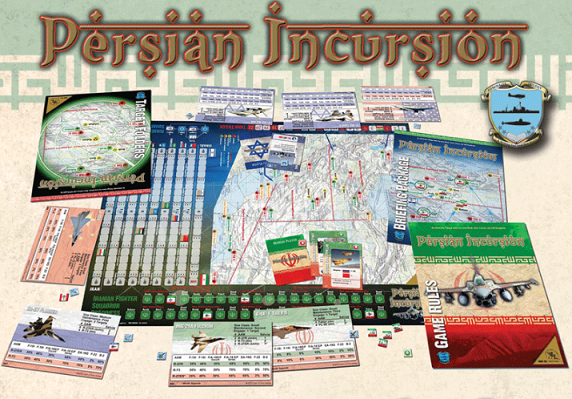
Persian Incursion is basically two games in one. There is a highly detailed military game of a seven-day Israeli air offensive in which Israel plans and executes its strikes while the Iranian air defenses try to stop them. But there is also a political game that unlocks the military aspect. Persian Incursion assumes that an Israeli attack is only possible if one of Iran’s neighbors — Saudi Arabia, Turkey, or a U.S.-influenced Iraq — either publicly or tacitly allows Israeli entry into its airspace for the strike on Iran. (The rules state that though Israel could chance an initial airstrike without an agreement, it would need permission for follow-up attacks.) With that in mind, the game comes with various starting scenarios, such as a super-radical Iran that scares its neighbors into allowing Israeli access, or Turkish support for an Israeli strike (note that the game came out in 2010, before the current Israeli-Turkish spat).

Here’s how Clash of Arms, the publisher, describes the game packet:

Persian Incursion provides comprehensive and detailed information on:

• Orders of battle for the Israeli and Iranian Air Forces and the Iranian Air Defense Force
• Analysis of the Iranian nuclear and oil infrastructure
• Iranian ballistic missiles and Israeli ballistic missile defenses
• Target folders for Iranian nuclear facilities, oil terminals and refineries, and airfields
• Variable starting conditions

Components:

• Rulebook; Briefing Package and Target folders;
• 17 x 22″ Full color map;
• Short Deck of “Super Cards” (4.25 x 6″);
• 2 Full decks of playing cards (110 cards);
• Cardboard counters;
• Box and dice.

Now I am absolutely not the guy you want to ask about the game-play, or about the game’s possible implications for policy analysis. Michael Peck may well be that guy, but even he doesn’t leave the game with a clear sense of how things might play out in real time:

The real question of this exercise, however, is whether an Israeli strike on Iran is a good or bad idea. Persian Incursion’s answer is an unqualified “maybe.” Israel can’t stop Iran from retaliating with missile attacks and terrorism. But it also can’t guarantee complete destruction of Iran’s nuclear program. Perhaps most importantly, the key to victory is winning the public-opinion, political war.

And when you get granular, “public opinion” turns out to mean the interwoven opinions of many, many and diverse people — some influential, some easily influenced, some whose world-view features a rigorous scientism, some a potentially wrathful deity – all of whom are themselves beset by a myriad of doubts, certainties, hopes, fears, bouts of toothache and who knows what else…

Modeling even one of those minds (and associated hearts) would be quite a trick…

So. That’s the “reference library” approach, to use Peck’s term:

Persian Incursion isn’t a novel — it’s a reference library inside a game. The background information included is staggering. Besides the rules book, there is a target folder and a briefing booklet listing the precise dimensions of Iranian nuclear facilities down to the meter…

The gamer has what we’ll assume is a highly accurate representation of the materiel side of things. Morale, at the granular level of a Netanyahu or a Khamenei?

Who can game the workings of a single human mind (and heart)?

[continued in Pt 2]


Switch to our mobile site