zenpundit.com » 2011 » March

Archive for March, 2011

Friend[s] of “Abu Reyyan” the Frankfurt Shooter

Friday, March 4th, 2011

[ by Charles Cameron ]

.

Aaron Weisburd has posted a screen-grab of “Abu Reyyan” the Frankfurt Shooter‘s FaceBook page at Internet Haganah
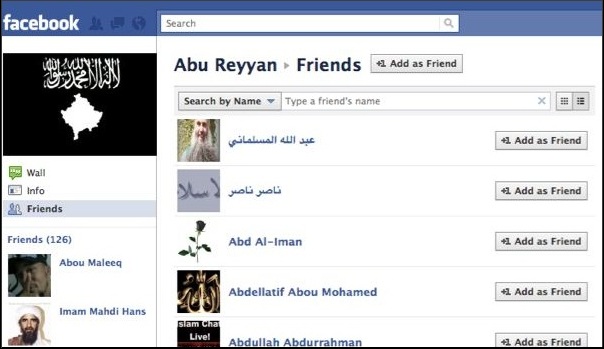
abu-reyyan-friends-screen-grab.jpg

Naturally enough, the name of the second friend listed in the left-hand column, Imam Mahdi Hans, caught my eye. Here’s a screen grab of part of Hans’ own Facebook page, showing his self-image to better advantage:
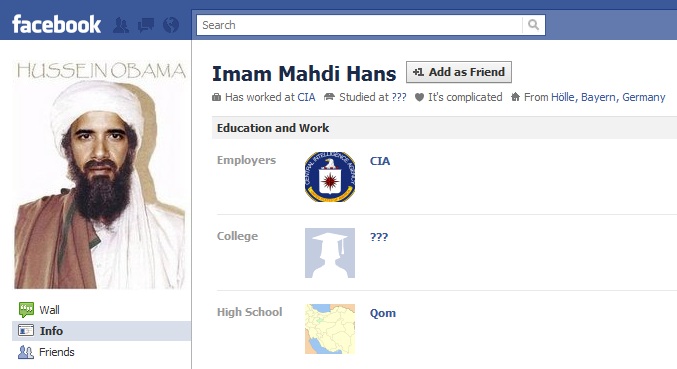
imam-mahdi-hans.jpg

Okay, I’ve seen that image before — in fact, I blogged about it on my old Forensic Theology site, towards the bottom of a long post, and yes — the image clever Hans is using is a blend of Osama with Obama, and includes a credit to “Phil Dragoo”.  And yes, Hans himself does claim to be the Mahdi on his FB page.

It’s probably just a joke, and a bit of a sideswipe at the Shi’a, Obama, and no doubt the CIA — but since I noticed the connection, and Aaron doesn’t have comments enabled, I thought I should mention it here…

.

UPDATE:

Aaron has kindly pointed out to me that there’s a second Mahdi among Abu Reyyan’s friends: Imam Mahdi Franz.
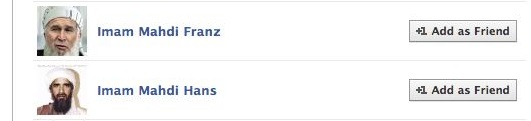
2-imam-mahdis.jpg

Like Hans, Franz’ avatar is a mashup of two images to generate a face presumably intended to represent bin Laden, but with the features of a US President: in the first case, Obama, and in the second, Bush 43.

In this case, the mashup is one that you’ll find on the cover of Tariq Ali‘s book, Clash of Fundamentalisms (the British hardback has the best version of the image; the US edition credits it to “Mister Hepburn / Slab”.

Here’s where it gets doubly interesting to me:

First, the pair of them taken together make a fine example of the anti-Shi’a strand in Salafism, picking up on the eschatology — which I don’t think they’d be doing quite like that if they felt a strong Salafi-Mahdist current themselves.

So that’s another data point in terms of the strength of what J-P Filiu calls “Apocalypse in Islam” – in Germany, Shi’ite Mahdism can be mocked by Salafis.

.. and second, for bonus points… the two pages are also pretty strongly “twinned” – Mahdi to Mahdi, Hans to Franz, Obama to Bush – so they’re also a great fit for my more playful side, suggesting an obvious example of my DoubleQuotes genre:
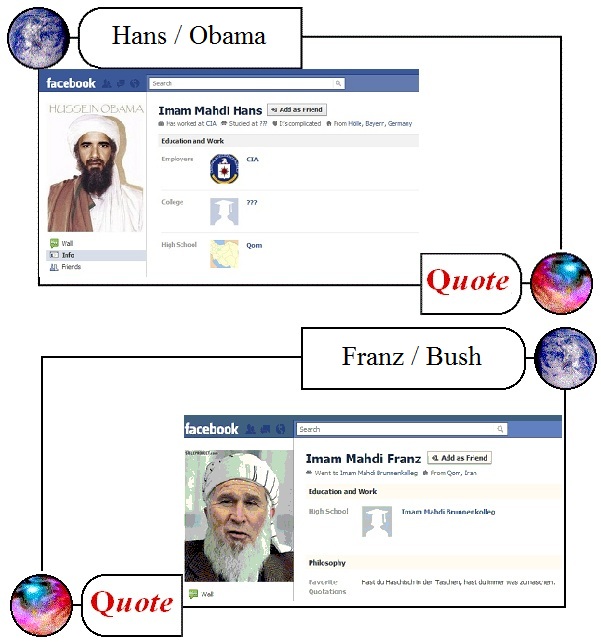
quo-twin-mahdis.jpg

Call and Response

Thursday, March 3rd, 2011

[ by Charles Cameron ]

Okay, don’t take this one too seriously:

quo-witches.gif

I’m a big fan of Frank Herbert‘s Dune, and the news that there’s now a Goodnight Dune version for kids on the web caught me off guard and carried me away…

Hat tip to Bryan Alexander of Infocult

Maybe Shallow, Poorly Supported, Arguments Make Us Stupid?

Thursday, March 3rd, 2011

Nick Carr’s new book gets smacked upside the head in LRB by Jim Holt ( hat tip to Scott Shipman).

Smarter, Happier, More Productive

…This is a seductive model, but the empirical support for Carr’s conclusion is both slim and equivocal. To begin with, there is evidence that web surfing can increase the capacity of working memory. And while some studies have indeed shown that ‘hypertexts’ impede retention – in a 2001 Canadian study, for instance, people who read a version of Elizabeth Bowen’s story ‘The Demon Lover’ festooned with clickable links took longer and reported more confusion about the plot than did those who read it in an old-fashioned ‘linear’ text – others have failed to substantiate this claim. No study has shown that internet use degrades the ability to learn from a book, though that doesn’t stop people feeling that this is so – one medical blogger quoted by Carr laments, ‘I can’t read War and Peace any more.’

….It’s not that the web is making us less intelligent; if anything, the evidence suggests it sharpens more cognitive skills than it dulls. It’s not that the web is making us less happy, although there are certainly those who, like Carr, feel enslaved by its rhythms and cheated by the quality of its pleasures. It’s that the web may be an enemy of creativity. Which is why Woody Allen might be wise in avoiding it altogether.

Meanwhile, futurist Jamais Cascio asks “Is the Alphabet Making Us Stupid?”

Wikistrat: Middle-East Monitor # 3

Thursday, March 3rd, 2011


Liberated from Tom Barnett:

Wikistrat’s Middle East Monitor (#3)

DateWe’re excited to announce the launch of Wikistrat’s Middle East Monitor for February 2011, which can be viewed in entirety by clicking here.

Summary

The Mid­dle East and North Africa is again a pro­foundly dif­fer­ent place than it was in De­cem­ber 2010 or even in Jan­u­ary 2011. The biggest de­vel­op­ment is the down­fall of Egypt­ian Pres­i­dent Hosni Mubarak as a re­sult of the up­ris­ing in Tunisia that brought down Pres­i­dent Ben Ali. As a pop­u­la­tion with over 80 mil­lion peo­ple and a major strate­gic power, the suc­cess of the up­ris­ing ex­po­nen­tially in­creases the mo­men­tum of pro­test­ers in the re­gion that has ex­isted since Tunisia’s Jas­mine Rev­o­lu­tion….

Wikistrat Bottom Lines

Go!Opportunities

  • The overall demand for liberalization can open the door to Foreign Direct Investment as economic openness is demanded and governments resort to economic reforms to reduce internal stresses.
  • The demand for political liberalization can permit a better flow of information and ideas, allowing for a proliferation of voices and opinions.
  • Western support for those demanding reforms can decrease hostility, particularly towards the U.S., over the perception that it is not committed to human rights and has imperialistic motivations.

Stop!Risks

  • Islamists like the Muslim Brotherhood could come to power because of the desire for a greater role for Islam in public life, their superior organization and in some cases, a desire for some elements of governance based on Sharia law.
  • Anarchy could result as protesters clash with security forces. This can lead to instability that negatively affects world markets and potentially result in the damaging of oil facilities.
  • The increased power of the populations could result in foreign policies more hostile to the West and more favorable to Iran.

Warning!Dependencies

  • The appeal of the Islamist parties and political figures. It is possible that the population will not feel the Islamist candidates are qualified to improve the economy or carry out reform or may simply question their agenda once campaigning is underway.
  • The loyalty of the security forces. This is an important factor as they are the ones given the responsibility to ensure the survival of the governments, but they may defect if ordered to become violent.
  • The unity of the opposition. Division can weaken the opposition and strengthen the government and lead to dysfunction during a power vacuum.

 Click here to download the summary as a PDF document. Subscribers can download this entire edition in PDF or view on our interactive wiki. 

Elementary, my dear Watson — for humans

Wednesday, March 2nd, 2011

[ by Charles Cameron ]

On the face of it, the two events described here – the super-match in which IBM’s Watson computer beat two human Jeopardy champs, and the crowd-sourced protein-folding experiment in which nearly 60,000 gamers fared better than a supercomputer — would seem to say, respectively, that computers can defeat humans, and that humans can beat computers. So what’s to believe?

quoexperiments.gif

I don’t think the opposition holds up on closer inspection, however.

Watson may have beaten the human contestants in Jeopardy, but as the paragraph I quoted shows, it was nonetheless a human that “had the last word”.

Ben Zimmer in The Atlantic goes on to describe just how clever that “last word” actually was:

If you are a fan of The Simpsons, you’ll be able to identify it as a riff on a line from the 1994 episode, “Deep Space Homer,” wherein clueless news anchor Kent Brockman is briefly under the mistaken impression that a “master race of giant space ants” is about to take over Earth. “I, for one, welcome our new insect overlords,” Brockman says, sucking up to the new bosses. “I’d like to remind them that as a trusted TV personality, I can be helpful in rounding up others to toil in their underground sugar caves.”
.
Even if you’re not intimately familiar with that episode (and you really should be), you might have come across the “Overlord Meme,” which uses Brockman’s line as a template to make a sarcastic statement of submission: “I, for one, welcome our (new) ___ overlord(s).” Over on Language Log, where I’m a contributor, we’d call this kind of phrasal template a “snowclone,” and that one’s been on our radar since 2004. So it’s a repurposed pop-culture reference wrapped in several layers of irony.

Frankly, Watson isn’t up to that level of clever – it would take a Sherlock or a Mycroft to pull that off…
.
So in that first instance, the computer apparently beats the humans, but the humans come across as brighter than the computer all the same.
.
More or less the opposite happens with my second example. Here we have tens of thousands of humans pitted against a single computer, and the humans appear to have the edge – but do they?
.
It’s not the individual human brain that wins here, but what you might term “massively parallel human processing” – which isn’t nearly as impressive.
.
So there are in fact three kinds of ingenuity on display here: the original small-group human ingenuity that constructed the machine, the machine’s own mechanical ingenuity, and the combined ingenuity of sixty thousand humans in distributed collaboration

*

Look, here’s my challenge. The folks at IBM need to read Hermann Hesse’s Magister Ludi, and figure out how to create the sort of computer that could best Joseph Knecht at his own game

Let’s make that a little easier. they need to be able to recognize rich analogies across wide disciplinary distances — well enough to come up with a relationship comparable in its impact on two previously unrelated fields of knowledge to, say, the Taniyama-Shimura conjecture linking elliptic curves and modular forms

Simpler still: they need to be able to play one of my HipBone Games – see Derek Robinson‘s description of the games in The HipBone Games, AI and the rest — well enough to pass a Turing test.

*

Elementary, my dear Watson…


Switch to our mobile site

