zenpundit.com » 2011 » November

Archive for November, 2011

One hadith, one plan, one video, and two warnings

Friday, November 11th, 2011

[ by Charles Cameron – Ghazwah-e-Hind, the other prong of Khorasan jihad, YouTube propaganda, Zaid Hamid, his warnings to the West (leave well alone!) and to the Hindus (convert!) ]

.
ghazwa.gif

1.

The Hadith:

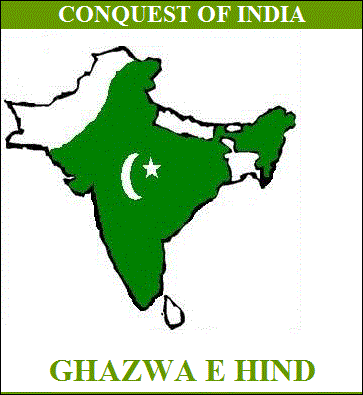
The major sweep of the victorious army with black banners will be from Khorasan to Jerusalem, as described in various earlier posts here — but  there are ahadith that deal with the conquest of India (and China, but that’s another story, see David CookStudies in Muslim Apocalyptic, pp 170 ff) that are currently enjoying a vogue in Pakistan…

Here is one version of the hadith, as quoted  by the Shaikh of the Naqshbandi Owaisiah Sufis, Muhammad Akram Awan, to whom I shall return in a future post, in a speech he gave in Pakistan in November 2008:

From Abu Hurairah (rau), he said: (saws)

The Messenger (saws) of Allah promised us Ghazwah-tal Hind. Now, if I encounter it, I shall invest my wealth and life in it. Then, if I am killed I will be among the most chosen Shuhada (martyrs) and if I live, I would be Abu Hurairah ‘the freed’ (from Hell Fire).

2.

The plan:

So how does that translate into contemporary geopolitics?

Syed Saleem Shahzad (Inside Al-Qaeda and the Taliban: Beyond Bin Laden and 9/11, pp 206-215) offers a brief overview of the Indian Jihad / Ghazwa-e-Hind in its current incarnation, with the involvement of the Pakistani ISI and AQ’s (presumed late) Ilyas Kashmiri, bringing us fast forward to the present day:

This was the ISI plan drawn up 30 years ago with Harkat-ul-Jihad-iIslami, Jamaat-e-Islami, Muslim Brotherhood connections, Islamic seminaries, and Sufi networks of constructing a theater of war from Central Asia to Bangladesh to defeat the Soviet Union in Afghanistan, and simultaneously to acquire the right of self-determination for Kashmiris in India. Thirty years later, Al-Qaeda simply refurbished the plan after sketching out its ideological boundaries, to prepare the greater theaters of war of Khurasan and Ghazwa-e-Hind for victory, before its armies, holding the black flag aloft, entered in the Middle East for the final battle against the Western world.

From my POV, the ghazwa is one of the topics Stephen Tankel might profitably have addressed as theological matter relevant to the LeT and the Mumbai attack…

Here’s the close of Shahzad’s book, to make the apocalyptic thrust in all this quite clear:

However, the saga of Al-Qaeda’s One Thousand and One Nights tales continues with new strategies and new characters. For Al-Qaeda these are just measures to keep the West running from pillar to post until it exhausts itself and Al-Qaeda can announce victory in Afghanistan. Al-Qaeda next aims to occupy the promised land of ancient Khurasan, with its boundaries stretching all the way from Central Asia to Khyber Paktoonwa through Afghanistan, and then expand the theater of war to India.

The promised messiah, the Mahdi, will then rise in the Middle East and Al-Qaeda will mobilize its forces from Ancient Khurasan for the liberation of Palestine, where a final victory will guarantee the revival of a Global Muslim Caliphate.

3.

The video: 

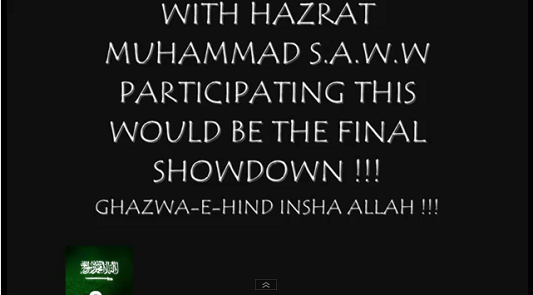
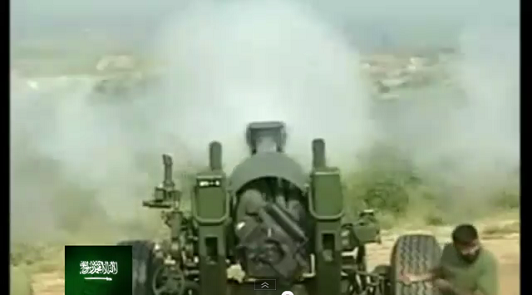
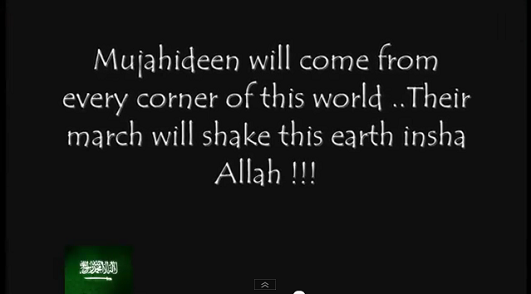
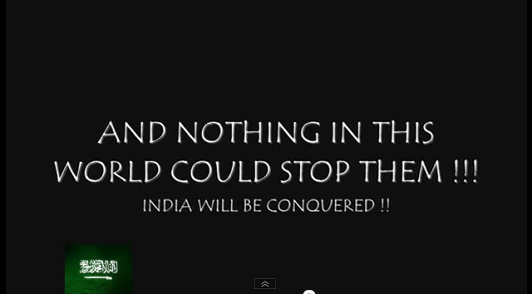
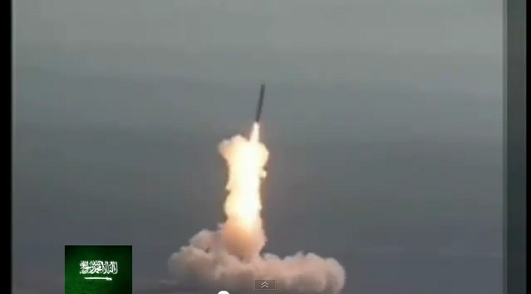
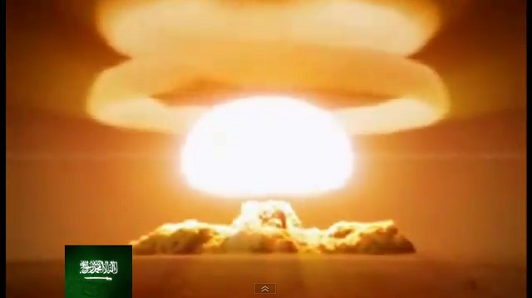
With that as background, I’d like to illustrate the emotional drive of the ghazwa idea, with screen shots from a video posted to YouTube in February of this year, titled Ghazwa-e-Hind (Prophecy) – Fall of India – Promised Victory. This section will take up quite a bit of screen space, but you can pretty much scroll on down and get the general idea, pausing where something seems a tad different or more interesting:

The video features stirring music throughout, presumably taken from Molossus (From “Batman Begins”) [2005] by Hans Zimmer & James Newton Howard — which we are invited to purchase on iTunes or AmazonMP3…

It opens with a rally, at which an Indian speaker is castigating Pakistan —
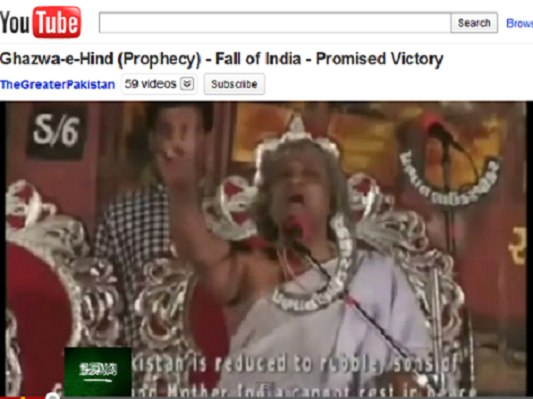
minus-1.png

next up: two frames that give a textual expression of the hope involved —
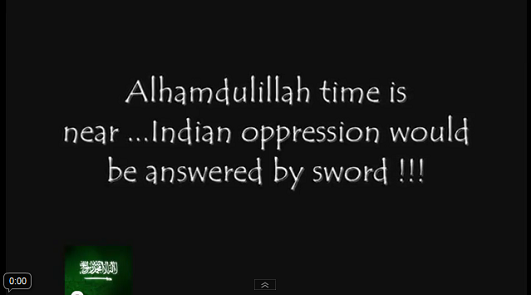
ghazwa-00.png

ghazwa-00a.png

then, what we might call a “starting” map —
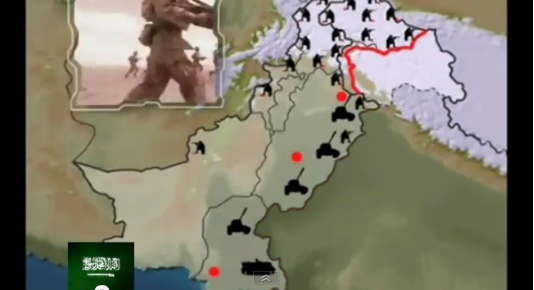
startmap.png

various evidences of military might —
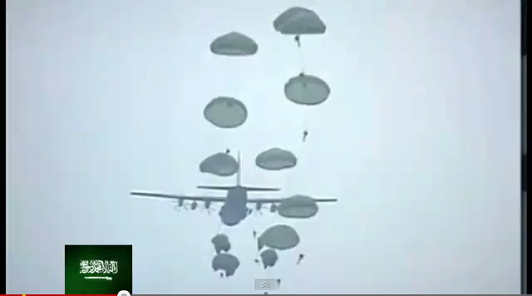
ghazwa-00b.png

ghazwa-00c.png

ghazwa-00d.png

ghazwa-00e.png

another couple of text frames —

ghazwa-00f.png 

ghazwa-00g.png

some arguably more intense weaponry —
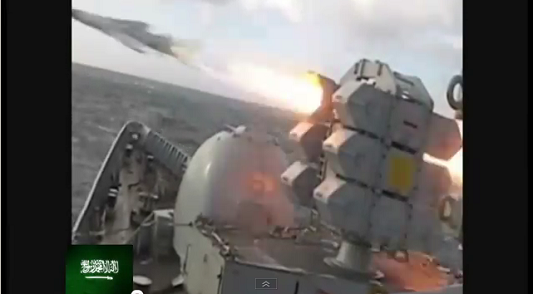
bb.png

cb-rocket-1.png

and no less intense special forces —

cb-rocket-2.png

then the hoped-for “close of play” map, book-ending the “opening” map above —
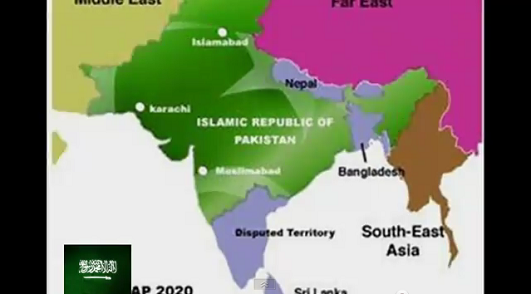
ghazwa-01.png

the ultimate threat —

ghazwa-02.png

and the flag of Pakistan flying over the Red Fort in Delhi —
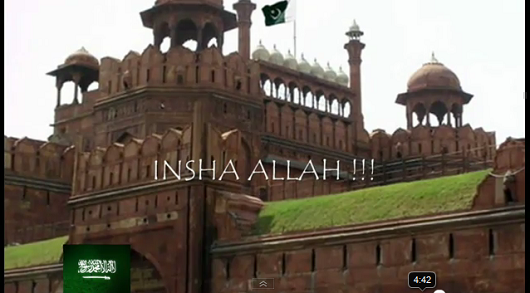
ghazwa-03.png

4.

The warning: 

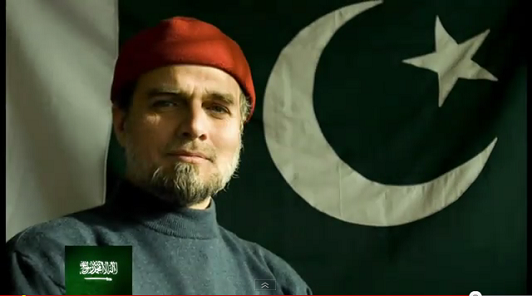
I have one final screen shot in the series, and it features Syed Zaid Hamid

ghazwa-04.png

the man who has been most actively stirring up public sentiment in Pakistan for the Ghazwa-e-Hind.

I will close with two of Hamid’s speeches, posted on YouTube, each of them containing a warning.  The first is in English, geopolitical in tone, and contains a warning to the US, Israel and India, that they should not attack Pakistan.

The second is addressed to the Hindus:

Such an invitation to convert is mandatory “when you meet your enemies’ before waging jihad, as stated in the hadith in Sahih Muslim, Book 19, 4294:

Invite them to (accept) Islam; if they respond to you, accept it from them and desist from fighting against them.

— and parallels bin Laden‘s Letter to America, in which UBL wrote:

The first thing that we are calling you to is Islam.

(a) The religion of the Unification of God; of freedom from associating partners with Him, and rejection of this; of complete love of Him, the Exalted; of complete submission to His Laws; and of the discarding of all the opinions, orders, theories and religions which contradict with the religion He sent down to His Prophet Muhammad (peace be upon him). Islam is the religion of all the prophets, and makes no distinction between them – peace be upon them all.

5.

The outline:

That’s the basic outline.

I hope to dig in deeper and provide more subtlety in future posts, but this topic is still pretty new to me — I first ran across it, somewhat tangentially, in the United States of Islam video which I began to discuss in October 2010, and which I may return to shortly.

I also wish to invite comment from others who have been looking into the Ghazwa for longer than I have.
To what End?

Friday, November 11th, 2011

[ by Charles Cameron — prophecy, millennial date-setting, when prophecy fails, scenario planning, hubris ]

.

when-prophecy-fails-9781578988525.jpg

To what End, prophecy and prediction?

Stephen O’Leary was right in his guess that Harold Camping would “recalculate” if and when (emphasis on the “when”) his May 22 prediction for the end of the world earlier this year failed. Camping did indeed recalculate, and his new prediction, for October 21, similarly passed without trumpets of the sort to be expected. This time, Camping apologized, admitting:

when it comes to trying to recognize the truth of prophecy, we’re finding that it is very very difficult.

He also said, with respect to his own failed prophecies:

God has done to us similarly to what he did to a couple of other great men of faith, one being Abraham…

First, the point I want to make. Then, more from Harold Camping, for those who are interested in the great question that’s raised When Prophecy Fails

1.

Here’s what I want to explore. Stephen O’Leary writes:

One thing that apocalyptic predictions throughout history have in common is that, without exception, they have all been proven wrong.

Stephen is an old friend of mine, and the author of the classic work Arguing the Apocalypse: a theory of Millennial Rhetoric (Oxford, 1994), and in the quote above he’s writing on May 19th in the Wall Street Journal’s “Speakeasy” blog.

What Stephen is saying here is something of a commonplace among millennial scholars, and his colleague Richard Landes, with whom he founded the Center for Millennial Studies, also a friend, picks up on it at the very end of his magisterial (I’ve used that term for this book before, and will again) Heaven on Earth: The Varieties of the Millennial Experience (Oxford, 2011), when he writes:

Whereas the rule, “apocalyptic prophecies are always wrong” holds, it does not hold about the future, especially a future in which humankind has the ability to self-destruct or, short of that, inflict cataclysmic damage on itself and the miraculous and crowded planet on which we live.

Religious predictions of the Coming One have (thus far) all failed, in other words, but scenarios of an End based on human behavior in aggregate may yet prove out.

Which then raises another question:

What is the relation of prophecy to scientifically informed prediction? Are religious predictors of apocalypse perhaps intuiting what some scenario planners are also anticipating – and thought to be foolish only because they express it in religious language, their native tongue?

Are they merely noting that Pride comes before (as well, perhaps, as after) a Fall?

2.

For those who may be interested, here’s more from the tail end of Camping’s statement [Family Radio: “Messages from Mr. Camping” 11/8/2011]:

We were ready to say, “Good bye to them. It’s all over. It’s all over. It’s time for the end.”

And now at the last moment, God has come and said, “No, no, it’s not the end. I still have some other plans.”

So what do we do? What do we do? Do we argue with God: “Wait a minute God. You said it so plainly. We were so convinced. There were so many proofs of the Bible, that it cannot have been that we were incorrect — maybe in a tiny detail here or there, but no God, we’re sure that it had to happen.”

But it didn’t happen. And we know that God brought it right to the very edge, right to the very day and past the day that the, there should have been judgment seen all over the world.

So, the first question I have to ask all of us — I have to ask myself this very, very carefully — Are we ready see that we did not understand God’s plan altogether? Are we ready to stand back and wait and do some more studying and recognize that maybe God is not finished with bringing salvation to the world.

As a matter of fact, we know that only about a third of the world had ever heard of the Bible before five months ago. Now by God’s mercy through the actions of Family Radio, as stupid as some may think they may have been, as incorrect as some may think they may have been, yet they all fit into a part of a plan where now the whole world has heard about the Bible. They’ve heard about the God of the Bible. God now is ready for the next action based on that kind of information, what will that be?

And that is where we have to start our thinking. We have to begin to think it out, “How does all of that impact our future teaching of the Bible?” And so, in our next study, we’re going to begin to examine that. Thank you very much.

3.

And so the wheel turns, the road goes ever on.

Does it?

Mini-Recommended Reading & Viewing

Friday, November 11th, 2011

Top Billing!SWJ Blog – Finding Petraeusism in Naglandia

What one SWJ editor calls “their most controversial article ever”:

….Today, we could use the term “Petraeusism” to mean “U.S military efforts conceived in disregard or ignorance of U.S. military limitations.” Likewise, we could use the name “Naglandia” to describe Afghanistan, a place where, much like Ford had attempted to do in the Amazon, the U.S. has attempted to establish a “New America,” albeit with the modern and contradictory political correctness that comes with our current obsession with “absolute tolerance” and our culturally-biased interpretation of Galula’s population-centricity in counterinsurgent activities. As if in some kind of twisted Shakespearean comedic tragedy, the U.S. military, traditionally an organization filled with political conservatives and Peace Corps-doubting Thomas’s, has turned itself into an organization that believes there is a Thomas Jefferson inside every Afghan and the solution to jump-starting an economy is to throw money at it. If only our losses could be capped in another seven years at the similar $240 million (inflation-adjusted figure) of Ford’s Amazon experiment.

Regardless of what General Petraeus’ and John Nagl’s concept for countering an insurgency actually was when they wrote the Army’s Field Manual on Counterinsurgency, FM 3-24, the manifestation in the military was one that had tactics dictating strategy, gave nation-building as the only option, and forced upon us all an assumption that has since become dogma: that bad governance is at the root of all discontent, followed closely by disgruntlement at not having a job. In addition, instead of stressing supporting a government’s internal defense when they align with our objectives and a population centricity that means an understanding- and not a protection- of the people, the U.S. went the opposite direction: emphasizing our own objectives and a “for their own good” attitude towards protection of the people. This operational paradigm does not, in and of itself explain all of our failures in Afghanistan-the lack of a clear goal and plan in the beginning probably holds most of the blame for that-but in the absence of a strategy in 2009 and after the very public vindication of General Petraeus’ textbook execution of FM3-24 in Iraq, it makes sense that the military brass turned very quickly to something they like at least slightly better than no plan: a bad plan.[4]

In defense of Henry Ford, in 1922, long before the advent of synthetics, naturally grown rubber along with oil was a natural resource of critical strategic military value with a high market price due to a British-Dutch-Belgian imperialist rubber oligopoly that left US producers eking out a market share from subpar plantations in Central American banana republics. Afghanistan isn’t quite as valuable as that.

John Hagel – Cognitive Biases in Times of Uncertainty

The rise of threat based narratives

But, there’s more.  Zero sum mindsets naturally lead us to focus on threat, rather than opportunity. If there’s only a fixed set of resources and rewards, there’s limited upside. Our attention shifts to protecting what we already have, however little it might be.  In a zero sum world, we are constantly vulnerable to the efforts of others to grab our share of the pie.

Threat based narratives take root – enemies are gathering force and intent on destroying or appropriating what we have.  We need to be vigilant and band together to protect our interests.  A quick look at the political narratives dominating the discourse in the US – whether on the Right or the Left – reveals the growing prevalence of threat based narratives.  Threat based narratives lead to polarization – if you’re not with us, then you must be against us.

Threat based narratives again have a pernicious effect – they reinforce our tendency to focus on the short-term.  They lead us to further magnify risk and discount potential rewards. The threat is imminent – we must focus on protecting ourselves now from the enemies gathering force.  We can’t afford to be diverted by longer-term issues – the battle is here and now. If we don’t win today, we will have no tomorrow.

Threat based narratives lead to a further consequence. They motivate us to seek out those who agree with us.  We can’t tolerate divergent views when we are under attack.  We must all come together under the same banner.  Uniformity of thought and perspective is highly valued and rewarded.  This pressure to conform reduces the potential for creative thinking and new ideas which further reinforces our sense that we live in a static world with a given set of resources and wealth. The passion of the explorer gives way to the passion of the true believer. Once again, we find reinforcement for a short-term mindset.

This is congruent with what I have been reading about intractable problems in Coleman’s The Five Percent

Recommended Viewing:

Wikistrat’s “The World According to Tom Barnett” 2011 brief, Part 8 (Q&A on global economic crisis)

More Q&A from my presentation of the current Brief to an international military audience in the Washington DC area in September 2011.

Audience question was about the global economic crisis and role of China in global economy.


Referenced from: http://thomaspmbarnett.com/#ixzz1dMqQSbVh

RSA Animate – “Drive” by Dan Pink

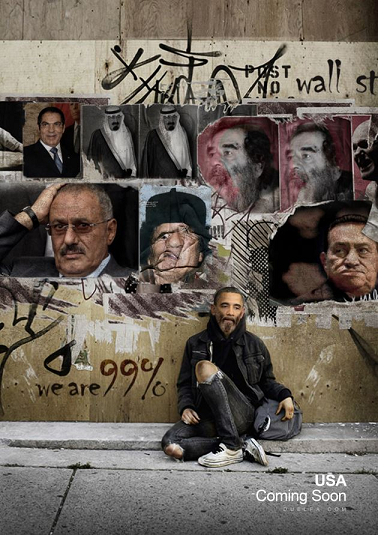
OWS, Obama, Iran and the Imam Mahdi

Thursday, November 10th, 2011

[ by Charles Cameron — two or three glimpses from Iran re the OWS movement ]

.

obama_as_99_percent_iranian_propaganda.png

You have have seen this already if you follow Aaron Weisburd, whose Internet Haganah has more detail on IRGC involvement in propaganda with an OWS flavor, including another striking graphic that’s just too fine for me to resist:

the-band.png

What interests me, though, is an additional “dot” provided by Tim Furnish, who (as always) is tracking the Mahdist aspects.

On his MahdiWatch blog today, Dr Furnish points us to a piece by one Charles Dameron (not even a typo-relative of mine) on Radio Free Europe / Radio Liberty, headlined Iranian Ayatollah: OWS A Sign Of The 12th Imam, and carrying the following report:

Most Occupy Wall Street (OWS) protesters would probably tell you that they’re out to change the world, or at least the United States’ marginal tax rates on high earners.But most of them — one hopes — probably wouldn’t profess to having any interest in hastening the reappearance of a religious messiah and ushering in a global, cataclysmic Day of Judgment.

Don’t tell all of this to Iranian Ayatollah Mohsen Heydari. He’s convinced that the OWS protests are the self-evident harbinger of a long-awaited event in Shi’ite eschatology: the reappearance of the 12th (Hidden) Imam, whose End of Times return will bring Islamic peace and justice to the world.

“The Occupy Wall Street movement is the big step to prepare the ground for the appearance of the 12th Imam,” Heydari told mosque congregants in the Iranian city of Ahvaz, the capital of the oil-rich province of Khuzestan, on November 7.

The remarks came during a special prayer service for the celebration of Eid al-Adha, a major religious holiday that ends on November 9.

Talk about the imminent arrival of the 12th Imam is a perennial feature of political and religious discourse in post-revolutionary Iran. President Mahmud Ahmadinejad famously expressed his wish that God would “hasten the emergence of your last repository, the Promised One, that perfect and pure human being, the one that will fill this world with justice and peace,” during a speech to the UN General Assembly in 2005.

I am not in any way suggesting that Iranian “borrowing” of OWS imagery should be held against OWS, though I think the more thoughtful OWS supporters would wish to be aware of it.

The important point, it seems to me, is that the overtly apocalyptic tie-in with expectation of the return of the Twelfth Imam is yet another indicator of the significance of the Mahdist current within Iranian military and government circles.

Jihad for all Seasons: Review of Storming the World Stage (in PRAGATI)

Thursday, November 10th, 2011

Storming the World Stage: The Story of Lashkar-e-Taiba by Stephen Tankel

PRAGATI, India’s National Interest Review magazine has published my review of Dr. Stephen Tankel’s book on Lashkar-e-Taiba, titled Storming the World Stage. The article is not yet online (I will add the link when it is released) but the issue digest PDF version is below:

pragati-issue56-nov2011-communityed.pdf

“Jihad for all seasons”

….Carnegie and RAND scholar Stephen Tankel has endeavored to demystify and deconstruct LeT in his meticulously researched book, Storming The World Stage: The Story of Lashkar-e-Taiba and bring into the light the complex relationships that entwine LeT with the Pakistani state and the subterranean universe of radical jihadi politics.  Conducting extensive interviews with Islamist militants, Western and Indian intelligence officials, Pakistani politicians and ISI officers and buttressing his narrative with sixty-three pages of end-notes, Tankel has produced a portrait of Lashkar-e-Taiba that is accessible to the layman while remaining a methodical work of scholarship.

…. An organisation that, like Hezbollah, is state-sponsored but not controlled, Lashkar-e-Taiba is suited for waging what military analyst Frank Hoffman terms “Hybrid War”, but how LeT would play that role in an Indo-Pakistani War is left to the reader’s inference. LeT also demonstrated in Mumbai a fluid tactical excellence in its use of off-the-shelf technology, small arms and mobility to reap an enormous return-on-investment by attacking soft targets, much along the asymmetric lines advocated by warfare theorist John Robb. Tactics that are a critical threat to any open society by forcing it to take preventive measures which are ruinously expensive and contraindicated to keeping society free and democratic….

Will update post as matters develop.


Switch to our mobile site