zenpundit.com » 2011 » December

Archive for December, 2011

We spend far too much time on content, and not enough time on form

Tuesday, December 13th, 2011

[ by Charles Cameron — recursion as form — this one’s for analysts: poets should know it already ]

.

We spend far too much time on content, and not enough time on form.

We spend far too much time on the data, and not enough time on relationships. It is pattern that connects the dots with accuracy, not more dots – quality of insight, not quantity of information.

And pattern is underlying form.

Haiku is a form. The sonnet is a form, the sonata is a form. And just to juxtapose sonnet and sonata is to recognize the formal relationship between them.

1.

Recursion is the form that Doug Hofstadter explores in his book, Godel Escher Bach, and you’ll find it every time one mirror reflects another mirror (what color does a chameleon turn when placed on a mirror?), every time there’s a doll inside a doll inside a Matrioshka doll, often in the form of a paradox (“this sentence is meaningless”) – and when people take photos of themselves holding photos of themselves…

as in the pic of Noam Chomsky and Morris Halle and (in case your politics doesn’t agree so much with Chomsky) the one below them of Jacob Appelbaum and Donald Knuth in my “specs” image at the top of this post.

2.

Content can be powerful, but form really doubles up on the power. Here’s one way of thinking about it: form is what tightens information into meaning.

A couple of news reports in the last couple of days have caught my attention because of their form:

Charter of Open Source Org is Classified, CIA Says

Open Source Works, which is the CIA’s in-house open source analysis component, is devoted to intelligence analysis of unclassified, open source information. Oddly, however, the directive that established Open Source Works is classified, as is the charter of the organization. In fact, CIA says the very existence of any such records is a classified fact.

“The CIA can neither confirm nor deny the existence or nonexistence of records responsive to your request,” wrote Susan Viscuso, CIA Information and Privacy Coordinator, in a November 29 response to a Freedom of Information Act request from Jeffrey Richelson of the National Security Archive for the Open Source Works directive and charter.

“The fact of the existence or nonexistence of requested records is currently and properly classified and is intelligence sources and methods information that is protected from disclosure,” Dr. Viscuso wrote.

This is a surprising development since Open Source Works — by definition — does not engage in clandestine collection of intelligence. Rather, it performs analysis based on unclassified, open source materials.

That’s hilarious, it’s so misguided: I don’t know whether to laugh or barf (not a word I ever expected to use in my writings, but there you go).

3.

That’s sad, this one’s just plain tragic:

Protesters calling for religious tolerance attacked with stones, threatened with death

Police are investigating a violent attack on a ‘silent protest’ calling for religious tolerance, held at the Artificial Beach to mark Human Rights Day.

Witnesses said a group of men threw rocks at the 15-30 demonstrators, calling out threats and vowing to kill them.

One witness who took photos of the attacked said he was “threatened with death if these pictures were leaked. He said we should never been seen in the streets or we will be sorry.”

Killing your enemies for reasons of religion is one thing: killing those who work for peace between you and your religious enemies is no worse of the face of it – it’s religious killing, no more and no less, in both cases — but it drives the point home with considerable, poignant force.

Keep your eye out for recursion, it’s an interesting business. And respect form – it empowers content.

4.

You’ll find recursion right at the heart of Shakespeare: his plays were performed in a round theater (the “wooden O” of Henry V) called the Globe, whose motto was “totus mundus agit histrionem” – roughly, “the whole world enacts a play” – a notion which Shakespeare put into the mouth of the melancholy Jaques in As You Like It:

All the world’s a stage,
And all the men and women merely players.
They have their exits and their entrances,
And one man in his time plays many parts…

A martial version of this idea, indeed, can be found in the philosopher Plotinus, who wrote in his Enneads (3.ii.15):

Men directing their weapons against each other — under doom of death yet neatly lined up to fight as in the pyrrhic sword-dances of their sport — this is enough to tell us that all human intentions are but play, that death is nothing terrible, that to die in a war or in a fight is but to taste a little beforehand what old age has in store, to go away earlier and come back the sooner. So for misfortunes that may accompany life, the loss of property, for instance; the loser will see that there was a time when it was not his, that its possession is but a mock boon to the robbers, who will in their turn lose it to others, and even that to retain property is a greater loss than to forfeit it.

Murders, death in all its guises, the reduction and sacking of cities, all must be to us just such a spectacle as the changing scenes of a play; all is but the varied incident of a plot, costume on and off, acted grief and lament. For on earth, in all the succession of life, it is not the Soul within but the Shadow outside of the authentic man, that grieves and complains and acts out the plot on this world stage which men have dotted with stages of their own constructing.

5.

I thought it would be interesting to see if recursion had power, too, in the field of religion, and this passage from Ephesians (4.8) sprang to mind…

When he ascended up on high, he led captivity captive, and gave gifts unto men…

That’s a lovely recursion, “leading captivity captive”. But I think we can go deeper. John Donne‘s sonnet Death be not proud reaches to the very heart of the Christian message, it seems to me –it parallels the passage from Ephesians closely, while focusing in on the hope of resurrection with its stunning conclusion:

Death, thou shalt die.

Here’s the whole thing: profound content in impeccable form:

Death be not proud

Death be not proud, though some have called thee
Mighty and dreadfull, for, thou art not so,
For, those, whom thou think’st, thou dost overthrow,
Die not, poore death, nor yet canst thou kill me.
From rest and sleepe, which but thy pictures bee,
Much pleasure, then from thee, much more must flow,
And soonest our best men with thee doe goe,
Rest of their bones, and soules deliverie.
Thou art slave to Fate, Chance, kings, and desperate men,
And dost with poyson, warre, and sicknesse dwell,
And poppie, or charmes can make us sleepe as well,
And better then thy stroake; why swell’st thou then;
One short sleepe past, wee wake eternally,
And death shall be no more; death, thou shalt die.

6.

What do you think?
COIN may be Dead but 4GW has a New Lease on Life

Monday, December 12th, 2011

As I had predicted, a global recession, budgetary chicken in Congress and national weariness after a decade of war in Afghanistan and Iraq have forced a public rethink of the prominence of counterinsurgency doctrine in America’s military kit.  Colonel Gian Gentile, long the intellectual archenemy of FM 3-24 and the “Surge narrative” has pronounced COIN “dead” and even CNAS, spiritual home of COIN theory inside the Beltway, is now advocating COIN-lite FID (Foreign Internal Defense). As this entire process is being driven by a global economic crisis, there is another aspect to this American inside-baseball policy story.

While COIN as the hyperexpensive, nation-building, FM 3-24 pop-centric version of counterinsurgency is fading away, irregular warfare and terrorism are  here to stay as long as there is human conflict. Moreover, as economic systems are to nation-states as vascular systems are to living beings, we can expect an acceleration of state failure as weak but functional states are forced by decreased revenues to reduce services and diminish their ability to provide security or enforce their laws. The global “habitat” for non-state, transanational and corporate actors is going to grow larger and the zones of civilized order will shrink and come under internal stress in the medium term even in the region that Thomas P.M. Barnett defined as the “Core” of globalization.

The theory of Fourth Generation Warfare is helpful here. Many people in the defense community object to 4GW thinking, arguing that it is a poor historical model because it is overly simplified, the strategic ideas typified by each generation are cherrypicked and are usually present in many historical eras (albeit with much different technology). For example, eminent Clausewitzian strategist Colin Gray writes of 4GW in Another Bloody Century:

….The theory of Fourth Generation Warfare or 4GW merits extended critical attention here for several reasons. It appears to be a very big idea indeed. It’s author [ William S. Lind] and his followers profess to be able to explain how and why warfare has evolved over the past 350 years and onto the future….

….Talented and intellectually brave strategic theorists are in such short supply that I hesitate before drawing a bead on Lind and his grand narrative of succeeding generations of warfare. Nonetheless, there is no avoiding the judgment that 4GW is the rediscovery of the obvious and the familiar. 

4GW theory is not something that can be defended as having sound historical methodology. However, it works well enough as a strategic taxonomy of mindsets and political environments in which war is waged; particularly with the inclusion of the van Creveldian assumptions of state decline, it is a useful tool for looking at warfare in regions of weak, failing and failed states. The same global region Dr. Barnett has termed “the Gap” in his first book, The Pentagon’s New Map.

Tom predicated his geostrategy on the power of globalization being harnessed with judicious use of Core military power to “shrink the Gap” and provide connectivity as an extremely powerful lever to raise up billions of the world’s poor into a more stable, freer and middle-class existence. While that still holds, the flipside is that times of  sharp economic contraction limit the ability of the Core, led by the United States, to intervene robustly, permitting the “bad guys” to make use of connectivity and black globalization for their own purposes. Where the great powers are disunited, disinterested or increasingly in the case of European power projection, disarmed, the Gap could potentially grow.

A new Iraq or Afghanistan sized campaign is not in the American defense budget for at least a decade. Or NATO’s. Hence the newfound interest in cheaper alternatives to massive intervention on the ground, for which the Libyan campaign might charitably be classed as an “experiment” ( where it was not simply bad strategy and negotiated operations) or as a multilateral reprise of Rumsfeldian ideas of transformative, light and fast military force mashed up with Reagan Doctrine proxy warfare, justified under a new ideological theory of R2P.

These are rational policy responses to conditions of parsimony, but it also indicates a coming era of strategic triage rather than grand crusades in using military force to stabilize parts of the global system.  The US and other great power  are going to be more likely to follow Teddy Roosevelt’s advice to “Do what you can, where you are, with what you have” than they are to heed JFK’s call “to pay any price, bear any burden”. The politics of hard times means that we will be minimizing our burdens by replacing, where we can, boots with bots, bullets with bytes and Marines with mercs. Not everywhere, but certainly on the margins of American interests.

Beyond those margins? We will aid and trade with whatever clients can maintain a vestige of civilized order without too much regard to the niceties of  formal state legitimacy. Too many states will be ceding autonomy to subnational and transnational entities on their territory in the next few decades and we will have to abide by that reality if regions of the world become Somalia writ large. What to do? A number of recommendations come to mind:

  • Get our own economic house in order with greater degrees of transparency and adherence to rule of law in our financial sector. Legitimacy and stability, like charity, begins at home.
  • Adopt policies that strengthen the principle of national sovereignty and enhance legitimacy rather than weaken or erode it. This does not mean respecting hollow shells of fake states that are centers of disorder, but respecting legitimate ones that effectively govern their territory
  • Foreign policies that reject oligarchical economic arrangements in favor of encouraging liberalization of authoritarian-autarkic state economies prior to enacting political reforms ( democracy works better the first time on a full stomach).
  • Create a grand strategy board to advise senior policy makers and improve the currently abysmal level of strategic calculation and assessment prior to the US assuming open-ended commitments to intervention
  • Accept that the Laws of War require a realistic updating to deal with the international equivalent of outlaws, an updating that contradicts and rejects the 1970’s era diplomatic effort to privilege irregular combatants over conventional forces.
  • Fighting foreign insurgencies is something best done by primarily by locals, if willing, with our aid and advice. If those with the most to lose are not willing to stand, fight and die then they deserve to lose and the US should either eschew getting involved at all or resolve to secure whatever vital interest that exists there by brute force and make certain that reality is clearly communicated to the world (i.e. Carter Doctrine).  Truly vital interests are rare.

A question for the readership

Saturday, December 10th, 2011

[ by Charles Cameron — terminology of war ]
.
I have a question:

Do we have or need a term for the kind of situation where one nation, while ostensibly at peace with another, fights them by means that are plausibly deniable –- I’m thinking a campaign of sabotage, computer viruses, assassinations -– whose leaders when asked if they would care to deny them, smile like so many Cheshire Cats?

This certainly seems to be one mode of the continuation of politics by other means — and once war is declared, it would fold itself into war itself as covert and info ops — but I was wondering: is there a name for this, or do we perhaps need a name for it, in “peacetime”, as one of the forms of warfare?

I pinged Mark on this, since he’d know better than I, and he replied:

There is no legal term for such a state.

Individually, these actions either constitute “violations of sovereignty” or “criminal acts” depending on how the state chooses to interpret them, until they consider them “an act of war” (i.e. mining harbors, sabotage, assassination) and act diplomatically. Until then it is a state of “peace” under International Law.

Which leaves me wondering: is it about time we had a name for this kind of war, which the United States and / or Israel may plausibly – and deniably – be waging at against Iran as we speak?

Would it be useful to have a term for, and a legal doctrine about, campaigns of this sort?

On bananas, cucumbers, tomatos and piano legs: an aside

Saturday, December 10th, 2011

[ by Charles Cameron, h/t Mike Few — bananas, cucumbers, tomatos and piano legs as sexual objects, reading the world as a book, Iraq recently, Shakespeare a while back, Robert Hooke ]
.

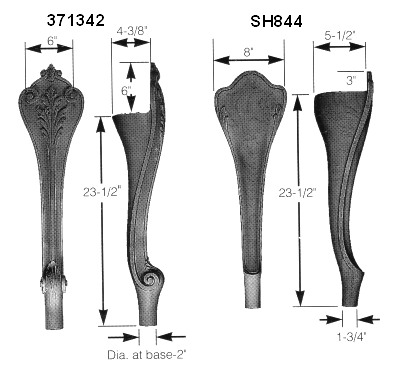
Louis XV grand piano legs, hard maple. Image credit: http://www.balaams-ass.com/grandlegs.htm

MikeF in a comment on my post, Let me put my banana in your fruitbasket, pointed us to his Small Wars Journal article The Break Point: AQIZ Establishes the ISI in Zaganiayh, in which he reports that the Mujahedeen Shura Council in Iraq passed out propaganda pamphlets providing “instruction on the proper actions of good Muslims” in preparation for the establishment of an Islamic State of Iraq. One example of “proper actions” given was as follows:

One cannot eat tomatoes and cucumbers together because one is male and the other is female. This action is immoral. Failure to comply will result in death.

Think long and hard on that one!

*

By way of light relief:

Frederick Marryat‘s 1839 book A Diary in America, in which he describes (as his title stipulates) American, not British, customs, seems to be the source of the idea that the (British, the urban legend having undergone a transatlantic metamorphosis here) Victorians covered the Legs (think: ankles, see diagram above) of their pianos for modesty’s sake.

Marryat, a credulous fellow as Matthew Sweet describes him in his Inventing the Victorians (p. xiii.), may well have been being teased when told this tale by his American friends. In any case, he reported that in an American girl’s school he visited, the head mistress “to preserve in their utmost purity the ideas of the young ladies under her charge” had “dressed all four limbs” of the school piano “in modest little trousers, with frills at the bottom of them!”

“Was this practice ever pursued, even in America?” Sweet asks sweetly, and answers himself: “Probably not.” And further, “whatever the case, the synecdochic relationship that now exists between Victorian sensibilities and the clothed piano leg is wholly fraudulent.”

Sweet is marvelous on this whole business, going on about it for pages. Most useful for my own purposes is his quotation from Richard Sennett‘s (1986) The Fall of Public Man, which argues:

that cultural change, leading to the covering of the piano legs, has its roots in the very notion that all phenomena speak, that human meanings are immanent in all phenomena.

*

And a tad more seriously…

Interestingly enough, that very notion is indeed to be found in Islam, where the Qur’an asserts that nature is to be read like a scripture. In the words of Seyyed Hossein Nasr:

The Quran refers constantly to the world of nature as well as to the human order. The sky and the mountains, the trees and animals in a sense participate in the Islamic revelation, through which the sacred quality of the cosmos and the natural order is reaffirmed. The sacred scripture of Islam refers to the phenomena of nature as ayat (“signs” or “portents”), the same term used for its verses and the signs that appear within the soul of human beings according to the famous verse: “We shall show our portents (ayat) upon the horizons and within themselves, until it be manifest unto them that it is the Truth” (41:53). Natural phenomena are not only phenomena in the current understanding of the term. They are signs that reveal a meaning beyond themselves. Nature is a book whose ayat are to be read like the ayat of the Quran; in fact, they can only be read thanks to the latter, for only revelation can unveil for fallen man the inner meaning of the cosmic text. Certain Muslim thinkers have referred to the cosmos as the “Quran of creation” or the “cosmic Quran” (al-Qur’an al-takwini), whereas the Quran that is read every day by Muslims is called the “recorded Quran” (al-Qur’an al-tadwini). The cosmos is the primordial revelation whose message is still written on the face of every mountain and tree leaf and is reflected through the light that shines from the sun, the moon, and the stars. But as far as Muslims are concerned, this message can only be read by virtue of the message revealed by “the recorded Quran.”

*

This view is not solely an Islamic one: Duke Senior, exiled to the Forest of Arden in Shakespeare‘s As You Like It (Act II Scene 1) declares:

And this our life: exempt from public haunt,
Finds tongues in trees, books in running brooks,
Sermons in stones, and good in everything.

And if Shakespeare be considered too worldly a source, here is Hugh of St. Victor (twelfth century):

For this whole visible world is a book written by the finger of God, that is, created by divine power … But just as some illiterate man who sees an open book looks at the figures but does not recognize the letters: just so the foolish natural man who does not perceive the things of God outwardly in these visible creatures the appearances but does not inwardly understand the reason. But he who is spiritual and can judge all things, while he considers outwardly the beauty of the work inwardly conceives how marvellous is the wisdom of the Creator.

More recently and less theologically, the scientist Robert Hooke (1635 – 1703), friend of Robert Boyle and discoverer of Hooke’s Law, wrote that in the interests of science it was:

much to be wisht for and indeavored that there might be made and kept in some Repository as full and compleat a Collection of all varieties of Natural Bodies as could be obtain’d, where an Inquirer might be able to have recourse, where he might peruse, and turn over, and spell, and read the Book of Nature, and observe the Orthography, Etymologia, Syntaxis, and Prosodia of Natures Grammar, and by which, as with a Dictionary, he might readily turn to and find the true Figures, Composition, Derivation, and Use of the Characters, Words, Phrases and Sentences of nature written with indelible, and most exact, and most expressive Letters, without which Books it will be very difficult to be thoroughly a Literatus in the Language and Sense of Nature.

*

All of which is to say that it may be unwise to read spiritual texts in too literal a manner.

Lex Talionis II: the matter of Israelis, Palestinians and more

Saturday, December 10th, 2011

[ by Charles Cameron — vendetta, vengeance, an eye for an eye, compensation, forgiveness, and the question of limits ]
.

I didn’t want this pair of events to slip by entirely unnoticed.

The first image above shows part of the “wanted” poster with which Rabbi Menachem Liebman offered a $100,000 reward to whoever would kill Huliad and Nidar Ramadan, recently released by Israeli authorities as part of the prisoner-swap for Gilad Shalit, who had previously been convicted of killing his own son, Shlomo Liebman, a settlement security guard.

The second, lower image is taken from the reciprocating offer of a $100,000 reward made by Dr Awad al-Qarni on Facebook, to whoever who would capture an(other) Israeli soldier.

These things tend to escalate.  According to this AllGov report, Prince Khaled bin Talal of Saudi Arabia commented that “Dr Awad al-Qarni said he was offering $100,000 to only take a prisoner but they [unnamed in the original Reuters report, but presumably Israelis] responded by offering $1 million to kill Awad al-Qarni” – and himself pledged an additional $900,000 to the bounty on the capture of Israeli soldiers, bringing the total to $1 million.

Accompanying this story on the AllGov site, appositely enough, was this illustrated quote from Mohandas Gandhi:

For those who have trouble killing Ramadan brothers or capturing Israeli soldiers, lesser rewards are also available in the United States: this article reports that a “$4,000 reward has been offered for the identity of the police officer who may have been responsible for the injuries sustained by former Iraq war veteran Scott Olsen” during the Oakland Occupy protests recently.

*

Juvenal wrote Semper et infirmi est animi exiguique voluptas Ultio — “revenge is the weak pleasure of a narrow mind”.

*

Let’s think about this for a moment.

Lex talionis is the law of limited retribution – one eye for one eye – found (following similar texts in the code of Hammurabi) in the Mosaic law, Exodus 21.23-25 requiring “life for life, eye for eye, tooth for tooth, hand for hand, foot for foot, burn for burn, wound for wound, bruise for bruise.”  The rabbis, however, commented that “inasmuch as the law seeks equity, its literal enforcement would frequently lead to gross inequity” [W Gunther Plaut, The Torah: A Modern Commentary, p 571. n. 6.] – and chose to interpret the text as mandating equivalent monetary compensation for value lost.

Tit for tat is a common expression of the same idea, and has also been used in a technical sense in strategies for the iterative playing of Prisoners Dilemma games referred to in my previous post.

Christ‘s injunction in Matthew 5.38-39 reads:

Ye have heard that it hath been said, An eye for an eye, and a tooth for a tooth: But I say unto you, That ye resist not evil: but whosoever shall smite thee on thy right cheek, turn to him the other also.

Similarly in the Qur’an, 41:34-35, Muslims are instructed:

Nor can goodness and Evil be equal. Repel (evil) with what is better: Then will he between whom and thee was hatred become as it were thy friend and intimate!

Joseph Smith, the first Mormon prophet, suggests in Journal of Discourses vol 2, pg 165-166 that such forbearance is appropriate the first time, but not thereafter:

Our enemies have prophesied that we would establish our religion by the sword; is it true? No, but if Missouri will not stay her cruel hand in her unhallowed persecutions against us, I restrain you not any longer: I say, in the name of Jesus Christ, by the authority of the Holy Priesthood, I this day turn the key that opens the heavens to restrain you no longer from this time forth. I will lead you to battle; and if you are not afraid to die, and feel disposed to spill your blood in your own defence, you will not offend me. Be not the aggressor—bear until they strike you on the one cheek; then offer the other and they will be sure to strike that then defend yourselves, and God will bear you off, and you shall stand forth clear before His tribunal.

The New Testament, however, suggests that this forbearance is not to be exercised only on the first occasion…  Thus in Matthew 18.21-22 we read:

Then came Peter to him, and said, Lord, how oft shall my brother sin against me, and I forgive him? till seven times? Jesus said to him, I say not to you, Until seven times: but, Until seventy times seven.

Also of interest is here the (possibly apocryphal) story of the Dalai Lama, who was asked how he would deal with a mosquito. “Brush it away,” he replied. “But what if it comes back?” “Brush it away again.” “But what if it comes back again?” “I crush it, and say ‘Come back as the Buddha!'”

For a detailed consideration of these issues in Islam, see Abdullah bin Hamid Ali‘s Islam and Turning the Other Cheek [.pdf], where this interesting discussion featuring the idea of forgiveness “seventy times” is also featured:

The Koran directs the Prophet — God’s mercy and peace be upon him — concerning the hypocrites, “Whether you ask for their forgiveness, or not, [their sin is unforgiveable]: if you ask seventy times for their forgiveness, Allah will not forgive them because they have rejected Allah and His messenger, and Allah guides not those who are perversely rebellious” (9: 80). After the death of the chief hypocrite, ‘Abd Allah ibn Ubayy, the Prophet — mercy and peace on him — saw no decisive prohibition in this verse against praying for hypocrites. This was, firstly, because outwardly the words give him a choice between asking forgiveness or not (Whether you ask for their forgiveness, or not…). Secondly, the verse mentions that God would not forgive even if he was to ask seventy times. His hope was that if he asked more than seventy times, it might be enough to secure forgiveness for Ibn Ubayy in spite of his open and insidious antagonism of the Prophet — mercy and peace on him. His companion, ‘Umar, contested this understanding of the Prophet’s — God’s mercy and peace be upon him. Later, the following verse was revealed confirming ‘Umar’s stance, “Nor do you ever pray for any of them that dies, nor stand at his grave; for they rejected Allah and His messenger, and died in a state of perverse rebellion” (9: 84)

*

Perhaps Koholeth (Ecclesiastes 3.1) should have the last word:

To every thing there is a season, and a time to every purpose under the heaven


Switch to our mobile site