zenpundit.com » 2011 » December

Archive for December, 2011

Lex Talionis I: the matter of Subramaniam Swamy and Harvard

Friday, December 9th, 2011

[ by Charles Cameron — Harvard controversy, free speech vs hate speech, Hindutva, moral high ground & sanctions for and against violence ]

.

I am grateful to various members of the New Religious Movements list for pointing me to the recent events in Harvard, where a group of scholars led by the formidable Diana Eck (her book on Banaras is a masterpiece and greatly treasured) have persuaded the Faculty of Arts and Sciences to omit two courses in economics usually taught by Subramaniam Swamy from their Summer School offerings next year, on the ground that an op-ed he published in Daily News and Analysis titled “How to Wipe Out Islamic Terror” fell under the category of hate-speech (as opposed to free speech).

The article in question is no longer available on the DNA site, but can be found on Pamela Geller‘s Atlas Shrugged blog.  An account of the controversy can be found on Inside Higher Ed, and Harvard Faculty’s debate was reported in the Harvard Magazine.

Subramaniam Swamy is President of what remains of the once powerful Janata Party and former Union Cabinet Minister.

With that as background, I would like to address the issue of the varying principles and rule-sets invoked as offering a moral high ground – or a necessary safeguard – in various religious and other traditions.

*

I have read Dr Subramaniam Swamy’s article, and while the various quotes in it recommending specific actions — such as “Remove the masjid in Kashi Vishwanath temple complex, and 300 others in other sites as a tit-for-tat” and “Enact a national law prohibiting conversion from Hindu religion to any other religion” – give western readers a sense of Swamy’s overall mindset and intentions, it was another quote that held my attention:

This is Kaliyug, and hence there is no room for sattvic responses to evil people. Hindu religion has a concept of apat dharma and we should invoke it. This is the moment of truth for us.

I suspect the reason this quote has not been featured in the reports I’ve read of the debate have to do with the number of words in it that are unfamiliar to the western reader.

I’m acquainted with Kaliyug (the Age of Darkness) and with the concept of the sattvic (“Sattva is a state of mind in which the mind is steady, calm and peaceful” to quote the sacred Wiki), but had to dig a bit to discover that apat dharma is essentially “righteousness in emergencies”:

There are special Dharmas during critical and dangerous circumstances. They are called Apat-Dharma.

Swami Sivananda

Apat Dharma: They are duties that come to one under extraordinary circumstances, in crisis or in emergencies (apatmulakah). In such circumstances, even that which under normal circumstance is deemed wrong becomes dharma (tatra adharmo’pi dharmah). Here the righteous motives guide our actions (bhava-suddhimattvat). Normally a doctor gives anaesthesia before operating the patient but an emergency operation performed on the battlefield to save the life or limb of a soldier on the battlefield may be done without anaesthesia and with the instruments available, be they sterilized or not. When emergency is declared in the country, the elected parliament can be dismissed, the Constitution suspended and the ruler assumes extra-ordinary powers to deal with the situation. When peace prevails, the youth of a country should get education and work, but during war, the country may call upon its youth to sacrifice their education and fight in defence of the country, sometimes with hardly any training.

Sanjeev Nayyar

So that quote – “This is Kaliyug, and hence there is no room for sattvic responses to evil people. Hindu religion has a concept of apat dharma and we should invoke it. This is the moment of truth for us” – is essentially the abstract principle on which Swamy’s various proposals are based, and thus corresponds to the principles articulated by PM Netanyahu in his recent opening of the Knesset as underlying his government’s policies with regard to national security:

Our policy is guided by two main principles: the first is “if someone comes to kill you, rise up and kill him first,” and the second is “if anyone harms us, his blood is on his own hands.”

If you want a sense of how important that quote about apat dharma is to a Hindu (and a fortiori, a Hindutva) reader, see the way it is singled out and quoted with an illustration of Krishna driving Arjuna‘s chariot into battle by “Sanchithere (I’ve used the same illustration at the head of this post):

*

What am I after here?

It seems to me that we could use a brief yet definitive scholarly account of what the guiding principles of the various religions and secular worldviews allow their adherents, in terms of justice, forgiveness, pre-emption, retribution and retaliation.

This would need to include, compare and contrast such principles as:

  • The Judaic notions of pre-emptive killing (Netanyahu’s first principle, found in the Talmud and commonly quoted as ‘ha’Ba Lehorgecha, Hashkem Lehorgo, If someone tries to kill you, rise up and kill him first) and the injunction, in fighting the Amalekites, “Now go and smite Amalek, and utterly destroy all that they have, and spare them not; but slay both man and woman, infant and suckling, ox and sheep, camel and ass” (1 Samuel 15:3).
  • Christ’s “But I say unto you which hear, Love your enemies, do good to them which hate you.” (Luke 6.27)
  • Christian “just war” theology.
  • The western / UN “norm” that some actions are simply beyond the pale, unacceptable under any circumstances (essentially the basis for war crimes tribunals)
  • Game theory’s “tit for tat” strategy in an iterated Prisoners’ Dilemma as proposed by Anatol Rapaport and articulated by Robert Axelrod in his book, The Evolution of Cooperation.
  • The Islamic tradition’s notion of response in kind (Qur’an: 2.194, “and so for all things prohibited, — there is the Law of Equality. If then anyone transgresses the prohibition against you, transgress ye likewise against him but fear Allah, and know that Allah is with those who restrain themselves”) – which would appear to imply that actions that would not normally be acceptable may be appropriate in response to an enemy that has already “transgressed” in that specific manner
  • Gandhi’s ahimsa, together with his corollaries, “An eye for an eye makes the whole world blind” (attributed) and “It is better to be violent, if there is violence in our hearts, than to put on the cloak of nonviolence to cover impotence.”
  • Swamy’s own “This is Kaliyug, and hence there is no room for sattvic responses to evil people” and “the nation must retaliate — not by measured and ‘sober’ responses but by massive retaliation.”
  • Buddha’s “Victory breeds hatred. The defeated live in pain. Happily the peaceful live giving up victory and defeat” (Dhammapada15,5)…

… and so forth.

*

I am grateful for further pointers and comments you may care to offer.

I hope to follow this post up with another, Lex Talionis II, which will address the use of private rewards for revenge killings in the Israeli / Palestinian matter.

Twitter combat, al-Shabaab, black banners, Tahrir and more

Thursday, December 8th, 2011

[ by Charles Cameron — first Twitter as combat zone, then black banners again, Somalia, Mahdism, Babism, AQ, Iraq, Libya, Egypt  ]


Just for the record.

You probably already knew ISAF has been tweeting back at the Islamic Emirate, and you can follow both at @ABalkhi and @ISAFmedia…

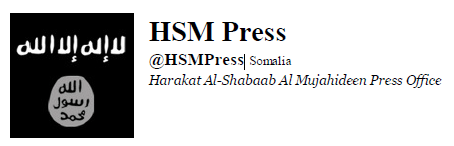
Well, @HSMPress just joined the fray — that’s al-Shabaab:

Notice the flag?

It’s that black banner again.

*

There has been some controversy over whether or not there was an element of support for AQ in Libya, and at the recent Tahrir Square demonstrations, and black banners have featured heavily in the discussions.

Let’s get our black banners straight. First, Libya.

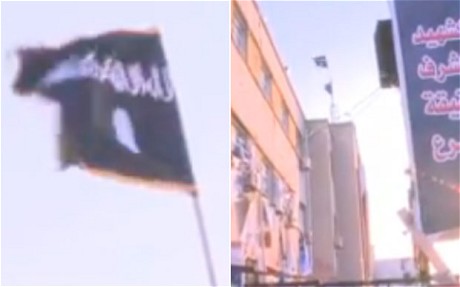
This was the black flag allegedly flown in Libya after the ouster of Col. Gadhafi.  It was published as illustrated here by the Daily Telegraph, under the headline “Libya: Al Qaeda flag flown above Benghazi courthouse” and with the commentary ” The black flag of Al Qaeda has been spotted flying over a public building in Libya, raising concerns that the country could lurch towards Muslim extremism.”

Note the resemblance to the logo al-Shabaab is using.

*

Juan Cole pooh-poohed the idea that this was an AQ flag, calling it a “silly urban legend going around” and quoting a Libyan scholar-friend on the point:

I looked up the mentioned flag, it appears to be a black flag with the shahada [Muslim profession of faith] in it. A black flag goes back all the way to the prophet, and the addition of the shahada makes it a Jihadist flag. There have been Jihadists in Libya from day one, and they fought against Qaddafi. But is Al-Qaeda, as in the global network taking over? No.

Cole’s friend’s comments are worth reading in full: they provide context on the various factions and their relative strengths, and Cole sums it all up in terms of the specific issue of AQ and Benghazi thus:

What this informed observer is saying is that a miniscule group of jihadists put up that flag, in the chaos of the post-revolutionary period, but that they are highly unrepresentative of politics in Benghazi.

Fair enough. But that wasn’t just a black flag with the Shahada, was it?

When Cole’s friend rites “A black flag goes back all the way to the prophet, and the addition of the shahada makes it a Jihadist flag,” Cole comments “Moreover, the black flag as a symbol is not a monopoly of al-Qaeda. Revolutionaries raised a black flag in the medieval Abbasid Revolution of 750 AD.”

Indeed. They may also have produced the ahadith about the army with black banners from Khorasan, which give such flags a distinctively Mahdist application – ahadith which Ali Soufan tells us have been used extensively in AQ recruitment.

So there are black banners and black banners. There was “Khalifa Abdullah’s great black banner, black-lettered with text from the Koran and the Mahdi’s sayings” mentioned in Burleigh‘s account of the Battle of Omdurman – and a little earlier, the Bab had instructed his followers to “gather under the black standard which was being raised in Khurasan” according to Munirih Khanum‘s Memoirs and Letters.

*

Aaron Zelin has a post at The Wasat which allows for a quick comparison between various black flags and banners. Here’s the flag that Aaron identifies as that of the Islamic State of Iraq:

That’s an AQ-related flag, and it distinctly features what is believed to be the seal of Muhammad:

So I wouldn’t be so sure that “No, that wasn’t an al-Qaeda Flag over Benghazi” Dr. Cole.

*

What about Egypt?

In another piece — this one entitled “Did the Muslim Brotherhood Threaten to Kill “All Jews”?” — Dr. Cole wrote:

The Muslim Brotherhood and other religious parties in Egypt (including the Salafis and the Gama’a al-Islamiya) held a rally at al-Husayn Square in Cairo last Friday to which a few thousand people came. The big rally was at Tahrir Square in downtown Cairo and was dominated by secular forces.

Cole is entirely right in rebutting a YNet correspondent’s claim that “a Koran quote vowing that ‘one day we shall kill all the Jews’ was uttered” at the al-Husayn site:

Beck, who clearly does not know what he is talking about, said that the crowd repeatedly quoted a verse in the Qur’an that spoke of killing all Jews. There is no such verse in the Islamic holy book. The Jewish revelation from God to Abraham and Moses is retold in the Qur’an, which has positive stories of the Children of Israel. The castigation of the Children of Israel in the Qur’an is of the same sort you see in the Hebrew Bible, and often put in the mouth of Moses or another Jewish prophet.

Indeed, a commenter on the YNet article from Quebec went further:

Eldad Beck wrote: “Time and again, a Koran quote vowing that ‘one day we shall kill all the Jews’ was uttered at the site”.

There is NO such verse in the Qur’an. In fact, the Qur’an says this:

“Those who believe in the Qur’an, those who follow the Torah and the Sabians and Christians–anyone who believes in G-d and the Last Day and who does righteous deeds need not be in fear and will not grieve.” (5:69)

There were indeed hotheads in the crowd who yelled that they would “fight the Jews (i.e., Israelis)”. If Mr. Beck spoke Arabic fluently, he would not have mistaken the shouted word “mutaqalah” (to fight, combat, overcome) with the word “qatala” (to kill). In addition, he would know that in Palestinian colloquial Arabic “al-yahud” (the Jews) usuallhy has the limited meaning of “the Israelis”.

Sadly the errors (or willful misrepresentations) of Beck have been repeated in dozens if not hundreds of paper and electronic media.

If he made an innocent error, he should apologize and set the record straight.

If not, let him stand before the Mercy Seat of Ha-Shem and explain why he violated the commandment given to Moses: “You shall not bear false witness against your neighbour.”

*

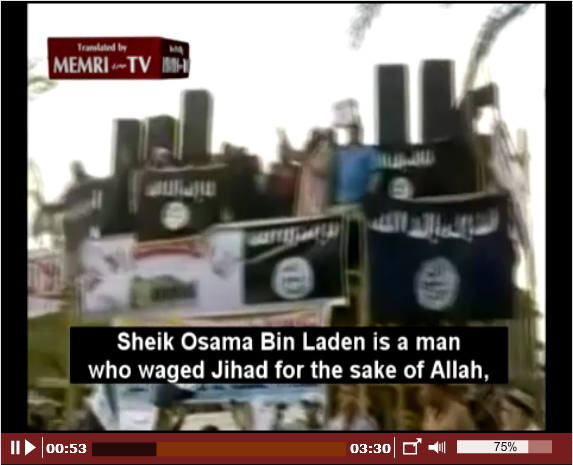
The thing is — getting back to our black banners with Shahada and distinctive seal of Muhammad — there were in fact demonstrations in Tahrir Square just a week earlier, at which those pesky black flags were in evidence:

MEMRI brought us the video of which that is a screen-capture, and provided a transcript of Sheikh Tawfiq al-Afni‘s address to the crowd, of which this is an excerpt:

Tawfiq Al-Afni (On stage): ”Sheikh Osama bin Laden is a man who waged Jihad for the sake of Allah, and we pray that Allah will unite us with him and the martyrs in Paradise. My brothers, in Islam, we say with great pride that we adhere to the Jihad for the sake of Allah…”

Crowd: “Allah Akbar.”

Tawfiq Al-Afni: “We are not waging Jihad for worldly benefits or for positions. By Allah, we have only come to pledge our allegiance to Islam. We wage Jihad for the sake of Allah and the Koran. […]

“We respond to Your call. Please turn our skulls into a ladder for your glory.”

Crowd:
“We respond to Your call. Please turn our skulls into a ladder for your glory.”

Black banner, Shahada, seal of Muhammad, Tahrir Square.

*

So it’s important that we should know these things (oh, and much more besides):

  • The black banners are in Tahrir and Somalia, as they have been in Mahdist movements stretching back to the Abbasids.
  • Black banners featuring the seal of Muhammad appear to have a connection with AQ, often indicative of sympathetic support, if not active participation.
  • That such voices exist in Egypt should not make us think that they represent a majority, nor indeed that they are the voice of the Muslim Brotherhood, but rather that they are among the voices raised in a tumultous situation.
  • There are many secular voices raised in Tahrir, and also Islamist voices with a willingness to take the path of politics and compromise.
  • We should remember that there are voices in Tahrir of both terror and reconciliation. We should not forget the voices of those Muslims who protected Coptic churches, nor of the Copts who protected Muslims while they bowed their heads in prayer
  • And no-one, no-one left or right should forget that the Egyptian army, too, has a voice, and a megaphone, and much more besides.

Let me put my banana in your fruitbasket

Thursday, December 8th, 2011

[ by Charles Cameron — Islamic rulings, women, delta blues ]

.

Credit: Steve Hopson, www.stevehopson.com CC Share Alike License

.

By my count, this is my 250th post on Zenpundit, and I wanted to honor the occasion with a post that would be unusually scholarly and to the point — something that would increase our understanding of the nuances of jihadist thinking, or something of the kind.  But you know, somehow I got sandbagged along the way.

I’m recovering from the shingles, which is a painful business and leaves a trail of neuralgia that can apparently last for months, I’m taking the kind of anti-pain medication where you’re not allowed to control heavy machinery, and frankly I’m just a bit woozy.  So I do have several serious posts in preparation, but I can’t seem to think straight enough to post them as yet.

So let’s get to the bananas: this is the best I can do for you right now.

i.

It seems an Islamic cleric has gotten himself in the news by proclaiming that Muslim women should refrain from proximity to bananas and, well, cucumbers:

An Islamic cleric residing in Europe said that women should not be close to bananas or cucumbers, in order to avoid any “sexual thoughts.”

The unnamed sheikh, who was featured in an article on el-Senousa news, was quoted saying that if women wish to eat these food items, a third party, preferably a male related to them such as their a father or husband, should cut the items into small pieces and serve.

He said that these fruits and vegetables “resemble the male penis” and hence could arouse women or “make them think of sex.”

Carrots, too, apparently.  But that’s beside the point.

ii.

What interests me is that a fair number of people seem to be ridiculing this ruling. Amrutha Gayathri, for instance, calls it “a ridiculously repressive and absurd proposal” and writes:

Unsurprisingly, the sheikh’s comment has become a target of online mockery, with a flurry of comments denouncing the Islamic repression of women. Many of the commentators are Muslims themselves, who have expressed their anger against the cleric for making Islamic religious practices appear unreasonable.

Islamic clerics of Saudi Arabia have been in the headlines recently when they spoke out against lifting the driving ban on women. The argument in that case suggested that “all women will lose their virginity” by indulging in pre-marital sex due to the mixing of genders (which, it is feared, will occur if women were allowed to drive).

The “scholarly” report by the clerics of Majlis al-Ifta al-Aala, the country’s highest Islamic council, warned there would be “no more virgins” in the country within 10 years of lifting the ban because driving will lead to a “surge in prostitution, pornography, homosexuality and divorce.”

iii.

I don’t know about all that, and I was thinking the ruling about bananas was frankly bananas too, until I was skipping around the internet today under the influence of my medications and ran across this gem from the Delta bluesman, Bo CarterLet me put my banana in your fruitbasket. The lyrics are terrific and, I’d say, very much to the point:

On second thoughts — maybe our Islamic cleric just knows his blues.

iv.

I hope to post more here shortly, once I’ve got my wind back.  

Updates on COIN is Dead Debate

Thursday, December 8th, 2011

From Major Mike Few of SWJ and Fabius Maximus:

SWJ Blog (Few)  Rethinking Revolution and Do Two Wrongs Make a Right?

When is a revolution over, completed, fulfilled?  Traditionally, we prefer to quantify revolutions as ending in a win, loss, or negotiated settlement.[1]  While this framework is helpful for shaping theory, it neglects that reality is often much more complicated and messy.  As John Maynard Keynes said, “it is a method rather than a doctrine, an apparatus of the mind, a technique for thinking, which helps the possessor to draw correct conclusions.”  Simply put, it is only a guide towards understanding history and human nature.

….In his seminal work, Rethinking Insurgency, Steven Metz challenged our community to rethink the existing assumptions and relearn how to counter insurgencies.[5]  Moreover, over the past decade, scholars challenged the accepted military definition that an insurgency is “an organized movement aimed at the overthrow of a constituted government through use of subversion and armed conflict.”  

Yet, with all the evidence, scholarship, theories, and analysis, we continue to muddle through small wars.  Why?  Perhaps, we often choose mass over maneuver and speed over subtle influence in attempts to control the problem.  Small wars are wicked problems.  If we continue to plug and play the latest “new” idea to tame a problem, then we will just muddle along and only make the problem worse.

….Before we can hope to distill any lessons learned from this past bloody decade of war and rewrite the existing counterinsurgency manual[7][8] and find a suitable foreign policy for this new century, perhaps we should first seek to better understand the nature of revolution. 


Fabius Maximus – COIN- Now that we See it Failed…. and COIN, another difficulty…. 

As we walk away from the Iraq and Af-Pak Wars, we face many questions about the future.  Two of these are:

  • When we should directly fight local insurgencies (what strategy)?
  • When we must do so, how should we do so (what doctrine)?

Given the historical record, this series of posts suggest the answers are:

  • We go to fight local insurgencies only when necessary (IMO neither Af or Iraq were necessary after their governments were overthrown).
  • We lack reliable doctrine to fight local insurgencies abroad. The number of successes by foreign armies against local insurgencies is too few to draw firm conclusions (see section 3 in the previous post for details).

That does not mean that counter-insurgency is impossible for foreign armies.  It suggests that repeating failed doctrines (Vietnam, Iraq, Af-Pak) will not work.  As the old Alcoholics Anonymous saying goes, insanity is repeating the same actions but expecting a different result.

Update:  Not all foreign wars, or even all small foreign wars, are counter-insurgencies.


Odierno’s Reading List

Tuesday, December 6th, 2011

General Ray Odierno, Chief of Staff of the US Army has a pretty good prospective professional reading list in the works with many titles of general interest to people in national security and foreign policy fields. He’s asking for feedback too.

Minus the Mustache of Understanding, whose inclusion seems to be required on lists of these kind, there are titles here that I would strongly recommend including McPherson’s Battle Cry of Freedom,  The Landmark Thucydides, Luttwak’s Grand Strategy of the Byzantine Empire and the best of military historians and strategists like Paret, Keegan, van Creveld and Parker.

I would recommend adding Acheson’s memoir Present at the Creation, for an understanding of policy and national strategy and Alan Schom’s critical and monumental biography, Napoleon Bonaparte: A Life, for a comprehensive understanding of Napoleon’s campaigns in context with his psychology and political leadership.

But what seems to really be missing from the General’s list is a good book on intelligence history and tradecraft.

Since the list is intended for military officers, it would not have to be a technical critique along the lines of Roberta Wohlstetter’s Warning and Decision (though that would not hurt) but something that gave a good overview, spymaster biography or history, would help.

I can think of many, but I’d like to see what the readership would nominate in the comment section. Have at it!

Hat tip to Lucien.


Switch to our mobile site