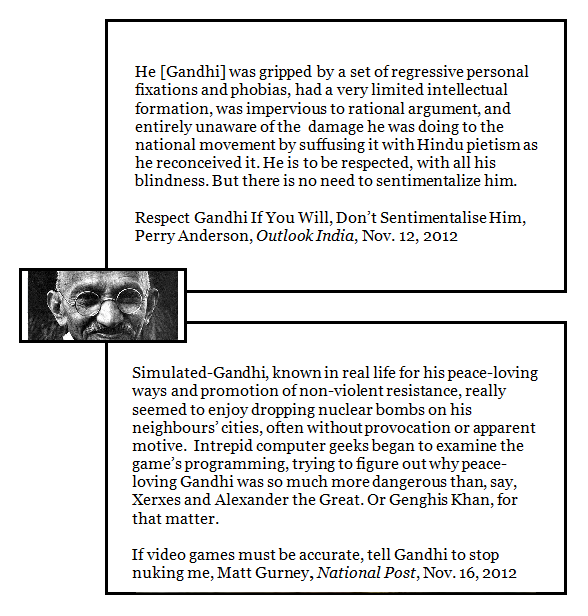
[ by Charles Cameron — two clashing quotes about Gandhi that followed one another in my RSS feed today, funny & strange ]
.
.
Strange, to say the least.
Gandhi was a strategist — as a friend of mine once wrote, “he achieved self determination for the largest number of individuals with the lowest cost in human life” of any rebel known to history —
He managed this feat by holding a position of non-violent non-cooperation, while showing that the ‘civilized’ opponent of the United Kingdom could not live up to its own imposed standards of conduct or law.
And at least some of the time, he was notably unwilling to romanticize himself — he once said:
My nonviolence does not admit of running away from danger and leaving dear ones unprotected. Between violence and cowardly flight, I can only prefer violence to cowardice. I can no more preach nonviolence to a coward than I can tempt a blind man to enjoy healthy scenes. Nonviolence is the summit of bravery. And in my own experience, I have had no difficulty in demonstrating to men trained in the school of violence the superiority of nonviolence. As a coward, which I was for years, I harbored violence. I began to prize nonviolence only when I shed cowardice.
So he’s not the total pacifist he’s sometimes portrayed as.
But nuclear weapons? “Much more dangerous than, say, Xerxes and Alexander the Great. Or Genghis Khan, for that matter”?
Not in India, not back then. In one of Hugh Everett‘s “many worlds”? — perhaps. And in Civ2, the game? — apparently, yes.
[ by Charles Cameron — keeping up with Aaron Zelin on a good day can be quite a feat — this post has taken me a few days to write! ]
.
Let’s start with this avatar business. I picked it up from Gregory Johnsen, who applied the term in a tweet a few days ago to Aaron Zelin:
I chuckled at the description and RT’d Johnsen’s tweet at the time — but a day later the full force of the words “more than just a high producing avatar” came back to me, when I took a look at the things I wanted to pass along here on Zenpundit from that day’s haul, and found that three of them came via Aaron.
This featured the Benghazi and Tunisian groups that share the name Ansar al-Sharia (ASB and AST), and points to the idea that:
much of the scope of their activities lies outside violence. A large-portion of the activities of these groups is local social service provision under their particular dawa (missionary) offices. This broader picture is crucial to better understanding emerging trends in societies transitioning from authoritarian to democratic rule.
This emphasis, Aaron suggests, derives from the writings of Sheikh Abu Muhammad al-Maqdisi:
One of the main critiques Maqdisi presents, and hopes to create a course correction within the jihadi movement, is his differentiation between the idea of qital al-nikayya (fighting to hurt or damage the enemy) and qital al-tamkin (fighting to consolidate ones power), which he expounds upon in his book Waqafat ma’ Thamrat al-Jihad (Stances on the Fruit of Jihad) in 2004. Maqdisi argues the former provides only short-term tactical victories that in many cases do not amount to much in the long-term whereas the latter provides a framework for consolidating an Islamic state. In this way, Maqdisi highlights the importance of planning, organization, education, as well as dawa (calling individuals to Islam) activities.
Finally, Aaron places ASB (Benghazi) and AST (Tunisia) in the wider context of Islamist movements, both Sunni and Shia, writing:
By providing charity, care, and aid ASB and AST are acting similarly in their operations (though should not be confused for allies with or having ideological connections) to the Muslim Brotherhood, Hamas, and Hezbollah. Providing social services has provided leverage for these groups to gain wider popularity and support within the local community.
By my count, therefore, we now have at least five tendencies to think about: (i) politically engaged Islamists, such as the Brotherhood and the Ennahda movement, (ii) jihadists who hope to topple the “near” enemy, ie local despotic rulers of Muslim-majority states, (iii) jihadists who hope first to cripple the “far” enemy, following bin Laden‘s doctrine, (iv) jihadists in the wake of Abu Musab al-Suri‘s nizam, la tanzim (system, not organization), with its implication of decentralized jihad and leaderless resistance, and (v) the distinctive approach to jihad that Aaron discusses, in which al-Maqdisi’s theories are implemented:
ASB and AST do not buy into the democratic process and in spite of it are attempting to consolidate their future Islamic State one small act of charity at a time.
One point of interest to me here was a version of the well-known “saved sect” hadith, which has been specifically viewed as referring to al-Qaida on occasion:
It was narrated from ‘Awf bin Malik that the Messenger of Allah said: “The Jews split into seventy-one sects, one of which will be in Paradise and seventy in Hell. The Christians split into seventy-two sects, seventy-one of which will be in Hell and one in Paradise. I swear by the One in Whose Hand is the soul of Muhammad, my nation will split into seventy-three sects, one of which will be in Paradise and seventy-two in Hell.” It was said: “O Messenger of Allah who are they?” He said: “Al Jama‘ah – The main body.” (Sunan Ibnu Majah 3992).
I’d seen versions of the hadith in which it is promised that one Islamic sect will endure to the end and be worthy of paradise, but I’m not sure I’d ever seen this version, with one Jewish and one Christian sect similarly treated.
I imagine the “three” sects are in fact the “one” sect of those who, in the different Abrahamic traditions, have remained faithful to the one truth taught by all the prophets from Moses via Jesus to Muhammad — but might there be some Christians faithful to this day, as is perhaps suggested by Qur’an 5.82 —
The nearest to the faithful are those who say “We are Christians.” That is because there are priests and monks among them and because they are free of pride.
The first part of that verse, be it noted, is less than flattering regarding the Jews…
Last, to return to the matter of Twitter, there was Aaron’s response to an FBI announcement —
The FBI tweet actually came after they had made the announcement Aaron was responding to, but his critique still stands…
**
There may be some flattery in this post, but if so, it’s not Aaron’s fault; there’s certainly a sincere compliment intended from my side. But what this post really is — and the length of time it’s taken me to write this has made the timing right — is a “Follow Friday” #FF for @azelin on Twitter, and the articles and resources his twitter feed will lead you to.
consider Aaron a friend in the digital way of things, but my point here is point you towards him if you do not already follow him, and to raise just a few of the issues that struck me in reading just one day’s worth of his output.
[ by Charles Cameron — on the difficulties that may be posed when “reading” graphics ]
.
**
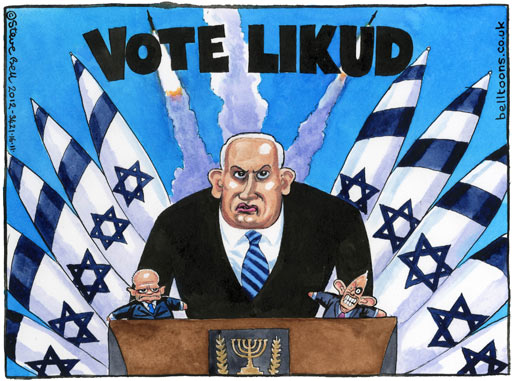
The question I want to ask in this post is: how much can you safely read into a political cartoon?
Here is the particular cartoon I have in mind:
It was published in The Guardian (UK) yesterday, and as you may be able to see, it portrays Israeli PM Benjamin Netanyahu as a puppet-master, with British politicians Tony Blair and William Hague as his puppets, and was published to illustrate the cartoonist’s view of British reaction to the Gaza situation.
How much can we read into it?
**
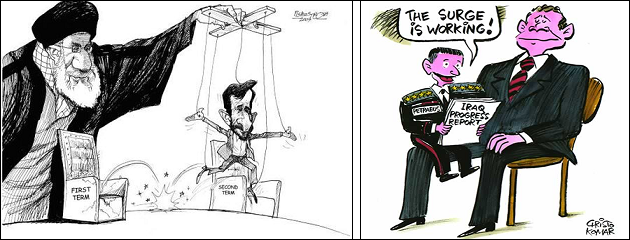
If you are used to seeing cartoons such as these —
showing Khamenei pulling Ahmadinejad‘s strings and Petraeus as a puppet of GW Bush, when you come across the Netanyahu cartoon in the Guardian, you may well view it as another in a long series of political cartoons suggesting that someone is running someone else’s show behind the scenes. It’s the old idea of the eminence grise, in other words, expressed in cartoon form.
**
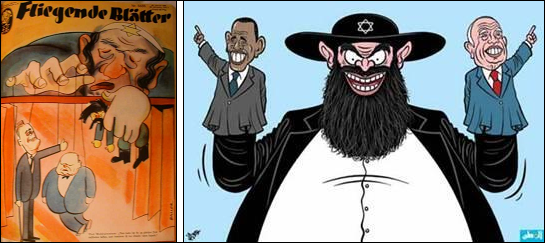
If, on the other hand, you’ve been exposed way too often to cartoons like these —
the one portraying Churchill, FDR and Stalin as Jewish puppets, taken from a 1942 issue of the Nazi paper, Fliegende Blätter, or the one depicting McCain and Obama as Israeli puppets, taken from a 2008 issue of the Saudi paper, Al-Watan… you may well see the same cartoon in a very different — and distinctly antisemitic — light.
**
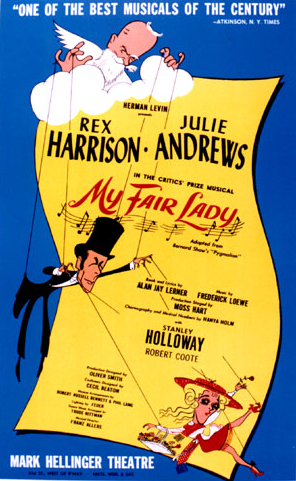
The last two graphics, at least, are extremely offensive, and I would like to offer another graphic here — one which also uses our “puppet master” theme — as a visual equivalent of offering a glass of water to cleanse the palate:
I’ll be addressing this My Fair Lady poster from a very different angle, in a later post in my “form is insight” series — this one on “dolls within dolls”, the “world stage which we have dotted with stages of our own devising” and “turtles all the way down”…
**
Having hopefully reduced the emotional freight which some of the cartoons above must surely have carried with them, I would now like to offer you some background which seems relevant to me. Characteristically, perhaps, it comes from a very different field of knowledge.
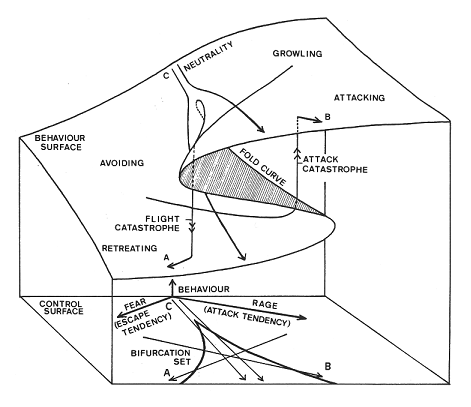
EC Zeeman‘s April 1976 article Catastrophe Theory in the Scientific American was my introduction to the mathematician Rene Thom’s remarkable body of work, an introduction which sailed mostly over my head — but one of Zeeman’s points, which he illustrated with the graphic below, made perfect sense to me.
The annotation to this illustration read in part:
If an angry dog is made more fearful, its mood follow* the trajectory ‘A’ on the control surface. The corresponding path on the behaviour surface moves to the left on the top sheet until it reaches the fold curve; the top sheet then vanishes, and the path must jump abruptly to the bottom sheet. Thus the dog abandons its attack and suddenly flees. Similarly, a frightened dog that is angered followes the trajectory ‘B’. The dog remains on the bottom sheet until that sheet disappears, then as it jumps to the top sheet it stops cowering and suddenly attacks.
My translation:
A dog that reaches the point where its ears are fully pinned back, indicating full-on fear, and its teeth are also fully bared, indicating full on rage, will behave differently depending on whether its fear level or its rage level was the first to be raised to “full”.
Just as a dog’s reaction to a full on mix of rage and fear may depend on which stimulus came first, so — I am suggesting — our own reaction to the cartoon in question — inherently antisemitic, or merely critical of a particular Israeli operation — may depend on our previous exposure to cartoons, politics, the Israeli-Palestinian conflict, or antisemitism.
**
We now have several levels of ease or difficulty in reading graphics. The Zeeman graphics are hard to read because they’re too small to be legible — but put them in the context of Zeeman’s article, and view them full size as originally published, and the only problem might be in following Zeeman’s text, itself a popularization and simplification of Rene Thom‘s work.
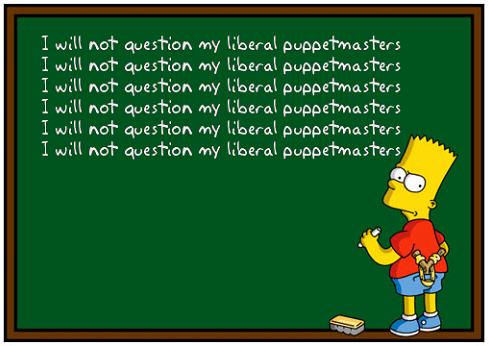
The Bart Simpson graphic is fairly straight forward, and regular viewers of the show would “read” it in line with hundreds of similar frames in which Bart writes repeated lines on a classroom chalkboard, from Season 1 episode 2’s “I will not waste chalk” to Season 23’s “There’s no proven link between raisins and boogers”.
And then there’s the disputed Netanyahu graphic… which can be “read” differently, depending on what previous “puppet master” associations the viewer beings to the task. Here, it seems to me, the task of interpretation can be viewed in one of two ways: (i) as an exploration of how it is likely to be read, which I’m suggesting will depend on previous association, and (ii) as an exploration of what “must have been” in the cartoonist’s heart.
**
Assessing the cartoon’s probable impact on segments of the public is one thing — knowing what the cartoonist intended, even though we tend to conflate the two, is quite another. Not for nothing does St Paul in I Corinthians 2.11 ask (in my own translation)
Who knows the qualities of a man but the spirit of that man within him?
[ by Charles Cameron — IDF terminology and the Gaza conflict, explanations of Exodus, an IDF video, Megillah 10b and the koan “with God on our side” / “with God on all sides” ]
.
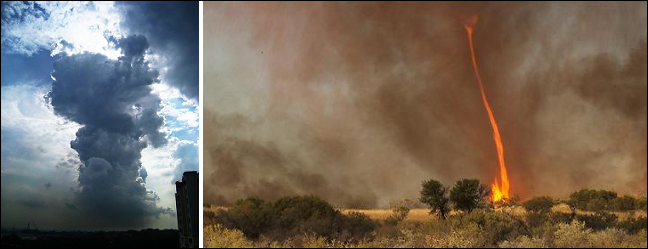
photo credits: Schristia, Cloud; Chris Tangey, Fire
.
I’m curious.
The IDF calls today’s Israeli operation in Gaza “Operation Pillar of Defense” in English, but as John Cook points out in Gawker, uses the term Hebrew term “Pillar of Cloud” in Hebrew.
There’s a great deal of interest here, apart from the difference between their use of non-Biblical terminology in English and Biblical terminology in Hebrew. One point that catches my ear, a poet being a poet, is that the phrase “Pillar of Cloud” is in fact only one half of a double reference…
Thus in Exodus 13.21-22 we read:
And the LORD went before them by day in a pillar of a cloud, to lead them the way; and by night in a pillar of fire, to give them light; to go by day and night: He took not away the pillar of the cloud by day, nor the pillar of fire by night, from before the people.
**
There are various ways of understanding the pillar of cloud and pillar of fire, but it’s pretty clear that there’s only one pillar —
And it came to pass, that in the morning watch the LORD looked unto the host of the Egyptians through the pillar of fire and of the cloud… [Exodus 14.24]
which is called a pillar of cloud by day and a pillar of fire by night, perhaps simply because we are speaking of theophany — the Divine Presence made visible — perhaps because smoke from a brazier is more visible in daylight and flames at night — perhaps because as Hans Goedicke, then chairman of the department of Near Eastern Studies at Johns Hopkins, suggested, the source of both fire and smoke was the eruption of Santorini around 1600 BCE.
The difference in worldviews behind those explanations alone is a matter of considerable interest.
**
Linguistically, however — and this is where the poet being a poet comes in — there are two pillars, and I have to wonder whether the name “Pillar of Fire” is being saved for a later and perhaps more impressive (“shock and awe”) operation, or — in line with the “by day and by night” distinction — refers to the covert side of the same op?
Not that anyone would be likely to give me that information, or that I’d have any use for it if they did.
But the Biblical phrasing is powerful, and “Pillar of Defense” doesn’t make a whole lot of sense — besides, cloud and fire go together in Hebrew in much the same way smoke and mirrors do in English.
Of the three choices, I’d have gone with “Pillar of Fire” myself.
**
An IDF spokesperson, in a response to Cook’s Gawker article, claimed:
I think that every example of Bible quotes you cited has defensive connotations, rather than “vengeful.”
One of those quotes is Exodus 14:24, which I quoted above but will now give in full, along with verse 25:
And it came to pass, that in the morning watch the LORD looked unto the host of the Egyptians through the pillar of fire and of the cloud, and troubled the host of the Egyptians, and took off their chariot wheels, that they drave them heavily: so that the Egyptians said, Let us flee from the face of Israel; for the LORD fighteth for them against the Egyptians.
I think calling that “defensive” is a bit one-sided, but on the other of the two hands in question, so is calling it “vengeful”.
The Israelites saw themselves in the larger context as escaping Egyptian oppression, the Egyptians obviously considered themselves under attack in the short term — just as surely as the people of Gaza must feel under attack by the oppressive Israelis today, while the Israelis clearly feel under attack by terroristic Hamas and its rockets. But hey, the IDF spokesman only offered his explanation that the Pillar of Cloud and Defense was “defensive” as “Just my two cents”…
FWIW, those two verses from Exodus sound just a little like Quran 33.26:
And He brought down those of the People of the Book who supported them from their fortresses and cast terror in their hearts; some you slew, some you made captive. And He bequeathed upon you their lands, their habitations, and their possessions, and a land you never trod. God is powerful over everything.
That’s an ayat that has always interested me, because of the use of the word “terror” found in a number of translations including this one, by AJ Arberry — others have “awe” or “panic”, but “terror” is interesting in the context of its contemporary usage.
**
Here’s the current strike counter strike in two tweets:
**
Okay, let’s get as close to visceral as modern technological warfare permits. After the recent truce was broken and numerous rockets fired into Israel, the IDF fired a missile that killed Hamas military leader Ahmed Jabari, and quickly put the video feed up on YouTube:
**
People are killing and getting killed. Should that be a matter for concern, or delight?
The narrative from which the IDF drew the name of their campaign in Gaza is taken from that of Israel’s escape from Egypt in Exodus, which also includes the parting of the waters and destruction of the Egyptian army:
And the angel of God, which went before the camp of Israel, removed and went behind them; and the pillar of the cloud went from before their face, and stood behind them: And it came between the camp of the Egyptians and the camp of Israel; and it was a cloud and darkness to them, but it gave light by night to these: so that the one came not near the other all the night. And Moses stretched out his hand over the sea; and the Lord caused the sea to go back by a strong east wind all that night, and made the sea dry land, and the waters were divided…. [Exodus 14.19-21]
And it came to pass, that in the morning watch the Lord looked unto the host of the Egyptians through the pillar of fire and of the cloud, and troubled the host of the Egyptians, And took off their chariot wheels, that they drave them heavily: so that the Egyptians said, Let us flee from the face of Israel; for the Lord fighteth for them against the Egyptians. And the Lord said unto Moses, Stretch out thine hand over the sea, that the waters may come again upon the Egyptians, upon their chariots, and upon their horsemen. And Moses stretched forth his hand over the sea, and the sea returned to his strength when the morning appeared; and the Egyptians fled against it; and the Lord overthrew the Egyptians in the midst of the sea. [Exodus 14.24-27]
Here again we see an instance of what I have called the two-fold logic of scriptures: In the Babylonian Talmud, Megillah 10b, R. Johanan tells us:
The ministering angels wanted to chant their hymns, but the Holy One, blessed be He, said, The work of my hands is being drowned in the sea, and shall you chant hymns?
to which R. Eleazar responds:
He himself does not rejoice, but he makes others rejoice.
**
To my mind, what we’re looking at here is a global koan: the immediate and eternal paradox of life and death.
[ by Charles Cameron — the excellence of today’s piece by Joshua Foust and the importance of intelligence that is not actionable, with illustrations from Zenpundit, Dickens and Shakespeare ]
.
Kate Bosworth peers out from under a blindfold in the 2010 movie, Warrior's Way
The United States’ overriding interest in “actionable” information on terrorists has produced a dangerous form of tunnel vision.
Bingo.
This is important, and I’ll circle back to it. But first, please follow the full arc of the circle…
**
I post little headers at the top of all my Zenpundit posts these days, to let people know where on the irrelevance scale my latest offering should be placed — I guess the idea came from the 19th century practice of offering “synoptic chapter headings” to titillate the reader of novels, as when Mr Dickens titles one chapter of The Pickwick Papers:
Chapter XVIII. Briefly illustrative of two points; first, the power of hysterics, and, secondly, the force of circumstances
why is non-actionable (useless) intelligence sometimes the most intelligent (useful)? – importance of multiple frames for complex vision
The piece was about the Haqqani network, but obliquely so — I was leaping from an image in a video where a cluster of Haqqani-guys in training were running around dressed as trees, to a similar image in Shakespeare‘s Macbeth:
Macbeth shall never vanquish’d be until
Great Birnam wood to high Dunsinane hill
Shall come against him.
Well, that was the prophecy, and Macbeth took it to mean he’d never be defeated in battle:
That will never be.
Who can impress the forest, bid the tree
Unfix his earthbound root? Sweet bodements! Good!
Prophecies and portents are notorious for their double meanings, however, and this one’s fulfillment comes when Malcolm gives the order to his men:
Let every soldier hew him down a bough
And bear’t before him. Thereby shall we shadow
The numbers of our host and make discovery
Err in report of us.
Heh — “discovery” here means what today we’d call “intelligence” — and notice the importance here of reading multiple meanings out of a single sign.
A while later, a messenger arrives, and declaims:
As I did stand my watch upon the hill,
I look’d toward Birnam, and anon, methought,
The wood began to move.
This turns out to be true enough, for in the next scene Malcolm, now before Dunsinane, gives the order:
Now near enough: your leafy screens throw down.
And show like those you are.
and:
Make all our trumpets speak; give them all breath,
Those clamorous harbingers of blood and death.
And so it goes.
**
Let me emphasize, this is not, definitively not, actionable intelligence that I am in any way attempting to offer as such to anyone engaging in close-quarters combat with the Haqqanis.
Our arc is almost complete at this point, so let’s take a closer look at Josh Foust’s piece:
Large areas of the IC have move away from their traditional role of analyzing a broad range of current events for policymakers and toward supporting the global counterterrorism mission. News stories about this shift suggest the counterterrorism mission has become the overarching concern of the national security staff.
This shift in focus can create blind spots that pose unique challenges for the president. If branch chiefs and the policymakers they support value “exploitable” information over deep understanding, they might be ignoring potentially vital information that doesn’t seem immediately of interest.
Imagine an analyst finding reports of a growing discontent in a Middle Eastern country’s politics; if that does not provide immediate benefit for a decision-making process for targeting suspected terrorists, it can easily be ignored in the avalanche of targeting information.
Blind spots, eh?
Those would be “the dots” in the “larger picture” that you can’t “connect” until it’s too late. And where are they found? In “information that doesn’t seem immediately of interest” — intelligence that’s not “actionable” in other words.
Or to put that another way, what Josh calls “tunnel vision” comes from staring at what’s “actionable” — whereas vision that’s “out of the tunnel” comes from noticing what’s in peripheral vision.
**
Wei wu wei? It’s a Taoist motto: literally, it means “action without action” though it can also be translated “effortless action”.
I know, I know, this is a useless post. But you know what Hui Tzu said to Chuang Tzu?
I have a big tree of the kind men call shu. Its trunk is too gnarled and bumpy to apply a measuring line to, its branches too bent and twisty to match up to a compass or square. You could stand it by the road and no carpenter would look at it twice. Your words, too, are big and useless, and so everyone alike spurns them!
Zenpundit is a blog dedicated to exploring the intersections of foreign policy, history, military theory, national security,strategic thinking, futurism, cognition and a number of other esoteric pursuits.