zenpundit.com » 2012

Archive for 2012

Of quantity and intensity: the case of the Sufiyan

Sunday, October 28th, 2012

[ by Charles Cameron — catching the apocalyptic mention in a broad sectarian overview ]
.


.

I’d like to discuss the last four paragraphs of a recent NYT piece on the influx of Iraqi Shiites to Syria:

Iraqi Shiites did not initially take sides in Syria. Many Shiites here despise Mr. Assad for his affiliation with the Baath Party, the party of Saddam Hussein, and the support he gave foreign Sunni fighters during the Iraq war.

But as the uprising became an armed rebellion that began to attract Sunni extremists, many Shiites came to see the war in existential terms. Devout Shiites in Iraq often describe the Syrian conflict as the beginning of the fulfillment of a Shiite prophecy that presages the end of time by predicting that an army, headed by a devil-like figure named Sufyani, will rise in Syria and then conquer Iraq’s Shiites.

It was the bombing of an important shrine in Samarra in 2006 that escalated Iraq’s sectarian civil war, and many Iraqis see the events in Syria as replicating their own recent bloody history, but with even greater potential consequences.

Hassan al-Rubaie, a Shiite cleric from Baquba, the capital of Diyala Province, said, “The destruction of the shrine of Sayyida Zeinab in Syria will mean the start of sectarian civil war in Iraq, Syria, Lebanon, Bahrain and Saudi Arabia.”

**

There’s a lot going on there, and I just want to point you to the little diagram I posted above, which features what I consider one very significant point that jumped out at me on this occasion from the “larger picture”.

It’s my impression that the name Sufiyan will be far less familiar to most readers than the names Iraq, Syria, Lebanon, Bahrain and Saudi Arabia. Furthermore, Iraq, Syria and so on are nations — real geopolitical entities with territories, wealth, militaries, populations, factions, fighting and so forth. The Sufyani, by contrast, is a single person, perhaps a figure of legend.

For the contemporary western mind, therefore, it is easy to read those last four paragraphs and be struck by the breadth, the sheer physical extent of the potential conflict described there – and after noting the basic concept of sectarian rivalry between Sunnis and Shiites, that may in fact be the major “takeaway” from the article: this thing could be huge.

I want to suggest there’s a more significant, and less studied takeaway – that Sufyani is the key word here, because Sufyani is a figure in a specifically end-times narrative, a precursor to and noted adversary of the Mahdi.

**

That’s my bottom line here – that this individual the Sufyan may be less known and less impressive-sounding than a swathe of nations between the Mediterranean, the Red Sea and the Persian Gulf – but he represents the power of end-times belief, and the intensity that inevitably accompanies the final showdown between good and evil, with heaven and hell the only possible outcomes of one’s chance and choice to participate.

**

There is not a whole lot of documentation in English regarding the Sufyani, especially as viewed in Shiite eschatology, but this quick excerpt archived from an Iranian state media site will give us a basic overview:

According to narrations Sofyani, a descendant of the Prophet’s archenemy Abu Sofyan will seize Syria and attack Iraq and the Hejaz with the ferocity of a beast. The Sofyani will commit great crimes against humanity in Iraq slaughtering people bearing the names of the infallible Imams, and his army will lay siege to the city of Kufa and to Holy Najaf. Of course, many incidents take place in this line and finally Imam Mahdi sends troops who kill the Sofyani in Beit ol-Moqaddas, the Islamic holy city in Palestine that is currently under occupation of the Zionists. Soon a pious person from the progeny of Imam Hasan Mojtaba (AS) meets with the Imam. He is a venerable God-fearing individual from Iran. Before the Imam’s appearance he fights oppression and corruption and enters Iraq to lift the siege of Kufa and holy Najaf and to defeat the forces of Sofyani in Iraq. He then pledges allegiance to Imam Mahdi.

The Rice University scholar David Cook gives a worthwhile account of the Sufiyani in Shiite perspective, in his Hudson Institute paper Messianism in the Shiite Crescent [CC note: this paragraph added about an hour after first posting]:

First among the major omens connected with the belief in the Mahdi’s imminent return is the appearance of his apocalyptic opponent, the Sufyani. Mainstream tradition tells that the Sufyani will be a tyrannical Arab Muslim ruler who will hail from the region of Syria and who will brutally oppress the Shiite peoples. Before the 2003 collapse of the Saddam Hussein regime in Iraq, many messianic writers in both the Sunni and Shiite traditions identified Saddam Hussein as the Sufyani. Since 2004, however, there has been a tendency to gloss over the classical belief in the Sufyani’s Syrian-Muslim identity and to identify him instead with the United States (as many Iraqis hold the U.S. responsible for the slaughters in their country.) Another recent trend within Shiite messianism has been to identify the Sufyani with prominent Sunni radicals such as Abu Musab al-Zarqawi (killed June 2006), who was virulently anti-Shiite. From the perspective of the classical sources, Zarqawi would have indeed been an excellent candidate, because his hometown in Jordan is extremely close to where the Sufyani is supposed to come from.

It’s worth noting, perhaps, that the Sufyani also features in the (Sunni AQ strategist) Abu Musab al-Suri‘s work, the Call to Global Islamic Resistance. As Jean-Paul Filiu reports:

Abu Musab al-Suri looks with favor upon a hadith that speaks of the restoration of Islam by an armed force “coming from the east.” This will be the vanguard of the Mahdi, known by its black banners and led by Shuaib ibn Saleh, whom every believer will join “even [if it means] marching in the snow.” The Sufyani, whose face is scarred by smallpox, will rise up against it in Damascus and ravage Palestine, Egypt, and Hijaz, proceeding as far as Mecca, where he will kill the “Pure Soul.” Yet it is also at Mecca that the Mahdi will appear, and he will reconquer Damascus after eighteen years…

Meanwhile, out there on the wild profusion of the net, there’s naturally controversy as to who the Sufyani might be – suggestions I’ve seen include Bashar al-Assad of Syria and Abdullah II of Jordan – in much the same way that the identity of the Antichrist is debated in Christian eschatological circles, with candidates ranging from the Emperor Nero to Ronald Reagan and more recently Oprah Winfrey [link is to an amazing video clip which also features President Obama and Louis Farrakhan].

**

So?

So. Rather than – or in addition to – considering the sheer extent of geopolitical space referenced in the NYT piece, I’d suggest we should pay attention to the intensity factor signaled by the mention of the Sufyani. Following that tack, after all, we will also be considering a wide swathe of territory —

in Abu Musab al Suri’s terms, from Syria via Palestine, Egypt, and the Hijaz, to Mecca – but with the added intensity that apocalyptic war brings with it.

The war and peace paradox

Saturday, October 27th, 2012

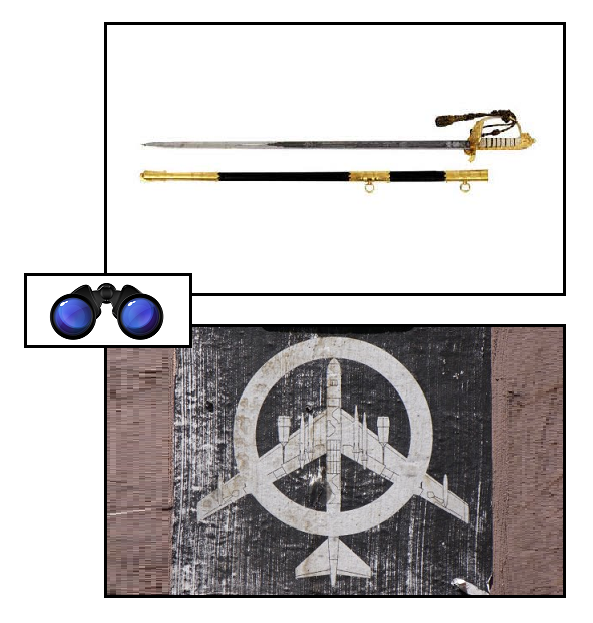
[ by Charles Cameron — a paradox in two graphics ]
.


.
The upper image shows the British “Firmin Sword of Peace” which was awarded this week to the 15 (UK) Psychological Operations Group (15 POG) for their work in Afghanistan. The Ministry of Defence news report described the award thus:

The prestigious Firmin Sword of Peace is given to the unit or establishment of each Service judged to have made the most valuable contribution to humanitarian activities by establishing good and friendly relations with the inhabitants of any community at home or overseas.

The lower image shows an artistic rendering of the peace symbol, seen on a wall in Melbourne, Australia, which is consonant with the old Strategic Air Command motto: Peace is our Profession.

**

Here there be paradox.

Cool theological footnotes to a heated political argument.

Saturday, October 27th, 2012

[ by Charles Cameron — Christian theology on two-fold logic, and its crucial importance in understanding the role of evil and the question of theodicy, with an aside concerning Islamic theology on the breath of life in utero, hence also abortion ]
.

As I shall say more than once, my own interest here is not in discussing the merits or demerits of a recent political debate, but to add a couple of theological nuances for our consideration.
.

Richard Moursock is reported to have said:

I struggled with it myself for a long time, but I came to realize life is that gift from God, and I think even when life begins in that horrible situation of rape, that it is something that God intended to happen.

Joe Donnelly is reported to have responded:

The God I believe in and the God I know most Hoosiers believe in, does not intend for rape to happen — ever. What Mr. Mourdock said is shocking, and it is stunning that he would be so disrespectful to survivors of rape.

Mourdock then apparently responded:

What I said was, in answering the question form my position of faith, I said I believe that God creates life. I believe that as wholly and as fully as I can believe it. That God creates life. Are you trying to suggest that somehow I think that God pre-ordained rape? No, I don’t think that. That’s sick. Twisted. That’s not even close to what I said. What I said is that God creates life.

Similarly, Rick Santorum is reported to have said:

I think the right approach is to accept this horribly created — in the sense of rape — but nevertheless a gift in a very broken way, the gift of human life, and accept what God has given to you. We have to make the best of a bad situation.

**

My sole intention here is to add in a note or two about theology — I explicitly do not address the moral, political, legal and gender ramifications of this issue.

We are accustomed to think in terms of what I’d call “single-track” logic: the logic of Aristotle’s excluded middle. Christianity however, in its gospel-based forms, on occasion uses a “two-track” logic, in which something can be both timeless and temporal, or both the will of God and a clear defiance of that will.

An example of the first can be found in Christ saying of himself, “Before Abraham was, I am.” (John 8.58).

On the face of it, that’s ridiculous – Christ appears to be claiming to have preceded Abraham, who is commonly called “our father Abraham” (Avraham Avinu, Rab in Yoma 28b cf. Genesis 26.3, cf. also Abeena Ibraheem in the Qur’an, 22.78). If single-track logic obtains, that’s a fair and reasonable critique.

The clashing tenses of the two verbs, however, gives us the clue that a two-track logic is at work: that Christ is claiming to be in eternal presence, in a manner that logically “precedes” Abraham’s admittedly prior place when considered in terms of a purely temporal sequence.

**

That piece of two-track logic doesn’t have any direct bearing on the politics of abortion in today’s USA, although it was a scandalous enough paradox to the Jews Jesus was addressing that the next verse states:

Then took they up stones to cast at him: but Jesus hid himself, and went out of the temple, going through the midst of them, and so passed by…

I have quoted it first to make the point that two-track logic is at work in the sayings of Christ in the New Testament – but the key reference point illuminating what Moursock and those of like mind might say concerning an act both being in flagrant defiance of God’s will and also in some way partaking of it would be the betrayal of Christ, resulting directly in his arrest and crucifixion – the hideously cruel form of capital punishment used in that time and place.

Matthew 26.24 indicates that the betrayal and death of Jesus are the means by which a sacrifice is made, in fulfillment of prophecy, and then goes on to point up a double moral:

The Son of man goeth as it is written of him: but woe unto that man by whom the Son of man is betrayed! it had been good for that man if he had not been born.

Reading that, it’s clear that within Christian two-track logic, an outcome (in our contemporary case, fertilization) can fall within the will of God, while there is “woe unto that man by whom” that outcome was brought willfully and sinfully effect.

Thus considering a child born of rape a blessing in its own right may — from a strictly theological standpoint — coexist with the idea that the rape should be abhorred and the rapist subject to whatever punishment the law may provide.

**

I should briefly note here two other pieces that address parts of the same issue:

  • Sarah Sentilles, Rape and Richard Mourdock’s Semi-Omnipotent God, posted at Religion Dispatches
  • G. Jeffrey MacDonald, Richard Mourdock: the theology behind his rape comments, posted at the Christian Science Monitor
  • Obviously, I am not impressed with Christian theological commentaries that miss the “twofold logic” at work wherever evil is encountered in a good creation.

    The case of the betrayal of Christ is the clearest possible indication that God can will the outcome of an act which is in flagrant opposition to his will. The gospels state and Christians believe that Christ’s betrayal itself, not just the consequential salvation of the world by virtue of his sacrifice, was foretold in prophecy: in this sense, even the betrayal was part of the divine will, though as we have seen, that in no way excuses Judas from his complicity in deicide.

    To be perfectly clear: it is my opinion that only the twofold logic I have pointed to satisfactorily approaches the age-long question of theodicy or the problem of evil, which I hope to return to in an upcoming post.

    **

    It is perhaps worth also noting here that the Qur’an suggests that life enters the developing body of a child in the middle of the second trimester, 120 days after conception — although we should also remember that “40 days” can mean “quite a while” in Semitic cultures, if Hebrew figurative usage us anything to go by.

    Thus we read in the Qur’an, 5.12-14:

    And verily We did create man from a quintessence (of clay). Then We placed him (as a drop of sperm) in a place of rest, firmly fixed. Then We made the sperm into a clot of congealed blood. Then of that clot We made a (foetus) lump. Then We made out of that lump bones and clothed the bones with flesh. Then We developed out of it another creature (by breathing life into it). So blessed be Allah, the most marvellous Creator.

    Expanding on this, in the premier hadith collection, Sahih al-Bukhari (# 3036), we read:

    Sayyiduna Abd Allah ibn Mas’ud (Allah be pleased with him) narrates that the Messenger of Allah (Allah bless him & give him peace) said:

    Each one of you is constituted in the womb of the mother for forty days, and then he becomes a clot of thick blood for a similar period, and then a piece of flesh for a similar period. Then Allah sends an angel who is ordered to write four things. He is ordered to write down his deeds, his livelihood, his (date of) death, and whether he will be blessed or wretched (in religion). Then the soul is breathed into him…

    I am indebted to commenters on Juan Cole‘s post Mourdock, Rape as a Gift of God, and Islamic Sharia on his informed Comment blog for the impetus to research the question of life in utero from an Islamic perspective.

    Wisdom traditions may differ across centuries and cultures…

    **

    In closing, let me repeat: this posts presents footnotes on points in theologies, and is not intended to make a statement or give any indication of a political opinion.

    My personal keen interest is in how our valuation of our human situation would change if more of us had an acute sense of two-track logic as it applies to “eternity within the temporal” and its corollary, the mutual interdependence of all that is.

    Of hot spots and feedback loops

    Friday, October 26th, 2012

    [ by Charles Cameron — with a pinch of humility which, if you ask me, burns hotter than any pepper ]
    .


    .

    Micah Zenko at the Council on Foreign Relations‘ Politics, Power, and Preventive Action blog raised a question yesterday that I found irresistible:

    Well…

    To be more exact, and exercise just a little humility, the question I found so exciting was really the one Crispin Burke posed, in a tweet pointing to Zenko’s piece:

    **

    So I read Zenko’s post with Burke’s term “hot spot” in the back of my head, and when I responded to Zenko, did so in terms of hot spots. Which because they’re like the celebrated “dots” we’re often told we’ve failed to connect, triggered some thoughts that I think are worth repeating, even if the phrasing is a little off from Zenko’s own.

    And the only real benefit I can see from my carrying Burke’s “hot spots” over into Zenko’s post is that it raised the issue of peppers, which adds a little spice to my response, and gave me a great graphic to go at the top of this post.

    Okay, here’s the key sentence that frames Zenko’s post:

    If you ask ten forecasters to predict the next conflict, you’ll likely get ten very different answers. But, they will agree on one thing: it is impossible to know for sure where and when the next conflict will emerge.

    Zenko may not mention hot spots as such, but already two things stand out for me: he uses the words “where and when” and “the next” — so he’s thinking in geographic terms and short timelines. In his title, he asks about 2013, which is almost in the greetings card section of my local Safeway by now. And he sees trouble in terms of places, not systems.

    **

    Here’s the response I posted at his CFR blog:

    A given hot spot may only be hot when coupled with another spot in a feedback loop – and the two spots may be widely separated geographically.

    To my way of thinking, an assessment of incipient troubles needs to look for feedback loops, blowback systems, echo chambers – all of them patterned phenomena that are likely to feature both sides of a potential or ongoing conflict from a systems analytic point of view. A microphone isn’t a hot spot, a loudspeaker isn’t a hot spot, but put the two of them in the same acoustic system and you can generate an ear-shattering howl…

    I’d look at “strong” versions of Islamophobic rhetoric and “strong” versions of Islamist rhetoric as a single system transglobally, for example, and I’d want to figure out what would cause dampening effects on both sides.

    Another tack I’d take is to ask questions like “what’s in our blind spots” and “what’s under the radar” – I vividly recall hearing Ali Allawi tell a session at the Jamestown Foundation that within Iraq, “most of the dissident Shi’a movements not within the ambit of the political process have very strong Madhist tendencies” and that they were “flying under our radar” — despite the fact that US forces had been involved in a major battle with one such group outside Najaf.

    I’ll post a more extended response on Zenpundit – but for now, I’d just like to throw in one additional question: is there a Scoville Scale for the “hotness of spots” as there is for peppers? It’s hard to know how to think through potential vulnerabilities without some sense of both intensity and probability of risk…

    **

    Forget Scoville and his habaneros — let’s get to the meat and potatoes.

    I’ll be straightforward about this. I suspect we’re doing our intelligence analysis and decision-making with only one cerebral hemisphere fully functioning — ie with only half a brain — like halfwits one might almost say, but in a strictly metaphorical manner — without benefit of corpus callosum.

    We don’t have the leaf > twig > branch > limb > tree > forest > watershed > continent > world zoom down yet.

    We don’t think in systems, we think in data points.

    Blecch, or d’oh! — your choice.

    **

    So my questions — and I don’t claim by any means to have an exhaustive list, that’s why we have many and varied bright people instead of just one or two — would be along the lines of:

  • how many kinds of metaphorical dry kindling are there in the world, which could turn into metaphorical wildfires?
  • and what sorts of metaphorical sparks could trigger them?
  • where are the rumblings?
  • what are the undercurrents of strong emotion running in different sociological slices of the world, that can be discerned from open sources such as the comments sections of online news media, conspiracy sites, religious group and subgroup (sect/cult) teachings, eccentric political movements, strands of pop culture — fanfic, comics, graffiti — single issue blocs?
  • where are the feedback loops, the parallelisms and oppositions, the halls of mirrors, the paradoxes, the koans, the antitheses, the conceptual antipodes?
  • where does energy drain from the system, and where does it collect, pool, and stagnate?
  • and perhaps most of all, what do we do, ourselves, wittingly or unwittingly, that tends to irritate others enough that they do unto us?
  • and do we consciously want to keep doing those things, and the blowback be damned?
  • **

    Where do we go from here. I think Zen (the Zen of Zenpundit, not the Zen of Zenko in this case) is right: we need to cross-weave our “vertical thinking” tendencies with “horizontal thinking” — see Zen’s posts on understanding cognition 1 and 2, which I take to be foundational for this blog.

    It’s the horizontal part that I’m trying to develop here, in my series of posts under the rubric of “form is insight” — because I think we have the other half of the equation, or the other cerebral hemisphere if you prefer, fairly well in hand.

    As always, it’s our vulnerabilities, dependencies, deficits and blind-spots we should be paying most attention to.

    Søren Kierkegaard on espionage & Kenneth Burke on strategy

    Thursday, October 25th, 2012

    [ by Charles Cameron — a meditation on theological espionage, literary strategy, a Sufi tale from Jalaluddin Rumi, and why the arts and humanities offer excellent preparation for analytic work ]
    .

    Kit Marlowe's portrait, Corpus Christi College, Cambridge, Kierkegaard sketch, Niels Christian Kierkegaard

    .

    It may seem somewhat strange, at least on the surface, for a poet to be interested in strategy and a theologian in the world of intelligence analysis.

    We poets. however, have been termed “the unacknowledged legislators of the world” by Mr. Shelley, one of our own number, and we theologians long considered our study the Queen of the Sciences – so here we have the roots of attitudes that may flower into this strange hybrid being that is myself.

    **

    It’s not easy to list significant writers who were also in the intelligence business, in part because both “writing” and “intelligence” are subject to varied definitions — so my own list here will lean heavily British, and have the patina of old age rather than the glamor of the freshly minted. Let’s just say that Christopher Marlowe, who wrote the great play Doctor Faustus, was apparently sent on extended errands while up at Cambridge on “matters touching the benefit of his country”.

    More recently Rudyard Kipling, John Buchan, Somerset Maugham, Graham Greene, even JRR Tolkien apparently, Ian Fleming, John le Carré, and Anthony Burgess have been among British writers who were also spies, and Peter Matthiessen can serve as a distinguished recent American example.

    Which brings me to the OSS, and this quote from a 2003 piece on Boston.com:

    Yale’s literature specialists played a key role in shaping the agency’s thinking. Mole-hunter James Jesus Angleton, the most controversial figure in CIA history, began his career as an apprentice of the New Critics on Yale’s English faculty, and his literary training in “close reading” may have shaped his hyper-skeptical (some would say paranoid) approach to counterintelligence.

    **

    Why do fine writers make decent intelligence analysts?

    John le Carré, who has been both, has this to say:

    Artists, in my experience, have very little centre. They fake. They are not the real thing. They are spies. I am no exception.

    I’d like to take that a little further. I’d like to say that to be a keen observer of human behavior, you must be a keen observer of your own – only one who has taken the beam out of his own eye can see clearly the mote that is in another’s. That brings you, I believe that chameleon-like condition of receptivity and observation that Keats termed “negative capability” in his letter to Richard Woodhouse of October 27, 1818.

    More on that in the Sufi story below. Now, onward to the two quotes that anchor this piece.

    **

    Here’s Kenneth Burke on “strategy” in the arts, in his Literature as Equipment for Living [link is to .pdf]:

    For surely, the most highly alembicated and sophisticated work of art, arising in complex civilizations, could be considered as designed to organize and command the army of one’s thoughts and images, and to so organize them that one “imposes upon the enemy the time and place and conditions for fighting preferred by oneself.” One seeks to “direct the larger movements and operations” in one’s campaign of living. One “maneuvers,” and the maneuvering is an “art.”

    Are not the final results one’s “strategy”?

    And Kierkegaard on “spying” as a theologian, in the chapter, Governance’s Part in My Authorship from his The Point of View:

    l am like a spy in a higher service, the service of the idea. l have nothing new to proclaim, I am without authority; myself hidden in a deception. l do not proceed directly but indirectly — cunningly; I am no saint — in short, l am like a spy who in spying, in being informed about malpractices and illusions and suspicious matters, in exercising surveillance, is himself under the strictest surveillance. See, the police also use such people. For that purpose they do not choose only people whose lives have always been most upright; what is wanted is only experienced, scheming, sagacious people who can sniff out everything, above all pick up the trail and expose. Thus the police have nothing against having such a person under their thumb by means of his vita ante acta [earlier life] in order precisely thereby to be able to force him unconditionally to put up with everything, to obey, and to make no fuss on his own behalf. It is the same with Governance, but there is this infinite difference between Governance and the municipal police — that Governance, who is compassionate love, precisely out of love uses such a person, rescues and brings him up, while he uses all his sagacity, which in this way is sanctified and consecrated. But in need of upbringing himself, he realizes that he is duty-bound in the most unconditional obedience.

    **

    To return, then, to the issue of those who spy upon themselves…

    Jalaluddin Rumi has a story in his Masnavi, one of the many facets of which, I suspect, can illuminate this point, albeit a bit obliquely.

    He describes a contest that a sultan once held between the Chinese and Greek schools of artists, to determine which had the greater ability in art. Each school was given one half of a room, and a great curtain fixed between them. The Chinese, with a vivid appreciation of nature’s moods and humanity’s place between skies and mountains, painted their half of the room with exquisite care and subtlety. The Greeks took quite an other approach, covering the walls on their side with silver plate, then buffing and burnishing it to a brilliant reflective sheen.

    When the work was done and the curtain drawn back, the beauty of the Chinese room was stunning – but the loveliness of the Greek room, in which the Chinese room was reflected to dazzling effect, was even more so:

    The image of those pictures and those works
    was mirrored on those walls with clarity.
    And all he’d seen in there was finer here –
    his eyes were stolen from their very sockets.

    Rumi explains that the Chinese in his fable are like those who see the outer world only, while the Greeks are those who “stripped their hearts and purified them” – and that “the mirror’s purity is like the heart’s”…

    Those who examine their own hearts — Ursula le Guin nicely calls them “withinners” since their voyages, adventures, discoveries and treasures are found primary within themselves — may make reluctant spies, for they do not easily see one side of a dispute as entirely right and the other side utterly wrong: but their nuance places them among the finest of analysts.

    **

    Oh, but let’s be sensible and worldly: most of us like to balance our mundane lives with the more exciting possibilities that are their opposites, and espionage – the derring-do more than the analysis, to be sure – is a wonderful foil for scholars’ fantasies, just as being swept off one’s feet by a prince and loved tempestuously between the pages of a book is a sweet shift from the menial paper trails of office life, and space opera a fine venture for those beset by gravity and white lab coats.

    And whether Jason Bourne, Jack Bauer, James Bond or just a little J&B‘s your tipple, you may find espionage, dealing as it does with secrets, is a natural launching pad for fantasy…

    **

    More sseriously, for the analysts and educators among our ZP readership — let me just suggest that the literary and humane arts will deepen analytic understanding as surely as big data will extend its technical reach.

    And when you come right down to it — your human mind is still the best and subtlest software engine in the room…


    Switch to our mobile site

