zenpundit.com » 2012 » April

Archive for April, 2012

The future lies with those individuals who can see connections

Thursday, April 5th, 2012

[ by Charles Cameron — gaming the future, rethinking thinking, NPS essay contest, mixing drinks ]
.

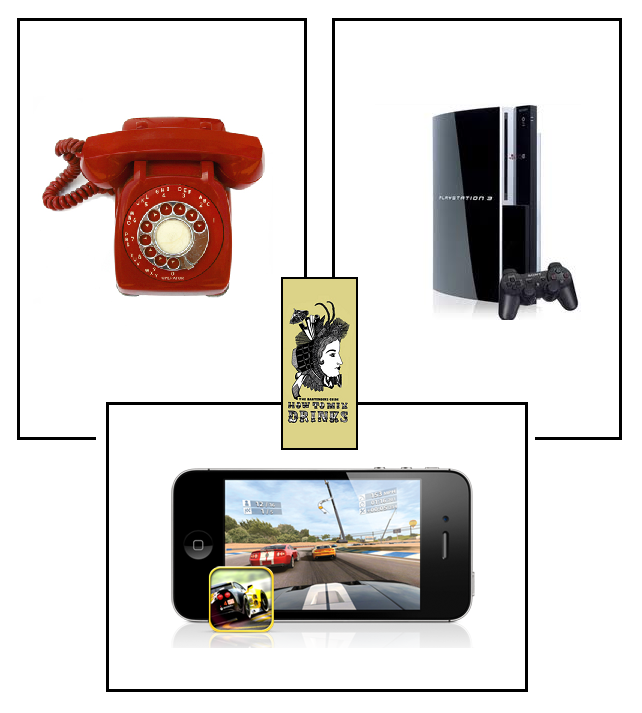
I’d like to introduce what may be a new format for my DoubleQuotes and SPECS. It features two ideas — in this case, the telephone and the game console — which merge into one via some overlap between them — here, the iPhone.

You want the neurosciwence behind all this? Try Fauconnier and Turner‘s The Way We Think: Conceptual Blending and The Mind’s Hidden Complexities.

It was a piece by Benjamin Kohlmann in today’s Small Wars Journal titled The Military Needs More Disruptive Thinkers that triggered this post.

*

Listen up:

The future lies with those individuals who can see connections across a myriad of professions and intellectual pursuits.  The mind that can see that a phone and entertainment device can be intertwined into something like, say, an iPhone.  Or, an intellect that recognizes how secondary and tertiary networks are often more valuable than first-order relationships, thus creating something like LinkedIn.  Or the strategist who understands that crowdsourced, horizontally structured non-state actors pose a greater threat to our security than Nation states.

That’s from today’s Small Wars Journal piece — and when I read that paragraph, I was way too excited to read the rest, because:

1. That’s what my series of posts [1, 2, 3, 4, 5] on Arthur Koestler‘s notion of intersecting concepts has been all about, and…

2. I’ve been working on a family of games that will train people — pleasurably — in precisely this kind of “overlap” thinking for at least fifteen years now. Don Oldenberg of the Washington Post described one of my games as an “on-line match of ricocheting intellects” back in 1996.

But you’ll be hearing more on #2 in the not too distant, once our team has all its ducks in a row — and black swans permitting.

*

Hey, this kind of thinking can get you noticed — it’s what last year’s Naval Postgraduate School Center for Homeland Defense and Security essay contest [link opens .pdf] boiled down to:

*

If you’ll permit me a quick detour:

Not only that, it’s also the basis for cocktail hour!

It appears that the Bartender’s Guide was first published in 1862, so bartenders have been doing this — mixing ideas, mixing drinks — for at least a century and a half. Maybe the fact that they work with liquor has something to do with it.

*

In any case, isn’t it time for the rest of us to catch up?

The future lies with those individuals who can see connections across a myriad of professions and intellectual pursuits.

Two for the Dalai Lama, and one more

Thursday, April 5th, 2012

[ by Charles Cameron – the UN panel of happiness experts, human nature on and off the freeway, and royal rainmaking in Thailand and Tanzania ]
.

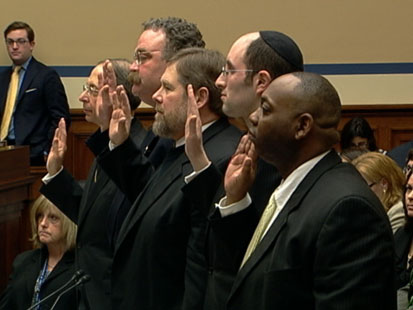
Seeings as how the Kingdom of Bhutan just convened a UN forum on the topic of Happiness and Well-being: Defining a New Economic Paradigm, I thought it might be interesting to compare the faces in reports of a recent, controversial congressional panel on contraceptive issues with those of the folks on the happiness panel:

And to be frank, neither panel looked particularly cheerful. I thought it might be nice to get away from all that seriousness, so I featured the Dalai Lama’s often playful eyes as an inset…

Seriously: is happiness something we should figure out in committee?

To be fair, though, they did have some decent guest speakers — Joan Halifax for one. My guess is, some people just bring their happiness with them.

*

And while I have the Dalai Lama in mind and in a conveniently copiable graphic, I thought I’d post a second, quick item — this one also having to do with happiness, I suppose, and raising the question of what human nature is.

When you’re stuck on the San Diego Freeway on the way back from work, you may not feel as “one with nature” as you do when you’re out for an evening walk on the beach in Malibu. But are the ribbons of the Interstate system really that different from the veining of a leaf?

I suspect that question might bring some quiet laughter to the Dalai Lama’s eyes…

Hat-tip: I have Andrea Lobel of Concordia U to thank for this second pair of images, which she very kindly sent me knowing of my delight in such pairings.

*

Time for one more?

Given my strong interest in ritual, you won’t be surprised to learn that royal rainmaking is of interest to me.

The insignia on the left is that of the Thai Bureau of Royal Rainmaking and Agricultural Aviation, founded by Thailand’s King Bhumibol Adulyadej, who holds European patents on several of his methods:

According to the notes attached to this video:

Among the best-known and most successful of His Majesty’s water provision projects has been the Royal Rainmaking programme. He began to study how clouds might be seeded to produce rain. In 1969 he carried out preliminary tests at Khao Yai National Park using a Cessna 180 and dry ice. In August 1969, he moved to Hua Hin and used two aircraft in a variety of weather conditions to determine what worked best. Initially, he financed the research with his own funds but in 1970, he sought temporary funding for a “Rainmaking Project” from the government. With it, he established the Royal Rainmaking Research and Development Institute. Based on it, he has spent succeeding years refining his techniques to accord with varying cloud conditions and to suit differing climatological and geographic areas, enjoying considerable success throughout Thailand.

On the right is the encampment for the mapolyo a mbula or ancestral offerings for rain of the Ihanzu of Tanzania.

Todd Sanders, in his book Beyond Bodies: Rainmaking and Sense Making in Tanzania, writes:

Because the Ihanzu have long depended on the rain for their very existence, it is not surprising that rainmaking is central, both conceptually and practically, to their everyday lives. They have two royal rainmakers – one male, the other female – whose job it is to ensure the rains arrive on time and fall properly each year. … Through varied rain rites carried out each year in the village of Kirumi, royal rainmakers regulate the annual movement from the dry ‘male’ season (kipasu) to the wet ‘female’ one (kitiku) and back again. These rites take various forms, as we shall see…

For a detailed account of the mapolyo a mbula rites and the legend that accompanies and explains the diagram above, see Sanders’ Reflections on Two Sticks: Gender, Sexuality and Rainmaking in Cahiers d’Etudes Africaines:

These rites take place only when the rains have utterly failed and it has been divined that the royal Anyampanda clan spirits have demanded such an offering. Offerings take place over two days, but the entire ritual sequence often lasts a month, sometimes longer. It is only the two Anyampanda royal leaders, and no one else, who can bring such rain offerings to fruition.

*

Enough, I’m done for now — I’m happy.

Of Solomon and the Ant

Thursday, April 5th, 2012

[ by Charles Cameron — King Solomon’s battle order in the Qur’an, the speech of ants, science confirms scripture, two possible directions of scriptural interpretation ]
.

.

If I might connect two recent strands of my thinking here on Zenpundit:

1.

One thing I have been puzzling over is the relationship between highly charged metaphysical realities in battle, and the physical personnel and materiel of war, in posts such as Quantity and Quality: angelic hosts at Badr and / or Armageddon and More “night watch” than “guardian angels” perhaps.

This Qur’anic passage, 27.16-19 which I shall quote in the Marmaduke Pickthall version, presents an interesting “battle order” in this regard:

And Solomon was David’s heir. And he said: O mankind! Lo! we have been taught the language of birds, and have been given (abundance) of all things. This surely is evident favour. And there were gathered together unto Solomon his armies of the jinn and humankind, and of the birds, and they were set in battle order; Till, when they reached the Valley of the Ants, an ant exclaimed: O ants! Enter your dwellings lest Solomon and his armies crush you, unperceiving. And (Solomon) smiled, laughing at her speech, and said: My Lord, arouse me to be thankful for Thy favour wherewith Thou hast favoured me and my parents, and to do good that shall be pleasing unto Thee, and include me in (the number of) Thy righteous slaves.

How’s that? “Armies of the jinn and humankind, and of the birds, and they were set in battle order…”

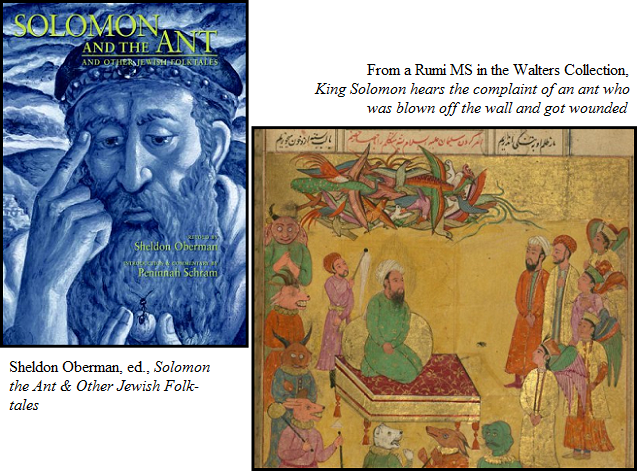
Note also the Jewish folk-tale concerning King Solomon and the ant… and Rumi’s telling, illustrated above from Walters manuscript W.626

2.

I have also been talking about mapping the conceptual way-stations that are found in conversations leading to radicalization – but that’s really just a target of opportunity for me, I am interested in mapping concepts in general. Here again, that Qur’anic passage is of interest.

That’s because it “maps” – in a very double-quote-ish way – to recent findings in science, as exemplified by:

Francesca Barbero, Jeremy A Thomas, Simona Bonelli, Emilio Balletto, Karsten Schönrogge, Queen Ants Make Distinctive Sounds That Are Mimicked by a Butterfly Social Parasite, in Science, Vol. 323 no. 5915 pp. 782-785 (2009).

Ants, it appears, talk among themselves, but the voices of their queens are distinctive: and the Maculinea rebeli butterfly larvae can mimic the speech of a Myrmica schencki queen. As reporter Jeremy Hance discussing this study puts it:

While ant vocalizations had not been as widely studied as their chemical communications, the researchers believed this might hold the key to the butterfly’s success. They recorded the vocalizations of both the ant workers and the queens, and discovered significant differences in the queens’ “dominant frequency and overall acoustics”. When the queen’s vocalizations were replayed, worker ants would gather around the caller and guard it. The researchers found that this was “consistent with the exalted status and protection afforded to queens in the hierarchy of a colony”.

Researchers then turned to the parasitical butterfly larvae, whose vocalizations were mimics of their hosts’. However, the scientists discovered that the sounds were 23 to 27 percent closer to the queens’ over the workers’, thus providing them with first-class treatment. While the butterfly larvae may use chemical resemblance to infiltrate the colony, once inside the colony it is the mimicked vocalizations that allow it to rise to the top, often at the expense of its hosts’ offspring.

3.

So ants talk, and butterfly larvae can communicate with them – successfully enough, in fact, that “living M. rebeli larvae are rescued in preference to ant larvae when a colony is disturbed,” and “nurse workers kill and feed their own brood to the social parasite if food is scarce”.

And so ants talk, and Solomon can understand them – enough so that their concerns about his army bring a laugh to his lips.

And the overlap between those two ideas – one scripturally based and dating back fourteen hundred years, the other a product of recent science – is of the kind that provides confirmation for believers of their belief along these lines:

the Qur’an says that ants speak, now science has shown this to be literally true… and this provides additional evidence that the Qur’an is Truth.

4.

Here, then, is yet another use of the “overlapping concepts” notion that I’ve explored in posts on Ada Lovelace, and more recently Nancy Fouts, Walter Benjamin, and the confluence of Hamlet and the Heart Sutra in a poem of mine…

Arthur Koestler affirms in The Act of Creation that such intersections are to be found at the heart of tragedy and catharsis, humor and laughter, and discovery and eureka: here we find them providing confirmation for religious belief.

5.

Such intersections can in practice be read in two directions, as Bernard McGinn notes in the article on Revelation he wrote for Robert Alter and Frank Kermode‘s Literary Guide to the Bible – here’s his comment on Martin Luther‘s interpretive process:

Earlier interpreters, such as Joachim (but not Augustine), had also claimed to find a consonance between Revelation’s prophecies and the events of Church history, but they had begun with Scripture and used it as a key to unlock history. Paradoxically, Luther, the great champion of the biblical word, claimed that history enabled him to make sense of Revelation…

When the overlaps are between scientific knowledge and scriptural statements, believers tend to read science as an empirical support for scripture – they don’t read scripture as supporting the findings of science.

When it comes to prophecy and fulfillment, however, the danger exists that current events will be forced into the Procrustean bed of scripture – as when JF Kennedy, Jimmy Carter, Ronald Reagan, and Barack Obama have each in turn been accused of being the Antichrist…

6.
.
.
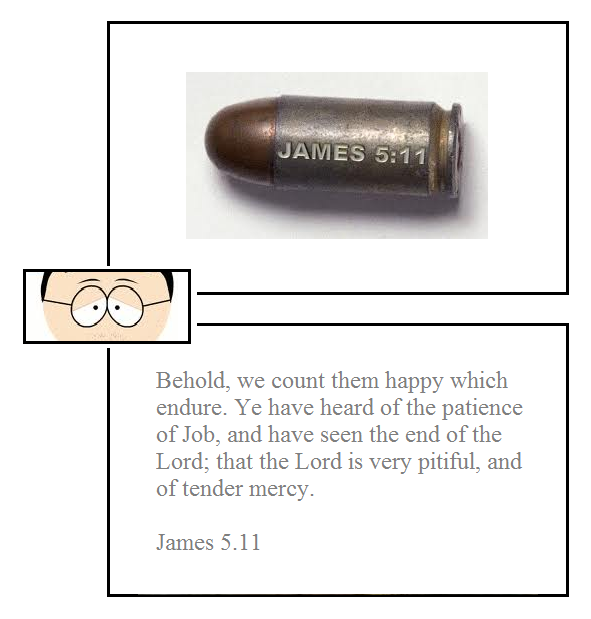
The bullet image above is available from Way 2 Worship as wallpaper for your computer screen. The verse below it, James 5.11, is the verse the bullet “cites”.

Comedy, tragedy — or inspiration?
Frederick the Great, Baron Von Steuben, and the Value of Practice, Practice, Practice

Tuesday, April 3rd, 2012
[by J. Scott Shipman]
Frederick the Great

.

During a recent trip to London, I took along John McAuley Palmer’s Washington – Lincoln – Wilson Three War Statesmen. Previously I reviewed Palmer’s excellent and informative America in Arms, so I’ve been looking forward to this follow-up. While I’m not finished with Washington (on about page 90), this one is a much tougher read than the first, but I’m going to press on as I can make the time among competing work and books.

What I wanted to share with you was an excerpt from Palmer’s remarks on Baron Von Steuben’s Prussian military background.

Friedrich Wilhelm August Heinrich Ferdinand von Steuben

.

Von Steuben, in many respects was Washington’s ace at organizing, equipping, and training the army—a job for which Von Steuben was eminently qualified. His was the latest training in the methods of Frederick the Great and his vaunted what was to become his Prussian General Staff. (many thanks to Seydlitz for correcting my error)

For training, Frederick used what he called the “applicatory method.” This sounds a lot like Fred Leland’s cutting edge law enforcement training and Don Vandergriff’s work with the US Army. Here are a few quotes:

“He found that military success depends, not upon profound theoretical knowledge, but upon sound judgement and quick resolute decision under stress. Directing a successful attack is therefore not the same thing as writing an essay about it. It is a question of grasping a situation, making a practical decision, and issuing intelligible orders to the several parts of a military command. It is a question of not merely knowing but of doing. (emphasis, Palmer, pages 42-43)

“This led Frederick to form the habit of giving himself tactical problems in his daily walks and rides. Carlyle gives us the following interesting glimpse of the great king after he had become a distinguished and successful general:

For Friedrich is always looking out, were it even form the window of his carriage, and putting military problems to himself in all manner of scenery. What would a man do, in that kind of ground, if attacking, if attacked? With that hill, that brook, that bit of bog? And advises every officer to be continually doing the like. That is the value of picturesque or other scenery to Friedrich. (emphasis mine)

“From making this a method of self-culture to making it a means of instructing others is but a step…It is the continual test of judgement, of decision, and of facility in issuing effective orders.” (Palmer, page 43)

Frederick also used this training method as a “tactical measuring rod” to help determine the competency of his leadership.

Von Steuben proved Frederick’s methods with Washington’s army. But what struck me was the simple power of establishing and maintaining good habits that promote, practice, enable coping with dynamic environments, and the exploitation individual curiosity and action. Frederick institutionalized his “self-culture” into his meta-culture and so did Von Steuben in turn.

This type of practicing; the continual maintenance of good habits will help ensure a competitive posture in just about any field. Further, Frederick practiced ad hoc—wherever he was, he was thinking through the lens of his profession and asking relevant questions of himself and his subordinates—further lessons for today’s leaders, regardless the profession.

Looking, paying attention, and thinking is free—so even in declining budgets we should follow the example set by Frederick and Baron Von Steuben in his turn.

Cross-posted at To Be or To Do.

Call and response?

Tuesday, April 3rd, 2012

[ by Charles Cameron — just curious, entirely speculative ]
.

Just a quick, speculative question here…

I’m wondering whether the movie-poster-style image of NYC above, which (as I understand it) appeared on the jihadi forums today, Monday 2nd April, might have no bearing on actual plots under way, but instead be an over-the-weekend response to Ambassador Crocker’s statement published Friday 30th March?

Ambassador Crocker says “next time it will not be New York or Washington, it will be another big Western city” which raises blood pressure elsewhere, and then the eye-catching image gets posted on the forums and boosted in the NY Daily News — and NYC can get in on the worry too…

Just a thought.


Switch to our mobile site