zenpundit.com » 2012 » October

Archive for October, 2012

Recommended Reading

Monday, October 8th, 2012

Gunpowder & Lead (Drunken Predator Drone) –Pakistan’s “Sovereignty” Canard 

….Every time I cross the border, every time an American missile hits Pakistani soil, Pakistan’s government exercises their sovereignty by choosing not to blow me out of the sky. I operate openly, and Pakistan’s doing so would be a huge bummer, butwell within their technical capacity. Yes, the sole act of not starting a war doesn’t equate to government permission. But sovereignty implies a range of options and authorities beyond war, and Pakistan has visibly exercised that sovereign authority in the recent past.

After the May 2011 bin Laden raid (which, as a side note, constituted a real sovereignty violation, with no warning whatsoever and American boots on the ground deep inside Pakistan) bilateral relations were already sour. But on November 17th of that year, a nighttime gun battle between NATO and Pakistani forces (the latter of whom were suspiciously close to fleeing Taliban) resulted in an air strike that killed 26 Pakistani border police near a village called Salala. Pakistan halted trucks resupplying NATO forces in Afghanistan, kicked American drone operations out of the Shamsi air base, and demanded an unprecedented cessation of drone strikes.

And we listened. Drone strikes that had been commonplace ground to a total halt. It took six weeks before U.S.-Pakistani ties had mended to the point where the strikes could resume. In contrast, it took six months of diplomacy and a public apology before Pakistan reopened the “Ground Lines of Communication.” This incident made it clear that, behind closed doors, Pakistani authorities could grant authority for American air strikes in the tribal areas- but they could also take it away. That’s sovereignty.

Pundita –Lara Logan to Gen. John Allen: “American soldiers continue to die because of the support Pakistan gives to America’s enemies.” Allen to Logan: “You’ve just stated the truth.” 

CBS correspondent Lara Logan has earned respect as a war reporter in the only way anyone can earn such respect — through sheer slog work over years in very dangerous situations. So today her views are as much an important part of her interviews as those of the persons she questions.  Her latest report from Afghanistan, The Longest War, broadcast during last Sunday’s 60 Minutes, features her discussion with a Taliban commander about al Qaeda in Afghanistan and ‘insider’ killings of NATO troops, and with ISAF/US commander Gen. John Allen and Afghanistan’s President Hamid Karzai. The entire report is worth viewing (also available in transcript form) but here I focus on her exchanges about Pakistan:

CTOvision (Alex Olesker) –History of Cyber Intelligence Discussion 

….Gourley began with his own question for the panelists. Can we meaningfully explore the history of cyber in an unclassified way? Jay Healey, who is currently the lead investigator for the Cyber Conflict Studies Association’s cyber history book, thought you could. Right now so much information comes from the private sector, and hence is unclassified. Today’s model of cyber information sharing relies on the private sector to provide the intelligence, as it is typically their networks and infrastructure that comes under attack. In the theoretical division of labor, it is then the government’s role to solve the problem, but in practice, it has always been the network owners and private companies that take action, suggesting that the relationship should be reversed. As it stands, classified information isn’t terribly important as it stays within the government anyway. Devost added that while classified information is valuable and government agencies should be studying that history themselves, we can still form a cogent story without it for the private sector. Sean Kanuck noted that the unclassified parts of the story are typically the most important. More critical for the full story is including two kinds of cyber analysis that work best together: the forensic, which is done both by government and industry, and the analytic, which can determine why the attack occurred and is performed by the intelligence community but also by business intelligence. RADM Cox answered that while the classified aspects of history are required to get the full picture, the account without them can still be a useful and accurate one.

The first comment from the audience was that when we study history to understand cyber, we should go back even further, which led to a discussion of valuable historical works that can inform intelligence. Some suggested reading from audience members and panelists included Machiavelli, Alvin and Heidi Toffler’s War and Anti-War, the 1999 Chinese PLA manual Unrestricted Warfare, international law and humanitarian law textbooks, and The Victorian Internet, which explores the first cyber attacks and cyber espionage using telegraphs.

Volokh Conspiracy –Cybersecurity and Attribution — Good News At Last? 

….Right now, policymakers are intent on improving network security, perhaps by pressing the private sector to improve its security, or by waiving outmoded privacy rules that prevent rapid sharing of information about attackers’ tactics and tools.

Those things would improve our network security, but not enough to change our strategic position – which is bad and getting worse.  The hard fact is that we can’t defend our way out of the current security crisis, any more than we can end street crime by requiring pedestrians to wear better and better body armor.

That’s why I’ve been urging a renewed strategic focus on catching attackers and punishing them.  Catching and punishing rulebreakers works for street crime.  It even works for nation states.  So why hasn’t it worked in the realm of network attacks?  Mostly because our intelligence community insists that attribution is just too hard.

I think that’s wrong, and I’ll spend this post explaining why.

My theory is simple: The same human flaws that expose our networks to attack will compromise our attackers’ anonymity. Or, as I put it in speeches, “The bad news is that our security sucks.  The good news is that their security sucks too.”

War is Boring – I’m Hit! I’m Hit!’

City Journal (Sol Stern) –The Curriculum Reformation

The Carnegie Endowment – New Leaders, New China?

The Hudson Institute –Global Tribunals V. U.S. Values

The Claremont Institute –Boys to Men

Slate – Cormac McCarthy Cuts to the Bone (hat tip to Feral Jundi

RAND –Do Targeted Killings Work?

RECOMMENDED VIEWING:

Haaretz on the Temple Mount, pt II: axis mundi

Sunday, October 7th, 2012

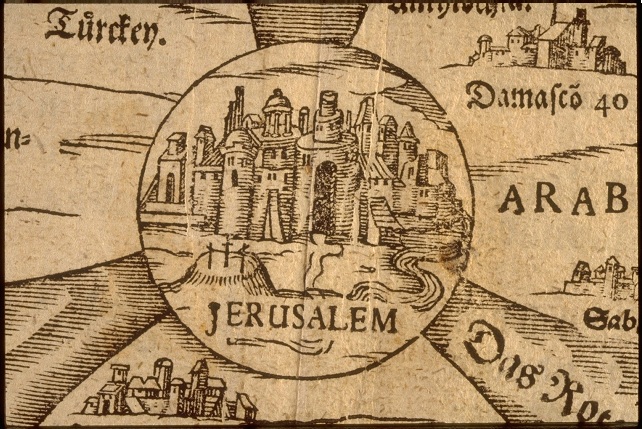
[ by Charles Cameron — Jerusalem, and the Temple Mount in particular, as the still point in the turning world — Midrash, Haaretz, a map from 1581, M Eliade, TS Eliot, Navaho Night Way ]
.

There is tremendous poetic force to the notion of the axis mundi, the mythic center around which all else revolves.


.

In an earlier post, I quoted this saying, which exemplifies the power of the “center of the world” motif as applied to Israel and the Temple Mount:

As the navel is set in the centre of the human body,
so is the land of Israel the navel of the world…
situated in the centre of the world,
and Jerusalem in the centre of the land of Israel,
and the sanctuary in the centre of Jerusalem,
and the holy place in the centre of the sanctuary,
and the ark in the centre of the holy place,
and the foundation stone before the holy place,
because from it the world was founded.

– Midrash Tanchuma, Qedoshim.

**

Let’s give that room to breathe.

**

There are those who will dismiss all such images and words as irrelevant, impractical, foolish, irrational — Jerusalem is not the center of the earth any more than the earth is the center of the solar system — but to a poet they are words in a familiar language, not of fact but of imagination and love. They are poetry.

Sadly, in my view, the members of the various movements to rebuild the Jerusalem Temple on or near the sites of the Al-Aqsa Mosque and Dome of the Rock on the Noble Sanctuary / Temple Mount take the poetry of the Mount as axis mundi literally and all too politically — as happens not infrequently with authentic poetry.

Phrased as political prose, the idea just isn’t the same, as these words from Shany Littman‘s Haaretz article addressed in the prequel to this post will demonstrate:

Rivka reminded us that over and above the sheer experience and the historical tales, the visit had a purpose: to understand the essence of the Jewish home through the Temple, as the visit revolved around a bride on her wedding day. Holding up a page containing what looks like a satellite image of planet Earth, she showed how, from a certain angle, the Land of Israel and Jerusalem appear to be at the center of the world, in its innermost circle. “I give lessons to women about modesty,” she said. “I show them this image and replace the word ‘modesty’ with the word ‘inwardness.’ The innermost circle, the most hidden, is the Land of Israel, Jerusalem, the Temple, the Holy of Holies. What is modesty, what is a modest, inward place? It is hidden, the place least visible to the eye.”

But the bride was contentious: “You could take that photograph from a different angle and then Jerusalem will not be in the center.” “True,” Rivka replied, “but here we see that the State of Israel is at the heart of the world. If the world knew how much it would gain from us building the Temple, they would heap good stones on us, because they will profit from it. The most prosperous countries in the world are the Western ones; China, Africa and Asia are poor.”

A questioning eyebrow was raised. “Don’t look at the industry,” Rivka said. “Look at the miserable people, who are not allowed to have more than one child and don’t have proper housing and suffer from tsunamis and earthquakes. Look at the suffering they are undergoing. And why? Because the Jewish people resides close to the Temple, the world on this side gains; where we do not reside [i.e., the East] the world loses. This is the place that coordinates and pinpoints all the prayers and the connection with the Master of the Universe. If we are not here, they lose. And we lose, too.”

and, in the words of Prof. Weiss from the same article:

I want to take the movements to a place that is more sensible: a Temple-based state, where the state’s entire content revolves around the Temple.”

**

Map (above) by Heinrich Bunting from a copy of Itinerarium Sacrae Scripturae (1581) in the Jerusalem as the center of the world exhibition at the University of Southern Maine’s Osher Map Library, detail below:

**

For more on the symbolism of the axis mundi, see Mircea Eliade‘s essay Symbolism of the Centre in his book Images and Symbols — or consider these lines from TS Eliot‘s poem-series, Four Quartets:

At the still point of the turning world. Neither flesh nor fleshless;
Neither from nor towards; at the still point, there the dance is,
But neither arrest nor movement. And do not call it fixity,
Where past and future are gathered. Neither movement from nor towards,
Neither ascent nor decline. Except for the point, the still point,
There would be no dance, and there is only the dance.
I can only say, there we have been: but I cannot say where.
And I cannot say, how long, for that is to place it in time.
The inner freedom from the practical desire,
The release from action and suffering, release from the inner
And the outer compulsion, yet surrounded
By a grace of sense, a white light still and moving…

**

In many ways, both Eliot’s words and those of the Midrash remind me of the beauty found in the prayers of the Navaho Night Chant:

In beauty may I walk.
All day long may I walk.
Through the returning seasons may I walk.
On the trail marked with pollen may I walk.
With grasshoppers about my feet may I walk.
With dew about my feet may I walk.
With beauty may I walk.
With beauty before me, may I walk.
With beauty behind me, may I walk.
With beauty above me, may I walk.
With beauty below me, may I walk.
With beauty all around me, may I walk.
In old age wandering on a trail of beauty, lively, may I walk.
In old age wandering on a trail of beauty, living again, may I walk.
It is finished in beauty.

To my reading eye as a poet, these are all expressions of the same kind — invocations of the human spirit by rhythm and imagery — true poems, visions. They offer us a form of nourishment and insight not easily found today — nourishment and insight which shrivel and die when reduced to politics or prose.

**

For more on the Navaho chantways, and the balance called “sa’a naghai bik’e hózhó” which this prayer embodies, see John Farella, The Main Stalk: A Synthesis of Navajo Philosophy.

Three from Haaretz on the Temple Mount

Sunday, October 7th, 2012

[ by Charles Cameron — growth and mainstreaming of Rebuild the Temple movements in Israel, parallels with perceived slights against the Prophet of Islam, volatility of the situation ]
.

You saw the New York Times headline, New Clashes at Site in Jerusalem Holy to Both Muslims and Jews? That was just a taste, here’s more of the story:
.


.

Haaretz has posted three pieces in the last couple of days about the movement to build a Third Temple on the Temple Mount / Noble Sanctuary in Jerusalem. I’ll give you the title, link and brief summaries of for the two shorter pieces, and some significant quotes from the Longer one.

**

I’d also like to suggest considering the issues here as analogues of those in the recent “blasphemy” incidents.

We might think in terms of freedom of speech being akin to freedom of worship — but we should also consider the dangers inherent in what would likely be perceived as a huge provocation, in what may be the most volatile hot-spot on earth.

Consider: building the Third Temple might involve the destruction of the Al-Aqsa Mosque, whether by an act of God or by human intervention. Whether it would or not is in dispute, as we shall see — but as we shall also see, attempts to destroy it have already been made…

Bearing that in mind..

**

1: Temple Mount Faithful: From the fringes to the mainstream

Once consigned to messianic extremist fringes, movements fighting the ban on Jewish
prayers on Temple Mount are now endorsed by moderate rabbis. Even the Education Ministry has taken sides by encouraging pupils to visit the site.

If that’s accurate, it’s a significant shift in relation to what my American-Israeli journalist friend Gershom Gorenberg called in his book about the Mount, The End of Days, “the most contested piece of real-estate on earth” — for a quick overview of the importance of the site, see my piece of that name from July of this year.

**

2: Jerusalem Magistrate’s Court: Jews should be allowed to pray on Temple Mount

Police currently enforce the Muslim ban on Jewish prayer at the site, citing security concerns.

Put those two pieces together, and you have a sense of momentum gathering for an epic clash, one which would have immense apocalyptic significance in terms of those eagerly awaiting a Coming One in each of the three Abrahamic traditions

**

3: Following the dream of a Third Temple in Jerusalem

More than 90 percent of Israel’s religious public wants to be allowed to pray at the Temple Mount in Jerusalem. Some groups, though, wish to go even further and build a Third Temple in place of the Al-Aqsa Mosque. What fuels the dreams of these Jewish extremists?

Shany Littman, the author of this impressive magazine-length piece which is behind a paywall on the Haaretz site but has been reposted here, expresses through the voices of a diverse group of people she met and talked with, the deep-seated longing behind the movement —

I pray for it three times a day and I wanted to take seriously what I say. I say, ‘Next year in rebuilt Jerusalem.’

and the theological logic behind that —

It is the heart of Judaism. Numerically, one-third of the 613 commandments are not fulfilled today because of the absence of a Temple. The Temple is the Jewish public sphere that we lost. I want a transnational Judaism, which will encompass all the commandments.

the sacred politics —

I want to take the movements to a place that is more sensible: a Temple-based state, where the state’s entire content revolves around the Temple.

the somewhat archaic-sounding motivations involved —

the fulfillment of the three commandments the Israelite nation was given in anticipation of its imminent entry into the Land of Israel: to appoint their king and establish his kingdom, to wipe out the seed of Amalek and to build their Holy Temple.

the progress that has already been made in terms of preparation —

only two vessels that are not yet ready are the Ark of the Covenant, which cannot be reconstructed because it contained the stone tablets from Mount Sinai, and the huge external altar, on which the sacrifices were performed.

and recent trends on the part of Israeli police and politicians that seem to show an increasing willingness to allow Jews to pray in what is, after all, their holiest of holy places.

**

I have been pondering these things, and I think we can helpfully, if carefully, draw a parallel between the extreme caution with which the Israelis have approached the issue of the potential for Jewish behavior — up to and including the possible removal of the Al-Aqsa Mosque and or Dome of the Rock — enraging not just Jerusalem’s Palestinians but the Islamic world, and the far smaller provocations of Charlie Hebdo, the puerile video, and the Qur’an-burning Revd. Jones.

Consider the rules and regulations invoked by the Israeli poloice on Jewish visitors to the Mount (compare also the rabbinic decree in the “traffic sign” at the top of this post):

Because this was the month of Ramadan, no food or drink was to be brought. Also forbidden were praying, bowing, kneeling, singing and anything that might disturb the public order. And have a good day.

Prayer is banned — have I heard that phrase somewhere before?

Prayer is banned because it would be blasphemous — the ironies, the echoes, the resonances and paradoxes here are endless.

**

To understand the depth of feeling here — and remember, we are only examining the Judaic side of the issue here, and there are other perspectives in play — let’s peer a little deeper into the sacred / sacral motivation:

Sacrifice, not a very “contemporary” word but one with strong, archaic / archetypal meaning, is the heart of the Temple’s purpose:

Animal sacrifice was the primary ritual activity in the Temple. Rivka spoke of the practice yearningly. “Today it is hard to understand what sacrifice is,” she said. “When a person errs, makes a mistake, sins ? instead of bringing himself, he brings a substitute; he brings either an offering or an animal whose blood atones for his soul. This is something we have lost today. The media always talks about korbanot [the Hebrew word “korban” means both “sacrifice” and “victim”] ? victims of traffic accidents, victims of the peace process, victims of terrorism. And I say to myself, despairingly, that there is a place for korbanot ? and it is here. And what is the root of the word ‘korban’? It is from lehitkarev, to draw closer. To draw closer to Hashem.

Indeed, the sacrifice of a red heifer is widely believed to be necessary to purify those who would enter the Temple grounds — note in this next paragraph the reference to the return of the Messiah:

According to religious belief, until the ashes of a red heifer are obtained, access to the courtyard of the Temple is prohibited for Jews (see Numbers 19:1-22 and Mishna tractate Parah). Water mixed with the ashes of a red heifer can cleanse people of the impurity of the dead, which clings to everyone. Tradition holds that there have been only nine ritually suitable red heifers, and that the 10th will appear upon the advent of the Messiah. The absence of the ashes of a red heifer, with the concomitant inability to become ritually clean, is one of the reasons that many Jews are unwilling to visit the Temple Mount. However, the Temple movement activists claim this is only an excuse, and that there is no problem obtaining a red heifer today.

**

Now back to “on the ground” realities — and risks, including the risks of terrorism and war.

This situation of contesting claims to one of the world’s most sacred sites the has been simmering for quite some time, and I think the gist of the three Haaretz articles could be read as “the stew’s beginning the bubble”.

For another glimpse of the potential volatility of the situation, we can turn to a decade-old piece by Jeffrey Goldberg in the NYT — though if the situation is as significant as I take it to be, you’d also be well-advised to read Gershom Gorenberg’s book The End of Days.

Back in 1999, Goldberg wrote a piece which carried the sub-head:

There are Jews who want to seize the Temple Mount by any means necessary. And Christians who want to see the Jewish Temple rebuilt — and destroyed to bring on Armageddon. And Muslims who will never give up the Dome of the Rock. Will the peace process be stalled by the apocalypse?

It’s a long magazine piece, and like Littman’s piece for Haaretz, well worth pondering. Here I’ll just pull a couple of excerpts that touch on how Temple movement participants view the possible repercussions of their actions. Gershon Salomon is the leader of one such movement, and not infrequently raises funds addressing Christian audiences.

“The mountain is within reach,” Salomon told me. “God is waiting for us to move the mosques and rebuild. The Jews may not be ready, but the Christians are.”

In Casselbery, I saw Salomon work the Christian congregants into a flag-waving — Israeli flag waving — frenzy. After, as the congregants lined up to give Salomon checks and even their jewelry to pay for rebuilding the Temple, I asked him, “Do you think these people believe that God will remove the Dome of the Rock, or that man must remove it?”
He smiled beatifically.
“They know that God will make this miracle happen.”
By the hand of man?
“Only God knows.”

[ … ]

I ask him how he would feel if someone blew up the Dome of the Rock.
“The question is, Why did they build their mosque on our holy mountain, anyway? Who gave them permission? God didn’t.”
Would you be saddened if the destruction of the Dome of the Rock led to war?
“I don’t think it will come to that. The Muslims know in their heart that this belongs to us.”
“But what if it did lead to war?”
Salomon smiled. “The Temple will be a reality. God has promised it.”
But what about war?
“O.K.,” he said impatiently, “so we’ll have a war.”

Returning to the Haaretz magazine piece, we can perhaps temper that last remark with a word of moderation.

Journalist Arnon Segal is the activist son of a member of the Jewish Underground of the 1980s — one of whose leaders, Yehuda Etzion, plotted to blow up the Dome of the Rock. His views are accordingly of considerable interest.

Contrary to the usual image of those who are involved with the Temple, they are a great deal more soul-searching and hesitant than people think. People did not want to join with Yehuda Etzion, who was the one who raised the idea [of blowing up the mosque].

“I think it is nonsensical to blow up [Al-Aqsa Mosque]. We would not have achieved anything by doing that. That is not how to solve issues. The Arabs are against the Jewish presence on the Temple Mount as such. If the State of Israel were to permit sacrifices to be made, that would already be enough to make me jump for joy. Obviously my inspiration is from home, but not from a fanatic place. I was not brought up to hate Arabs. But an as-yet unattained Jewish national purpose and the concept of the Temple Mount? those are definitely notions I got at home.”

Segal insists that the debate over the Temple Mount is basically an internal Jewish issue and is not related to the conflict with the Arabs. “I am not an enemy of the Arabs. I do not say that I don’t want Arabs on the Mount. Even Rabbi Dov Lior said that all nations are permitted to pray on the Mount. We will not tell others not to pray to God on the Mount, even though the Muslims do not respect our right to pray there. I am ready to leave them Al-Aqsa. But Al-Aqsa is not the whole Mount.”

And here is Segal’s pragmatic evaluation of the risk:

I don’t think the Arab states are lovers of Zion, even now; if they could destroy us, they would already have done it. The Temple Mount will not irk them more than other things.

Would you want to test that hypothesis in “real life”?

The Person / Position Paradox: once more, with avatars

Saturday, October 6th, 2012

[ by Charles Cameron — a follow up to my previous post — and it’s not religion that’s the alternate reality this time, but games ]
.


.

I just posted a long and potentially contentious post about what I called a person / position paradox: that of the member of the US House Committee on Science, Space and Technology and chairman of the US House Science Subcommittee on Investigations and Oversight, Rep. Paul Broun MD (R-GA), who said recently:

that stuff I was taught about evolution and embryology and the Big Bang Theory, all that is lies straight from the pit of Hell…

And he meant it.

**

Well, while I was writing that post, this little gem (above) crossed my bows (ht Paxsims) — so perhaps you’ll permit me to poke a little fun at a member of the other US political party.

It seems that Colleen Lachowicz, Democratic candidate for the Maine State Semnate, is also Santiaga, Orc Assassination Rogue in the game-world, World of Warcraft.

Questions arising:

Does that make her more representative or less?
what about the fact that she plays at level 68?
is that a representative level to play at?
and an Orc Assassination Rogue? really?
or is she just a candidate who happens to be a gamer?

The image above comes from the Maine GOP, btw.

**

To look at this minor contretemps from another angle: how far are we from religion, here in the land of Orcs?

The great literary critic Northrop Frye in his Anatomy of Criticism writes of:

great art using popular forms, as Shakespeare does in his last period, or as the Bible does when it ends with a fairy tale about a damsel in distress, a hero killing dragons, a wicked witch, and a wonderful city glittering with jewels.

Frye is not knocking Revelation here, though one might at first think he is: he’s assigning it to a literary genre, as one might assign the Psalms to poetry, Kings and Chronicles to history, or the Gospels and Acts of the Apostles to biography. The Epistles, after all, are already classified as epistolary works. And — give the man a break — he’s also placing it in the same realm of great art as Shakespeare.

How far, then, do you suppose CS LewisNarnia — or Tolkien‘s Middle Earth, with its Elven folk Firstborn of the Children of Ilúvatar — might be from the World where Colleen is an Orc?

**

How much room can we concede to imagination in our “real world”?

And Dante‘s voyage took him through the three realms of Inferno, Purgatorio and Paradiso, didn’t it, and according to the Apostles Creed, Christ’s Harrowing of Hell took place between his death and resurrection.

So my next question would be:

When will we build and play the games of Paradise?

Introducing the Person / Position Paradox

Saturday, October 6th, 2012

[ by Charles Cameron — ye olde war of science vs religion embodied in Rep. Paul Broun, with sundry comparisons to human rights, UN, dominionism, JFK, creeping shariah etc ]
.


.

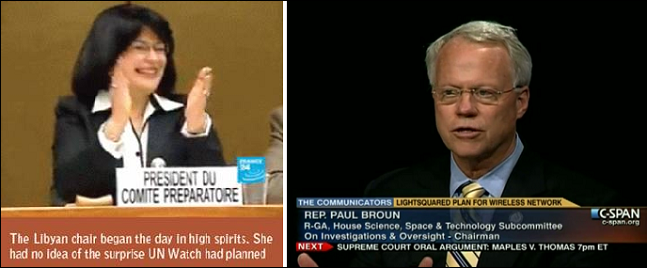
Lest we forget, Muammar Gaddafi‘s Libya, in the person of Ms. Najat Al-Hajjaji (above, left), was elected to preside over the United Nations Commission on Human Rights in 2003:

The Commission on Human Rights — meeting this morning under a new procedure two months in advance of its annual six-week session — elected Najat Al-Hajjaji of the Libyan Arab Jamahiriya as Chairperson for 2003, along with three Vice-Chairpersons and a Rapporteur.

And as recently as May 2010, still under Col. Gaddafi’s rule, Libya was elected a member of the UN Human Rights Council, and only suspended in February 2011.

Might we call this an instance of a Person / Position Paradox?

**

You know I like what I term “forms” as analytic tools — this would be another one to keep an eye out for, a particularly intriguing sub-type of the self-referential paradoxes I discussed in an earlier post.

It isn’t, of course, an analytical breakthrough for me to recognize the paradox inherent in a brutal dictatorship gaining the chair of the international Human Rights Commission at this late date: the United States protested Libya’s nomination at the time, which is why there had to be a secret ballot in the first place.

Let’s look at some of the accompanying language. Here’s Ms. Al-Hajjaji herself:

In an address following the ballot, Ms. Al-Hajjaji said among other things that the Commission must send a message that it would deal with human rights in all countries, and not just some of them; that it would take into account in its activities the world’s many different religious, cultural and historical backgrounds; and that among its tasks was to affirm the universality, indivisibility, and complementarity of human rights

Who could complain about that? And here’s the UN High Commissioner, praising the system that got her elected for its wisdom:

High Commissioner for Human Rights Sergio Vieira de Mello, also speaking briefly, reviewed his recent mission to the Democratic Republic of the Congo and to Angola, lauded the Commission’s new procedure for early election of a Bureau, and said it was important for the Commission to demonstrate that it could manage with wisdom, speed and restraint its procedural business so as to create the best possible spirit and conditions for addressing and resolving the many substantive issues on its agenda.

The lesson I learn here?

Paradoxes of this kind lead to a divergence of words from truths — in line with de la Rochefoucauld‘s maxim:

Hypocrisy is the homage vice pays to virtue.

**

Now comes the potentially contentious part.

Rep. Paul Broun MD (R-GA) (top, right), member of the US House Committee on Science, Space and Technology and chairman of the US House Science Subcommittee on Investigations and Oversight, told the Liberty Baptist Church of Hartwell, Georgia’s Sportsman’s Banquet last month:

God’s word is true. I’ve come to understand that. All that stuff I was taught about evolution and embryology and the Big Bang Theory, all that is lies straight from the pit of Hell. And it’s lies to try to keep me and all the folks who were taught that from understanding that they need a savior. You see, there are a lot of scientific data that I’ve found out as a scientist that actually show that this is really a young Earth. I don’t believe that the Earth’s but about 9,000 years old. I believe it was created in six days as we know them. That’s what the Bible says.

As a student of religions, I don’t find that statement particularly surprising: while the original 1611 edition of the King James Version of the Bible doesn’t include Archbishop Ussher‘s dating of the creation to 4004 BC, many versions of the KJV since 1701 have done so, the wildly popular “dispensationalist” Scofield Reference Bible, first published in 1909, does so… and Broun is being somewhat generous in allowing for the passage of 9,000 years since creation, where others might see the earth as entering the seventh (Sabbath) day (or millennium) about now…

As a religious belief, then, this is one of many attempts to fit chronology to scripture. I recall from my days studying the religious impact of millennial rollover (“Y2K”) concerns that one Rabbi Pinchas Winston claimed the year 2,000 (5760 in the Jewish calendar) would be a year of purification:

The secret regarding this is that, at the end of the year 5760 from creation, the verse, ‘I [God] will remove the impure spirit from the land’ (Zechariah 13.2) will be fulfilled.

For my source and further millennial date issues in Islam, Hinduism etc, see my chapter, Y2KO to Y2OK in Cathy Gutierrez and Hillel Schwartz, eds., The End that Does: Art, Science and Millennial Accomplishment, Equinox, 2006.

Politics, though — and the politics of science and science funding at that? Here’s more of Rep. Broun’s talk, explaining how Broun’s theology affects his politics:

And what I’ve come to learn is that it’s the manufacturer’s handbook, is what I call it. It teaches us how to run our lives individually, how to run our families, how to run our churches. But it teaches us how to run all of public policy and everything in society. And that’s the reason as your congressman I hold the Holy Bible as being the major directions to me of how I vote in Washington, D.C., and I’ll continue to do that.

**

I’m afraid this reminds me all too clearly of RJ Rushdoony‘s Institutes of Biblical Law, which opens with the following words:

When Wyclif wrote of his English Bible that “This Bible is for the government of the people, by the people, and for the people,” his statement attracted no attention insofar as his emphasis on the centrality of Biblical law was concerned. That law should be God’s law was held by all…

Those are the opening words of Rushdoony’s Introduction to his magnum opus. And I know, I know, I’m cherry-picking from its 850-page first volume, but on p. 251 he writes:

The law here is humane and also unsentimental. It recognizes that some people are by nature slaves and will always be so. It both requires that they be dealt with in a godly manner and also that the slave recognize his position and accept it with grace.

Is this all just another version of “creeping” theocracy?

Compare John Hubbard, Arkansas State Rep, whose book Letters to the Editor: Confessions of a Frustrated Conservative (not on Amazon) apparently includes this choice morsel:

… the institution of slavery that the black race has long believed to be an abomination upon its people may actually have been a blessing in disguise …

**

Some possible parallels that may be worth pondering, coming at similar issues from a diversity of angles — hopefully with enough different implications to generate some questioning of easy assumptions:

Can a Catholic be POTUS (JFK, eg) without serving the every whim of a foreign Head of State? Can a Mormon be POTUS without serving the wishes of a living prophet, seer and revelator? Can a person who aspires to the highest post in a “government of the people, by the people, for the people” be relied upon if he says things like this?

There are 47 percent of the people who will vote for the president no matter what. All right, there are 47 percent who are with him, who are dependent upon government, who believe that they are victims, who believe that government has a responsibility to care for them, who believe that they are entitled to health care, to food, to housing, to you name it. … And so my job is not to worry about those people — I’ll never convince them that they should take personal responsibility and care for their lives.

And what if he then admits he was in error?

In this case, I said something that’s just completely wrong.

Is that hypocrisy (see above) — or humility? And come to that: in politics, is honesty a vice?

**

But I’m sliding from religion into politics here, unless you take the Gettysburg Address as one of the central documents — akin to a scripture — of American civil religion. Or remember it was the Bible translator John Wyclif who said those words about government of, by, and for the people first…

Religion, not politics, is my concern and my “beat” — but right now, the “Warfare of Science With Theology” (to quote the apt title of Andrew Dickson White’s celebrated 1895 book) is once again in full swing, so the question of whether Rep. Broun’s positions as a a member of the US House Committee on Science, Space and Technology and chairman of the US House Science Subcommittee on Investigations and Oversight, given his views on voting according to his reading of the Bible, is also an instance of the Person / Position Paradox?

**

It seems to me that questions such as these are of vital to many of us. The question is: are they vital to our democratic principles — or to our salvation?


Switch to our mobile site