zenpundit.com » 2013

Archive for 2013

Choices: Burning Man or Bali?

Saturday, August 31st, 2013

[ by Charles Cameron — we have as many possible futures as there are eyes in the tails of numberless peacocks — for your consideration, here are two of them ]
.

Sources:

  • Burning Man, live webcast, h/t Scott Hess
  • Bali, Pura Tanah Lot
  • **

    I’ll go for Bali, with wifi and a laptop to watch the live feed from Burning Man. You?

    Easy

    Saturday, August 31st, 2013

    [by Lynn C. Rees]

    If, right this second, you could push that tempting Easy Button over there and launch our top secret stash of ophthalmologist-seeking cruise missiles to kill every man, woman, child, and goat related by blood, association, or unlucky proximity to Boy Asad, it would have zero political impact on the war over Syria.

    Beheading strikes have marginal persuasive value unless you can reliably find and kill uncooperatives who fail to become cooperatives. American military history from Arnold to Tecumseh to Santa Anna to Jeff Davis to Cochise to Geronimo to Aguinaldo to Villa to Sandino to Castro to Noriega to Saddam to Kaddafy to Bin Laden shows our ability to behead reliably is wildly unreliable. Even if we could reliably kill enemy leaders on demand, there’s no guarantee that killing will have favorable political effects. As Clemenceau may have observed and multitudes of al-Kyyda Number Threes can attest, “The graveyards are full of indispensable men” (many of them headless). This war already has one ready example of a beheading strike. Enduring political impact: zero.

    There are suggestions that we conspicuously target Boy Azzad-themed buildings with “symbolic importance” as a way to shock and awe someone, anyone, into surrender. If a true demonstration of ability to hit ’em where you (supposedly) ain’t, the political impact can be profound. However conspicuous, blowing up Boy Azod’s presidential palace, his Old Man’s or Big Brother’s graves, or even his presidential goat’s presidential stable, when no one doubts you could blow up any empty building or tent or camel in the world at any time, will have zero political effect unless you conspicuously miss it. These days, accidental hits get more airplay (e.g. blowing up embassies (no, they haven’t forgotten)). Accidental hit or near miss, photogenic Madam Asod will stand next to it, in front of the cameras for YouTube, and mock you. Those are the risks you run when conspicuously targeting motionless monuments of massive masonry. And the mockery is deserved, especially if you’ve just spent the last twenty years boasting about how antiseptic and networky your precision guided munitions are.

    Robert D. Kaplan wrote of Old Man Azodd’s takeover of Syria:

    An Alawi ruling Syria is like an untouchable becoming maharajah in India or a Jew becoming tsar in Russia—an unprecedented development shocking to the majority population which had monopolized power for so many centuries.

    If Boy Asadd and minions fell victim to those ophthalmologist seeking missiles twenty minutes from now, the Alahhwyytes would quickly stand up some other mustache in his place. As long as any Alawy keeps any kind of grip on their high end warfighting brass ring, they will brutally fight to defend it down to the last Syrian. The alternative, as already demonstrated, is, as Xenophon wrote of the Spartan helots, “they would gladly eat their masters raw”. The Allahwites realize this more than anyone: they used to be the helots.

    Half measures like cruise missling camels and empty tents in fit of D.C. pique by D.C. clique will do nothing good. Half measures are worse than tragedy and far worse than a mistake: they will be low and contemptible farce. The only way to break Boy Assad and friends is to break the Syrian state. This involves a relentless and unyielding intention to attrit the Syrian army down to street thug level and kill any Syrians that disagree with American political goals.

    Since neither this administration in particular (nor any post-WWI United States in general) has credibly shown that they can do that, it’s best that they hold back for now. If they’re determined to intervene, that intervention will be much easier politically if the massacres start on cue and if the massacres prove to be telegenically more shocking than what you get at the local matinee.

    Waiting patiently like this is unlikely: the people ruling this country aren’t any better at starting a war properly than they are at anything else.

    Farewell, a long farewell to Syria, my fair province. Thou art an infidel’s (enemy’s) now. Peace be with you, O Syria – what a beautiful land you will be for the enemy hands.

    — attributed to Heraclius, c. AD 637

    Big Pharaoh: Levels of complexity in presentation

    Thursday, August 29th, 2013

    [ by Charles Cameron — Syria, yes, but with a focus on networks, tensions, mapping, and understanding ]
    .

    Binary logic is a poor basis for foreign policy, as Tukhachevskii said on Small Wars Council’s Syria under Bashir Assad: crumbling now? thread, pointing us to the work of The Big Pharaoh. Here are two of the Big Pharaoh’s recent (before Obama‘s “undecided” speech) tweets:

    Each of those tweets is non-linear in its own way, but via its implications — we “complete the loop” by knowing that the “mass murderer” is the Syrian President, Bashar al-Assad and the “cannibal” is the Syrian rebel, Abu Sakkar, and that Al-Qaeda typically cries “allahu Akbar” after killing Americans, while Americans typically rejoice after killing Al-Qaeda operatives. So these two tweets are already non-linear, but not as complex as what comes next>

    **

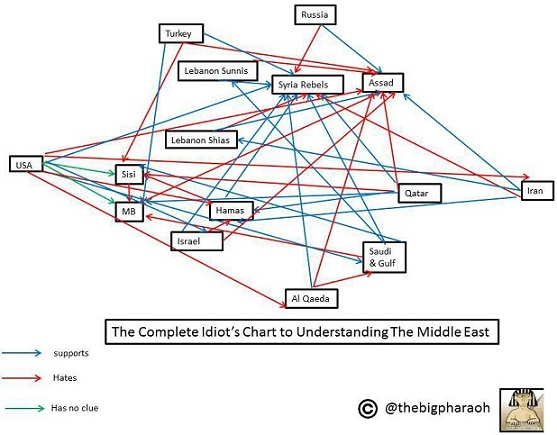
    The Big Pharaoh also put this diagram on his blog, and Max Fisher picked it up and blogged it at the Washington Post as The Middle East, explained in one (sort of terrifying) chart:

    I’d have some questions here, of course — one about the directionality of the arrows, which only seem to go in one direction — okay for the “supports” and “has nu clue” arrows, perhaps, but surely the “haters” would mostly be two-way, with AQ hating US as well as US hating AQ? There’s no mention of Jordan, I might ask about that… And there are no arrows at all between Lebanese Shias and Lebanese Sunnis — hunh?

    **

    What really intrigues me here, though, is that while this chart with fifteen “nodes” or players captures many more “edges” or connections between them than either or even both of the two tweets above, the tweets evoke a more richly human “feel” for the connections they reference, by drawing on human memories of the various parties and their actions.

    Thus on the face of it, the diagram is the more complex representation, but when taken into human perception and understanding, the tweets offer a more immediuate and visceral sense of their respective situations.

    And scaled down and in broad strokes, that’s the difference between “big data” analytic tools on the one hand, and HipBone-Sembl approach to mapping on the other. A HipBone-Sembl board may offer you two, or six, ten, maybe even a dozen nodes, but it fills them with rich anecdotal associations, both intellectual and emotional — a very different approach from — and one that I feel is complementary to — a big data search for a needle in a global needlestack…

    **

    But I’d be remiss if I didn’t also point you to Kerwin Datu‘s A network analysis approach to the Syrian dilemma on the Global Urbanist blog. He begins:

    A chart by The Big Pharaoh doing the rounds of social media shows just how much of a tangled mess the Middle East is. But if we tease it apart, we see that the region is fairly neatly divided into two camps; it’s just that one of those camps is divided amongst itself. Deciding which of these internal divisions are fundamental to the peace and which are distractions in the short term may make the diplomatic options very clear.

    and goes on from there, offering a series of network graphs of which is the fourth:

    from which he draws the following observation:

    What can we do from this position? If the US decides to pursue a purely military route to remove Assad from power, it will incur the ire of Russia, Iran and Lebanese Shias, but it can do so with a broad base of support including the Syrian rebels themselves, Israel, Qatar, Turkey, Lebanese Sunnis, and even Al Qaeda. However if it chooses a diplomatic route to curry support to remove Assad it must isolate him in the above graph by making an ally out of Russia and/or Iran (assuming that making an ally out of Lebanese Shias would have little impact). Russia doesn’t hate the US but it does hate the Syrian rebels, making it an unpromising ally against Assad. Iran hates the Syrian rebels and the US hates Iran, but the Al Qaeda is a thorn in both their sides, making it a potential though unlikely source of cooperation.

    Really, you and I should read the whole piece, and draw our own conclusions.

    **

    Or lack thereof. I’ll give the last tweet to Teju Cole, who articulates my own thoughts, too:

    Reprehending Ignorance about Syria

    Thursday, August 29th, 2013

    I’ve had the pleasure of introducing Timothy R. Furnish, PhD, as a guest blogger here before. Today he offers us his timely commentary on factors which should influence US decision-making regarding Syria. Here I would invite you to note especially his comments on the religious factors involved, which he characterizes as “the most salient issue at hand” and details in the long paragraph which begins “Finally…”

    Charles Cameron
    .

    Ottoman Asia (partial map, 1893)

    .
    American intervention in Syria, most likely in the form of air- or cruise missile-strikes against select targets, now seems a certainty, considering that not just the Obama Administration but a whole host of politicians and commentators — ranging across the political spectrum, from Bill O’Reilly to Senator John McCain and to “The New York Times” editorial board — stridently supports military action. The reasons adduced are primarily these:

    1) The usage of chemical weapons is an atrocity and violation of international law and must be punished accordingly
    2) Syria being Iran’s “pawn,” any strike at the Damascus regime is tantamount to one at the Islamic Republic and, thus, ipso facto a good thing
    3) al-Asad is a Hitleresque “monster” — no further discussion required
    4) President Obama’s credibility is at stake, his having previously deemed usage of chemical weapons to be an uncrossable “red line” that would trigger retaliation.

    Those opposed to the US attacking the al-Asad regime invoke, rather, points such as:

    1) Realpolitick-wise, the US has no national security interest in Syria
    2) Any action that degrades the al-Asad regime actually helps the jihadist elements of the Syrian opposition, especially the al-Qa`ida-affiliated, pro-caliphate Jabhat al-Nusra li-Ahl al-Sham min Mujahidin al-Sham fi Sahat al-Jihad (“The Front of Support to the Family of Syria from the Holy Warriors of Syria in the Battlefields of Jihad”). As LTC Ralph Peters put it on “The O’Reilly Factor” (8.27.13), “do we really want to help the jihadists who perpetrated 9/11?”
    3) US bombing — even if attempted “surgically” — will result in collateral damage to Syrian civilians and motivate Syria and its allies (especially Iran and Hizbullah) to activate terrorist cells against Americans, certainly in the larger Middle East, probably in Europe and possibly even in the US homeland.

    Three major areas of ignorance are manifested in these two Manichaean positions (albeit moreso in the pro-bombing camp).

    First, it is not (yet) certain that it was indeed the al-Asad regime that employed chemical weapons. According to a source with whom I am in contact — a former intelligence operative who worked in Syria for a number of years — it is quite possible that Jabhat al-Nusra, or one of the other jihadist opposition groups (Syrian Islamic Front, Ahrar al-Sham, Ansar al-Islam, Ahfad al-Rasul, etc.) pilfered a government chemical weapons stockpile and wielded the lethal bounty in a false flag operation. It is also possible that such jihadist groups were supplied chemical weapons directly by* North Korea.

    Second, it is simply not the case in modern times that use of chemical or nerve agents automatically provokes the international community’s wrath. Libya used such weapons in Chad in 1986, and (more infamously) Saddam Husayn did likewise against Iraqi Kurds in 1987. Neither of those events engendered US or NATO retaliation. Furthermore, Syria is not a signatory to the 1993 Chemical Weapons Convention prohibiting utilization of chemical or nerve agents; and Damascus signed the similar 1925 Geneva Protocol when it was under the French Mandate—thus having no choice in the matter. This in no wise lessens the horror of chemical weapons, but an American administration headed by a self-styled former law professor would do well to get its international legal ducks in a row before launching the first cruise missile.

    Finally, and most importantly, neither the pro- nor anti-bombing faction seems aware of the most salient issue at hand: that the ruling regime is composed of Alawis, a heretical Shi`i offshoot sect the adherents of which have long been condemned as murtaddun, “apostates,” in Sunni Islam — first by the (in)famous Sunni cleric Ibn Taymiyah in his early-14th c. AD fatwas, then again just last year by the al-Qa`ida cleric Abd Allah Khalid al-Adm, who said “don’t consult with anyone before killing Alawites.” Alawis have existed for about a millennium, mostly in the mountains of coastal Lebanon and Syria, and have always been persecuted by Sunni rulers, going back to the first days of Ottoman Turkish control of the Levant in the 16th century. Under the French Mandate, post-World War I, and afterwards they insinuated themselves into the military and intelligence service such that, eventually, one of their own, Hafiz al-Asad, took control in 1970. Spurned by Sunni Arab countries, the elder al-Asad cleverly got his Alawi sect officially declared Shi`i by the influential Lebanese Twelver Shi`i cleric Musa al-Sadr (before the latter disappeared in Libya in 1976); and when the ayatollahs took control of Iran in 1979, Damascus and Tehran began, if not a beautiful, certainly a mutually beneficial, friendship — which has existed ever since. Hafiz and his son Bashar al-Asad both ruled largely as secularists — due to their sectarian affiliation, and to their official ideology of Arab socialism, articulated as the Ba`ath Party. (So to be fair to Hillary Clinton — who, in March 2011, referred to Bashar al-Asad as a “reformer” — he was much more modernizing and tolerant than many Sunni leaders of the region, if only out of political necessity.) That meant that the 10% of the Syrian population that is Christian largely supported the leader of the strange Islamic sect (also comprising about 10% of Syrians) over against the 3/4 of the population that is Sunni, fearing what a Muslim Brotherhood/Salafi takoever would portend for them. Such fears have skyrocketed since the “Arab Spring” came to Syria over two years ago — especially as groups like Jabhat al-Nusra and its ilk have trumpeted their hatred of Alawis and their burning desire for a Sunni caliphate that would relegate Christians (and Jews) to their historical, second-class dhimmi status. Thus, it is not totally beyond comprehension why a beleaguered, religiously-heterodox regime might feel it necessary to deploy, and perhaps even use, chemical weapons — as a means of staving off probable extermination at the hands of jihadists.

    All in all, it appears that the pro-bombing position is much weaker than the anti-attack one. As noted previously, chemical weapons’ usage has not automatically resulted in international action in punishment; Syria is not, legally, bound by relevant conventions; and we are not certain which side actually used these arms. The idea that “any strike against the Damascus regime is a blow to Iran” is dubious at best: Iraq is at least as solicitous of the Islamic Republic as is Syria, but no calls for bombing Baghdad have been proffered. Some advance the thesis that striking al-Asad’s forces helps Israel’s geopoliticial position — but one can equally well argue that cutting off Tehran’s access to Lebanese Hizbullah would undercut the ayatollahs’ main conventional warfare outlet, and thus make it more likely they would want to use the nuclear weapons they will very soon possess. Furthermore, why should the Alawi, Druze and Christian minorities of Syria pay the price for US cowardice about attacking Iran directly? As for the “al-Asad = Hitler” trope — how many years will it take before the West, particularly the US, can wage war without “Hitlerizing” the opposition? That’s not a rational argument; it’s an emotional one. And regarding the allegation that President Obama needs to attack Syria in order to resurrect his political credibility, at home and abroad — let us hope that he is not, still, that callow after over five years in the White House. At least Richard III only needed his ignorance, not his political cunning, reprehended.

    On the other side of the equation: the US does have security interests in the region, but not specifically in Syria; it is certainly true that vitiating al-Asad’s military will simultaneously empower the opposition — and not just the ostensibly-Westernized Free Syrian Army but also the jihadists like Jabhat al-Nusra; and it’s very likely that extant Iranian-trained terrorist cells will activate in Europe and the US if we intervene in Syria.

    As Gandalf advised in The Fellowship of the Ring: “Do not be too eager to deal out death in judgement. Even the very Wise cannot see all ends.” The Obama Administration, and its supporters advocating attacking the Syrian regime, may not be able to see all ends; but they could certainly strive to be a bit wiser and consider some relevant data that might just be inconvenient to their position — before meting out yet more American death in the Middle East.

    _____________________________________________________________________________________________________

    To view the Ottoman Empire map at the head of the post at full size, see here and click for high resolution.

    FTR, this post was received from Dr Furnish dated, and posted here, 8.28.2013. * indicates an edit made at Dr Furnish’s request upon rereading after publication.

    Bomb Syria?

    Thursday, August 29th, 2013


    [by Mark Safranski a.k.a. “zen“]

    There is much ado about a prospective Western (i.e. American) aerial campaign to bomb the Iranian allied Alawite-Baathist dictatorship Syria over use of chemical weapons against primarily al Qaida allied Sunni Islamist extremist rebels.

    To what end or how that end will be brought about by a surgical use of American air power, aided by token French and British contributions, well, no one is quite sure.

    The driving insider force behind this astrategic call to arms are Susan Rice, Samantha Power and Anne-Marie Slaughter, the three Furies of R2P.  Slaughter writes on military intervention in Syria with her usual combination of moral certainty and operational magical thinking here. Rice angrily pontificates here while an unusually muted UN Ambassador Samantha Power just tweeted about it while on vacation from the emergency UN Security Council meeting on, uh, Syria.

    The strategic argument about Syria is not about the normative qualities of the Assad regime, which is anti-American, brutal, terrorist supporting and fascistic. Or that the regime is committing atrocities. It is. It is about what political objective, if any, the use of military force against Syria can accomplish at what cost and with what probable outcomes. At a grand strategic level, there are also questions about how military intervention in Syria will impact great power relations and the shaping of international law.

    I suspect many R2P advocates like Slaughter, Rice and Power are attracted to the idea of bombing Syria partly to garner a precedent to support doing similar things in the future, whether or not it has any positive effect on the Syrian civil war. That however, if true, is an extremely poor reason for military intervention anywhere. If bombing had some hope of changing the behavior of the Syrian regime or replacing it with something better, I would warm to the prospect but where is the evidence that is a likely outcome? Consider:

    The Syrian rebels include armed groups as violent, lawless and squalid as the Assad regime. You know, the Beheading community of the third jihad international, with fringe support from the occasional cannibal commandos. If these Islamist lunatics come to power in Damascus they will cheerfully engage in ghastly pogroms of mass murder and torture that will make Assad’s goons look like the British Raj at tea time.

    The Assad regime and the Alawite minority from whence it originates have their backs to the wall in a conflict that determines if they continue to rule Syria or are exterminated. Having no margin for maneuver or concession, America bombing them is irrelevant to whether in their calculus they can stop fighting their local enemies. The whole point of combining the threat of force with diplomacy – allegedly the reason given for bombing Syria – is to be able to make Assad an offer that he can’t refuse and not a threat that the Alawites can’t accept. Then, while blustering loudly and ominously we undercut our own bellicose posturing and announce that regime change was off the table. WTF?  Really?

    The President should fire this unholy crew of incompetents and intellectual poseurs and hire some real foreign policy advisers with at least an undergraduate level grasp of how diplomacy, strategy and war have worked for the past 2000 years.

    Failing that, a few poker players who can bluff without showing the entire table their cards.


    Switch to our mobile site

