zenpundit.com » 2013 » July

Archive for July, 2013

Where’s Ms. Waldo?

Sunday, July 7th, 2013

[ by Charles Cameron — on two technologies for human dot-connection ]
.

How long would it take you to find this particular woman:

in this crowd, if you already had another photo of her?

Click here and give it a try.

Next question: how long would it take the best pattern recognition software in the world?

For bonus points: how many cameras like this are there in the world, who has access to that kind of software, what countries are cameras and software in, what kinds of agencies use them, under whose supervision, how easily hacked — and how many such photos will have been taken, grand total, by the end of 2013?

I don’t have even a hazy idea of the answers. I don’t even know where in the photo the woman in the headband can be found. I imagine there are export controls on both cameras and software, I suspect they can be circumvented…

**

As I noted in a comment here three weeks ago:

Green party politician Malte Spitz sued to have German telecoms giant Deutsche Telekom hand over six months of his phone data that he then made available to ZEIT ONLINE. We combined this geolocation data with information relating to his life as a politician, such as Twitter feeds, blog entries and websites, all of which is all freely available on the internet.
.
By pushing the play button, you will set off on a trip through Malte Spitz’s life. The speed controller allows you to adjust how fast you travel, the pause button will let you stop at interesting points. In addition, a calendar at the bottom shows when he was in a particular location and can be used to jump to a specific time period. Each column corresponds to one day.

You can give that one a whirl, too: feel free to zoom in and out.

**

Happy trails!

Book Review at Pragati: The Strategy Bridge by Colin Gray

Friday, July 5th, 2013

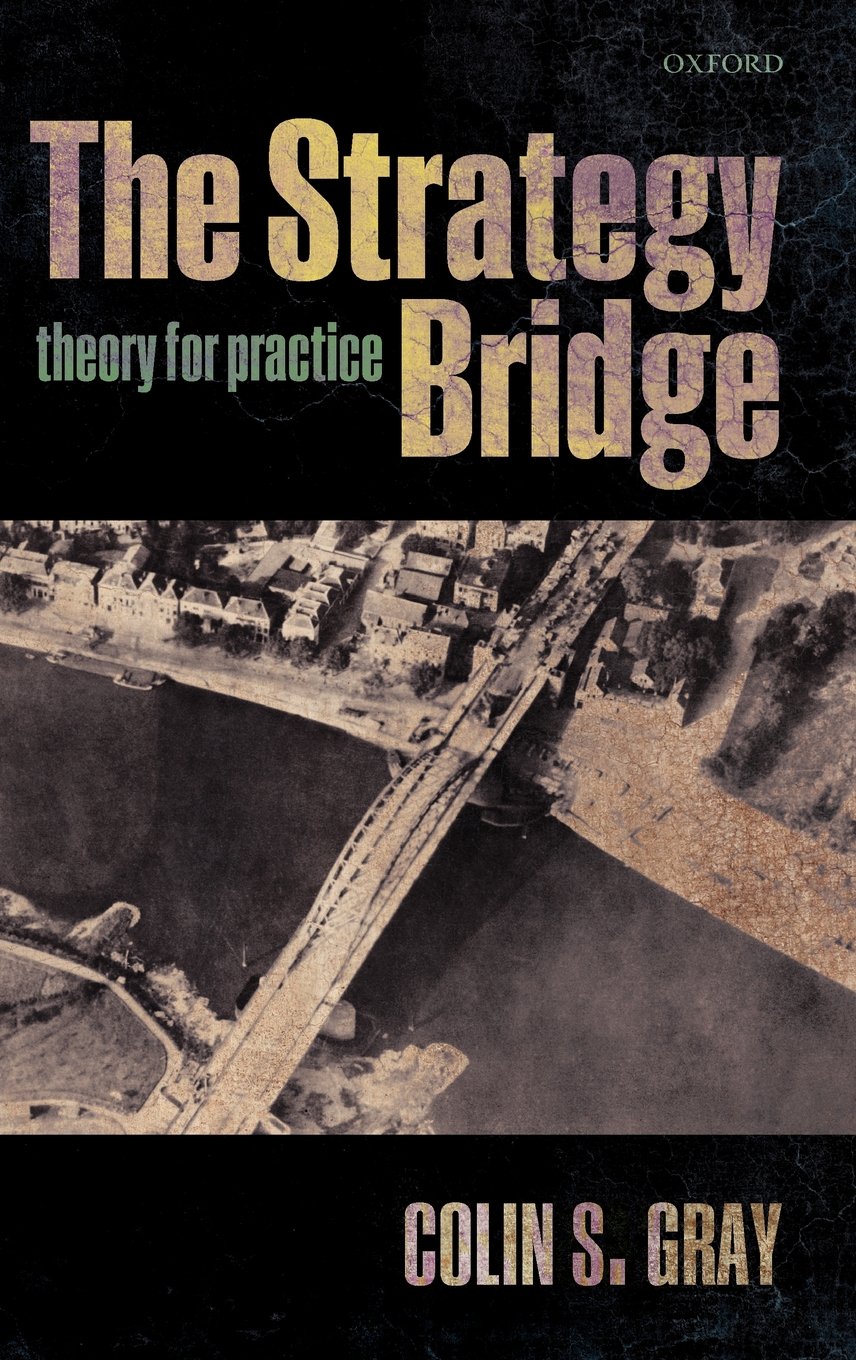
I have a new book review up at Pragati Magazine this morning, The Strategy Bridge:Theory for Practice by Colin S. Gray which is a must read book for any serious student of strategy.

Pragati, which is a national interest and policy magazine for India is starting to turn greater attention towards the subject of strategy and is also running another article in the same issue on strategy and the Maoist insurgency and recently on Indian grand strategy.

A Bridge over Troubled Waters

The title of The Strategy Bridge is also Gray’s operative metaphor, both for the purpose of strategy and the role of the strategist himself that represents the dialectical dynamic of war and strategy-making, the latter being a shared enterprise, save for some extreme historical outliers where strategy was vested in one man, like the regimes of Napoleon and Adolf Hitler. Strategy is the ‘bridge’ that must be built between policy determined by a national leadership and the operational and tactical behaviors of the military and other arms of national power. The strategist “mans the bridge”, orchestrating all of the elements within a master strategic concept and managing the iterative relationship.

Gray writes “The function of the military strategist, his unique raison d’etre, is to ensure that policy and the military instrument are purposefully connected… The strategist must understand the whole nature of a conflict, including war and warfare if antagonism has escalated thus far, because subject to political control, he has the duty of care over the entire competitive performance of the security community… The mission of the military strategist is to decide how the enemy is to be defeated. It is his task to invent a theory of military victory. That theory has to be expressed in and revealed in plans, which are contingent predictions of an extended kind, and must be commanded by generals to whom the strategist delegates some restricted command authority. Whether or not the strategist wishes or is able to function as a general also, must vary with historical circumstances”

….The Strategy Bridge is subtitled “Theory for Practice” because it is intended as a serious work of theory, a framework for understanding enduring principles of strategy so that a practitioner can thoughtfully apply them in making strategies for the specific context in which they find themselves to provide correct guidance for the operational planners and tacticians who will execute it. Consequently, Gray has not written an introductory text for a novice student but an insightful book for the strategic practitioner of journeyman experience – field grade officers, senior intelligence and foreign policy analysts, academic strategists, think tank researchers and national security advisers to senior government officials – who have a store of knowledge of their own. Hence the repeated invocation of “the bridge” metaphor by Gray; his primary audience are the people “doing strategy” and their success or failure “manning the bridge” will help determine the degree to which government purpose remains connected to action or whether the whole business will go off the rails into a quagmire, as it too often does. 

Read the rest here.

For the Fourth of July: The Once and Future Republic?

Thursday, July 4th, 2013

Ahem….”I told you so“.

“Congress intended to allow the intelligence communities to access targeted information for specific investigations. How can every call that every American makes or receives be relevant to a specific investigation?”

                                                             – Representative James Sensenbrenner (R-Wisconsin)
                                                                 A primary author of The Patriot Act 

“We have not yet seen any evidence showing that the NSA’s dragnet collection of Americans’ phone records has produced any uniquely valuable intelligence. Gen. Alexander’s testimony yesterday suggested that the NSA’s bulk phone records collection program helped thwart ‘dozens’ of terrorist attacks, but all of the plots that he mentioned appear to have been identified using other collection methods. The public deserves a clear explanation”

                                                                 – Senators Ron Wyden (D- Oregon) and Mark Udall (D- Colorado)

“What I learned from our journalists should alarm everyone in this room and should alarm everyone in this country….The actions of the DoJ against AP are already having an impact beyond the specifics of this particular case. Some of our longtime trusted sources have become nervous and anxious about talking to us, even on stories that aren’t about national security. And in some cases, government employees that we once checked in with regularly will no longer speak to us by phone, and some are reluctant to meet in person. This chilling effect is not just at AP, it’s happening at other news organizations as well”

                                                               – Gary Pruitt, President of the Associated Press 

“The people who are worried about privacy have a legitimate worry….But we live in a complex world where you’re going to have to have a level of security greater than you did back in the olden days, if you will. And our laws and our interpretation of the Constitution, I think, have to change.”

                                                              – Michael Bloomberg, Mayor of New York City 

“One-party autocracy certainly has its drawbacks. But when it is led by a reasonably enlightened group of people, as China is today, it can also have great advantages.”

                                                                -Thomas Friedman, NYT Columnist 

“Toll records, phone records like this, that don’t include any content, are not covered by the fourth amendment because people don’t have a reasonable expectation of privacy in who they called and when they called, that’s something you show to the phone company. That’s something you show to many, many people within the phone company on a regular basis.”

                                                                 – James Cole, Deputy Attorney-General 

“In the abstract you can complain about Big Brother and how this is a program run amok, but when you actually look at the details, I think we’ve struck the right balance.”

                                                                 -Barack Obama, President of the United States 

While we need intelligence services, including the formidable collection capacity of the NSA, we don’t need a mammoth repository of information being continually compiled on every American, held in perpetuity by the US government.

First, the mere existence of so massive a database on the data of all Americans is itself a critical strategic vulnerability and a potential risk to the national security of the United States because it centralizes for any would be spy or hacker not just anything, but virtually *everything* they would want to know about *everyone*. The greatest testament against the strategic wisdom of this scheme from a counterintelligence perspective is the erstwhile Mr. Edward Snowden – breach just one security regime and you walk away with the whole store or as much of the store as you have time and brains to snatch.

How many Snowdens have we *not* heard about because they were quietly fired by a contractor? How many other Snowdens working for foreign intelligence services eluded government detection and got away with who knows what?  Or are still doing it now?

Not exactly a resilient system from a cybersecurity perspective, is it?

What the USG has done here is not dumb. It is fucking dumb with a capital F. Sometimes we get so caught up from a technical viewpoint in what we might be able to do that no one stops and seriously considers if we should do it. From such unasked questions come the unwanted second and third order effects we live to rue.

Unless, of course,  building a draconian comprehensive digital dragnet for a  “leaky system” is what was desired in the first place. If so, bravo gentlemen.

Which brings us to the second point: the surveillance state as currently configured in law with the legal equivalent of string and chewing gum is inimical to the long term survival of the United States as a constitutional Republic. This is not an attack on any particular person or politician or three letter agency. It’s a hard world filled with extremely bad men who would do us lasting harm, so we need our spooks, but the spooks need proper constitutional boundaries set by our elected representatives in which to operate and somewhere in the past decade we have crossed that Rubicon.

The United States of America has had a historically remarkable run of 237 years of good government and in all that time the system failed us only once. That one time cost the lives of approximately 630,000 Americans.

On a level of moral and political legitimacy, we have created a bureaucratic-technological machine, a sleepless cyber  J. Edgar Hoover on steroids that contradicts our deeply held political values that define what America is and aspires to be. There is no way to reconcile cradle-to-grave digital dossiers on the 24/7 life of every American with the provisions of the US. Constitution. Really, an ever-watching state was not in the cards at our Constitutional Convention, even with the delegates like Alexander Hamilton who privately thought George Washington might make a fine King.

On a more pragmatic level, in creating the SIGINT-cyber surveillance state we have made not an idiot-proof system, but an idiot-enabling one that represents an enormous potential reserve of power that will be an unbearable temptation for misuse and abuse. The long, bloody and sordid record of human nature indicates that someone, eventually, will not be able to resist that temptation but will be smart enough to get away with it. If we are greatly fortunate, it will be a lazy person of limited vision looking merely to enrich themselves and their friends. Or a malevolent minor bureaucrat like Lois Lerner looking to punish “the little people” who raised her ire.  If we are unlucky, it will be a gifted figure of ill intent and outsized ambitions, an American Caesar.

Or an American Stalin.

In the long term, our Democracy will not be healthy when the government – that is, the Executive – monitors everyone and stores everything  we do forever. While most of us are not that interesting, reporters, public figures, newspaper publishers, members of Congress, aspiring politicians, their campaign donors,  judges, dissenters, writers and so on are very interesting to people in power. The Congress, for example, cannot do it’s job properly when it’s cloakroom is bugged and their email is read anymore than can the editorial office of the Associated Press. What we have built, if it existed in a foreign country, would be frankly described as a “Deep State.  Nations with deep states are not pleasant places to live and they usually do not work well. At best, they look like Russia and Turkey, at worst they look like Pakistan and Iran.

Rolling the surveillance state back to targeting foreign enemies, it’s proper and constitutional role, instead of every American citizen – yes, we are all, every man, woman and child of every race, creed, color and political persuasion being treated as potential enemies by the Federal government – is up to us and only us.  Tell your Congressman, your Senator and the President what you think in a respectful and thoughtful way – and then make this an issue that decides your vote.

If we do nothing, we have no one to blame but ourselves for what comes next. We can at least console ourselves with pride in the fact that the US had a good go at making freedom work unequaled in world history, but that democracy may had had it’s time.  Others in the distant future, may profit from our example the way we learned from Athens, Rome and Britain. Or we can leave while the door still remains open.

Enjoy your Fourth.

                                                “Well, Doctor, what have we got, a republic or a monarchy?”

                                                                      – Mrs. Powell

                                             ” A Republic, if you can keep it”

                                                                      – Benjamin Franklin
                                                                         Signer of the Declaration of Independence
                                                                         Delegate, Constitutional Convention

Clausewitz and Center of Gravity

Wednesday, July 3rd, 2013

At Small Wars Journal a provocative essay by Col. Dale C. Eikmeier:

Give Carl von Clausewitz and the Center of Gravity a Divorce

….Because we love Carl von Clausewitz and the center of gravity concept, we need to grant them a divorce- for our sake.  We tried for years to make it work, but it’s time to face reality, together they are just too abstract and confusing for us to embrace.

 The center of gravity concept, a mainstay of the US military “operational art” since 1986[1], has never fully satisfied doctrine’s intent.   According to Dr. Alex Ryan, a former School of Advanced Military Studies instructor, the concept is, “so abstract to be meaningless”[2]  Now if a ‘mainstay’ is so ‘abstract’ that subject matter experts declare it ‘meaningless’ we have a doctrinal problem.  The genesis of this problem is a doctrinal foundation built on dubious authorship and editing, underdeveloped theory, imprecise metaphors, and flawed translations. [3]  This Clausewitzian foundation, which was never very solid, is now collapsing under the weight of 21st century warfare.  For this reason it’s time to end our reliance on Clausewitz’s On War as the authority on the center of gravity concept.

….Crack Four.  Another problem is flawed translations.  Clausewitz never used the term “center of gravity”, or in German, “Gravitationspunkt”, he used the word schwerpunkt, which means weight of focus or point of effort which is different from center of gravity, hubs or sources of power. [9]   But it is easy to understand how an English translator when picturing this point of effort could think of a center of gravity which further illustrates the danger of metaphors.  Milan Vigo in Joint Operational Warfare Theory and Practice provides a detailed analysis of the evolution of schwerpunkt from focus of effort to center of gravity which is summarized below:[10]

  1. Schwerpunkt – main weight or focus or one’s efforts.
  2. Mid 19th century, schwerpunkt is associated with an enemy’s capital as the point of focus. Germans and Austrians used the word schwerpunktlinie to mean a line of main weight or effort that links one’s base of operations to the enemy’s capital. This is where the schwerpunkt as ‘the target’ understanding comes from.
  3. Late 19th century it comes to mean a section of the front where the bulk of one’s forces are employed to reach a decision. Schwerpunkt is now the ‘arrow’ not the target.  This is a subtle shift from the point of focus on a target, to the arrow or what is focused.  Count Alfred von Schlieffen and German military practice used the ‘arrow’ understanding up to WW II.
  4. Colonel J.J. Graham’s 1874 English language translation of On War  mistranslated Schwerpunkt as “center of gravity”[11]
  5. Post World War I German military progressively adds a new meaning using schwerpunkt to mean the focus of planning efforts.  This is a natural evolution of the late 19th century hybrid of ‘the arrow’ and the ‘target’ understandings.
  6. The Bundeswehr (German Army) now uses the English term “center of gravity” while the Austrian Army uses the German term “Gravitationspunkt” which translates to “center of gravity”. 

Hence, English translators took Clausewitz’s “schwerpunkt”, ‘the target or point of focus’ meaning mistranslated it into center of gravity which morphed into the source of power or ‘the arrow’ meaning. 

I’m not understanding Eikmeier’s hostility to the employment of metaphor as a device for learning as it is a conceptual bridge for understanding without which human society would not have made much progress.  Yes, metaphors can be misunderstood or abused but so can just about everything else. Most important ideas were either understood by or are most easily explained by metaphor and analogy.

“Center of gravity” in Clausewitzian theory is often misunderstood by non-experts or incorrectly identified in the enemy in practice in the midst of a war, but the same can be said of many other valuable concepts. Ask people to explain “gravity” itself and see how precisely scientific an explanation you receive, but that hardly means we should abandon the concept.

Regarding translation from On War, Eikmeier may have a more valid point but I am not qualified to assess it. I have a fair grasp of the political-historical context but not the linguistic and cultural nuances of early 19th century German language expression. Maybe Seydlitz89 will care to weigh in here?

On Time and timeframes

Monday, July 1st, 2013

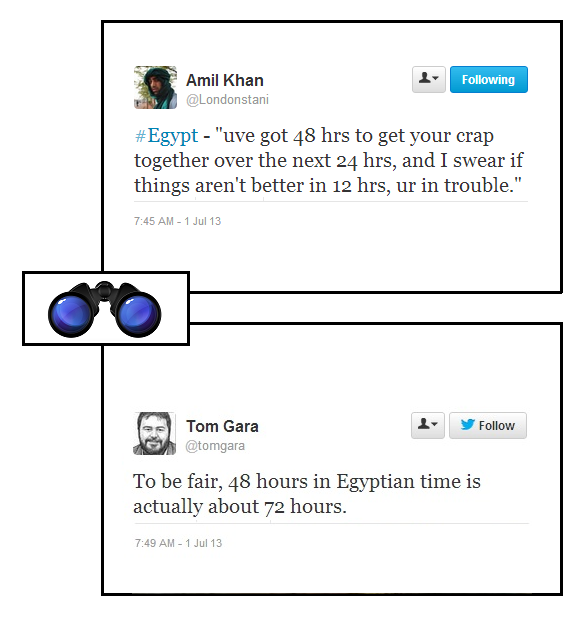
[ by Charles Cameron — 48 hours, Egyptian time, can mean many things, also DoD foresight, next 48 hrs ]
.

We seem to have at least four “times” here, ranking from 12 to 72 hours — or zero to 72 if you take the Army’s announcement itself as a sort of starting pistol — and they’re operating, obviously enough, under different frames. The army likes nicely rounded numbers like “48 hrs”, PERT chart thinking gives you the least time available in which to take the first step towards a desired aim, here “12 hours” — and “24 hours” is the latest target time for serious, visible progress to avert “worst case” response preparations. Or something along those lines.

And “72 hours”? That may be Egyptian elastic time, and thus roughly comparable to Lakota time

The Lakota view of time was simple. “Time was never a specific minute, but rather spaces of time,like early morning, just afternoon or just before midnight. The real meaning of time could be summed up by the phrase “nake nula waunyelo” loosely translated it means:

“I am ready for whatever, any place, any time, always prepared”.

When work needed to be done, people were prepared to work late inthe fields or stay up until 3 am to finish goods to be sold at market.When no work needed to be done, they didn’t work.

The irony is in the next comment:

Policy makers saw an opportunity to improve things by installing awestern time ethic and a respect for the clock.

I don’t know Egypt — but I have spent time “on Lakota time” and don’t wear a watch or carry a phone these days… The piece I drew those quotes from, Lessons from the Lakota: Time lessons for today’s managers, may or may not be useful advice for managers, but its overview-with-graphic of different time systems is worth a quick look. Anthropologists would be able to tell you more about individual cultures, but my point is that differing timeframes are among the major features of different worldviews, and we need to have a decent sense of them when we interface with them.

So “72 hours” may be an instance of relaxed but purposive time, okay? Which wouldn’t necessarily fit well with starched and pressed military time.

**

And here’s the blockbuster:

According to the Congressional Budget Office’s Analysis of DoD’s Future Years Defense Program from 2013, military foresight time runs five years ahead, while USG foresight time runs to 2030 at least:

In most years, the Department of Defense (DoD) provides a five-year plan, called the Future Years Defense Program (FYDP), associated with the budget that it submits to the Congress. Because decisions made in the near term can have consequences for the defense budget well beyond that period, the Congressional Budget Office (CBO) regularly examines DoD’s FYDP and projects its budgetary impact over several decades. For this analysis, CBO used the FYDP provided to the Congress in March 2012, which covers fiscal years 2013 to 2017; CBO’s projections span the years 2013 to 2030.

That’s confidence of a kind… but consider this:

I know, I know — whatever happens in Egypt “momentarily” may turn out to be no more than an eddy briefly interrupting a larger time-flow in the “mid-term” — a phenomenon I’d like to map nicely with some river graphics one of these days.

**

But time? What was it St Augustine said of it?

What, then, is time? If no one asks me, I know what it is. If I wish to explain it to him who asks me, I do not know.


Switch to our mobile site