zenpundit.com » 2013 » September

Archive for September, 2013

It’s been a while since anyone last used a nuclear bomb, right?

Monday, September 9th, 2013

[ by Charles Cameron — keeping you in the “loopy” loop ]
.

There’s more ridiculous sloshing around on the web than I can hope to monitor, but my personal collection hit a couple of high points recently that I thought I should share with you. Did you know, for instance, that Israel recently exploded a nuclear bomb in Syria? How could you consider yourself informed, and be unaware of such a thing? It was on YouTube…

But pshaw, that’s secular nonsense, and as you know, my tastes run to the religious. So did you know the emeritus Pope Benedict had a demonic advisor by his side while he was making a major speech?

That sure as hell beats out the namby-pamby 10 Weirdest Fundamentalist Christian Conspiracy Theories an Alternet writer came up with, eh?

In any case, please watch both the above videos: I trust you will then realize that the world is in far worse shape than you thought it was before reading this post.

After all, it’s on YouTube.

**

How about this?

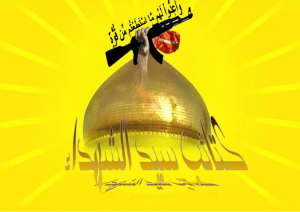
Hang on a moment, Sayyida Zaynab is the shrine dear to Shiites that Kata’ib Sayyid al-Shuhada is defending, as this graphic suggests:

And last but not least, consider this, from a US Senator:

Coincidence!?!? — or just a clumsy creative leap?

_________________________________________________________________________________________________

NB: Updated to replace “Hezbollah” with “Kata’ib Sayyid al-Shuhada” above — h/t Phillip Smyth.

A follow-up piece from Furnish

Saturday, September 7th, 2013

[ by Charles Cameron — here Dr Furnish explores and explains the rival eschatologies afoot in the Syrian conflict ]
.

The New Mahdi, from http://ghareb.deviantart.com/art/Ahat-ALGhareb-107961264 via Furnish

.

Timothy Furnish has a new post up on Syria at his MahdiWatch blog, supplementing his recent guest post on Zenpundit, Reprehending Ignorance about Syria, in which he discussed sectarian issues, with Intervening (in Syria) Like It’s The End of the World?, in which he zeroes in on the strands of Mahdist expectation and enthusiasm on both sides of the conflict. Dr Furnish’s new post is long, so I’ll offer you some key paragraphs as a teaser, then suggest you go read the rest.

Iraq has always been more more central to Islamic history than far-eastern or far-western peripheries like Afghanistan or Libya, albeit less so than Syria. Iraq was on the fault-line between Western and “Eastern” civilizations, going back to Roman and Byzantine times, when it was a contested buffer zone between those empires and the various Persian ones. The region of Iraq itself was divided, after the coming of Islam, into Sunni and Shi`i sections — the former often under Ottoman Turkish rule, the latter in the orbit of (or at least doctrinally sympathetic to) the Safavid , and subsequent other Shi`i, Iranian states. To this day, especially post-American occupation (which empowered the Twelver Shi`i Iraqi majority to take power), Iraq is religiously and even eschatologically important for the Twelvers of the world primarily because six of the twelve Imams’ tombs are there and, after his reappearance, the returned 12th Imam al-Mahdi will rule from Kufa, Iraq. However, despite Baghdad’s undeniable importance as a political and intellectual center from its founding in 750 AD to its demise at the hands of the Mongols in 1258, Iraq pales in importance next to Syria for the majority Sunni Muslims, particularly Arab ones.

Syria was the first area outside the Arabian peninsula to be conquered, and not only was it taken from the superpower al-Rum (the Byzantine Christian Empire), but al-Sham, “Greater Syria” centered on Damascus included Jerusalem, the capture of which “proved” Islamic superiority to the other, corrupted monotheistic religions: Judaism and Christianity. This fervent triumphalism only intensified after the hated Crusaders were expelled from their 88-year occupation by the Syrian Kurd Salah al-Din in 1187, and the “Zionist occupation” of al-Quds (“The Holy”=Jerusalem) since 1948 is seen by many Arab (and other) Muslims are merely a temporary setback, which the Mahdi and Jesus will rectify. Thus many hadiths predict eschatological events transpiring in what the French and Brits used to call “the Levant,” the most important among them including: al-Sufyani, (a “type” of the Muslim antichrist, al-Dajjal, “the Deceiver”) will emerge from Syria; Christians will (re)conquer Syria; the Mahdi will reveal himself; the Dajjal himself appear; Jesus will return by descending into Damascus; the armies of the Mahdi and the Sufyani will battle; and Jesus will kill the Dajjal in or near Jerusalem. After all this the Mahdi and Jesus will jointly rule over a Muslim planet, and eventually both will pass away. The true end of history, and the Final Judgement, will not come for some years after that. Also: the Sunni Mahdi and the Twelver Shi`i one perform virtually the same role, the major differences being 1) the former will step onto the stage of history for the first time, whereas the latter will return from a millennium-old mystical ghaybah, or “occultation;” and 2) Sunni eschatologists prognosticate that the person whom Shi`is believe to be their 12th Imam will actually be the Dajjal—and Shi`is say the same about the Sunni Mahdi!

Thus, Syria is the most important eschatological venue of Islam, bar none. Quoting sayings of some of their twelve Imams, at least one Iranian government official has superimposed eschatological themes on the Syrian conflict — Hujjat al-Islam (or “Hujjatollah,” a cleric ranking below Ayatollah) Ruhollah Husayniyan, who claims that the strife in Syria is the prelude to the Imam al-Mahdi’s coming and revolution. (This sort of “newspaper exegesis” has been going on for years in Tehran and Qom, actually.) And Twelver Shi`is in neighboring Iraq and Lebanon are not only enthused about this idea, but have been motivated by Mahdism to go join the fight for Bashar al-Asad and the Alawi regime over against its Sunni opponents!

Here are Dr Furnish’s concluding words.

While certain writers in the US obsess about Evangelical Christians trying to fit the Syrian Islamic civil war into a Christian eschatological blueprint, the truth is that they have no significant political power (and the ones I know are adamantly against President Obama’s proposed strikes on the al-Asad military) — they just like to opine, talk, and sell books. The true believers in the Mahdi, the Sufyani and the return of the Islamic Jesus — who comprise hundred of millions of Muslims, according to polling data — should be the real focus of concern, most especially those of their ranks putting their beliefs into practice in Aleppo, Dayr al-Zur and Idlib. The Obama Administration would do well to consider the apocalyptic aspect of the Syrian civil war, before committing our forces to helping those of the Mahdi or the 12th Imam.

As I suggested earlier, now go read the whole thing.

**

ICYMI, I think that final phrase — “before committing our forces to helping those of the Mahdi or the 12th Imam” — is one we should read with care in light of his earlier sentence:

Sunni eschatologists prognosticate that the person whom Shi`is believe to be their 12th Imam will actually be the Dajjal—and Shi`is say the same about the Sunni Mahdi!

Whichever side we might commit our forces to, in other words, we’d be supporting one strain of Mahdism or the other…
Octavian Manea interviews T.X. Hammes

Saturday, September 7th, 2013

[by Mark Safranski, a.k.a. “zen“]

Octavian Manea and SWJ are on something of a roll lately. Colonel T.X. Hammes (ret.) PhD is the respected author of the excellent The Sling and the Stone. If you have never read it, you should.

The Fallacies of Big Expeditionary Counterinsurgency: Interview with T.X. Hammes

SWJ: How different is Mao’s people’s war compared with what you call 4GW (Fourth Generation Warfare)? Is 4GW an updated, evolved form of people’s wars? In the end, isn’t 4GW focused on people and minds, on influencing people and minds?

TX: Mao is a little bit different because (in China) it was a domestic insurgency and focused on wearing down the nationalists and changing the minds of the warlords who supported them. In the case of 4GW, the focus is overseas. People you can’t reach with force, you must reach with the message. 4GW is an evolved form of insurgency. It is also important to note that Maoism is a type of insurgency that essentially fits a hierarchical society, not a tribal one. It always ends with a conventional campaign to destroy the government’s army as the final step in overthrowing the government. You can’t run a Maoist insurgency in the mountains of Afghanistan, the society won’t tolerate that kind of structure.  Nor can you do it in Iraq. 4GW covers both because its objective is not the military defeat.  4GW does not focus on the destruction of the enemy’s armed forces, but on changing the minds of the enemy’s political decision makers. 4GW directly attacks the will of enemy decision makers.  Once the outside power has been ejected, the conflict can continue until resolution. 

SWJ: Tell us about the center of gravity in a 4GW.

TX: The center of gravity in a 4GW is the will of the policymakers of the other side. 4GW war uses all available networks – political, economic, social and military – to convince the enemy’s political decision makers that their strategic goals are either unachievable or too costly for the perceived benefit. 4GW is not necessarily targeted at the people.  If the war is small enough, it can run on for years like El Salvador.  In that case, the US commitment was small enough there was no major political cost to US decision makers to continue supporting the El Salvadorian government.

When you look at the counterinsurgent side, I am more and more convinced that as a foreign power you can only do indirect counterinsurgency. You can advise and assist.  But keep it small – the host nation has to make it work. We, the United States, have done this successfully a number of times. Admittedly, we have not created the perfect nations that the nation-builders want, but that wasn’t the goal. The goal was to achieve US strategic goals. And we achieved our strategic goals in the Philippines, El Salvador, Columbia and Thailand. In a 4GW, the insurgent is not trying to win over the people as a whole. But the counterinsurgent must do so. In a tribal society, you can do what Kilcullen refers to as wholesale COIN – if you persuade the tribal chief everybody flips. In a more democratic society, you have to convince the people. It is more of a retail operation. It is critical to understand the society you are in and tailor your counterinsurgency and insurgency accordingly. 

I would add, in the 4GW theme of reasoning with the “moral level of war”, that a foreign power supporting a host nation government with FID that faces an insurgency, can probably get away with “punitive raiding”  of the non-state actors from time to time, particularly in rapid response to some heinous action committed by rebels. A heavy in-country footprint though will change the political calculus for the population – it is too easy to look lie occupiers and stringpullers. Foreign troops are rarely welcome guests for long.

Read the rest here.

The Middle East in two War Games — and a tribute to Ibrahim Mothana

Friday, September 6th, 2013

[ by Charles Cameron — with regard to Mothana: the voice of sanity is not easily heard in the asylum ]
.

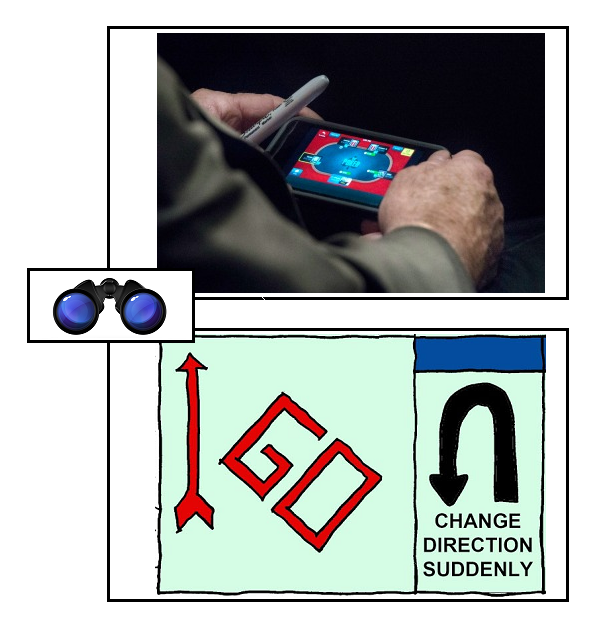
Here’s most everything you need to know about the complexities of the Middle East, spelled out in two simple war games:

Sources:

  • McCain plays poker during Syria war hearing
  • Detail from Yemeni Politics — The Board Game
  • **

    The Yemen politics game was the work of 24 year old Ibrahim Mothana, who died this week. His moving NYT op-ed about his beloved Yemen in June last year told us:

    Drone strikes are causing more and more Yemenis to hate America and join radical militants; they are not driven by ideology but rather by a sense of revenge and despair. Robert Grenier, the former head of the C.I.A.’s counterterrorism center, has warned that the American drone program in Yemen risks turning the country into a safe haven for Al Qaeda like the tribal areas of Pakistan — “the Arabian equivalent of Waziristan.”

    Anti-Americanism is far less prevalent in Yemen than in Pakistan. But rather than winning the hearts and minds of Yemeni civilians, America is alienating them by killing their relatives and friends. Indeed, the drone program is leading to the Talibanization of vast tribal areas and the radicalization of people who could otherwise be America’s allies in the fight against terrorism in Yemen.

    His written testimony for the Senate Judiciary Committee’s Subcommittee on the Constitution, Civil Rights and Human Rights can be found in this Guardian post from Glenn Greenwald in May of this year.

    Mothana had many admirers across the spectrum, as this tweet from Gregory Johnsen attests:

    We mourn his loss, and ask for peace.

    For joy and sorrow: DoubleQuotes in the Wild

    Friday, September 6th, 2013

    [ by Charles Cameron — without access to joy, how shall we carry the burdens of despair? ]
    .


    via Bill Murray likes

    **

    DoubleQuotes are juxtapositions that have a powerful impact. Our minds and hearts are drawn naturally to seeing parallels and contradictions, making comparisons between ideas and creative leaps from one idea to another, and since this is a very basic human cognitive ability, I’ve developed my own DoubleQuotes format for presenting striking juxtapositions, and use it frequently in my posts here at Zenpundit. But I also collect strong examples of such juxtapositions when others make them, and call them DoubleQuotes in the Wild.

    Today, I’d like to double up on my wild DoubleQuotes, and having offered you Jimi Hendrix (graffito juxtaposed with tree, above) to bring you joy, now offer you the poignant example from a Serbian Orthodox monk (Aleppo, Syria, then and now, below) to bring you sorrow:

    **

    Music, munitions — we may think them unequal combatants, yet as von Clausewitz puts it:

    One might say that the physical seem little more than the wooden hilt, while the moral factors are the precious metal, the real weapon, the finely-honed blade.

    — or in somewhat more recent terms, as Michael Herr noted in his book Dispatches:

    Whenever one of us came back from an R&R we’d bring records, sounds were as precious as water: Hendrix, the Airplane, Frank Zappa and the Mothers, all the things that hadn’t even started when we’d left the States.

    sounds … as precious as water


    Switch to our mobile site