zenpundit.com » 2015 » January

Archive for January, 2015

In Praise of Don Vandergriff for the “Next Yoda” at ONA

Saturday, January 17th, 2015

[by Mark Safranski, a.k.a. “zen“]

Don Vandergriff

Friend of ZP blog and expert on adaptive leadership training Don Vandergriff has thrown his hat into the ring to replace the much admired, should not have been retired, Andrew Marshall,  the long time (appointed originally by Richard Nixon) head of the Pentagon’s Office of Net Assessment, affectionately known in DC circles as “Yoda”. Given the military’s badly broken personnel system and dire problem with “toxic leaders” and Vandergriff’s adamant philosophical emphasis upon ethical integrity, strategic thinking and honest intellectual inquiry, he would be a breath of fresh air and catalyst for change.

James Fallows of the Atlantic Monthly gave Don a ringing endorsement:

Want to signal a change? My candidate, until someone has a better idea, is Donald Vandergriff, who has in fact applied for the job.

Vandergriff spent 24 years on active duty an enlisted member of the Marine Corps and an Army officer. When he retired ten years ago as a major, a relatively junior rank, he exemplified the tensions between an independent-thinking, irrepressible, let’s-rock-the-boat reformer and the “don’t make waves” normal promotion machine.

Because of his writings and advocacy, near the end of his active-duty tenure Vandergriff was described as “the most influential major in the U.S. Army.” I did an Atlantic-online discussion with him and Robert Coram, author of a popular biography of the late Air Force colonel John Boyd, a dozen years ago. He has written many well-received books about working fundamental change in the training and promotion of officers, including The Path to Victory; Spirit, Blood, and Treasure; and Raising the Bar. If you want an illustration of someone willing to take (and suffer) career risks in the cause of telling unpleasant but important organizational truths, he would be your man.

Yes he would.

Fabius Maximus blog weighs in as well:

….Donald Vandergriff (one of the authors on the FM website) has identified a powerful point of leverage to change our massive and dysfunctional military apparatus:  its personnel system, the process by which the Army recruits, trains, and promotes its officers. Change this and the effects ripple outward through the entire organization over time as the nature and behavior of its leaders evolve. The Army has begun the long slow evolution of its personnel policies, responding to the ideas of Vandergriff and others.

This success puts Vandergriff on the cutting edge of America’s sword. He, and others like him, are crafting a solution of the third kind (about people) to defeat our foes at 4GW.  We can win at 4GW. We must learn to do so, or the 21st century will be a harsh time for America.

There are many strategic and operational issues that the U.S. military and NatSec community would prefer to ignore because they do not play to our areas of strength where the United States enjoys overwhelming dominance relative to the rest of the world. Well, these problem areas will only grow in scope and importance because they are the points where our adversaries see hope of gaining leverage and comparative advantage over us. I am almost tempted to say “Duh” here because enemies hitting your weak points instead of running headlong into our strong points and being killed en mass is strategy 101, but strategy is less popular in some quarters these days than it should be. Don Vandergriff is the sort of man to highlight deficiencies so they can be remediated and, eventually, become new strengths.

Don Vandergriff….strongest recommendation.

Of morale, angels and Spartans

Saturday, January 17th, 2015

[ by Charles Cameron — how sky differs from heaven, and what that means for morale and jihad ]
.

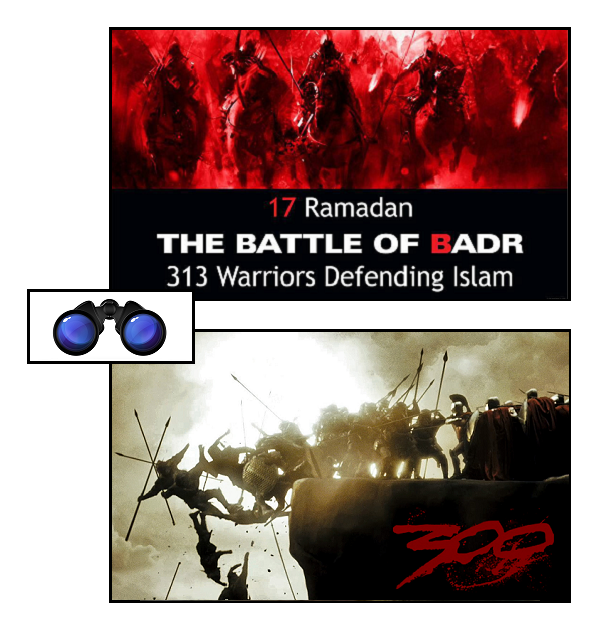
SPEC Badr & Spartans

**

Okay, that Spartans / Battle of Badr DoubleQuote above is just a teaser, locating us in the general zone of morale..

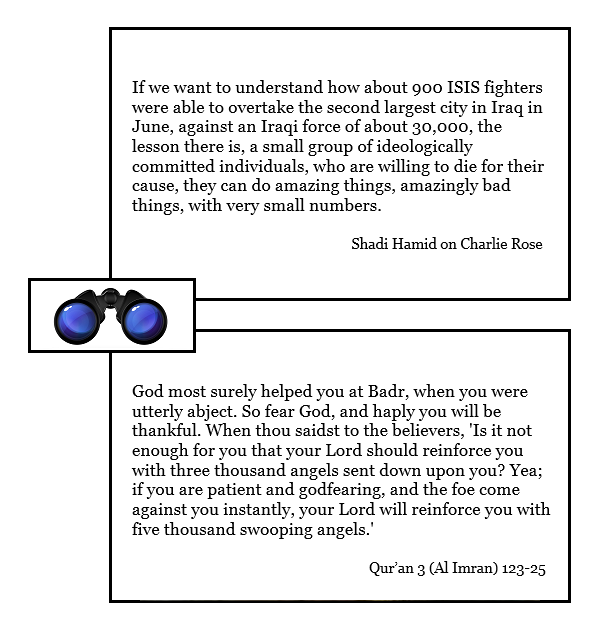
What I’d really like to offer you here is another Badr-related DoubleQuote, of which the first part comes from Shadi Hamid, speaking about half way through the Charlie Rose show, A conversation about Islam and politics with Reza Aslan, Will McCants, Michael Hanna and Shadi Hamid, which aired on the 14th of this month (full video at the bottom of this post). He said:

We have to take religion seriously, but I worry sometimes, if we focus too much on religion we forget that there’s a political context. That if we want to understand the rise of Isis we can’t understand that without looking at the political vacuum that emerged in Syria. That didn’t happen by itself; there’s a series of policy decisions from the international community that helped contribute to the rise of ISIS.

So I guess the interesting question then is, How does religion interact with these political factors. So we have to bring those different variables into focus and I think we lose some of that, we lose that complexity if we’re just saying Islam is the problem. On the other hand, though .. these terrorists and extremists, they believe that what they’re doing, they’re going to be granted direct entry into Paradise, and that inspiration, motivation, is a very powerful thing that we shouldn’t underestimate. And ideology in this sense is a sort of force multiplier on the battlefield.

All of that seems relevant to me, but it’s his next few phrases I want to DoubleQuote (upper panel, below):

SPEC DQ Shadi Hamid & Quran

And whereas Hamid’s explanation, as befits a Brookings Fellow refers to a belief about Paradise, the Qur’an, as befits sacred scripture, treats the world as though it is thronged not with beliefs but with angels..

**

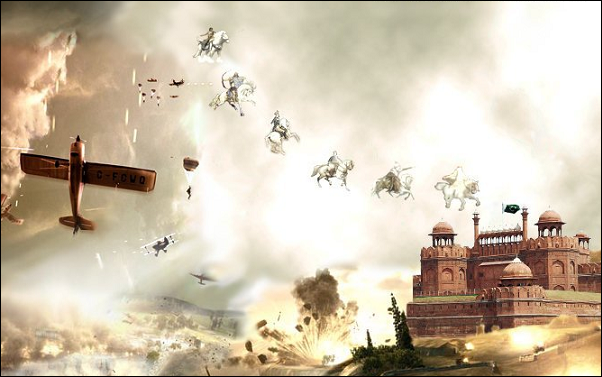
The comparison and contrast between our conntemporary, post-Enlightenment view of “the sky” (in which birds, planes, helicopters, missiles and drones may be found, but no angels, jinn, apsarases or faeries) and that of the world’s various scriptural and mythological “heavens” (in which helicopters and parachutes are generally absent, though angels, demons, gandharvas, apsarases and the rest abound) is one that has long fascinated me — but the two are usually kept distinct. Albrecht Durer will show you angels and demons just above the rural countryside in “heaven” — but you won’t find them in military aviations journals..

It is against that background that I find this piece of artwork about the Ghazwa e-Hind so interesting — it appears to envision both “sky” with its various planes and parachutist (most of the planes a little dated, alas), and “heaven” with its celestial cavalry, occupying the same visual space:

Great Ghazwa Sky meets Heaven

**

All this leads me to the question — which would seem to become ever more urgent as we move from textual to visually enhanced modes of communication —

How does one graphically depict morale or esprit de corps?

That’s my question for the day.

** ** **

Here, for those who would like to view it in its entirety, is the Charlie Rose show from which Shadi Hamid’s quote above was taken:

Sisi followup: two publications of significant interest

Friday, January 16th, 2015

[ by Charles Cameron — SH Nasr’s The Study Quran and the Diyanet collection of ahadith ]
.

Quran & Ahadith

**

In a recent post I quoted President Sisi‘s speech calling for “a revolution” in Islamic thinking about “that corpus of texts and ideas that we have sacralized over the centuries” and which is now “antagonizing the entire world”. I would like to bring your attenbtion here to two publications which may well provide support for such a rethinking: SH Nasr’s The Study Quran and the Diyanet collection of ahadith

**

The Study Quran:

I have seen some of the proofs of this Quran, and it strikes me that once it is published (in Fall this year) it is likely to be the resource of record for anyone lacking in depth Arabic language skills and knowledge of Islamic thought across history. Superb, and very auspiciously timed.

From their prospectus:

In The Study Quran, renowned Islamic scholar Seyyed Hossein Nasr and a team of editors address the deeper spiritual meaning of the Quran, the grammar of difficult passages, legal and ritual teachings, ethics, theology, sacred history, and the place of various passages of the Quran in Muslim life.

For the first time, both Muslims and scholars will have a clear and reliable resource for looking up the history of interpretation for any passage in the Quran—together with a new, accurate English translation.

From the book itself:

The Quran is the constant companion of Muslims in the journey of life. Its verses are the first sounds recited into the ear of the newborn child. It is recited during the marriage ceremony, and its verses are usually the last words that a Muslim hears upon the approach of death. In traditional Islamic society, the sound of the recitation of the Quran was ubiquitous, and it determined the space in which men and women lived their daily lives; this is still true to a large extent in many places even today. As for the Quran as a book, it is found in nearly every Muslim home and is carried or worn in various forms and sizes by men and women for protection as they go about their daily activities. In many parts of the Islamic world it is held up for one to pass under when beginning a journey, and there are still today traditional Islamic cities whose gates contain the Quran, under which everyone entering or exiting the city passes. The Quran is an ever present source of blessing or grace (barakah) deeply experienced by Muslims as permeating all of life.

Inasmuch as the Quran is the central, sacred, revealed reality for Muslims, The Study Quran addresses it as such and does not limit it to a work of merely historical, social, or linguistic interest divorced from its sacred and revealed character. To this end, the focus of The Study Quran is on the Quran’s reception and interpretation within the Muslim intellectual and spiritual tradition, although this does not mean that Muslims are the only intended audience, since the work is meant to be of use to various scholars, teachers, students, and general readers. It is with this Book, whose recitation brings Muslims from Sumatra to Senegal to tears, and not simply with a text important for the study of Semitic philology or the social conditions of first/seventh-century Arabia, that this study deals.

**

The other publishing venture of great interest in this context is Turkey’s Diyanet project for a contemporary selected edition of the Hadith.

Emran El-Badawi, co-director of the newly formed International Qur’anic Studies Association, told the Christian Science Monitor in 2013:

Change is certain to come to the Islamic world, not just to the streets of Cairo or Istanbul but deep within Islam’s religious tradition as well. The Turkish Directorate of Religious Affairs, called the Diyanet, recognizes this with its seven-volume revision of the Hadith – which is the source of Sharia law and second only to the Quran.

Thousands of the prophet’s sayings and traditions were circulated and eventually collected in the centuries after his death in 632. The sheer size of Hadith collections and their archaic 7th century Arabian context have made the texts too intractable for many Muslims today. This is the challenge which the six-year Turkish Hadith project, with its selections and interpretive essays, seeks to overcome.

The central issue surrounding the Hadith, as with other foundational religious works such as the Bible, is whether it should be read literally or in a historical context and for its inspired message. A literal reading, for instance, may seek to justify medieval practices like severing the hands of thieves or allowing underage marriage. An inspired interpretation would see them as historical practices absent the kind of rule of law that democracies like Turkey have today.

The question for Turkey’s new multi-volume set is whether its contemporary interpretations can be widely appreciated by the Islamic community, or whether they will be considered too avant-garde – the fate of previous modern interpretations.

Elie Elhadj, in his post A Turkish Martin Luther: Can Hadith be Revised? on on Joshua Landis‘ Syria Comment blog wrote in 2010:

The Indian Islamic thinker Muhammad Ashraf observed that it is curious that no caliph or companion found the need to collect and write down the Hadith traditions for more than two centuries after the death of the Prophet (Guillaume, Islam, 1990, 165). Ignaz Goldziher concludes “it is not surprising that, among the hotly debated controversial issues of Islam, whether political or doctrinal, there is none in which the champions of the various views are unable to cite a number of traditions, all equipped with imposing Isnads” (Goldziher, Muslim Studies, 1890, Vol. II., 44). John Burton observes, “the ascription of mutually irreconcilable sayings to several contemporaries of the Prophet, or of wholly incompatible declarations to one and the same contemporary, together strain the belief of the modern reader in the authenticity of the reports as a whole” (Burton, An introduction to the Hadith, 1994, xi).

Leaders of Turkey’s Hadith project say successive generations have embellished the text, attributing their political aims to the Prophet Muhammad (BBC, February 26, 2008).

And Tom Heneghan, Religion Editor for Reuters noted in 2013:

The collection is the first by Turkey’s “Ankara School” of theologians who in recent decades have reread Islamic scriptures to extract their timeless religious message from the context of 7th-century Arab culture in which they arose.

Unlike many traditional Muslim scholars, these theologians work in modern university faculties and many have studied abroad to learn how Christians analyse the Bible critically.

They subscribe to what they call “conservative modernity,” a Sunni Islam true to the faith’s core doctrines but without the strictly literal views that ultra-orthodox Muslims have been promoting in other parts of the Islamic world.

As to its likely influence, in Egypt and thus (I infer) on Sisi’s project, Heneghan offers this hint:

“Among intellectuals in Egypt, there is a welcome for this new interpretation which they think is very important for the Arab world to be exposed to,” said Ibrahim Negm, advisor to Egypt’s grand mufti, the highest Islamic legal authority there.

**

I haven’t seen any reference as yet to the preparation of an English translation.

Takfir squared, Prisoners Dilemma and MC Escher

Friday, January 16th, 2015

[ by Charles Cameron — call it backlash, backfire, or blowback, somewhere they’re dclaring takfir on the takfiris ]
.

Ali Minai at BrownPundits has a worthwhile take on what he calls, paradoxically enough, Unreal Islam, from which I’ve excerpted this paragraph:

However, another version of takfir is now afoot in the world. Call it “reverse takfir”. Unlike the militant version, it is well-intentioned and self-consciously humane, but it is also dangerous. This “benign” version of takfir is epitomized by the idea that the acts of violence being committed by self-proclaimed holier-than-thou Muslims are not the acts of “real Muslims” and do not represent “real Islam”. In effect, it declares the terrorists to be infidels! The idea is widespread, and is espoused in three different contexts: By well-meaning non-Muslims (such as Presidents Bush and Obama) seeking to avoid stereotyping and the implication of collective guilt; by ordinary Muslims wishing to dissociate themselves from the beheaders; by Muslim sectarians wishing to separate their brand of orthodoxy from that espoused by terrorists; and – most ironically – by Muslim governments and security forces seeking an “Islamic” justification for attacking extremist fellow Muslims, thus implicitly buying into the central jihadi argument of apostasy as a capital offense. The urge to do this reverse takfir is understandable and not without factual basis: Most Muslims are indeed not violent extremists who wish to kill infidels. And it does help protect innocent Muslims from backlash, which is rather important. The problem, however, is that it also feeds the narrative of denial and deniability that allows the militancy to thrive.

**

Call it reversal, call it backlash, backfire, blowback, call it enantriodromia, eye-for-an-eye, tit-for-tat — the return of violence for violence seems both instinctual, in the sense that a desire for vengeance seems to spring unprompted in the individual, and culturally embedded, in that it can be found in Torah and Pashtunwali alike, and elsewhere, and elsewhere.

Whether the individual instinct can usefully be separated from cultural instinct is at least a question, perhaps a koan — but it was Axelrod‘s insight, working on the Prisoners Dilemma in game theory, that the “strategy” of tit-for-tat may best be considered as an iterative process, .. for-tit-for-tat-for-tit-for-tat-for .. rather than as an isolated instance, tit-for-tat-period.

Gandhi made the same leap to iterative thinking when he said:

An eye for an eye makes the whole world blind

— or did he?

**

Iteration requires that we pull back, to see not just “my / our” response — which is probably self-evident, if not so all-consuming as to be omnipresent and invisible — but to see “both sides”.

We move from:

Escher one hand drawing

— which is the natural or “default” view, equivalent to the righteous indignation of one’s own side in a conflict, to:

Escher drawing_hands

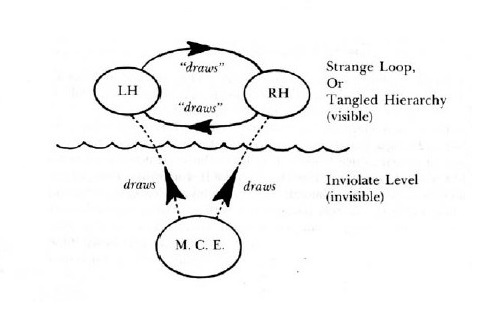
— which definitely seems paradoxical on the face of it, and which notably doesn’t give preference to one side or one hand over the other — Doug Hofstadter‘s celebrated diagram illustrates the process thus:

Hofstadter Escher hands

**

Lincoln uses this strategy in his Second Inaugural, in describing the Civil War:

Each looked for an easier triumph, and a result less fundamental and astounding. Both read the same Bible and pray to the same God, and each invokes His aid against the other. It may seem strange that any men should dare to ask a just God’s assistance in wringing their bread from the sweat of other men’s faces, but let us judge not, that we be not judged. The prayers of both could not be answered. That of neither has been answered fully.

It is to a large extent the elevation of Lincoln’s comments above partisanship into inclusivity, surely, which gives that great speech its greatness.

**

For your further consideration:

Robert Axelrod:

  • The Evolution of Cooperation, 1984
  • The Complexity of Cooperation, 1997
  • The Evolution of Cooperation, revised 2006
  • Doris Schattschneider:

  • M.C. Escher: Visions of Symmetry
  • Intelligence vs the Artificial

    Friday, January 16th, 2015

    [ by Charles Cameron — who believes that detours are the spice of life ]
    .

    Craig Kaplan:

    Craig Kaplan

    Maurits Escher:

    M Escher

    **

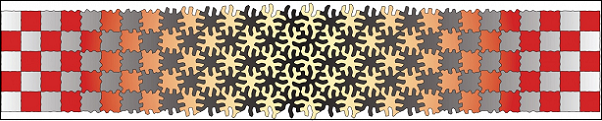
    There’s a fasacinating article about Craig Kaplan and his work with tiling that I came across today, Crazy paving: the twisted world of parquet deformations — I highly recommend it to anyone interested in pattern — and I highly recommend anyone uninterested in pattern to get interested!

    Kaplan himself is no stranger to Escher’s work, obviously enough — he’s even written a paper, Metamorphosis in Escher’s Art — the abstract reads:

    M.C. Escher returned often to the themes of metamorphosis and deformation in his art, using a small set of pictorial devices to express this theme. I classify Escher’s various approaches to metamorphosis, and relate them to the works in which they appear. I also discuss the mathematical challenges that arise in attempting to formalize one of these devices so that it can be applied reliably.

    I mean Kaplan no dishonor, then, when I say that his algorithmic tilings, as seen in the upper panel above, still necessarily lack something that his mentor’s images have, as seen in the lower panel — a quirky willingness to go beyond pattern into a deeper pattern, as when the turreted outcropping of a small Italian town on the Amalfi coast becomes a rook in the game of chess

    **

    Comparing one with the other, I am reminded of the differences between quantitative and qualitative approaches to understanding, of SIGINT and HUMINT in terms of the types of intelligence collected — and at the philosophical limit, of the very notions of quantity and quality.


    Switch to our mobile site