zenpundit.com » 2015 » January

Archive for January, 2015

Deadly PT Boat Patrols–a brief review/recommendation

Thursday, January 15th, 2015

[by J. Scott Shipman]

Deadly PT Boat Patrols

Deadly PT Boat Patrols, A History of Task Group 50.1 New Guinea 1942-43, by Allan L. Lawrence, Jr.

Late last fall a good friend suggested that I read Mr. Lawrence’s book. My friend made the connection, and Mr. Lawrence was kind enough to send an autographed copy. I read Deadly PT Boat Patrols over the Christmas break and wanted to share the title with our readers. The book is about his dad and namesake serving in the South Pacific on Motor Torpedo Boats during WWII, but really what Mr. Lawrence has crafted is a richly detailed day-by-day history of not only his father’s service, but the service of his colleagues. And when I say day by day, I mean Lawrence provides the reader with a running diary of Task Group 50.1—how they were formed and made their way to New Guinea.

Mr. Lawrence didn’t set out to write a Task Group history, however. He writes

Originally, this project was intended to be simply a photographic essay focused solely upon the Colt 1911A1 Automatic Pistol used by my father while assigned to Motor Torpedo Division SEVENTEEN in enemy waters off New Guinea. It was intended for submission to be a renowned historical pistol collectors association for inclusion, if found worthy, in their quarterly magazine. As the project unfolded, however, it became apparent that there was sufficient material of an historical nature to expand upon the original theme.

And “expand” Mr. Lawrence has done! Filled with many never before published photographs (many provided by the participants or their families) of both the men and their machines , but also of native populations, Deadly PT Boats offers the reader real insight (often in the words of the participant’s war diaries) into the struggles, dangers, and deprivations suffered and endured by the men who crewed these small fast boats. The book also has some hilarious recollections of these Sailors on liberty and the fun they had together in the midst of a brutal war.

The elder Mr. Lawrence is offered in his own words:

I like to talk about these things to anybody that is interested but you don’t find people that are interested in that kind of stuff. They’re more interested in running around with veterans plates on their cars, ya know?…I never had a dogtag—never was issued a dogtag—they said we were moving too fast. (pages 180-181)

Mr. Lawrence continued on the carnage of PT boat warfare:

It was really a nasty business—a mess, really, but those bastards were vicious, really vicious. And you couldn’t take them as prisoners. [Significant pause] Invariably you’d wind up with two or three dead bodies with their leather harnesses, their knapsacks and canvas all in the screws so you’d screw yourself up because you’d stall your engines out…So you’d come back on one engine the next day cutting the body parts and harness and stuff out from up between the screws and struts, ya know—diving down.” (page 182)

If there is a weakness in Deadly PT Boats it would be the sometimes painful level of detail and the need for a good editorial scrub, but the book is a labor of love, and if read with this in mind Mr. Lawrence takes the reader along side these young men and their lives of frustration and boredom interrupted by moments of sheer terror.

Mr. Lawrence brings the reader full circle and provides a “where are they now” or how the main characters ended up after the war. All in all, a good read.

Aficionados of WWII naval history should add Deadly PT Boats to their library as valuable contribution to the genre.

Strongly recommended.

The Islam we hope to read into Sisi’s al-Azhar speech

Tuesday, January 13th, 2015

[ by Charles Cameron — bearing in mind Ian McEwan’s comment, “General Sisi or Isis — the palindrome is apt” ]
.

Sisi speaks at al-Azhar

President Sisi speaks at al-Azhar

**

President Sisi of Egypt made a remarkable speech to the assmbled dignitaries of al-Azhar the other day. The Coptic Christian scholar Raymond Ibrahim has a translation of the relevant section:

I am referring here to the religious clerics. We have to think hard about what we are facing — and I have, in fact, addressed this topic a couple of times before. It’s inconceivable that the thinking that we hold most sacred should cause the entire umma [Islamic world] to be a source of anxiety, danger, killing and destruction for the rest of the world. Impossible!

That thinking — I am not saying “religion” but “thinking” — that corpus of texts and ideas that we have sacralized over the centuries, to the point that departing from them has become almost impossible, is antagonizing the entire world. It’s antagonizing the entire world!

Is it possible that 1.6 billion people [Muslims] should want to kill the rest of the world’s inhabitants — that is 7 billion—so that they themselves may live? Impossible!

I am saying these words here at Al Azhar, before this assembly of scholars and ulema — Allah Almighty be witness to your truth on Judgment Day concerning that which I’m talking about now.

All this that I am telling you, you cannot feel it if you remain trapped within this mindset. You need to step outside of yourselves to be able to observe it and reflect on it from a more enlightened perspective.

I say and repeat again that we are in need of a religious revolution. You, imams, are responsible before Allah. The entire world, I say it again, the entire world is waiting for your next move… because this umma is being torn, it is being destroyed, it is being lost — and it is being lost by our own hands.

**

Let me first draw a few relevant distinctions in regards to an Islamic Revolution (Sisi’s term), Reformation (cf Luther) or Enlightenment (cf Voltaire):

  • there is what Sisi would like to see
  • there is what Sisi would like to communicate
  • there is what various schools of Islam think Sisi intends
  • there is what we would like to think Sisi wants to communicate
  • there is what we would like to think Sisi would like to see
  • there is what we ourselves would like to see
  • **

    Mark Movsesian at First Things offers this caution:

    Some are praising Sisi for his bravery. That’s certainly one way to look at it. When Sisi calls for rethinking “the corpus of texts and ideas that we have sacralized over the years,” he may be advocating something quite dramatic, indeed. For centuries, most Islamic law scholars—though not all—have held that “the gate of ijtihad,” or independent legal reasoning, has closed, that fiqh has reached perfection and cannot be developed further. If Sisi is calling for the gate to open, and if fiqh scholars at a place like Al Azhar heed the call, that would be a truly radical step, one that would send shock waves throughout the Islamic world.

    We’ll have to wait and see. Early reports are sometimes misleading? there are subtexts, religious and political, that outsiders can miss. Which texts and ideas does Sisi mean, exactly?

    That last comment in particular encapsulates my own response to Sisi’s speech. When Sisi speaks of “that corpus of texts and ideas that we have sacralized over the centuries” is he referring to the Qur’an? I am certain he is not. The ahadith of Bukhari? I strongly doubt it. The accumulated corpus of fiqh? That would be my guess.

    Perhaps someone with access to the original of Sisi’s speech can clarify these matters.

    **

    In any case, it is worth noting that Sisi is not the first to make such a call.

    Prof. Ali Khan‘s paper, The Reopening of the Islamic Code: The Second Era of Ijtihad, opens with the observation:

    For more than a hundred years now, an accord has gradually emerged among Muslim scholars that Islamic classical jurisprudence (fiqh) must be reformulated to meet the needs of Muslim communities

    In more detail:

    Mainstream Muslim scholars and jurists from across the world seem to have reached a near-consensus that, although the Basic Code cannot be abandoned, it must be re-interpreted to establish legal systems that respect classical fiqh but also incorporate change. This evolutionary call — “that history, as a continuous movement in time, is a genuinely creative movement and not a movement whose path is already determined” — is made to extract Muslims from historical stalemate and expose them to ceaseless dynamism. Every day, in the words of the Quran, shines with new splendor, majesty and freshness.

    What, in Khan’s view, comnstitutes the Basic Code?

    This article is founded on a fundamental premise that the Quran and the Sunna constitute the immutable Basic Code, which should be kept separate from ever-evolving interpretive law (fiqh).

    Khan notes:

    Muslims have at least three options with respect to the Basic Code. First, they privatize faith, embrace secularism, and divorce lawmaking from the Basic Code. Second, they alter the text of the Basic Code to meet modern needs. Third, they accept the Basic Code as a permanent guide for individual and social life but see the Code as a flexible and evolutionary source.

    He then comments:

    The first option has been tried but the confrontation with religious forces opposing secularism has often maligned the secular state. The second option is unacceptable to all Islamic communities. The third option seems to be the most suitable alternative for the material and spiritual development of the Muslim world.

    I hope that provides some background to Sisi’s remarks…

    Another formulation of what we might look for from a renewal of Islamic scholarship comes from Bassam Tibi:

    To me religious belief in Islam is, as Sufi Muslims put it, “love of God,” not a political ideology of hatred. .. In my heart, therefore, I am a Sufi, but in my mind I subscribe to ‘aql/”reason”, and in this I follow the Islamic rationalism of Ibn Rushd/Averroes. Moreover, I read Islamic scripture, as any other, in the light of history, a practice I learned from the work of the great Islamic philosopher of history Ibn Khaldun. The Islamic source most pertinent to the intellectual framework of this book is the ideal of al-madina al-fadila/”the perfect state”, as outlined in the great thought of the Islamic political philosopher al-Farabi.

    And there’s plenty of reading to follow up on there…

    ** ** **

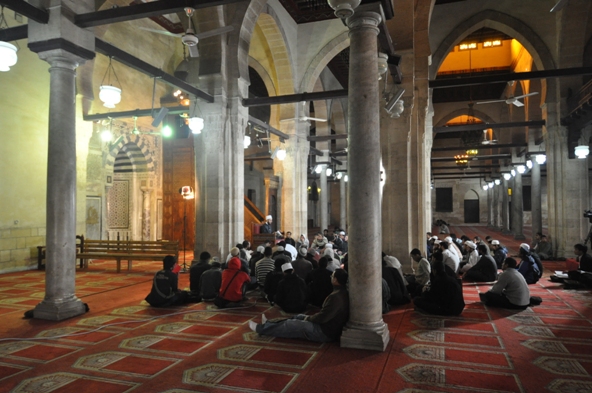
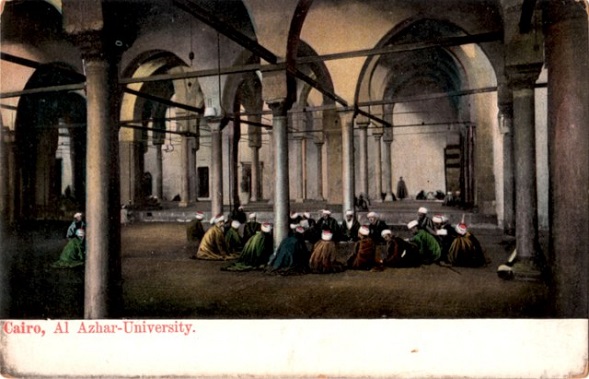
    Older even than my beloved Oxford —

    al-azhar-lecture
    A lecture in al-Azhar mosque, Cairo, 12 December 2011. Photo credit: Tom Heneghan

    A lecture at al-Azhar, undated postcard, image credit Postcard Memory Palace

    A lecture at al-Azhar, undated postcard, image credit Postcard Memory Palace

    — the tradition of Islamic scholarship at al-Azhar has been with us beyond than a thousand years.

    Aircraft Carriers and Maritime Strategy – a debate

    Tuesday, January 13th, 2015

    [by J. Scott Shipman]

    Last Friday night at the U.S. Naval Academy, retired Navy Captain Henry “Jerry” Hendrix and Commander Bryan McGrath debated the future of the aircraft carrier. My wife and I were fortunate to attend. Given the pressure placed on the Navy’s shipbuilding budget, the debate could not have been more timely. Commander McGrath argued the “nuclear aircraft carriers with air wings are the most cost effective and efficient platform to project power in the maritime and littoral realm to support U.S. national security interests in current and future security environments.” Captain Hendrix argued against this resolution. While both arguments hold much merit, I tend to side with Captain Hendrix.

    Lots of numbers and statistics were thrown around, but one issue did not enter the debate: it has been 70 years since an aircraft carrier was shot at. The lesson of the Falklands War underscores the potential power of modern precision munitions, and carriers are big targets.

    This video is highly recommended. C-SPAN also recorded the debate with a transcript here.

    Birmingham, a little light relief in tough times

    Tuesday, January 13th, 2015

    [ by Charles Cameron — all tweets guaranteed safe for the workplace ]
    .

    Steven Emerson made the mistaken claim on Fox News that Birmingham is an all-Muslim enclave — and has withdrawn his claim and apologized fulsomely in the aftermath. While Emerson is not an “expert” I’d follow or trust, I have to admit I’ve enjoyed some of the humo[u]r his claim brought forth under the #FoxNewsFacts hashtag. Here are my personal favorites:

    Qibla:

    For the record, that’s the Mecca bingo hall on Kingstanding Circle, Birmingham.

    Hijab:

    Hudud:

    Isn’t that Henry V she’s beheading?

    Keffiyeh:

    Paris, a literary DoubleQuote

    Tuesday, January 13th, 2015

    [ by Charles Cameron — I was tempted to call this post “Hebdoevsky” but resisted ]
    .

    SPEC DQ Hebdo Dosto

    **

    Today I was reminded of Dostoevsky‘s Grand Inquisitor, portrayed here in some apparently rare 1975 footage by Sir John Gielgud:

    A tip of the hat, then, to Akil N. Awan, whose post The Charlie Hebdo Attack: The Double Alienation Dilemma suggested this DoubleQuote to me.

    **

    Interestingly, The Grand Inquisitor can now be read online in at least three translations:

  • HP Blavatsky, which should be of interest to occultists
  • Constance Garnett, the old classic standby translation, nicely formatted, and
  • Richard Pevear & Larissa Volokhonsky, horribly formatted, reputedly the best modern version

  • Switch to our mobile site