zenpundit.com » 2015 » May

Archive for May, 2015

Egypt, ex-professors, death sentences, strange loops

Saturday, May 16th, 2015

[by Charles Cameron — hunh? ]
.

**

The Mufti must sign the death warrant of the man who appointed him. The professor who worked on authoritarianism in Egypt is sentenced to death by Egyptian authoritarianism. Strange loops indeed, Dr Hofstadter!

Dr Shahin has responded: Statement by Prof. Emad Shahin on his death sentence:

In another travesty of justice, an Egyptian court today issued a mass death sentence against more than 120 defendants in two cases known as the “Grand Espionage” and “Prisons Break.” I was falsely charged in the first case and I received the death sentence pending referral to the mufti. I repeat my absolute rejection of the charges against me and note that I am hardly the only victim of injustice in this case. Furthermore, I condemn the sham trials engulfing Egypt since July 2013 where wholesale death sentences on flimsy or no evidence have been the mark of the current military regime.

Ramadi

Saturday, May 16th, 2015

[ by Charles Cameron — is there an OODA loop specific to the respective tempi of adaptation? ]
.

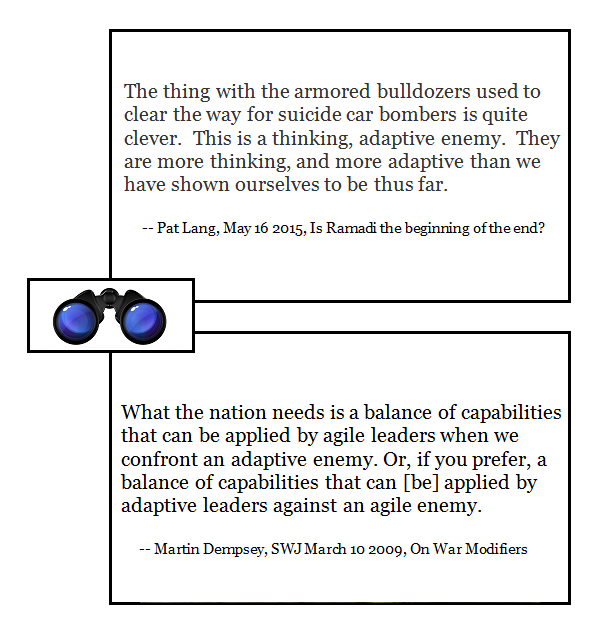
Here, I suspect — as an admitted novice — is the crux of the news from Ramadi:

SPEC DQ Ramadi

**

Sources:

  • Pat Lang, Sic Semper Tyrannis
  • Martin Dempsey, Small Wars Journal
  • The two paths of the Islamic State

    Friday, May 15th, 2015

    [ by Charles Cameron — guide books for the perplexed ]
    .

    In his latest audiotape, Abu Bakr al-Baghdadi offers two paths to those willing to follow him:

    So there is no excuse for any Muslim who is capable of performing hijrah to the Islamic State, or capable of carrying a weapon where he is, for Allah (the Blessed and Exalted) has commanded him with hijrah and jih?d, and has made fighting obligatory upon him.

    And we call upon every Muslim in every place to perform hijrah to the Islamic State or fight in his land wherever that may be.

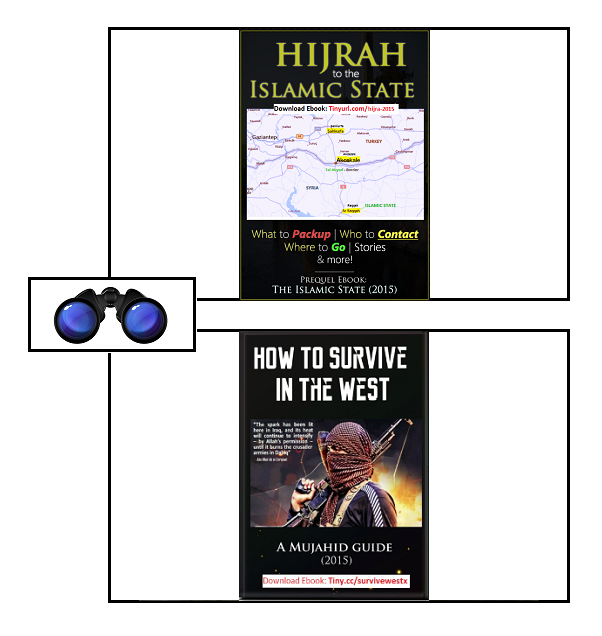
    Conveniently, there are two guidboos available in the Black Flags series, each of which deals with one of those paths:

    SPEC DQ 2 books IS

    **

    My own recommendations would be somewhat different:

  • do no harm
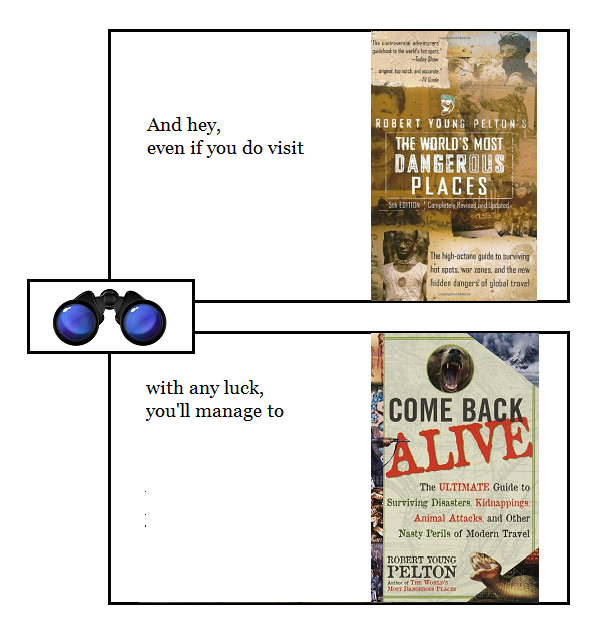
  • on the whole avoid anyplace mentioned in Robert Young Pelton‘s The World’s Most Dangerous Places, and
  • find joy in the fleeting moment
  • **

    SPEC DQ double pelton

    A song of the narco-miraculous

    Friday, May 15th, 2015

    [ by Charles Cameron — on dark spirituality, magic and apocalyptic ]
    .

    I’ve received a review copy of Tony Kail’s Narco-Cults, and by chance when I first opened it, my eye fell on a miracle story.

    **

    Here, in a clip from a narcocorrido video, is an officer of the US Border Patrol vanishing into thin air as the result of a Santeria invocation:

    narco miracle

    Here’s the book’s narrative description of that event:

    Consider the following story. A Cuban Santería priest speaks into a twoway radio as three Hispanic men cross over the border into Arizona. One of the men, who is transporting drugs under his clothes, wears several multicolored Santería necklaces (elekes). The man responds to the priest on the radio as a U.S. Border Patrol agent begins to follow him. As the “coyotes” begin to run from the agent, the agent draws his weapon and aims it at the smugglers. As the priest whispers an incantation into the radio, the agent mysteriously disappears into thin air. The men jump into the agent’s truck and drive away as the priest kneels before the image of Elegua, a Santería deity who is believed to be the owner of fate and the crossroads. mages of drug smugglers bowing in front of statues of saints and figures like Santa Muerte are seen as music begins to play away in the background.

    This is a scene from a popular narco music video called La Clika Del Elegua from Mexican musician El Pelon Avile. The video is a perfect depiction of how spiritual traditions are used by modern-day drug smugglers for protection in the drug war.

    Here’s the video of the narcocorrido in which the miracle is depicted:

    **

    Turning the page, we find:

    The heavy scent of spirituality among the cartels is so prevalent that some members of law enforcement have sought shelter in magical religions for protection. Members of the Mexican police have been documented in the media as undergoing various rituals for protection from the cartels. Some officers have even had tattoos of sacred religious symbols placed on their bodies to give them magical protection. One officer in Tijuana shared that his tattoos gave him protection from bullets that killed his comrades during a gunfight.

    How far is that from, say, this:

    Christian group brushes aside death threat from kidnappers

    Death threats against 13 Christian preachers from their Muslim extremist captors are not a concern as the evangelists are confident God will protect them, a member of the Christian ministry said Thursday.

    The kidnapped head of the Jesus Miracle Crusade, fiery televangelist Wilde Almeda, particularly has special powers that will protect him from bullets, said Robert Chua, a member of the group.

    Or for that matter:

    The Second Battle Of Adobe Walls

    A charismatic medicine man, named Ish-Ta-Ma, claimed he could make the warriors bullet proof and that his bowel movements would provide rifle cartridges. ..

    Emboldened by Ish-Ta-Ma’s prophesies, the combined tribes of Southern Cheyenne, Comanche and Kiowa, near one thousand strong, advanced towards Adobe Walls before daylight in what should have been an easy route. Fate was not in their favor.

    Or:

    Thomas Muentzer

    When the final showdown comes in 1525, the peasants are arrayed against the German princes and their army, and Thomas Muentzer continues to assure them, even at the last moment, that Christ will intervene on their side. This is the apocalyptic moment foretold in the Revelation. They’re singing hymns. They literally are awaiting a glorious triumph. Muentzer assures them that he will catch the cannonballs in his shirthsleeves. Of course, it turned into a slaughter. Five thousand ill-equipped peasants were slaughtered. The Peasants’ Revolt was utterly destroyed. It was one of those incredible explosions of apocalypticism that arise in history.

    Cognitive Tools for Creative Thinking

    Friday, May 15th, 2015

    [by Mark Safranski, a.k.a “zen“]

    It has been some time since I have touched upon this topic. Recently though, I initiated a discussion at work on ways to enhance and stimulate creativity and  creative thinking and presented a suite of methods for generating and refining ideas. I didn’t get into the insight-based aspects of creativity, nor the high-level kinds of synthesis you see with people who have genuine mastery over a field or domain. My focus was more on developing people’s ability to think divergently, generate or recognize novel ideas and then refine or develop them.

    Therefore, many of these are active, intentional exercises or strategies. They tend to be productive but their creativity is not quite the same as what is produced, say, when a skilled musician is “jamming”, an inventor is tinkering or a painter or scientist is experimenting in the “flow“.  The following are also not an exhaustive list:

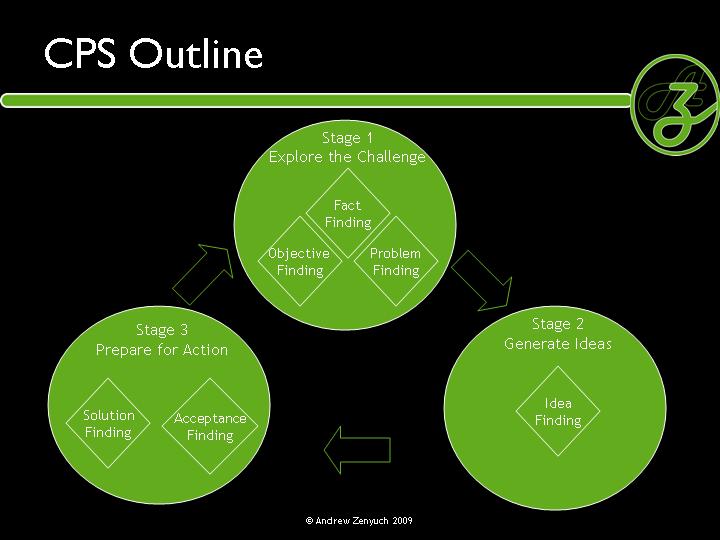
    Creative Problem Solving (CPS)

    Developed by Alex Osborn and Sidney Parnes, CPS seeks to harness Divergent and Convergent thinking in a holistic, multi-step, learning process. In essence, the students are sequentially alternating between Generating ideas and Focusing on refining, evaluating, applying them until the “problem” is solved. This is one of the older models of instilling creative thinking and has been widely used, particularly for well-defined or technical problems.
    Edward DeBono Lateral Thinking Exercises

    DeBono developed a system of forced choice and association exercises that are well suited to promoting critical and creative thinking at the same time as students address a concept or activity. Lateral Thinking exercises lend themselves naturally to being made into graphic organizers or as leading questions in class or group discussion. Some examples:

    PMI – “Plus, Minus, Interesting”                             OPV – “Other People’s Views    

    ADI – “Agreement, Disagreement, Irrelevant”  APC – “Alternatives, Possibilities, Choices”

    EBS – “Examine Both Sides”                                      CAF – “Consider All Factors”

    HVLV – “High Value, Low Value”                             AGO – “Aims, Goals, Objectives”

    TEC – “Target, Explore, Conclude”                          PISCO – “Purpose, Input, Solutions, Choice”

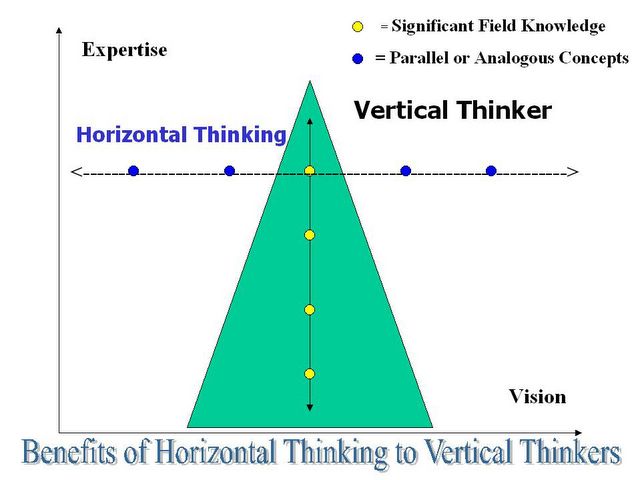
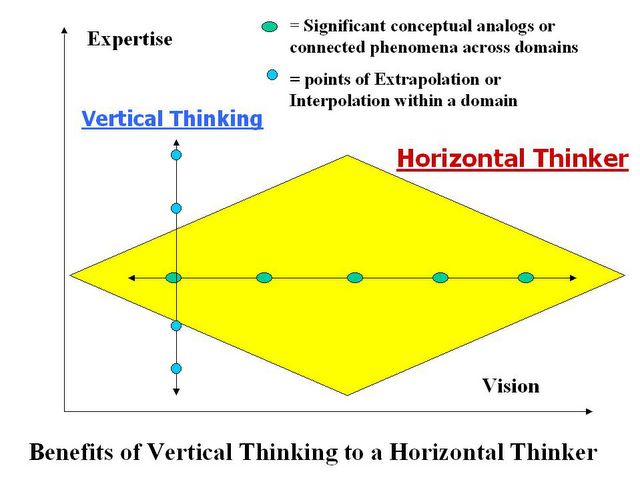
    Related to Lateral Thinking, but not the same, is Horizontal Thinking. While the former are concrete exercises, horizontal thinking is using a familiar area of knowledge to look for analogies and patterns in less or unfamiliar fields. Both Lateral and Horizontal thinking differ from the traditional model of analytical-reductionist Vertical Thinking associated with critical thinking done within a subject matter field. Vertical thinking and Lateral/Horizontal thinking complement one another


    Variations on “Brainstorming

    We all have used brainstorming. There are some ways to make brainstorming more productive.

    Ideational Pools – Ask a series of open-ended questions to a group that creates a much richer, single “pool” of ideas than simple brainstorming

    Uses, Instances, Similarities – this is usually about a physical object and the purpose is to generate as many alternatives as possible – i.e. “How many different uses can you think of for a piece of rope?”. It is both divergent and lateral thinking as an activity.

    Synectics – Extends brainstorming by taking the results and developing metaphors, similes, metonymy/synedoche that describe/explain them

    Group Roles (or stages)

    1. Generator: Comes up with ideas
    2. Conceptualizer: Organizes, categorizes, renames ideas
    3. Optimizer: Refines ideas with a view to action – the “How”
    4. Implementor Takes action


    Morphological Synthesis

    Morphological synthesis works through decomposition and forced association, There are several variations but it works best with well-defined problems. Examples.

    1. Define the problem or identify a thing. List all of the attributes.
    2. Combine and re-configure attributes in new ways

    or

    1. Divide problem into parts
    2. Develop a solution for each part
    3. Combine solutions


    Critical Question Mapping

    A system of fast learning, developed by friend of ZP Dr. Terry Barnhart, discovers the “what” of a situation by having everyone brainstorm all of the critical questions that must be answered to find a solution. No declarative statements may be made, only questions asked. After the group has exhausted the potential questions, the questions can be organized into clusters, a learning strategy, divided for research, etc.


    Scenario Exercises

    The use of imaginative but realistic premises for a thought experiment and discussion. Popular in the fields of futurism, alternative history and physics, they allow the students to explore reasons behind making decisions, constructing hypothetical, framing problems or as an allegorical experience before exploring the real situation or problem. Scenarios come in different forms and draw on both critical and creative thinking:

    Counterfactual: Ex- “What if the South won the Civil War?”

    Futurist: Ex- Imagine a world entering a new ice age – how would Illinois ecosystems be impacted by the climate change?”

    Physical: Ex- “Schrodinger’s Cat”

    Paradoxical: Ex – “Could a man travel through time and kill his own grandfather? Could you drown in the fountain of eternal life?”


    Doublequotes

    Juxtaposing opposing or incompatible authoritative views to encourage synthesis or reflective choice. This is a favorite technique of Charles Cameron in his Hipbone method of analysis that he employs regularly here at ZP.


    Moral Reasoning

    Like Scenarios, moral reasoning and ethical dilemmas push people to think both creatively and critically. Example:

    “A madman who has threatened to explode several bombs in crowded areas has been apprehended. Unfortunately, he has already planted the bombs and they are scheduled to go off in a short time. It is possible that hundreds of people may die. The authorities cannot make him divulge the location of the bombs by conventional methods. He refuses to say anything and requests a lawyer to protect his fifth amendment right against self-incrimination. In exasperation, some high level official suggests torture. This would be illegal, of course, but the official thinks that it is nevertheless the right thing to do in this desperate situation. Do you agree?”

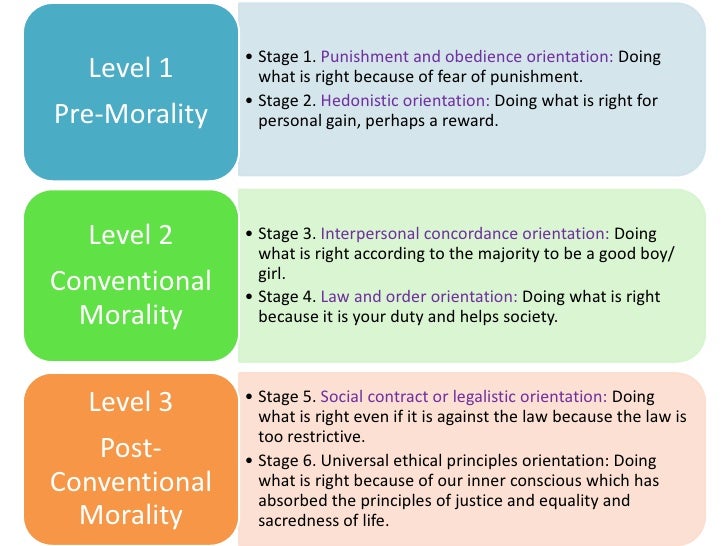
    Many ethical dilemmas and student solutions can be analyzed according to Kohlberg’s Stages of Moral Development but the value for creative thinking is in creating the conditions of a forced choice requiring a resolution.


    What techniques do you use for creativity?


    Switch to our mobile site