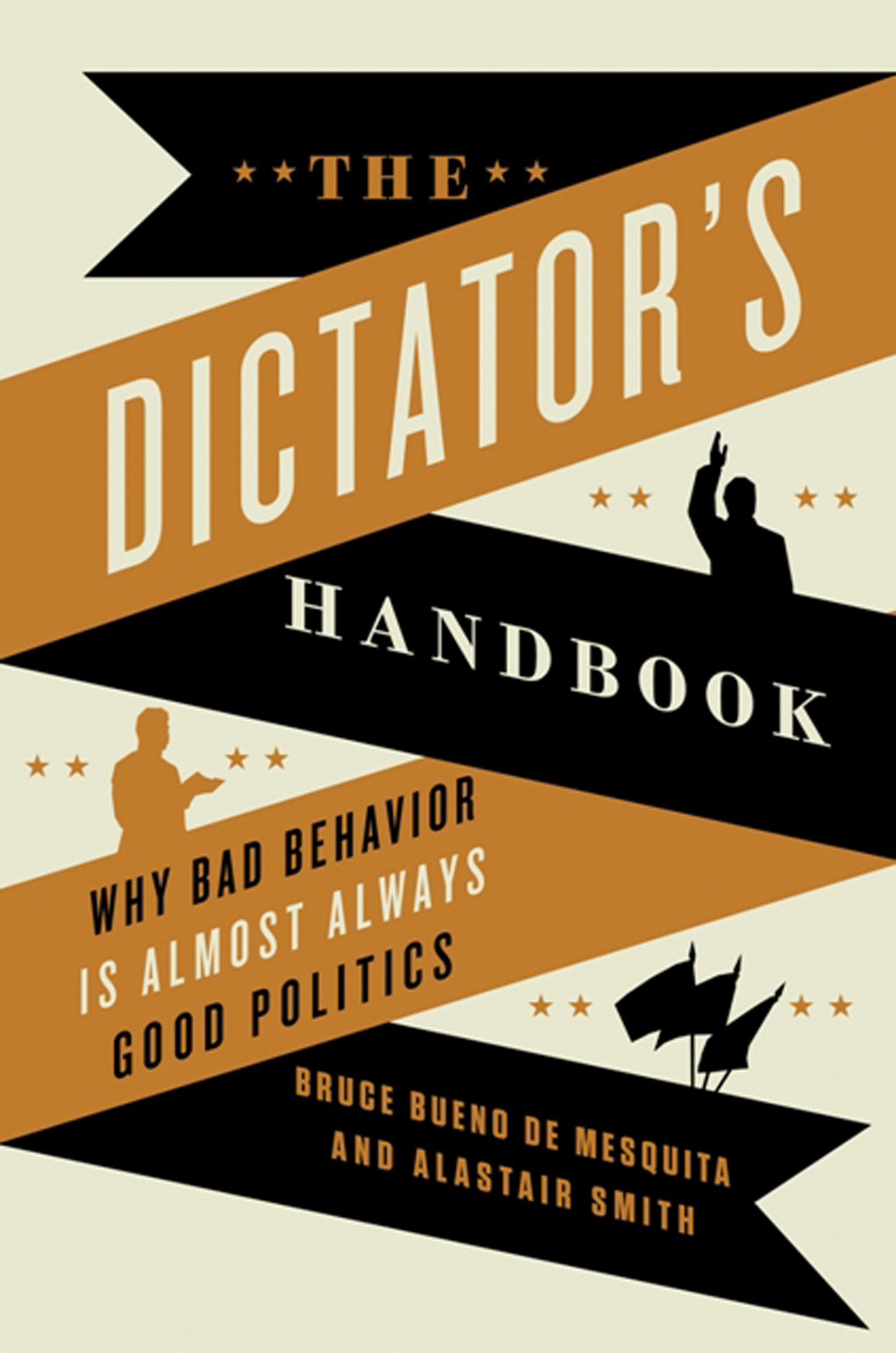
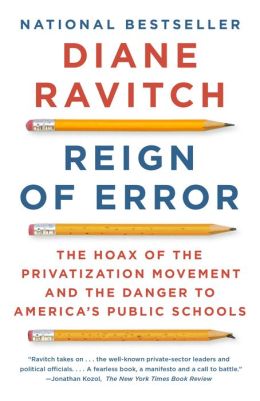
I am mostly finished with Reign of Error and The Five Percenters. The former is a devastating and methodically documented critique by historian and former Bush I administration official Diane Ravitch of a crony capitalist network’s effort to hijack public education and its revenues under the guise of reform. The latter is a friendly journalistic history of the often feared and widely misunderstood Five Percent Nation, which split away, at times violently, from the better known Nation of Islam of Elijah Muhammed and Louis Farrakhan. Knight’s objectivity is somewhat suspect here as he himself became a rare white Muslim Five Percenter (a.k.a. “Azrael Wisdom“) and apologist, but his closeness to the group’s insiders cannot be denied.
[ by Charles Cameron — two books of the same name ]
.
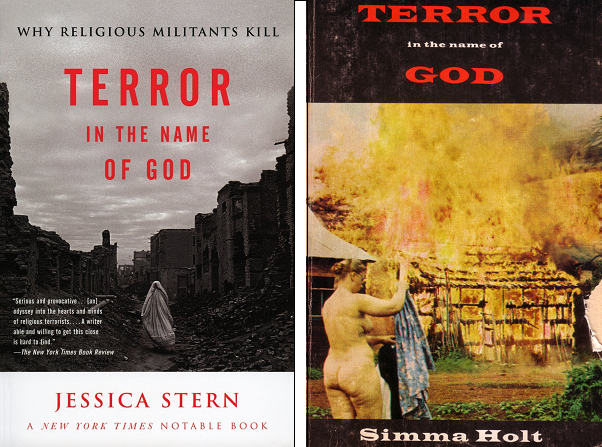
I have long been an admirer of Jessica Stern‘s Terror in the Name of God, which benefits greatly from the author’s intrepid insistence on visiting and debriefing those religious militants from around the world she wishes us to understand. Imagine my surprise, therefore, at discovering yesterday a book with the same title, written by one Simma Holt, published in 1964, and dealing with religious violence as practiced by the Svobodniki or Sons of Freedom sub-group of the Doukhobors or Old Believers:
**
I haven’t been on a thrift-store book run in a couple of years, and yesterday’s jaunt with son Emlyn rewarded me with three or four items, of which this was the standout — albeit my copy lacks the lurid dust-jacket.
The Old Believers have interested me for some time now, but I haven’t known much about them. Apparently their split (“Raskol”) from the larger body of Russian Orthodoxy was in opposition to reforms intended to align the Russian with other Orthodox patriarchies in terms of practice — the one change I’d run across having to do with the substitution of the sign of the cross made with two fingers by the sign made with three fingers.
I am accordingly very interested to see what more I can learn about the Old Believers in general and in particular the Svobodniki, their doctrine of “Opposite Speak” and their theological sanctions for arson and murder.
Now too, I get to explore Aylmer Maude‘s 1904 book on the Doukhabors, A Peculiar People. That phrase — more fully, “ye are a chosen generation, a royal priesthood, an holy nation, a peculiar people” (I Peter 2.9) — has always pleased me, and Maude’s Christian name, a relatively uncommon one I believe, is my own second name, and the name of one of my uncles.
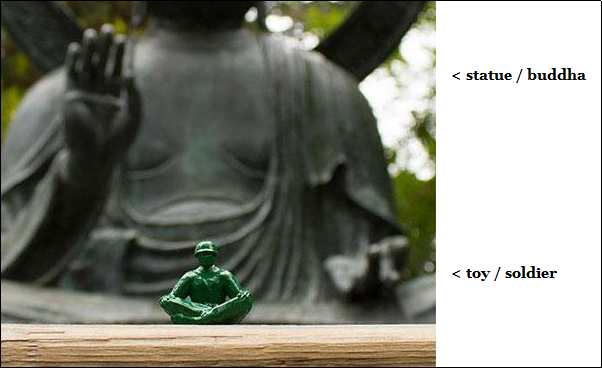
If something is a total opposite to war, that is the practice of yoga. Concentrating or relaxing your muscles and mind in order to release tension, is something a soldier would never have the luxury to do under the dangerous circumstances of war.
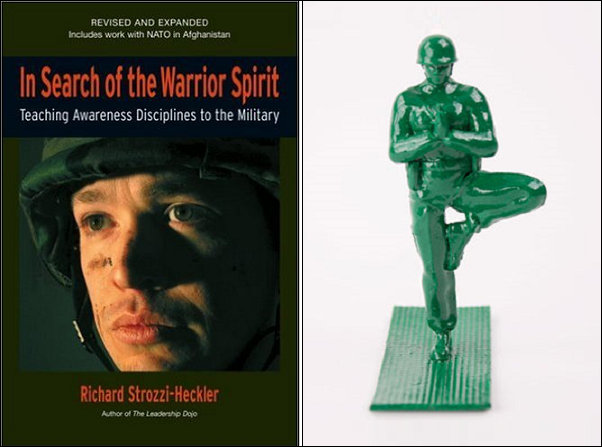
Inventor Dan Abramson thought of a amazingly creative and beautiful way to connect the two, by creating “Yoga Joes”, a series of simple green plastic army men that have some killer… yoga moves.
Apart from artistically interesting, Abramson’s cool idea to create a series of yoga soldiers gives an essence of serenity to the cruel and violent nature of war.
“I made Yoga Joes because I thought that it would be a fun way to get more people into yoga – especially dudes… beyond that, I wanted to make a violent toy become peaceful,” he says.
That’s glib, and wrong, and not too far from what many people think who identify with the “peace” side of “war and peace”.
**
Richard Strozzi-Heckler, on the other hand..
Well, he was one of them, teaching Aikido, arguably the most openly pacifistic of the martial arts — and when he got invited to train some Green Berets, in the words of George Leonard:
Even before the program got started, Richard was excoriated by people he respected for even considering teaching aikido and other awareness disciplines to Green Berets, to “trained killers.”
Leonard goes on to ask some probing questions:
Does this imply that those of us who love peace would have no soldiers at all? And if we do have soldiers, do we really want them to be deprived of the best possible training? Do we want low-grade soldiers with no awareness or empathy? And if we do teach awareness and empathy to our soldiers, will they be able to perform the brutal tasks sometimes assigned them? Surely we don’t want a horde of Rambos loosed upon the world. But if not Rambo, then who?
**
Think for a minute:
If something is a total opposite to war, that is the practice of yoga.
If I asked you, what is the opposite of yoga, would you say war?
And what’s the opposite of peace?
I wrote above of those who identify with the “peace” side of “war and peace” — and there are, by contrast, those who who identify more readily with the “war” side — but are those two sides “at war” with one another? Can, to press the point, “peace” be “at war” with anything?
So I say to you –
This is how to contemplate our conditioned existence in this fleeting world:
Like a tiny drop of dew, or a bubble floating in a stream;
Like a flash of lightning in a summer cloud,
Or a flickering lamp, an illusion, a phantom, or a dream.
[ by Charles Cameron — mind of a skeptic, heart of a devotee ]
.
I’m heading the post with this video to capture your attention, but recommend you move right past it to the body of the text, and return to it later if and when you have an hour and more to spare:
**
I quoted Daveed Gartenstein-Ross in my post We’re a legacy industry in a world of start-up competitors as saying “we tend to think of ideas that are rooted in religion – as a very post-Christian country – we tend to think of them as not being real – as ideas which express an ideology which is alien to us” — and Dave Schuler commented:
I can’t help but think that is a point-of-view most comfortable to a Jew who has lived mostly in Oregon and on the East Coast of the United States. The view looks pretty different from the South, Peoria, or even the South Side of Chicago.
The question as to whether we live in a post-Christian or Christian country maps fairly closely, I think, onto the question whether the world we live in is a secular or religious world — and it’s that form of the distinction I’d like to address in this post.
Statistically, 70.6% of Americans polled by Pew consider themselves Christian, 5.9% either Jewish, Muslim, Hindu, Buddhist, or of other faiths, as against 22.8% unaffiliated, atheist or agnostic. America is clearly a predominantly Christian nation from that point of view.
It seems to me, however, that there are two ways of looking at our nation and world as secular — via recourse to structure, and via consideration of our media, analytic, and policy-making elites — and I want to offer up an example of each, as I found them in the last few days.
**
The first comes from a simply terrific lecture delivered at Stanford by Roberto Calasso in honor of his friend René Girard — as found at the head of this post:
One point is clear, that the world, for the first time, is covered by a sort of — entity — which is that entity which makes that airports in all parts of the world work more or less in the same way. And that is the way of the secular society. And of course if you go from the French airport to the cities, or from a German airport to the cities, you’ll find totally different things – but behind that, there is a structure which is common to all of the societies. And of course, there are very large islands of theocratic (or whatever you can call them) societies which are enemies of the secular society. But they are islands, rather large islands, in the middle of a texture which is much bigger.
There are economic and scientistic corollaries to this point, to be sure, but the point itself, the approach it takes, is one that I had vaguely surmised, perhaps, but have never before expressed nor seen expressed with such clarity.
We live in a world tilted towards short-cuts, not immersions — surfaces, not depth — and simply put, that predisposes us to the quantifiable and away from quality..
That’s one sense in which we live in a secular world — irrespective of our religious beliefs and disbeliefs.
*
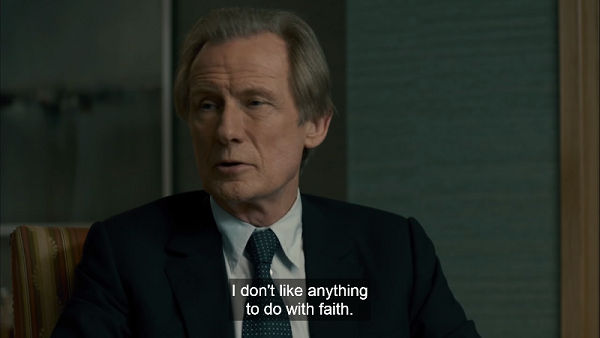
But it is also the case that those who understand the world on our behalves — pundits, analysts and policy-makers — tend to do so in secular terms. I’ve read this idea, and indeed said it, many times, so rather than search out some appropriate quotes, I pounced on this screen capture from David Hare‘s brilliant movie, Page Eight, in which the senior MI5 analyst Johnny Worricker, played by Bill Nighy, speaks:
The Worricker Trilogy is on Amazon Prime now, if you have access. You’ll find some fine writing there..
Zenpundit is a blog dedicated to exploring the intersections of foreign policy, history, military theory, national security,strategic thinking, futurism, cognition and a number of other esoteric pursuits.