zenpundit.com » 2015 » October

Archive for October, 2015

On the Tower of Babel as a National Security issue

Saturday, October 17th, 2015

[ by Charles Cameron — bilingual politics and forked tongues, also the KJV ]
.

SPEC languages

Sources:

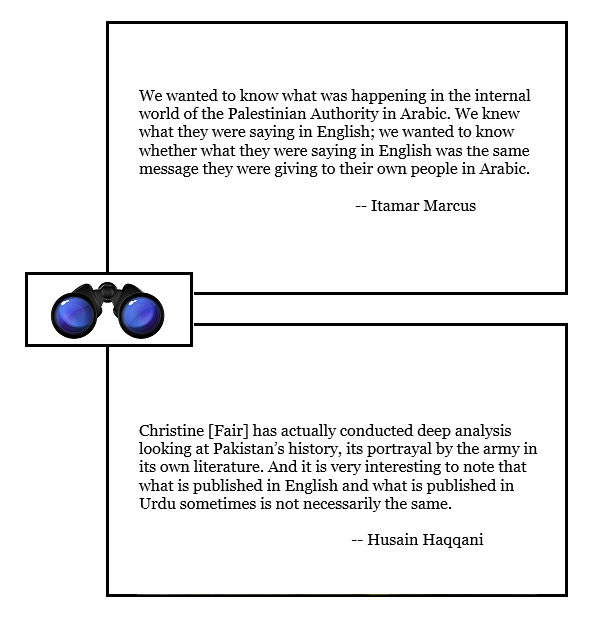
  • Husain Haqqani, upper panel
  • Itamar Marcus, lower panel
  • If you watch the two videos linked above, from which these quotes were taken, you will glimpse the stunning degree to which the use of native languages other than English permits the transmission of messages to local populations to which we are not privy, and which indeed may dangerously contradict the messages emanating from those same sources for international consumption in English.

    Flashback to 1979:

    On October 15, 1979 the members of the President’s Commission on Foreign Language and International Studies submitted their report to President Jimmy Carter. This multifaceted document of 150 pages presented 65 recommendations directed toward ameliorating what the report described as “America’s scandalous incompetence in foreign languages.” Woven into these recommendations and their supporting texts were no fewer than 70 references to study abroad, international exchanges and/or overseas experiences. The frequency with which these references appeared suggests that the members of the commission were convinced that such experiences, in and of themselves, would play a major role in altering the sorry state of affairs in which the United States found itself with respect to the learning of second languages.

    How are we doing, thirty-five years on, and how will we be doing five, ten years from now?

    **

    On a lighter note:

    The English language is supreme — God speaks it. As one writer on the internet notes with regard to translations of the Bible other than the King James Version:

    The new versions have been translated in America, which is not a monarchy. God’s form of government is a theocratic monarchy, not a democracy. Therefore, it makes perfect sense that His word would be translated for the English speaking people under a monarchy with an English king. I know the King James Bible is the word of God because it was translated under a king.

    I kid you not / just kidding.

    Paintful humor in wake of Ankara bombing

    Thursday, October 15th, 2015

    [ by Charles Cameron — in which 359 turns out to be just a degree closer to zero than 358 is ]
    .

    **

    For those Zenpundit readers no more fluent in Turkish than I am, Acting Prime Minister Ahmet Davutoglu‘s interview above was reported by Today’s Zaman:

    During the interview on Wednesday night Davutoglu also commented on the Ankara bombings on Saturday which left nearly 100 people dead in a suspected Islamic State of Iraq and the Levant (ISIL) attack. “There is a 360-degree, not 180 degrees, difference between the Islam we defend and daesh has in its mind,” the acting prime minister said in an apparent gaffe that sparked a series of tweets mocking his statements which meant the government and ISIL are on the same page on their interpretation of Islam. Daesh is the Arabic acronym for ISIL.

    “Davutoglu said there is a 360-degree difference between ISIL and them. They would sue others who would say that,” academic Koray Çaliskan said.

    “Professor Prime Minister Ahmet Davutoglu, a closed disc has 360 degrees,” Liberal Democratic Party (LDP) leader Cem Toker tweeted, recalling that Davutoglu is a professor.

    **

    Today’s Zaman also quoted the “famous Turkish geometry teacher” whose classes on YouTube have garnered him an impressive following, Mustafa Mete Ekolan aka Ekol Hoca. Ekol tweeted the following graphic illustration today:

    **

    It’s worth noting that Today’s Zaman Editor-in-Chief Bulent Kenes was released pending trial today. A fine legal point made by his defense lawyer:

    Gunaydin said in the petition to the court there is no crime in the Turkish Penal Code (TCK) for “sending tweets.”

    DoubleQuote as Match Cut

    Monday, October 12th, 2015

    [ by Charles Cameron — further passing notes in the virtual music of ideas, including meditations for glass bead game players ]
    .

    From the agile algorithmic eyes at Archillect:

    A match cut or graphic match in cinema is, in Wikipedia’s words,

    a cut in film editing between either two different objects, two different spaces, or two different compositions in which objects in the two shots graphically match, often helping to establish a strong continuity of action and linking the two shots metaphorically.

    **

    Perhaps it’s time to post my Meditations for Glass Bead Game Players:

    i

    First, I ask you to consider the rhyme of “womb” with “tomb” — which has the delicious property that these two words describe, if you will, the two chambers from which we enter this life and through which we leave it. Not only do the two words rhyme on the ear, in other words, they can also be said to rhyme in meaning. Meditation: if you were wearing headphones, and these two words were spoken, what would the stereophony of their meanings be?

    ii

    Next, I would invite you to consider visual rhymes — known as “graphic matches” in film studies. Take, for instance, lipstick and bullet. To rephrase the opening of a book I am still working on:

    The conjunction comes from a Yardley’s cosmetic advertisement of a few years back: a woman model wearing a leather bandolier with a variety of lipsticks in place of bullets. It is a powerful image partly because it plays on the visual similarity of bullets and lipsticks, each in their own metal jacket. Indeed, the visual match between them is astonishing — and the lurking Freudian visual pun only adds to our delight.

    The juxtaposition of lipstick and bullet I take to be an example of a certain kind of visual logic, a visual kinship. Transposing their relationship from visual to verbal terms, one might say that lipstick and bullet “rhyme.”

    But there is more than the purely visual here too… There is also a meaning rhyme that echoes in Freud’s pairing of Eros and Thanatos, in Wagner’s Liebestod, in Woody Allen, and in the opening sentence of Bedier’s Tristan and Iseult:

    My Lords, if you would hear a high tale of love and death…

    Meditation: what is the stereophany (by analogy with epiphany, theophany — neologism intended) of the meanings of lipstick and bullet?

    iii

    Consider next musical rhymes — fugal treatment of a theme — and if you have the means, play yourself Bach’s Chromatic Fantasia and Fugue, BWV 903, or Passacaglia and Fugue, BWV 582…

    iv

    Next I would ask you to consider — briefly — rhymes between ideas themselves… Ponder, for instance, the twin themes of the myth of Narcissus, and the rhyme that exists between the idea of “echo” and that of “reflection”…

    v

    Consider rhymes between things, between names and the things they name (onomatopoeia), and between ideas and names and things and musical themes and images:

    Seen together, aerial maps of river estuaries and road systems, feathers, fern leaves, branching blood vessels, nerve ganglia, electron micrographs of crystals and the tree-like patterns of electrical discharge-figures are connected, although they are vastly different in place, origin, and scale. Their similarity of form is by no means accidental.

    G Kepes, New Landscapes of Art & Science

    When the surf echoes and crashes out to the horizon, its whorls repeat in similar ratios inside our fleshåWe are extremely complicated, but our bloods and hormones are fundamentally seawater and volcanic ash, congealed and refined. Our skin shares its chemistry with the maple leaf and moth wing. The currents our bodies regulate share a molecular flow with raw sun. Nerves and flashes of lightning are related events woven into nature at different levels.

    Grossinger, Planet Medicine

    The links of association that are possible between one thing and another are extraordinary, and rhymes of the sort we have been discussing are just the beginning… On being asked:

    What is the intersection of fish and flames?

    my list-colleague Barbara Weitbrecht responded:

    Fish being cooked … flame-colored fish … fish flickering through sunlit water like flames … things to do with water: one in it, one antagonistic to it … fish and flames both images of sleep, of subconscious ideas surfacing, of revelation … fish and flames both images of the Deity ….

    vi

    Consider all things as the calligraphy of a god or gods…

    vii

    Consider, finally, the stereophany between these two elegant paragraphs, one written by the contemporary American poet and naturalist, Annie Dillard, and the other by her compatriot Haniel Long:

    My friend Jens Jensen, who is an ornithologist, tells me that when he was a boy in Denmark he caught a big carp embedded in which, across the spinal vertebrae, were the talons of an osprey. Apparently years before, the fish hawk had dived for its prey, but had misjudged its size. The carp was too heavy for it to lift up out of the water, and so after a struggle the bird of prey was pulled under and drowned. The fish then lived as best it could with the great bird clamped to it, till time disintegrated the carcass, and freed it, all but the bony structure of the talon.

    Haniel Long, Letter to Saint Augustine

    And:

    And once, says Ernest Seton Thompson–once, a man shot an eagle out of the sky. He examined the eagle and found the dry skull of a weasel fixed by the jaws to his throat. The supposition is that the eagle had pounced on the weasel and the weasel swiveled and bit as instinct taught him, tooth to neck, and nearly won. I would like to have seen that eagle from the air a few weeks or months before he was shot: was the whole weasel still attached to his feathered throat, a fur pendant? Or did the eagle eat what he could reach, gutting the living weasel with his talons before his breast, bending his beak, cleaning the beautiful airborne bones?

    Annie Dillard, Teaching a Stone to Talk

    These are the rhymings of the ten thousand things. It is with such meditations as these that we may build the “hundred-gated cathedral of Mind” to which Hesse refers…
    And that “brings us by a commodius vicus of recirculation back” to my post, DoubleQuotes — origins, of just a few days ago.

    Whose mind hath the finer blade?

    Monday, October 12th, 2015

    [ by Charles Cameron — robert frost, the poet, or yogi berra, the player? ]
    .

    SPEC Frost Yogi

    **

    Also of interest, Frost‘s comment, quoted on the Classic Poetry Pages:

    One stanza of ‘The Road Not Taken’ was written while I was sitting on a sofa in the middle of England: Was found three or four years later, and I couldn’t bear not to finish it. I wasn’t thinking about myself there, but about a friend who had gone off to war, a person who, whichever road he went, would be sorry he didn’t go the other. He was hard on himself that way.

    As that page shows, I’m certainly not the first to note the overlap between Robert Frost and Yogi Berra — but it caught my attention today as I was reading a comment on Scott Aikin and Robert Talisse‘s On Some Yogisms:

    And “When you come to a fork in the road, take it,” was his joking way of giving directions to his NJ home. You could get there by going either way once you reached the fork he was referring to; both roads led to his house eventually.

    That gives a literal context to Berra’s flight of fancy — and yeah, some roads are looped, it’s true — but without the wit, there’s be no wisdom.

    **

    Witty Wittgenstein, as apparently quoted by Ray Monk and in the Aikin and Talisse piece:

    A serious and good philosophical work could be written consisting entirely of jokes.

    The Ideal and the Real? Or: Doctors got there first

    Sunday, October 11th, 2015

    [ by Charles Cameron — together with a hypothesis about sanctity and insanity ]
    .

    SPEC Ideal and Real

    Either way, I don’t really find the idea of attacking hospitals appealing.

    **

    See:

  • Alex Tabarrok, The Atlantic, The Case for Getting Rid of Borders — Completely
  • Tim Craig et al, Washington Post, By evening, a hospital. By morning, a war zone
  • Médecins Sans Frontières
  • Hypothesis:

    When the pent up energy of the ideal releases into the real, the impact is somewhat analogous to that of thunder and lightning: the shock-wave gets the human conductor of the discharge labelled “insane” while the flash of illumination gets the same person acclaimed as “a saint”.

    One significant differences is that here the shock-wave almost always precedes the flash of light — which can take quite a while to become generally visible..


    Switch to our mobile site