— Pablo Picasso JAG (@GuernicaArtWork) May 6, 2012
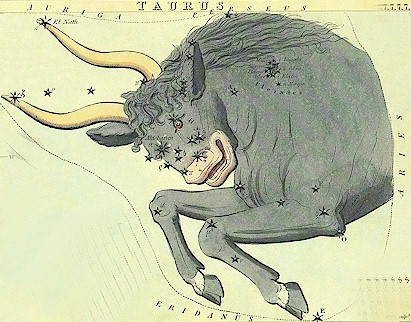
Isn’t that a bull’s head in cloth, hanging right above the shoulder of the leaping boy in the Syrian image — and isn’t that alnmost exactly Picasso’s swooping white head, again in cloth, just to the right of it? The illusion of their similarity is enhanced by the aspect ratio of the Twitter image from Syria, which cuts off a stretch of green in the original photo, just below the image as you see it here..
**
But it may be I’m seeing this because the bullfight and tauromachia have been on my mind recently — mythic combats of man pitted agains one of his worthiest opponents. There’s an archaic resonance there that’s inmportant in some way, but the actual killing of the bull, blood in the sand, horrifies me, the animal descending from grandeur to humiliation, its bowed head propped on one horn as it awaits finality — terrible.
And I was accordingly happy to recall the less violent version of the sport, still pitting man’s skill against adversary — in the bull-leaping of Knossos:
[ by Charles Cameron — laïcité meets the banlieue, and ISIS takes note ]
.
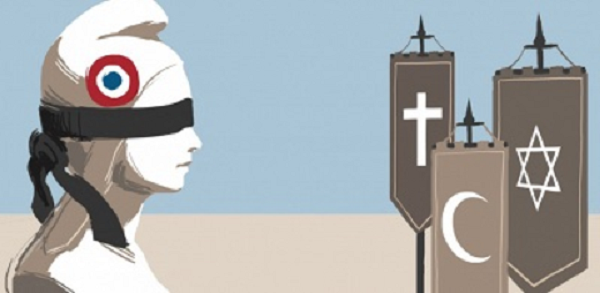
France: blind to religions. Graphic: Nouvel Obs
**
My latest piece is up at LapidoMedia, addressing the impact of the French doctrine of blinding secularism on French Muslims — and ISIS targeting of France:
ANALYSIS When laïcité destroys egalité and fraternité
FRANCE and ISIS have a special enmity, and it is compounded by the French form of secularism, known as laïcité.
France’s colonial history and policy of state-reinforced religion blindness adds special intensity to the confrontation.
It is important to understand how particularly powerful the animosity is.
France’s contribution to the coalition attacks on ISIS in Iraq and Syria is second only to that of the United States.
While France had a thousand troops in theatre in March 2016, the UK by comparison had only 275, with Germany at 150, and Belgium at 35.
Meanwhile, close to two thousand fighters of French origin are reported to have joined ISIS forces – more than any other western European country.
Jihadist attacks in France have included the Charlie Hebdo attack in January 2015, the November attack at the Bataclan concert hall later that year, this year’s Bastille Day attack in Nice, and the gruesome killing of Fr Jacques Hamel in Normandy, also in July.
An ISIS video released in mid-August encouraged further Nice-like attacks on France.
Charlie Winter, a researcher who follows Isis media closely, said of Rumiyah: “Intriguingly, it features relatively little original content, suggesting Isis is having to cut corners in its media operations.”
It is not clear if the new magazine has replaced the main Isis title, Dabiq, which has appeared sporadically in recent months. Dabiq is named after a town in northern Syria where Isis believes a Koranic prophecy foretells the final victory for a Muslim army against an alliance of world armies before the apocalypse. Syrian rebel and Kurdish fighters are now less than five miles from taking the town.
“If you put out a publication about a place you no longer control it might raise eyebrows,” said Raffaello Pantucci, the Royal United Services Institute’s director of international security studies.
Okay, I’ve included the Charlie Winter and Raff Pantucci quotes because they’re both germane to the bigger question of how ISIS is faring these days. It’s the middle paragraph that disturbs me.
**
Dabiq in the Qur’an?
On the contrary — it’s not even in David Cook‘s two seminal books about Islamic end-times writing, ancient or modern, nor in J-P Filiu‘s Apocalypse in Islam.
Dabiq (the town) was mentioned by Abu Mus’ab az-Zarqawi (died June 2006) in a quote featured at the start of the first issue of Dabiq, the ISIS magazine (july 2014):
The spark has been lit here in Iraq, and its heat will continue to intensify – by Allah’s permission – until it burns the crusader armies in Dabiq.
The last page features the longish hadith that backs up Zarqawi’s point — I posted the whole thing just the other day in A Tale of Two Places – Dabiq and Rumiyah. And Will McCants gives it the detailed treatment in his fine book, The ISIS Apocalypse.
But the Qur’an?
Dabiq simply isn’t there. And yet three Times writers think — let me repeat —
Dabiq is named after a town in northern Syria where Isis believes a Koranic prophecy foretells the final victory for a Muslim army against an alliance of world armies before the apocalypse.
And so Times readers get the impression ISIS is basing its worldview on the strongest possible Islamic authority, when in fact it’s using a little-known saying attributed to Muhammed by Abu Hurayrah.
Bearing in mind Abu Hurayrah’s intense dedication to learning hadith, his devotion to the Prophet, and the various tests which were applied to his memory and scholarship by his contempories during his life, it appears very unlikely he himself fabricated any hadith. This does not mean, however, that material was not falsely imputed to him at a later date. The fact he narrated a uniquely large number of traditions itself did make inventing hadiths in his name an attractive proposition.
**
And not a fact checker in sight.
It all kinda makes LapidoMedia‘s point, doesn’t it? We need religious literacy in journalists who deal with current events that include sugnificant religious influences..
The second of my five religions, Zen Buddhism, came about entirely as a consequence of a famous tale you allude to in your wonderful letter.
After quickly rocounting the tale in question — about the Zen patriarch Hui Neng and the “finger pointing at the moon” which should not be mistaken for the moon itself, he went on:
I spent a great deal of time that night meditating upon the gloriously full moon, a little about my finger, and a great deal about the space in between. Space. The space between. The space beyond. When I could be any or all of these, I went to bed. I thought to myself: How arbitrary it is that we should see ourselves as the finger, and as not-the-moon, when we might just as well consider ourselves the spaces in between – since without that, we could never be not-anything!
This lunar encounter served me well until about five years later I hit a terrifying crisis of identity when I lost faith in any ability to use words to communicate at all. I began to fray at the edges… If everyone’s words were their own symbols, how could we ever manage to communicate? Did we? Or were we just braying at each other at random, each one watching a different play on the stage we had been thrown together upon?
**
That phrase “the spaces in between” is particularly interesting when you think of it as referencing the space between word and what it refers to, the word “moon” and the up-there orb, the moon. You might think, “there’s no such space between, they’re in different realms, is all” — but there is a between, it’s the relationship. And that’s what all my HipBone & DoubleQuote Games are about — the relationship (mapped along a linking line, aka an “edge”) between two concepts (“nodes”). Because relationship is the essence of their antecedent, Hesse‘s Glass Bead Game. And of all relationships, perhaps those between name and thing, finger and moon, map and territory, moon and enlightenment, are among the most fascinating.
Consider, though, the relationship between person (genetically understood) and person (memetically understood), as in the case of persons of genius or great charisma.
Hermann Hesse played the Glass Bead Game himself, he tells us, in his garden, while raking leaves into the fire, and it consisted of figures he admired, talking across th4 centuries — “I see wise men and poets and scholars and artists harmoniously building the hundred-gated cathedral of the mind.” In his book, the Game does not consist of these people, but of their ideas — disembodied, if you will.
The genetics / memetics difference shows up elsewhere in intriguing ways. Should Peter, the closest disciple, lead the church after Christ‘s death, or James, his blood brother? — that’s the Jerusalem vs Rome controversy that plays out in the background to the New Testament. Should his followers follow Brigham Young, his closest disciple, after Joseph Smith‘s death. or a family member? When Kabir, the poet-saint of India died, his Hindu followers wanted to cremate his remains, his Muslim followers to bury him — when they uncovered his body, they found (so the tale is told) that it had turned to roses, and were thus able to divide his remains and perform both ceremonies.
Family has a claim to the person, discipleship has a claim to the inspiration. Funny, that.
During the Enlightenment at the end of the 17th century and the start of the 18th, a disparate group of intellectuals in Europe and the United States engaged in a long-distance discourse that became know as the Republic of Letters, or Respublica Literaria. It was one of the first transnational movements, and scholars have endlessly debated its relevance and influence upon the dramatically proclaimed Age of Enlightenment it heralded. Personally, I feel no need to explain this in terms of cause and effect – the Republic of Letters was simply the written discourse of a movement that was changing the way people thought about their relationship with the world.
It is a seldom noticed fact that while anyone who can read and write could write a letter, very few actually do – and fewer still in our current era, what it is tempting to call the Age of Distraction. Letters, rather than say postcards and other friendly waves expressed in writing, involve a kind of engagement that has become rather rare these days. A letter invites a response, asks us to think about something, requests insight from another perspective… Letters are conversations at a slow enough pace to allow the correspondents to think a out what they are saying. I would like to suggest that it takes a particular kind of introvert to engage in letter writing in this sense – a quiet soul not content to bury themselves in just their solitary activities, but willing and able to reach out in words to another, similar person. I love a good conversation in a pub or bar, or at a conference, or even on a long journey, but as enjoyable as these forms of discourse may be for me they cannot adequately substitute for the pleasure of the letter.
For Chris, blog posts are the current equivaoent of letters, and what he terms The Republic of Bloggers is a latter day equivalent of the Republic of Letters of yore.
It is similar in spirit to Col. Pat Lang‘s Committee of Correspondence, Sic Semper Tyrannis, except that there all the correspondents correspond on the one blog.
The Republic of Letters is a concept I very much appreciate, and I have tried to embody it both here and in my time at the Skoll Foundation’s Social Edge platform a decade ago.
**
At which point, I must introduce blog-friend Pundita, sometimes known as the Julia Childs of Foreign Policy discussion. She and I have been going back and forth on the topic of sacred music — qawwali, gospel, and so forth.
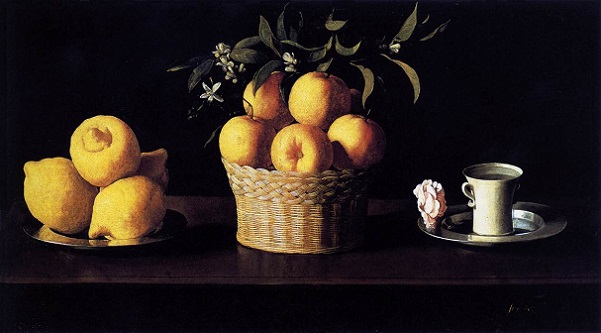
Look at the still-life at the top of this post. What do you see? If you tell me you see the Virgin Mary and the Mystery of her giving birth to the Christ, either you are already familiar with the painting, made famous in this era by Morton Lauridsen’s explanation of how it inspired his version of O Magnum Mysterium. Or you are steeped in the symbolism of the High Church and/or the use of Christian symbols in art.
I’m sorry but the symbolism is so abstract that those are the only ways to read Mary and the Virgin Birth into a painting of fruit, a flower, and a cup of water, although I’ll concede the symbolism could have been understood by well-educated Christians centuries ago in Europe.
Lauridsen himself did not understand the symbolism of the painting when he first saw it — a point he does not make clear to readers in his 2009 article for The Wall Street Journal about the painting It’s a Still Life That Runs Deep, and its role in inspiring his version of OMM.
That post was in response to something I’d sent her, recommending Lauridsen’s work. More “Republic of Bloggers” style communication!
**
Chance reading the other day brought me to Jacob Mikanowski‘s piece, Camera-phone Lucida, in which i found:
The first society to experience the problem of having too much money and too much stuff, the Dutch had multiple genres of food-related still lifes, each dealing in a different level of luxury. They began with the humble ontbijtjes, or breakfast paintings, to the slightly more elaborate banketjestukken or “little banquets,” and on to the kings of them all, the pronkstilleven, from the Dutch word for “ostentatious.” The “little breakfasts” were the domain of simple food: a plate of herrings, a freshly baked bun, a few olives, maybe a peeled lemon for a bit of color. The atmosphere in these canvases is orderly and Calvinist. By contrast, in the pronkstilleven, the prevailing mood is one of jubilant disorder. Lobsters perch precariously on silver trays. Tables are strewn with plates of oysters, overturned tankards, baskets spilling over with fruit, scattered nuts and decorative cups. Cavernous mincemeat pies jostle with lutes and the occasional monkey.
For a century scholars have sought a deeper meaning in these and other still lifes. A half-eaten cheese stood for the transubstantiated body of Christ; walnuts represented him on the cross — the meat of the nut was his flesh, the hard shell was the wood of the cross he died on.
And so — inside or outside th Republic of Bloggers — the conversation flows..
**
And if Morten Lauridsen can wring such beauty from a reading of symbolism in Zurbarán, let him do so!
I hated the Taliban. They were the enemy of all mankind. My hate didn’t single them out just for Third World thuggishness, seventh century fanboy oppression, or giving aid and comfort to a declared enemy of my country. No, my hate singled them out for blowing up some 1,500 year old pieces of rock.
For 1,000 of those 1,500 years, Islam lived alongside the twin Buddhas of Bamiyan. A millennium of entropy, nature, and sporadic fits of vandalism had ravaged the two Buddhas. But there they stood, as they’d stood for a millennium and a half.
History is fragile: we inherit only suggestive rubble from the past. From that rubble, we summon imagined pasts without number and without foundation. A particularly insistent ghost of conjured history drove Taliban iconoclasm: the shadow of the umma, the idolized but idol-free community of believers supposedly created by Muhammad before his death c. AD 632. From its antiseptic remove, far from the compromised Islam of March 2001, this stern shade loomed down from the heights of 15 centuries and commanded the Taliban to erase those two idolatrous Buddhas of Bamiyan from history. The phantom of the umma promised that, piece by piece of shattered idol, the sanctified community of the Prophet would draw nearer and nearer. The ends of March 622 came calling, now armed with the means of March 2001. Dynamite, artillery, and rocketry let the Taliban do in three weeks what history failed to do in fifteen centuries. And so the Buddhas of Bamiyan fell.
Meddling in what survives and what doesn’t is unnecessary. History eats itself: time, accident, and negligence will devour more history than intention ever aspire to. The Taliban insisted on moving history along. Moreover, they thought they could not only speed it up but make it flip 180 degrees and run backwards. And so the Taliban declared war on history.
To me, this made the Taliban barbarians. To me, they too deserved to be erased from history. The only man who seemed to be actively helping the Taliban exit history was Massood. Massood created an island of sanity in a dark hole of crazy. And now Massood was gone, sped to Allah by those same barbarians.
Downstairs I went. I ranted about the shame of Ahmed Shah Massood’s death to my Mom. She had no idea who Ahmed Shah Massood was. She didn’t know where Afghanistan was. To her, it was a quarrel in a far-away country between people of whom she knew nothing. The Massood in Afghanistan might as well have been the Massood in the Moon, fighting to keep one small grubby corner of the lunar surface Taliban-free.
Mom patiently listened as dinner was set. She’d grown used to my ranting on and on and on and on and on and on and on about this or that distant obscurity. She knew I’d fulminate my way out of my idée fixe of the moment, then return to quietly tending my trivia. The world would go on. Normalcy would again flow unvexed into the future.
She was right. Rant mode ran out of steam. I ate dinner. I went back to my lair, where my books and my computers would protect me. I went to sleep. And so the clock set on September 9th, 2001.
With murder in its heart, unseen in the gathering night, history, thought dead since 1989, was creeping up the East Coast to be reborn. And twin towering Buddhas and the Lion of Panjshir were but the first to fall.
Zenpundit is a blog dedicated to exploring the intersections of foreign policy, history, military theory, national security,strategic thinking, futurism, cognition and a number of other esoteric pursuits.