zenpundit.com » 2016

Archive for 2016

Thucydides Roundtable, Book II: On Pericles, Strategy and his Regime, Part I.

Tuesday, October 25th, 2016

[Mark Safranski / “zen“]

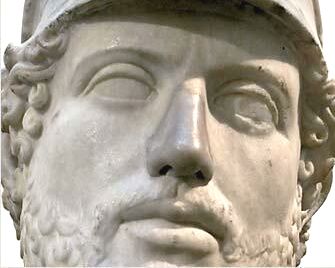
Image result for pericles

Pericles, son of Xanthippus and strategos of Athens

“For heroes have the whole earth for their tomb”
– Pericles

“…like that star of the waning summer who beyond all stars rises bathed in the ocean stream to glitter in brilliance.”
                            – Homer

Book II of the Peloponnesian War features the great Athenian leader Pericles and contains Thucydides’ remarkable apologia for his statesmanship and the Periclean regime over which he presided, which lasted only so long as he lived.  A kind of golden age within a golden age, thrown away by a senseless mob, at least as Thucydides tells the tale. What cannot be discounted however is that the man Thucydides called the “first citizen” of Athens was the dominant political figure of his day and put his stamp first upon Athens, then upon Hellas and then led his people into war to conserve and defend his vision of democratic empire against a jealous and fearful Sparta. Furthermore the novel strategy pursued by Pericles was integral the Athenian polis he had reshaped according to his vision and was designed to strengthen that regime as much as to win a military victory over Sparta.

In the text of Book II, Thucydides gives the reader three important narratives regarding the statesmanship of Pericles: his funeral oration; Pericles defense of his strategy before the Assembly; and Thucydides own analysis and eulogy of Pericles and his policies. From these we can see the continuity between Pericles political program for Athens at home and his imperial ambition for the role of Athens in the Hellenic world. Pericles, along with Ephialtes, had been pivotal in the decline the aristocratic, Aeropaegi faction that had been led by Cimon, whom Pericles had ostracized. Cimon’s regime was Athens as limited democracy, guided by the nobility, friendly to Sparta and deferential to Spartan hegemony. Pericles upended all of that root and branch. His Athens was to be at once radically democratic, investing power in the thetes of the Assembly, and gloriously heroic.

This was, to say the least, an unconventional viewpoint in classical Greece that had associated heroic qualities, or arête, with the well-born presiding over a hierarchical society. This cultural prejudice went back to at least Homeric times, if not to the older civilization of Mycenaean Greece. Pericles utterly rejected that and argued the excellence of all Athenian citizens was made possible by the political system of Athens and that Athens’ exalted status among Greek city states rested on the arête of its citizens:

….Our constitution does not copy the laws of neighbouring states; we are rather a pattern to others than imitators ourselves. Its administration favours the many instead of the few; this is why it is called a democracy. If we look to the laws, they afford equal justice to all in their private differences; if no social standing, advancement in public life falls to reputation for capacity, class considerations not being allowed to interfere with merit; nor again does poverty bar the way, if a man is able to serve the state, he is not hindered by the obscurity of his condition. The freedom which we enjoy in our government extends also to our ordinary life. There, far from exercising a jealous surveillance over each other, we do not feel called upon to be angry with our neighbour for doing what he likes, or even to indulge in those injurious looks which cannot fail to be offensive, although they inflict no positive penalty….

….”Nor are these the only points in which our city is worthy of admiration. We cultivate refinement without extravagance and knowledge without effeminacy; wealth we employ more for use than for show, and place the real disgrace of poverty not in owning to the fact but in declining the struggle against it. Our public men have, besides politics, their private affairs to attend to, and our ordinary citizens, though occupied with the pursuits of industry, are still fair judges of public matters; for, unlike any other nation, regarding him who takes no part in these duties not as unambitious but as useless, we Athenians are able to judge at all events if we cannot originate, and, instead of looking on discussion as a stumbling-block in the way of action, we think it an indispensable preliminary to any wise action at all. Again, in our enterprises we present the singular spectacle of daring and deliberation, each carried to its highest point, and both united in the same persons; although usually decision is the fruit of ignorance, hesitation of reflection. But the palm of courage will surely be adjudged most justly to those, who best know the difference between hardship and pleasure and yet are never tempted to shrink from danger. In generosity we are equally singular, acquiring our friends by conferring, not by receiving, favours. Yet, of course, the doer of the favour is the firmer friend of the two, in order by continued kindness to keep the recipient in his debt; while the debtor feels less keenly from the very consciousness that the return he makes will be a payment, not a free gift. And it is only the Athenians, who, fearless of consequences, confer their benefits not from calculations of expediency, but in the confidence of liberality.

“In short, I say that as a city we are the school of Hellas, while I doubt if the world can produce a man who, where he has only himself to depend upon, is equal to so many emergencies, and graced by so happy a versatility, as the Athenian. And that this is no mere boast thrown out for the occasion, but plain matter of fact, the power of the state acquired by these habits proves. For Athens alone of her contemporaries is found when tested to be greater than her reputation, and alone gives no occasion to her assailants to blush at the antagonist by whom they have been worsted, or to her subjects to question her title by merit to rule.

While Pericles was called “conservative and moderate” by Thucydides – and he certainly was a wise steward of shrewd strategic judgement in comparison with Cleon or Alcibiades – he was also in the context of the wider Greek world a social revolutionary. Moreover, a social revolutionary with demonstrated imperial ambitions and policies which Greek cities with tyrannical, aristocratic or oligarchic leadership found unsettling. Furthermore, Pericles drove home the point with the Parthenon, which he openly financed with the Delian League treasury, demonstrating that “ally” in Athenian eyes meant “subject”, Chiseled into marble on the Parthenon amidst a reconstructed Acropolis were ordinary Athenian citizenry made ideal and deified. This was clearly a political as well as a religious statement in what was the greatest temple of the ancient world. If one wonders why the Peloponnesian war took on so lethal an ideological dimension of factional strife  in every city touched by the Athenians or Spartans, the answer is written on the ruins of the Parthenon.

End Part I

New Issue of Infinity Journal!

Tuesday, October 25th, 2016

[Mark Safranski / “zen“]

Infinity Journal

Our friends at Infinity Journal have the latest edition out today. For newer readers, Infinity is a peer review e-zine on strategy that has published some of the more eminent figures in strategic studies, military history and security studies, new rising young scholars, an international set of active duty and retired military officers and serious students of war. The current issue boasts such topics as Clausewitzian theory, preventive war, the limits of air power and Chinese strategic thinking ( Registration is required but is always free).

I would however like to draw your attention specifically to their featured exclusive:

Does the U.S.’s War on the Islamic State Make Sense?

by Ron Tira

….The regional competition is multilateral[vii], with quite a large number of participants: global powers, regional powers and sub-state actors. Of them, the most competent challenges to the U.S. and its traditional regional allies come from Iran, its sub-state Shiite proxies and from Russia.

Iran is a serious competitor that poses the most severe threat to Saudi Arabia, the Gulf principalities and Israel. Iran possesses nuclear capabilities and ambitions, a robust ballistic missile apparatus, and long, subversive tentacles. Its regional footprint is also growing, from Iraq, Syria, Lebanon and Yemen, to Gaza, Bahrain and Saudi Arabia’s eastern provinces. Hezbollah is armed with more high-trajectory weapons than most NATO allies – combined, with high-impact shore-to-sea/shore missiles, cruise missiles, UAVs and cutting-edge surface-to-air missiles. Hezbollah is no longer a solely-Lebanese actor, and its footprint can be found throughout the Shiite-Sunni frontline. Iran and Hezbollah are ambitious, aggressive and skillful in orchestrating ends, ways and means. In contrast, IS’s objectives are unattainable and it is unable to orchestrate ends, ways and means[viii]. Hence, there is no comparison between the risk posed to America’s traditional regional allies by Iran and Hezbollah and the one posed by IS’s proverbial Toyota hordes.

Russia is pursuing an aggressive Middle Eastern policy[ix], aimed at gaining regional ground at the expense of the U.S. as well as accruing chips for its global game. There is no comparison between the risks posed to American interests by Russia’s new assertive posture – running in an arch from the Baltics, through Crimea, the eastern Mediterranean and Syria’s Tartus harbor – and the risks posed by IS’s street fighting in Syria’s battered Sunni heartland.

In fact, IS #1 and other extreme Sunni Jihadist organizations are a primary balancer of Iran and its proxies. IS and its ilk stand between Iran and its hegemony bid in the Sunni parts of Iraq. They also stand between Iran and Russia and their ambitions in Syria. IS pins Iran and Hezbollah down to the quicksand, and increases their expenditure in blood and treasure. IS both attrits Iran and Hezbollah as well as keeps them busy from pursuing other interests, with potentially graver consequences.

Furthermore, the fact that the U.S. has surprisingly prioritized the fight against IS ahead of containing the Russians[x], resulted in the need or at least desire to collaborate with the Russians against IS. It is this order of priorities set voluntarily by the U.S. that made Russia so artificially important, and unnecessarily given the Kremlin powerful global cards….

Read the rest here.

On targeting as a mood this electoral season, 2

Sunday, October 23rd, 2016

[ by Charles Cameron — honor and shame ]
.

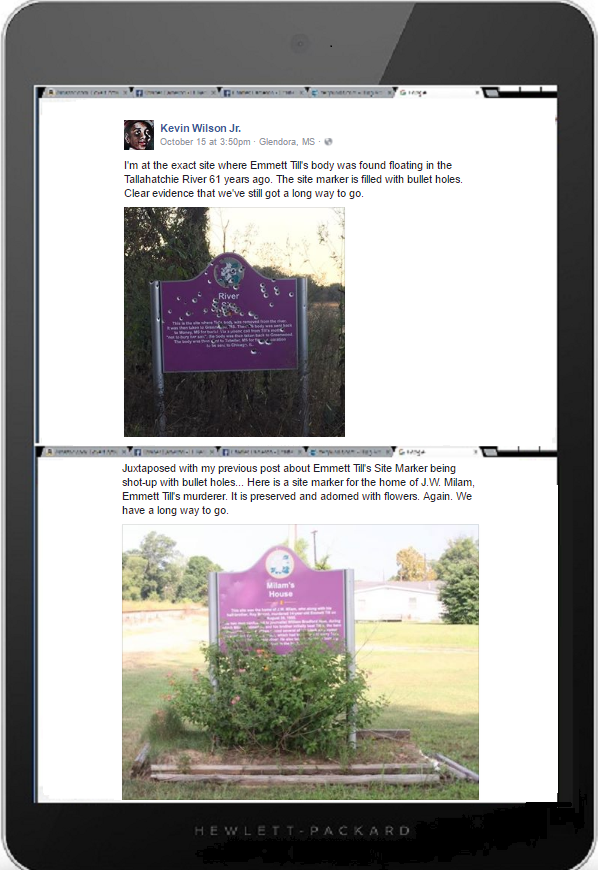
dq-600-emmett-till

Not “no comment” — speechless.

Thucydides Roundtable, Book I: reflections in a beginner’s mind

Sunday, October 23rd, 2016

[ by Charles Cameron ]
.

I’m entirely new to Thucydides, having received my copy of the book only on Friday, so I’ll keep this brief. I hope to have caught up a bit more by this time next week.

Meanwhile, my mind works associatively, so..

**

rich-vs-poor-in-rio
Riches and poverty in Rio

The goodness of the land favored the enrichment of particular individuals, and thus created faction which proved a fertile source of ruin. It also invited invasion.

trump-border-wall
Donald Trump

**

In Spencer-Brown’s inimitable and enigmatic fashion, the Mark symbolizes the root of cognition, i.e., the dualistic Mark indicates the capability of differentiating a “this” from “everything else but this.”

He does not even use the term barbarian, probably because the Hellenes had not yet been marked off from the rest of the world by one distinctive name.

Turkish President Recep Tayyip Erdogan, in a speech after a suicide bomb explosion in Istanbul on January 12, 2016, said: “Pick a side. You are either on the side of the Turkish government, or you’re on the side of the terrorists.”

**

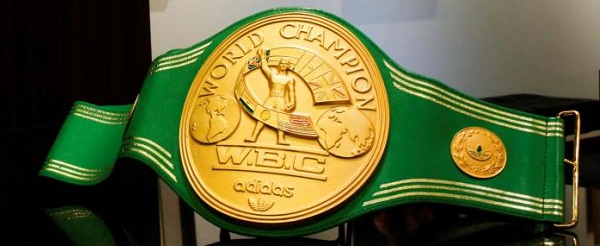
The iconic 'Rumble in the Jungle' belt of late boxing champion Muhammad Ali is displayed for auction at Heritage Auctions house in Manhattan, New York, U.S., August 19, 2016. REUTERS/Eduardo Munoz

The iconic ‘Rumble in the Jungle’ belt of late boxing champion Muhammad Ali is displayed for auction at Heritage Auctions house in Manhattan, New York, U.S., August 19, 2016. REUTERS/Eduardo Munoz

To this day among some of the barbarians, especially in Asia, where prizes for boxing and wrestling are offered, belts are worn by the contestants..

Koki Kameda of Japan, center, donning the newly-captured champion belt, green, in addition to the two he already has, poses with his younger brothers Daiki, left, and Kazuki after Koki's victory over Alexander Munoz of Venezuela in their 12-round WBA bantamweight world title boxing bout in Saitama, Japan, Sunday, Dec. 26, 2010. Koki Kameda won a unanimous decision over Munoz to take the vacant title. (AP Photo/Shizuo Kambayashi)

Koki Kameda of Japan, center, donning the newly-captured champion belt, green, in addition to the two he already has, poses with his younger brothers Daiki, left, and Kazuki after Koki’s victory over Alexander Munoz of Venezuela in their 12-round WBA bantamweight world title boxing bout in Saitama, Japan, Sunday, Dec. 26, 2010. Koki Kameda won a unanimous decision over Munoz to take the vacant title. (AP Photo/Shizuo Kambayashi)

On targeting as a mood this electoral season, 1

Sunday, October 23rd, 2016

[ by Charles Cameron — the only virtue I can see in this darkness is that the light contrasts with it ]
.

I find this frankly horrifying:

This, at a supposedly Christian university?

Feh.

**

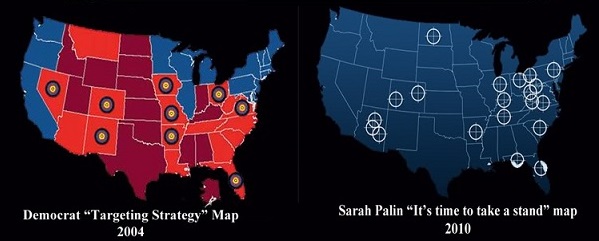
Mark you, I think targeting an individual — any individual –in this way is very different from targeting contested seats in an election. I can understand both Democrats and Republicans using the imagery of targets or cross-hairs to suggest where they’d like their supporters to get active, get out the vote and win seats..

acceptable-or-not

I said as much in On sneers, smears, and mutual sniping:

Neither “targetting” political adversaries nor “having them in your crosshairs” equates to killing or there would have been a whole lot more attempted assassinations — just the one was bad enough.

Have some proportion, people.

**

However, as an inveterate DoubleTweeter I have to say that pinning targets or cross-hairs on individual leaders in highly charged political disputes speaks a wholly different language, and presents a far higher threat level, than targeting districts on an electoral map:

**

For the record, I find this no less offensive:

trump-target


Switch to our mobile site