zenpundit.com » 2017

Archive for 2017

Quant and qualit in regards to “al wala’ wal bara'”

Thursday, August 24th, 2017

[ by Charles Cameron — score one for quantitative, links-based analysis ]
.

It’s not so surprising that JM Berger‘s exploration of concepts in IS propaganda notes first that the title of al-Mujahir‘s speech which he will be digging into in greater detail — “Be Patient, For Indeed the Promise of God is Truth” — is a Quranic reference, then turns to the same root concepts — first tawhid, and then al wala’ wal bara’

The first is tawhid, or monotheism, a belief in the indivisible oneness of God, which can be extrapolated into a “rejection of legal, class, social, political, racial, national, territorial, genetic, and economic distinctions” and general political unity among Muslims. Importantly, this concept provides a divine mandate linking the Eligible InGroup to the Extremist In-Group.

The second concept is wala and bara (loyalty and enmity), which functions “as a tool of ‘in-group’ control”, which is broadly interpreted by jihadists to mean that Muslims are required to stand together loyally (wala) and fight outsider and outside influences (bara), across spiritual, emotional and physical dimensions.

— that Joas Wagemaker and others have found cento jihadist thought:

Notably, the concept of al-wala’wal-bara’ was taken a step further by a Hanbali scholar, Hamd ibn ‘Ali ibn ‘Atiq (d. 1883), who, as Joas Wagemakers perceptively observed, connected al-wala’ wal-bara’ with the concept that can be seen as the very basis of Islam, the unity of God (tawhid). In other words, a Muslim cannot profess his belief in tawhid, and by extension Islam, if he does not demonstrate his enmity toward non-Muslims. Moreover, ibn ‘Atiq used Qur’anic verses, in particular Surat 60:4, to uphold the necessity of expressing bara’. The trend that ‘Atiq established by binding al-wala’ wal-bara’ to the foundation of Islam continued into the twentieth century, where it was taken up in Saudi Arabia by religious scholars who supported or opposed the Saudi rulers.

Robert Rabil, Salafism in Lebanon: From Apoliticism to Transnational Jihadism

Wagemakers ties this conjunction of tawhid with al-wala’ wal-bara’ to Juhayman al-‘Utaybi, and thence back to al-Faraj and forward again to al-Maqdisi. Al-‘Utaybi’s Mahdist occupation of the Grand Mosque in Mecca on the first day of the current Islamic century should be viewed as the founding moment for the movement of Salafist jihad leading directly to ISIS’ proclamation of the caliphate.

**

It is when the quantitative, “linkage-based” conceptual analysis kicks in —

— that the power of the digital approach makes itself clear.

Here we have dozens of phrases linked to beliefs, traits, and practices, which are susceptible of manipulation for counter-messaging — in a way which picks on the weak points in existing jihadist propaganda. This JM achieves by comparing al-Mujahir’s recent speech with al Adnani‘s 2011 “The Islamic State Will Remain Safe”.

In al-Adnani, grandiose predictions; in al-Mujahir, more realistic appraisal, six years later. In the gap, potential for illustrating IS’ failure to live up to its promises over that six year period.

JM’s approach, utilizing the prior work of his ICCT colleagues Haroro Ingram, gets into the weeds, into the detail, in a way that theologically-minded scholars have not.

For the Quant side, a distinct win.

Both side of both sides, a DoubleTweet

Thursday, August 24th, 2017

[ by Charles Cameron — didn’t i post this? okay, it’s a few days old, but i’ll post it ]
.

Trump:

Obama:

**

Both forms of both / and:

What interests me here is that Trump’s tweet and Obama’s both represent “both / and” positions.

Obama sees our common humanity cutting across whatever borders of skin color or whatever might be thought to separate us.

Trump shares the blame equally between the alt-right folk and the folk who were protesting them, when at least arguably the protesters came with (largely) peaceable intent, while the alt-right folk were trying for provocation:

Note, however, that Trump sees things in exactly the reverse manner — another enantiodromia? From Amy Davidson Sorkin in the New Yorker — Donald Trump, from His Tower, Rages at “the Other Side” in Charlottesville:

You had a group on one side that was bad and you had a group on the other side that was also very violent. And nobody wants to say that. But I’ll say that right now.” The bad group was the white nationalists; the “very violent” group was those who had come to object. In case anyone missed his point, he continued, “You had a group on the other side that came charging in—without a permit—and they were very, very violent.” Trump wasn’t putting the two sides on the same level; he was saying that the counter-protesters were worse.

**

There’s a very different feel to the two kinds of “both / and” IMO — Trump’s actually favoring one side in a conflict and protecting it by shifting some of the blame away from it, while Obama’s is neutral as to sides (though in the case of racists vs non-racists, he’d presumably favor the non-racists.

My head buzzes: an interesting little logical knot, I think.

Trump in Arizona, Rosalind in Arden

Wednesday, August 23rd, 2017

[ by Charles Cameron — think of the universe as a handkerchief — folding it into one by its opposite corners ]
.

Consider these two phrasings — the first, from a WaPo report of Donald Trump‘s speech in Arizona, in which Jenna Johnson or her editor thought he “ranted and rambled” —

— the second from fair Rosalind, in Shakespeare, As You Like It, Act 3 scene 5.

**

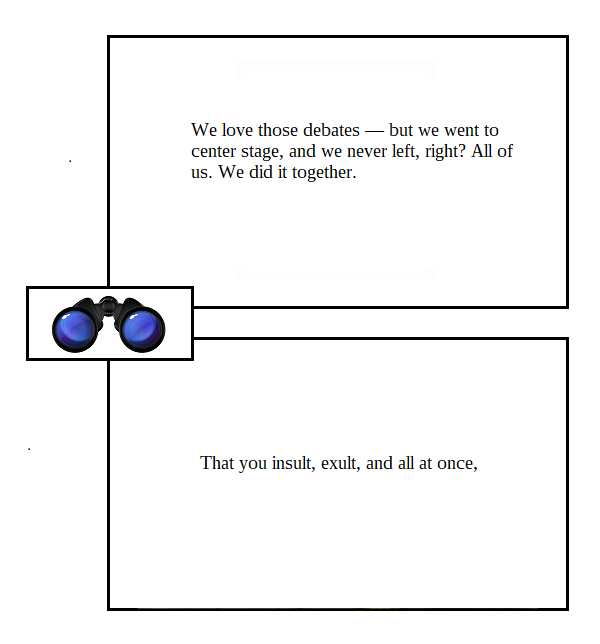
I donm’t think in the long haul that Trump is very Shakespeare the playwright, though as a character he may be Shakespearean. But I’m very taken with the genius of Shakespeare’s Rosalind, “insult, exult, and all at once..” and Trump’s “never left, right? All of us..”

Audrey Stanley, who directed a superlative Greek-tragedy-influenced As You Like It at Ashland while I was an adjunct anthro professor there, instructed her actors to make of each word its own universe, before running them together with the natural rhythms of speech, focusing in on “insult, exult” — both of which are two syllable words of which the second syllable is “sult” — yet having diametrically opposed meanings, and thus “universes”.

The actor who can move his or her breath and rib-cage from the fullness of “insult” to the fullness of “exult” — spitting defiance to joyous exaltation, at opposite extremes of the verbal spectrum — has performed a “coniunction oppositorum” as Jung would say, a folding of the universe as I would put it, from two (opposites) into one — “and all at once”.

It’s a brilliant and potentially transformative utterance, given to the brilliant and potentially transformative character, Rosalind.

Is Trump “brilliant and potentially transformative” — eh?

**

Under Audrey’s inspiration, I have long admired that brief line of Rosalind’s, and have only found one line — in Dylan Thomas — to match it:

Curse, bless, me now with your fierce tears, I pray

— that’s from his scandalously fine villanelle, Do Not Go Gentle into That Good Night:

**

Oy. Only one comparable usage. Until Trump.

Well, I’ll leave you there. I don’t think Trump, as I’ve said, is Shakespeare, quite — but in Arizona he stumbled into a speech pattern that attracts my notice.

Shakespeare Trumped, perhaps? I don’t know, but it comes close..

Until next time..

Definitive ouroboros photo

Tuesday, August 22nd, 2017

[ Charles Cameron — yes, this! ]
.

Picking up on symmetries observed

Wednesday, August 16th, 2017

[ by Charles Cameron — after Scaramucci on symmetry ]
.

It’s encouraging — heart-heartening — to see Doreen St. Félix at the New Yorker picking up on An Image of Revolutionary Fire at Charlottesville:

Two points about her commentary strike my interest. The first had to do, specifically, with symmetry, an old hobby-horse of mine as you may know:

Steve Helber shot an image of peculiar symmetry, in which a man of fortitude was bearing a different light. Two men extend weapons: one is the Confederate flag, furled, hiding its retrograde design, and the other is an aerosol can, modified to eject fire. The figures stand in a classical configuration, on the diagonal, as if a Dutch master has placed them just so.

The second made reference to theology..

The composition of this photo is fiercely theological. The black man is wielding what the black theologian James Cone, quoting the prophet Jeremiah, might call the “burning fire shut up in my bones,” what James Baldwin would have identified as “the fire next time.” (Cornel West, a student of Cone, has advanced the liberatory concept of “black prophetic fire”; West travelled to the city to march with members of Charlottesville’s faith community on Saturday.) It is a pose that upsets a desire for docility; it’s a rebuke to slogans such as “This is not us” or “Love not hate.” This graceful man has appropriated not only the flames of white-supremacist bigotry but also the debauched, rhetorical fire of Trump, who gloated, earlier this week, that he would respond to a foreign threat with “fire and fury.” The resistance has its fire, too.

**

I don’t think I see that image the same way St. Félix does. She sees fire on both sides — the fires of the tiki torches in the hands of the supremacists, though they are absent from this particular pohotograph, and the fire visible in the photo, wielded by the “man of fortitude”. Using an improvised flame-thrower strikes me as, if anything, more menacing than waving a furled flag, to be honest, and even though flame-man is in the lower position, his flame makes him, in my eyes, the dominant figure in the composition — and flag-wielder, correspondingly, even though holding the higher ground, more the underdog,

While my sympathies would naturally lie with those who protest supremacism rather than those who proclaim it, this image at first saddens me with the spectacle of fire-power unilaterally vielded by the guy I’d otherwise cheer for — and it’s only when I read a little deeper —

Long said that the protest had seemed peaceful until “someone pointed a gun at my head. Then the same person pointed it at my foot and shot the ground.”)

— that I began to understand why he, rather than the supremacist, might be the one who has feeling most threatened.

**

I feel ambiguous, then, about St Félix’ reading of the photo, but grateful that someone has an eye out for form, art, symmetry, in the photo-reporting of a vile, incendiary event.


Switch to our mobile site