Are we more inclined to favor attacks on the left (anarchists) than on the right (supremacists) — does left violence just seem more noteworthy — do more people from one side of the divide follow New Jersey Homeland Security, maybe — or is it all just a little to anecdotal and indeterminate to form any conclusions?
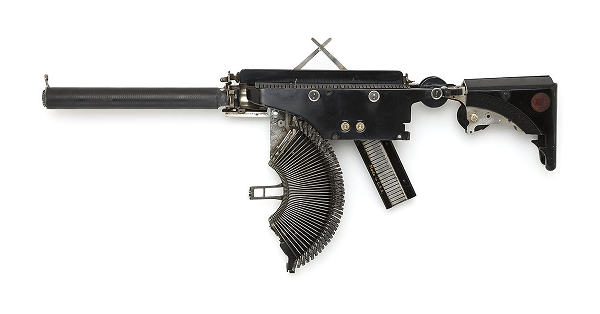
Typewriters revolutionized the way we write and guns changed the wars we fight, yet it can’t be denied that both are artifacts of tremendous cultural impact, despite the dramatic differences in function. This notion helps illuminate the peculiar Typewriter Guns of Québécois artist Eric Nado, a sculptural series of typewriters transformed to look like guns.
Thankfully non-functional, Nado’s guns seem like strange weaponry from the future, due to their brilliantly vibrant hues and the protruding typewriter parts that seem like alien steampunk appendages in this technological recontextualization. This may be partially an aesthetic choice, but it also relates to the artist’s desire to fully recycle the typewriters. In his project statement, Nado iterates that every piece of the typewriters were re-incorporated into the guns, an almost eerie vein of sustainability given how convincingly dangerous these sculptures look.
**
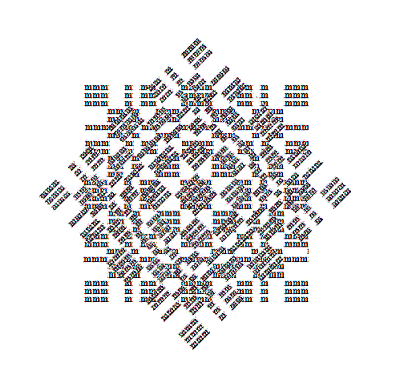
Reminds me of Ernst Jandl‘s sound poem schtzngrmm, based on taking the letters of the word “trench” — “Schützengraben” in German literally, letter by letter, so as to evoke (some of) the sound of trench warfare:
But I’ll let Jandl read it himself and comment on that final “t-tt” and its aural cognate, “tod” — death:
**
Back in the day, I was a “visual poet” as Jandl was a “sound poet” — the two experiments observed poetry as it approached art and music, respectively — and here’s one of mine, now enshrined in Marvin & Ruth Sackner‘s definitive The Art of Typewriting:
That’s no gun — it’s a rose, and I presented it to Elizabeth Taylor, no less, when she was supporting Basil Bunting for the Oxford Poetry Professorship, and we met in a pub by the river..
[ by Charles Cameron — for Kristen and J Scott Shipman, Tim Furnish, Mark Osiecki, and whomever it may delight]
.
Note the words:
Music has certain remarkable qualities, which even the spoken word does not possess. Music does something that words can’t. It goes to the deepest point of who we are, the center of our person, it is a quintessential part of what it means to worship God, to be able to sing to God, to be able to pour our hearts in thanksgiving, praise, Orthodox worship cannot take place without singing.
You know, I have very few things to offer back to the world in thanks for the many, many things the world has offered me, but this remark reminds me of another from John Eliot Gardiner, spoken after Sara Mingardo‘s recitative in his rehearsal DVD for Bach‘s cantata Christen, ätzet diesen Tag, BWV 63. Gardiner quotes Bach:
Nota bene: Bei einer andächtigen Musik ist allezeit Gott mit seiner Gnaden Gegenwart. Now I find that very, very significant. That he’s saying wherever there is devotional music, God with his grace is present. Which, from a strict theological point of view is probably heresy, heretical, because it’s saying that music has an equivalent potency to the word of God. And I think that in essence is why Bach is so attractive to us today because he is saying that the very act of music-making and of coming together is, in a sense, an act which invokes the latency, the potency, the potentiality of God’s grace, however you like to define God’s grace; but of a benediction that comes even in a dreadful, overheated studio like Abbey Road where far too many microphones and there’s much too much stuff here in the studio itself, that if one, as a musician, puts oneself in the right frame of mind, then God’s grace can actually come and direct and influence the way we perform his music.
DoubleQuote!
And so, once again, here is Sara Mingardo, incomparable:
Zenpundit is a blog dedicated to exploring the intersections of foreign policy, history, military theory, national security,strategic thinking, futurism, cognition and a number of other esoteric pursuits.