Are we more inclined to favor attacks on the left (anarchists) than on the right (supremacists) — does left violence just seem more noteworthy — do more people from one side of the divide follow New Jersey Homeland Security, maybe — or is it all just a little to anecdotal and indeterminate to form any conclusions?
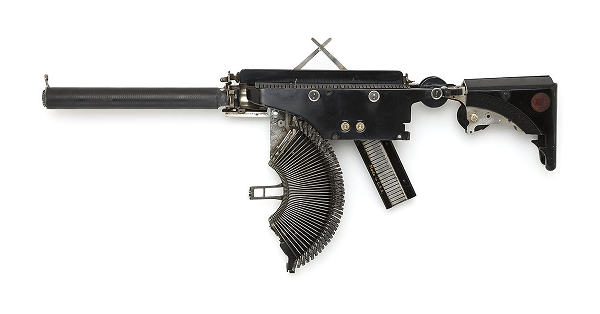
Typewriters revolutionized the way we write and guns changed the wars we fight, yet it can’t be denied that both are artifacts of tremendous cultural impact, despite the dramatic differences in function. This notion helps illuminate the peculiar Typewriter Guns of Québécois artist Eric Nado, a sculptural series of typewriters transformed to look like guns.
Thankfully non-functional, Nado’s guns seem like strange weaponry from the future, due to their brilliantly vibrant hues and the protruding typewriter parts that seem like alien steampunk appendages in this technological recontextualization. This may be partially an aesthetic choice, but it also relates to the artist’s desire to fully recycle the typewriters. In his project statement, Nado iterates that every piece of the typewriters were re-incorporated into the guns, an almost eerie vein of sustainability given how convincingly dangerous these sculptures look.
**
Reminds me of Ernst Jandl‘s sound poem schtzngrmm, based on taking the letters of the word “trench” — “Schützengraben” in German literally, letter by letter, so as to evoke (some of) the sound of trench warfare:
But I’ll let Jandl read it himself and comment on that final “t-tt” and its aural cognate, “tod” — death:
**
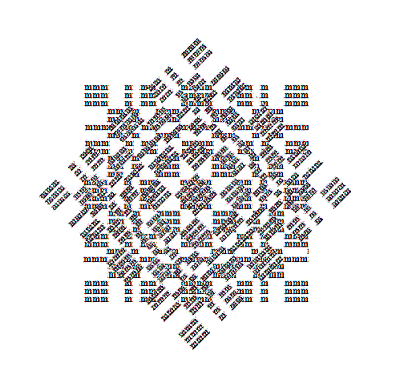
Back in the day, I was a “visual poet” as Jandl was a “sound poet” — the two experiments observed poetry as it approached art and music, respectively — and here’s one of mine, now enshrined in Marvin & Ruth Sackner‘s definitive The Art of Typewriting:
That’s no gun — it’s a rose, and I presented it to Elizabeth Taylor, no less, when she was supporting Basil Bunting for the Oxford Poetry Professorship, and we met in a pub by the river..
Zenpundit is a blog dedicated to exploring the intersections of foreign policy, history, military theory, national security,strategic thinking, futurism, cognition and a number of other esoteric pursuits.