June 8th, 2017
[ by Charles Cameron — not the most politically relevant quote from Comey, but perhaps the most curious ]
.
It’s not every day you get to see Lao Tzu playing out in the natsc arena:

Sources:
Stephen Mitchell, tr., Tao Te Ching, chapter 56
Politico, James Comey testimony transcript on Trump and Russia
Posted in analytic, Charles Cameron, classified, comey, Doublequotes, intelligence, secret, silence, tao, Uncategorized | 1 Comment »
June 8th, 2017
[ by Charles Cameron — Tankel’s take on Trump’s CT ]
.
Mostly the self-devouring snakes I track here are a little more subtle about the circular nature of their logic — the phrasing often hides the fact that man bites self, or dog chases own tail. This example, however, is just so blatant, presented in so large and darkna font, with its accompanying image just so dazzlingly colored, that I just has to bring it here.
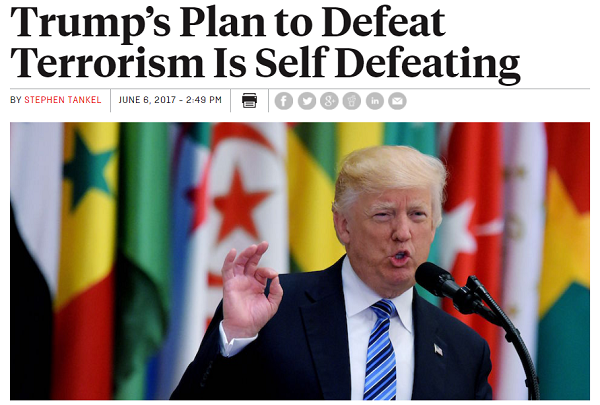
Self-defeating, self-eating — it’s the self- part that signals trouble. Stephen Tankel is a fine researcher — his book Storming the World Stage: The Story of Lashkar-e-Taiba is recommended readng on the 2008 Mumbai terror attacks.
He is not a happy chap:
The emerging Trump counterterrorism strategy appears to be a dysfunctional combination of repurposed elements of the George W. Bush and Barack Obama approaches infused with some of Trump’s worst impulses
You may wish to read him.
**
Meanwhile, as an ad to accompany CNN’s Iran’s Revolutionary Guards blame Saudis for Tehran attacks, I got this:

Okay ouroboroi!
Posted in #FAIL, Charles Cameron, counterterrorism, donald trump, form, India, iran, obama, ouroboros, saudi arabia, Uncategorized | 2 Comments »
June 7th, 2017
[ by Charles Cameron — on the distinction between philo and agapo in Greek, loyalty and honesty in public service ]
.
If you are familiar with the Gospel of John, you may recall the passage in which Christ questions Peter (upper panel below) which is often rendered in English “Do you love me?” “You know that I love you” (thrice — but which is subtler in the Greek, since Christ twice asks Peter if he loves him (unselfishly, most deeply), to which Peter responds that he likes him (feels affectionate or friendy love for him) — and on the third occasion, Christ uses Peter’s choice of verb, “Do you feel friendoy towards me?” and Peter answers, “Yes, you know I do.”

There’s an eerie echo of that conversation in Jim Comey‘s prepared remarks for his tesimony before the Senate Select Committee on Intelligence tomorrow (lower panel, above).
Comey twice avoids giving his verbal assent to loyalty, which Trump each time asks for, ansd on the third occasion goes part way to meet him with an assurance of “honest loyalty.”
Comey goes on to testify:
As I wrote in the memo I created immediately after the dinner, it is possible we understood the phrase “honest loyalty” differently, but I decided it wouldn’t be productive to push it further. The term – honest loyalty – had helped end a very awkward conversation and my explanations had made clear what he should expect.
Both Christ and Comey strike me as attempting twice to hold their interlocutor to a higher standard than that which he proposes, while tactfully making a verbal concession on the third attempt…
Posted in Charles Cameron, christianity, comey, donald trump, FBI, language, love, rhetoric, scriptures, Uncategorized | Comments Off on An eerie foreshadowing of Comey-Trump in the Gospel
June 7th, 2017
[ by Charles Cameron — sometimes a flurry of tweets can be the thing itself — see also today Michael Kenney on al-Muhajiroun ]
.
Here you go — Daveed as recommended by Phillip Smyth just now: today
Assuming that ISIS was behind the Tehran attack, as it has claimed, I have a few observations.
1) Attacking Iran differentiates ISIS from al-Qaeda. AQ has probably wouldn’t attack Iran due to the contours of the AQ/Iran relationship. Similarly, ISIS propagandized against the Taliban by arguing that they wouldn’t fight Pakistan, while ISIS was killing Pakistani soldiers. So there’s an obvious propaganda play ISIS can make here for a Sunni audience, parallel to its earlier Pakistan propaganda.
2) Iran is at the forefront of pushing ISIS’s caliphate back. So this is similar to other ISIS attacks against coalition countries. Nor is it clear that ISIS is concerned about provoking Iran: They already have provoked Iran. It’s fighting them on the ground now.
3) Wild card possibility: Unlikely, but could ISIS be making a play for Sunni state support, similar to what al-Qaeda gets? There are various reasons that I would bet against this, but I would put it on the table as a possibility, however remote.
Posted in Charles Cameron, daveed gartenstein-ross, iran, IS, ISIS, twitter, Uncategorized | Comments Off on Gartenstein-Ross on ISIS and Iran
June 7th, 2017
{ by Charles Cameron — including the curious case of the Covenant of Security ]
.
Michael Kenney, on the recommendation of John Horgan:
Lots of reports in the media about London Bridge attacker Khuram Butt’s “membership” in al-Muhajiroun, but this is not how network activists understand membership in al-Muhajrioun. For them it is about “intellectual affiliation,” gaining the ideological and practical knowledge they need to be competent activists. ALM is full of rotating recruits. These people come in, get exposed to the network’s ideas, radicalize to different degrees, and then often leave after a certain period of involvement, typically lasting months or years. Some leave b/c they don’t accept ALM’s interpretation of the Covenant of Security, which forbids attacks in UK, as long as their lives and livelihoods are protected. Butt may have believed that the Covenant no longer applied to him in the UK, allowing him to engage in violence in his home country. This is not ALM’s position on the Covenant, though activists emphasize this is each individual’s decision.
Here’s a description of the Covenant of Security, from a long-ago Daniel Pipes piece about the Covenant and al-Muhajiroun, titled Does a “Covenant of Security” Protect the United Kingdom?:
According to Sifaoui, it has long been recognised by the British Islamists, by the British government and by UK intelligence agencies, that as long as Britain guarantees a degree of freedom to the likes of Hassan Butt [a loudmouth pro-terrorist Islamist], the terrorist strikes will continue to be planned within the borders of the UK but will not occur here. Ironically, then, the presence of vocal and active Islamist terrorist sympathisers in the UK actually makes British people safer, while the full brunt of British-based terrorist plotting is suffered by people in other countries.
Michael Kenney, more:
To learn more about al-Muhajiroun, please see my JCR article with @steve_coulthart and Dom Wright, Structure and Performance in a Violent Extremist Network:
This study combines network science and ethnography to explore how al-Muhajiroun, a banned Islamist network, continued its high-risk activism despite being targeted for disruption by British authorities. We analyze news reports, interviews, and field notes using social network analysis and qualitative content analysis to test hypotheses pertaining to network structure and performance. Our analysis suggests that the activist network’s structural properties had important implications for its performance during three separate time periods. What began as a centralized, scale-free-like, small-world network centered on a charismatic leader evolved into a more decentralized “small-world-like” network featuring clusters of local activists connected through multiple bridges. This structure allowed the activist network to engage in contentious politics even as its environment became increasingly hostile. We conclude by discussing the implications of al-Muhajiroun’s small-world solution for scholars and policy makers.
Posted in britain, Charles Cameron, Islam, jihad, john horgan, Uncategorized | Comments Off on Michael Kenney on al-Muhajiroun


