zenpundit.com

Jottings 3: Espionage on the chess board

May 3rd, 2013

[ by Charles Cameron — playing the two great games, from Caxton to Le Carré ]
.

.

Karla, the Russian spymaster in John Le Carré‘s Smiley novels, is represented as the white queen in the 2011 Tomas Alfredson / Gary Oldman film of Tinker Tailor Soldier Spy (lower panel, above).

In chess terms, that’s quite a step up for spies — pawn promoted to queen.

**

Before the digital age, in the early years of printing, way back in 1474, Thomas Caxton‘s press issued the second book ever printed in England — his Game and Playe of the Chesse — and things were subtly different. The eight pawns, for instance, differed one from another, each representing a different human type or craft, and named accordingly: “Labourer, Smith, Clerk, Merchant, Physician, Taverner, Guard and Ribald.”

It’s the Ribald (in the upper panel, above) who interests us here — for he’s the spy on the chessboard, as surely as Joshua the son of Nun and Caleb the son of Jephunneh were spies in the land of milk and honey. Caxton describes the Ribald, stationing him in front of the Rook, thus:

The rybaulders, players of dyse and of messagers and corrours ought to be sette to fore the rook/ For hit apperteyneth to the rook whiche is vicayre & lieutenant of the kynge to haue men couenable for to renne here and there for tenquyre & espie the place and cytees that myght be contrarye to the kynge/ And thys pawn that representeth thys peple ought to be formed in this maner/ he must haue the forme of a man that hath longe heeris and black and holdeth in his ryght hand a lityll monoye And in his lyfte hande thre Dyse And aboute hym a corde in stede of a gyrdell/ and ought to haue a boxe full o lettres

And what should be the appearance of such a one?

And thys pawn that representeth thys peple ought to be formed in this maner/ he must haue the forme of a man that hath longe heeris and black and holdeth in his ryght hand a lityll monoye And in his lyfte hande thre Dyse And aboute hym a corde in stede of a gyrdell/ and ought to haue a boxe full o lettres

Let’s go over that first part one more time, and make sure we understand it:

It pertains to the Rook, which is vicar and lieutenant of the King, to have men available to run hither and yon to make inquiries and spy out the place and cities that might be contrary to the King.

**

And isn’t that precisely what Moses sent Joshua and Caleb out to do, when he instructed them in Numbers 13.17-20:

Get you up this way southward, and go up into the mountain: And see the land, what it is, and the people that dwelleth therein, whether they be strong or weak, few or many; And what the land is that they dwell in, whether it be good or bad; and what cities they be that they dwell in, whether in tents, or in strong holds; And what the land is, whether it be fat or lean, whether there be wood therein, or not. And be ye of good courage, and bring of the fruit of the land.

**

Espionage has been around longer than chess: some things never change — and some things have changed significantly.

Today, you can’t tell one pawn from the next…
Jottings 1: Wittypedia

May 3rd, 2013

[ by Charles Cameron — concerning the Dajjal, the Muslim antichrist — and introducing “jottings” ]
.

.

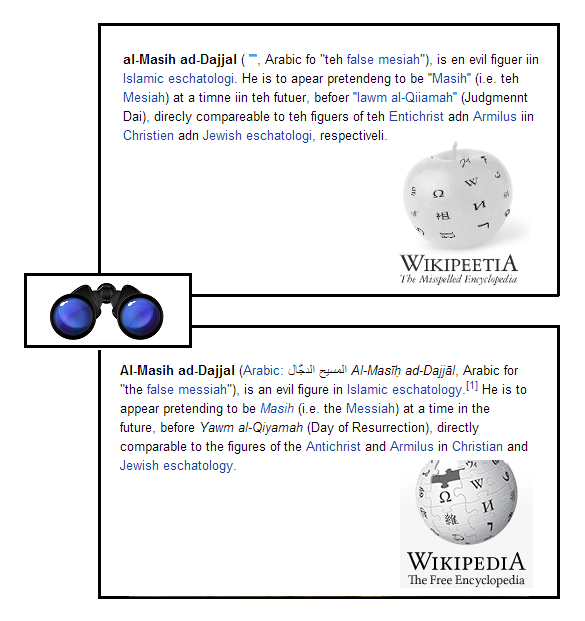
That’s witty — Wikipeetia, a version of Wikipedia that you may some day find yourself reading if you mis-spell a search term.

Like, if you write Entichrist.

Fascinating.

**

Jottings:

I am hoping to make Jottings a continuing series of brief posts, some serious and some light-hearted, that release the toxins of fascination and abhorrence from my system rapidly, ie without too much time spent in research. Jottings — hey, my degree was in Theology, Mother of the Sciences — derives from the English “jot” — and thence from the Greek iota and Hebrew yod, see Wikipedia on jots and tittles.

Jottings 2: Dr Fadl book announcement

May 3rd, 2013

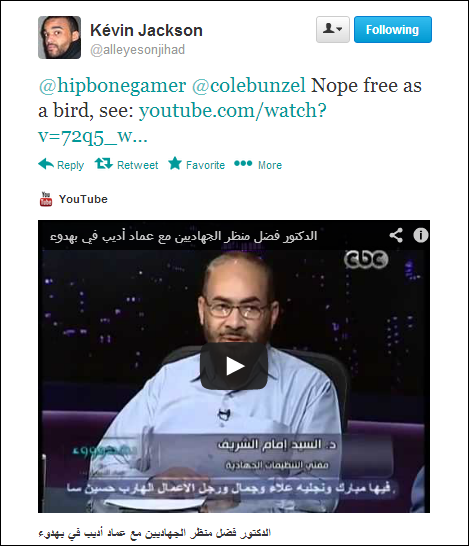
[ by Charles Cameron — I got the announcement via Cole Bunzel, and Kévin Jackson kindly informed me that Dr Fadl is currently free ]

.

Dr Fadl‘s announcement, in Arabic, is here — I had to use Google Translate, which wouldn’t pass a Turing test. However…

**

A while back, I made a post here titled Will Dr Fadl retract his Retractions? in which I wrote:

Sayyid Imam al-Sharif, popularly known as Dr Fadl, wrote two of the key works of jihadist ideology, The Essential Guide for Preparation and the thousand-page Compendium of the Pursuit of Divine Knowledge, in the late 1980s — thereby providing his friend from student days, Ayman al-Zawahiri, with powerful scholarly backing for the doctrines of militant jihad and takfirism. Lawrence Wright refers to Fadl as an “Al-Qaeda mastermind” in a detailed 2008 New Yorker analysis.

Dr Fadl was imprisoned without trial in the Yemen shortly after 9/11, but it was after he had been transferred to an Egyptian prison in 2004 that he wrote Rationalizing Jihad, the first volume of his “retractions” — a work so powerful in its attack on his own earlier jihadist doctrine that al-Zawahiri felt obliged to respond with a two-hundred page letter of rebuttal. A second volume from Dr. Fadl followed more recently.

If Dr Fadl regains his liberty, the question arises whether he will claim his critiques of jihadist dictrine were obtained by force, and effectively retract his retractions – or whether he will stand by them, as I somehow expect he might — still declaring, this time as a free man, that “There is nothing that invokes the anger of God and His wrath like the unwarranted spilling of blood and wrecking of property,” and “There is nothing in the Sharia about killing Jews and the Nazarenes, referred to by some as the Crusaders. They are the neighbors of the Muslims … and being kind to one’s neighbors is a religious duty.”

**

As late as October 2012, I was noting an Atlantic piece by Daveed Gartenstein-Ross and Aaron Zelin on How the Arab Spring’s Prisoner Releases Have Helped the Jihadi Cause, and asking whether Dr Fadl had been released in my post Quick update / pointer: GR & AZ on prisoner release — but now we know.

In response to an inquiry I tweeted after seeing Bunzel‘s tweet above — asking whether Dr Fadl was still imprisoned, albeit more comfortably than most — Kévin Jackson replied:

I’m no Arabist, but I’d guess we can take it that Sayyed Imam Al-Sharif aka Dr Fadl is talking freely in this book, which he says will cover both his experience of the history of AQ “from the womb (the Afghan jihad against communism) … to the end” in detail, with dates and names, and “all this with the background of the study of Islamic jurisprudence that distinguish between right and wrong, and this is a jurisprudential historical book.”

**

Tricky that, the need to rely on Google Translate. Once again I regret my lack of umpteen languages.

Ancestral voices prophesying war

May 2nd, 2013

[ by Charles Cameron — “And ‘midst this tumult Kubla heard from afar, Ancestral voices prophesying war!” ]
.

At 36 minutes and 12 seconds, this video of Bob Dylan‘s Masters of War slowed down “800%” — i.e. to eight times its normal length — may or may not be something you find time for.

It’s eeeeerie, I can tell you that much. And I’m not the only one to post it either — Wired featured it in their birthday greeting to Dylan last year.

If you have the meditative patience for Tibetan chanting, you might want to give Dylan at 1/8th speed a try.

**

Sources:

  • Coleridge, Kubla Khan
  • Dylan, Masters of War, eight versions…
  • Of the Umayyad mosques of Aleppo and Damascus

    May 2nd, 2013

    [ by Charles Cameron — convinced that the architecture of sacred geography is of extraordinary importance, now and always ]
    .

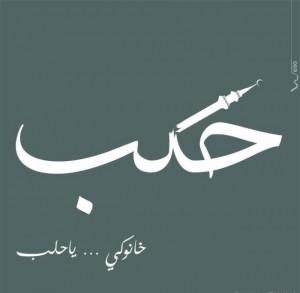
    On April 24, the Umayyad Mosque in Aleppo’s UNESCO world heritage site was destroyed… with both the rebels and government forces blaming the event on the other. There’s a beautiful post at Syria Deeply about the mosque and its destruction, which is worth reading in full – here I’ll simply excerpt the paragraph which explains the graphic at the head of this post:

    It’s very symbolic. People are really devastated. A lot of people changed their picture on social media to show the minaret. Or rather, a broken minaret. It’s part of our identity [in Aleppo.] The BBC got backlash for heavily covering it, because people said, ‘Why are you covering the destruction of a minaret when so many people are dying?’ But there is that sense that it’s part of our identity, and people are mourning it.

    and two more, which convey in the poetic words of Amal Hanano, a rich sense of the accompanying tragedy:

    The lesson of the minaret: every tyrant will fall and the city remains. History has taught us that the people find a way to pick up the pieces of their city and rebuild. One thousand years from now, these years will be a chapter in history books. The future people of Aleppo will visit this sacred site and will feel the calm and peace once more. The stone will be old again. They will point to the square tower and whisper to their children the tale of this minaret that falls every few centuries when the lesson of tyranny must be taught to a people who had forgotten. Those people of the future are lucky. They will be unaware of the pain of living those years, unaware of the shame of writing this chapter. History is abstract and seamless to them, like it once was for us. It is merely a story they can recite while they trace their fingers over the stone and remember without consequence. I envy them.

    We were once like those people, telling tales of barbaric Mongols or tragic fires that had destroyed the Umayyad Mosque, the Great Mosque of Aleppo. Instead we will have to be the ones to pick the pieces this time and find a way to rebuild, to heal and to restore what was erased. Even when the rebuilding is done and the blood has stopped flowing, we will never be able to enter these sites without remembering what was lost. It will never smell timeless again for us. History will never be seamless with our memory again.We know that what we will rebuild is a replacement for something that was once perfect. Something that can never come back and will never be the same. We will be destined to whisper to our children and grandchildren: “Once upon a time, there was a minaret that was 1,000 years old. We loved it and we loved our city. But we had forgotten our history. We had forgotten that the hatred of men destroys all that we love, all that is sacred. And one day we woke up and the minaret was gone.

    **

    My thoughts turn now to another Umayyad mosque…

    The Umayyad mosque in Damascus is one of the holiest shrines in Islam, including within its precincts the tomb of the great warrior Saladin / Salah al-Din, but also featuring a minaret described in Muslim eschatology as the place where Jesus will return to earth. The hadith, presented by Aaron Zelin in a post on Jabhat al-Nusrah at al-Wasat, says in part:

    it would at this very time that Allah would send Jesus, son of Mary, and he will descend at al-Manarah al-Bayda’ (the white lighthouse or minaret) in the eastern side of Damascus wearing two garments lightly dyed with saffron and placing his hands on the wings of two Angels

    If my readings are correct, the two most recent imams of the mosque have been (i) Moaz al-Khatib, who was deposed and imprisoned under Assad, and during the Syrian revolution led the National Opposition Coalition until his April 21st resignation, and (ii) Mohamed al-Bouti, the famed scholar who replaced him, who was killed in a suicide attack on another Damascus mosque, the Iman Mosque, on March 21st.

    The burial of al-Bouti — who had supported Assad and called the Syrian opposition “scum” — in the Umayyad, close to the tomb of Saladin, is therefore a potentially incendiary move, giving extraordinary high honor to the imam in the aftermath of a revolutionary strike against another mosque in which that same Assad-supporting imam was killed while preaching.

    **

    May the Umayyad mosque of Damascus, now a locus of possible contention, avoid the fate of its sister in Aleppo. May the “white lighthouse” minaret be preserved…


    Switch to our mobile site