zenpundit.com

The Glenn Beck, Mahdism & Antichrist series

April 27th, 2011

[ by Charles Cameron ]

.

Glenn Beck has a new documentary coming out tonight on Mahdism and the Antichrist.

He calls it “the documentary that you will not see on mainstream television” and to get to see it, you have to be a subscriber to Beck’s Insider Extreme channel on the web. But then that fits with Beck’s emphasis right now — he doesn’t mind crying shame on the media for not carrying the documentary, but he doesn’t want unbelievers to see it either — he told his radio audience today:

Make sure you see it tonight at nine o’clock. And if I may recommend that you watch it with some friends. Invite some friends over, some like-minded people, don’t try to get any converts in. Pull up the nets, man, pull up the nets.

So okay — it won’t be on “mainstream television” but it will be seen in a million “like-minded” homes, and it will influence them, it will influence their perspective on Islam, and on the Middle East.

Here’s a description of what they can expect, drawn from Joel Rosenberg‘s blog today. Joel is the author of the apocalyptic thriller The Twelfth Imam, has seen the rough cut and will be appearing on the video, along with those he lists here:

Tonight on his website, Glenn Beck will premiere his new documentary film, “Rumors of War — Part Two.” As with Part One, I was interviewed for the film…

The documentary examines current events and trends in the Middle East and the Islamic world from various vantage points — Biblical End Times theology, Jewish End Times theology, and Islamic End Times theology. It discusses the latest threats from the Radical Islamic world to Israel, the West and our allies. It features a wide range of Jewish, Muslim and evangelical Christian authors and commentators in a balanced yet provocative and fascinating way. Among them:

  • Dore Gold, former Israeli ambassador to the U.N.
  • Reza Kahlili, former CIA agent inside Iran and author of A Time To Betray
  • Tim LaHaye, author of the Left Behind novel series
  • Brigitte Gabriel, author of They Must Be Stopped: Why We Must Defeat Radical Islam and How We Can Do It
  • Joel Richardson, author of The Islamic Antichrist
  • Dr. Zudi Jasser, president of American Islamic Forum for Democracy

*

The thing is, Beck doesn’t know a whole lot about these things, and his advisers get things wrong — sometimes flat out wrong, sometimes just out of proportion — too.

I aim to review Beck’s documentary along with its predecessor, and the books of Joel Richardson and Joel Rosenberg, and also take a look at some other books and articles that cover the same materials with greater scholarship and less religious special interest — notably the works of David Cook, J-P Filiu and Timothy Furnish — clear up some of this issues in which definitive corrections are in order, suggest areas where the preponderance of evidence and informed commentary leans away from Beck’s position, and raise again those urgent questions which remain.

Because from where I sit, Glenn Beck has hit on one of our blind spots — and is giving us a dangerously distorted mirror in which to view it.

*

Here’s Beck talking about the upcoming documentary this morning on his radio show:

Tonight, you don’t want to miss, on Insider Extreme, something that we have been trying to tell the story for quite some time, and I have told it to you many times before, the story of the Twelfth Imam, well this is not the full story of the Twelfth Imam, this is what people Middle East believe about the Twelfth Imam, or the Mahdi as the… Sunnis? Sunnis are in Egypt, Shias are in, ah, is it Shias in Iran or is it the other way around? I think it’s S.. Shias are in Iran. One believes in the Twelfth Imam, the others believe in the Mahdi, same guy, it is the… the… you would know it as the Antichrist. It is the, it has every earmarking of the Antichrist, every single one, I mean, he makes a peace for seven years with Egypt, he viol… — I mean with Israel, he violates it, he marks people with a number, he beheads people if they don’t submit, I mean it’s all there. It’s all there. And Ahmadinejad says that he is alive and well and orchestrating the things in the Middle East.

Did you get that? He’s not sure: “is it Shias in Iran or is it the other way around?”

If Beck has been working on this documentary for a year now, let’s hope he does in fact know the difference between Sunni and Shi’a, and that he’s using the popular gag technique of pretending not to know, so his audience — who haven’t all been working on a documentary and may well not know — can feel all the more strongly “he’s one of us”. And besides, Sunni, Shia, it’s all the same, Mahdi, Twelfth Imam, no difference at all, right?

So that’s the level of required accuracy that’s tolerated here. Which side was it wanted to keep slavery? I forget now, I think it may have been the South. Belfast — now is that Catholic, or Protestant?

*

And one last quick note from the same post on Joel Rosenberg’s blog:

As far as I can tell, Glenn Beck is leaving the Fox News Channel in part because Fox is opposed to him devoting so much time on his program to End Times issues, Bible prophecy, Iran’s eschatology, and the linkage of these things to left wing efforts to sow seeds of revolution and chaos. It’s too bad, really.

That’s an interesting data point.

*

There will be plenty to talk about, anyway:

the new documentary, Joel Rosenberg’s thriller, which I enjoyed, Joel Richardson, with whom I correspond and whom I like, the new Mahdist video in Iran which is causing quite a stir, and may or may not be an “official” Iranian production, the vexed question — vexed in all three Abrahamic faiths — of whether you can hasten the coming of the Awaited One and if so, how, and the implications of all this both in the United States and in the Middle East, the Iranian nuclear program…

The Glenn Beck, Mahdism & Antichrist blog series, coming up.

This Story Made My Day

April 27th, 2011

From the respected gents at BLACKFIVE:

Westboro Baptists Defeated

SSgt-Jason-Rogers-278x300

USMC Staff Sgt. Jason Rogers, 28, was killed in action by an IED while saving a fellow Marine in Helmand Province, Afghanistan on April 7.  Sgt. Rogers was assigned to the 2nd Combat Engineer Battalion, 2nd Marine Division, II Marine Expeditionary Force, out of Camp Lejeune, N.C.  This was his fifth combat tour in Afghanistan.  His fifth.

….Sgt. Rogers was buried in Brandon, Mississippi last Saturday.  Above is the view of Mississippi Highway Patrol Trooper Elmo Townsend as he escorted Sgt. Rogers from Airport Road and along U.S. 80 through a gauntlet of hundreds of local patriots who turned out to honor his sacrifice. 

The human vermin of the Phelps family, venomous traitors who style themselves the Westboro Baptist Church, who insult decent people from coast to coast by shouting vile slander at the funerals of heroes, threatened to protest this funeral as well.  Yet, not a whiff of their stench fouled the air anywhere near the procession nor funeral.  Therein lies the story….

Read the rest here.

If you are old enough to have ever lived under “old school” rules, you will love this story. More of this, please (Hat tip to Alyson the Good).

Speaking of Grand Strategy….

April 27th, 2011

From Thomas P.M. Barnett…..

International Grand Strategy Competition – Last Week to Sign Up

As Wikistrat International Grand Strategy Competition is getting closer, more analysts representing leading universities and research institutes are coming on board. For all of you who still don’t know what it’s all about – have a look here. The first ever collaborative Grand Strategy Competition will take place online throughout June with select teams competing for the $10,000 prize.

This week is the last opportunity to sign up. The best teams will join an exclusive group of teams representing top institutes such as Georgetown University, CSIS, New York University, Columbia University CSIS, the Institute for World Politics, NATO’s Atlantic Treaty Association and many more…

If you wish to join – Apply now.

I am privy to the list of  teams, but not free to blog it. I can say, it’s first tier, with well known acronym institutions involved. If you are a grad student in the IR/Security Studies/mil history fields and you have a few bright amigos, I strongly suggest you give this a shot. At worst, you will learn a few things and have some useful networking opportunities with peers and interested sponsors in dark suits. At best, someone will walk away with $ 10,000 and some throw-down bragging rights.

Time for a Grand Strategy Board?

April 25th, 2011

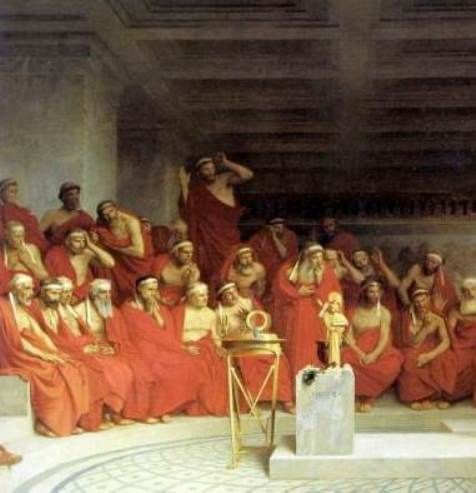
The Gerousia

“I have not lived so long, Spartans, without having had the experience of many wars, and I see among you of the same age as myself, who will not fall into the common misfortune of longing for war from inexperience or from a belief in it’s advantage and safety”

Archidamus, King of Sparta

One thing on which most commentators, academics and former officials seem to agree is that the United States government has a difficult time planning and executing strategy. Furthermore, that since 1991 we have been without a consensus as to America’s grand strategy, which would guide our crafting of policy and strategy. This failing bridges partisan divisions and departmental bureaucracies; there are many career officials, political appointees and even a few politicians, who can explain the nuances of the Afghan War, or the Libyan intervention, the depreciatory tailspin of the US Dollar or America’s Russia policy – but none who would venture to say how these relate to one another, still less to a common vision.

Sadly, they do not, in fact, relate to one another – at least not, as far as I can discern, intentionally.

Few American policies or even military operations (!) in one country can be said to have been conceived even within a coherent and logically consistent regional strategy and it is not just common, but normal, to have DIME agencies working at completely contradictory purposes in the same area of operations. The interagency process, to the extent that it exists, is fundamentally broken and incapable of interagency operational jointness; and the institutional coordinating mechanism for any “whole of government” effort, the National Security Council, has become too consumed with crisis management. A mismatched prioritization of resources which leaves little time for the kind of long range planning and strategic thinking that allows nations to seize the initiative instead of reacting to  events.

It would be a useful corrective for the better conception and execution of US policy, for the President and the Congress to create a special board for grand strategy that could give presidents and key officials frank assessments and confidential guidance to help weave their policy ideas into a durable and overarching national strategy. One that might last beyond a few days’ headlines in The New York Times.

The President of the United States, of course has a number of bodies that could, should but do not always provide strategic advice. There’s the Defense Policy Advisory Board, an Intelligence Advisory Board,  the National Intelligence Council, the State Department’s Policy Planning Staff, the Office of Net Assessment and not least, the NSC itself and the Joint Chiefs of Staff, whose Chairman, by act of Congress, is the military advisor to the President and Secretary of Defense. While strategic thinking does percolate from these entities, many have very specific mandates or, conversely, wide ranging briefs on matters other than strategy. Some operate many levels below the Oval Office, are filled with superannuated politicians or have personnel who, while intellectually brilliant, are excessively political and untrained in matters of strategy. The Joint Chiefs, the professionals of strategy, are highly cognizant of the Constitutional deference they are required to give to civilian officials and are very leery of overstepping their bounds into the more political realms of policy and grand strategy.

What  the President could use is a high level group just focused on getting strategy right – or making sure we have one at all.

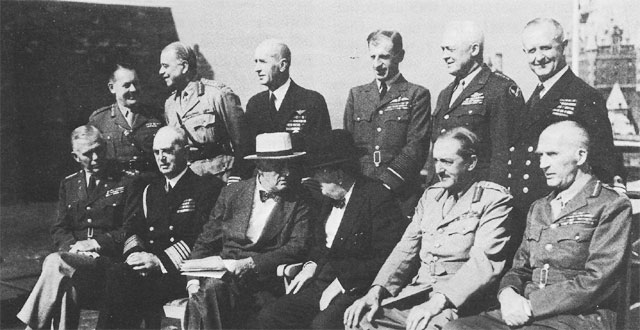
I’m envisioning a relatively small group composed of a core of pure strategists leavened with the most strategically oriented of our elder statesmen, flag officers, spooks and thinkers from cognate fields. A grand strategy board would be most active at the start of an administration and help in the crafting of the national strategy documents and return periodically when requested to give advice. Like the Spartan Gerousia, most of the members ( but not all) would be older and freer of the restraint of institutional imperatives and career ambitions. Like the Anglo-American joint chiefs and international conferences of WWII and the immediate postwar era, they would keep their eye on the panoramic view.

combined-chiefs.jpg

The Octagon Conference – FDR, Churchill and the Combined Chiefs of Staff

Here’s my grand strategy board in a hypothetical perfect world, unlike the one that prevails inside the beltway. I’m sure people will quibble with particular names or will suggest others. I freely admit, for example, that I do not have the best grasp of who our leading intellectual powerhouses are in the Navy, Air Force or the closed world of intelligence analysis and this impairs my ability to put together the list. Nevertheless, I’m trying anyway:

Let’s start with a group of acclaimed and eminent strategic thinkers who have demonstrated over a long tenure, their ability to consider matters of war, peace and statecraft as well as the nuances of strategic theory:

Thomas Schelling -Chairman
Andrew Marshall
Edward Luttwak
Colin Gray
Joseph Nye

Next, some senior statesmen:

Henry Kissinger
George Schultz
Zbigniew Brzezinski

Madeleine Albright

General officers and one colonel with a demonstrated talent for challenging conventional assumptions:

Lieutenant General Paul van Riper
General James Mattis 
General Jack Keane
Colonel John Warden

Two economists:

Alan Greenspan
Nouriel Roubini

Two scientists:

Freeman Dyson
E.O. Wilson

Mixed group of strategists, historians, practitioners and theorists:

David Kilcullen
John Robb
John Negroponte

Barry Posen
Antulio Echevarria

Chet Richards
Micheal Vlahos
Thomas P.M. Barnett
Stephen Biddle
Robert Conquest
Duane Clairridge
Jack Matlock
Martin van Creveld

Visionaries and Contrarians:

Nicholas Nassim Taleb
William Gibson
Ray Kurzweill
Andrew Bacevich

What are the problems with my grand strategy board (aside from having zero chance of coming into being)? 

For one, it is probably way too large. In my efforts to balance expertise in strategy with varied thinking it grew bigger than what is manageable in real life, if the group is to be productive.

Secondly, it is an exceedingly white, male and conservative leaning list – though to some extent that reflects the criteria of experience, the field of strategy itself and the nature of American politics.  Barbara Ehrenreich, for example, is definitely bright but her politics are fundamentally opposed to effectively maximizing American power in the world or the use of military force – thus making her of little use except as a voice of dissent.

Another limitation of this exercise is the idiosyncratic eclecticism of my approach – this was a blog post written over a few days in my spare time and not a methodical inquiry into who in American life would verifiably be the “best qualified” to help construct a grand strategy. There are “insiders” who command great respect within the national security, defense and intelligence communities who are unknown to the general public, or even this corner of the blogosphere, who would be enormously helpful to such a board. Finally, a grand strategy board would not be a panacea; it would be subject to all the inertial pressures that over time would reduce it’s ability to effect change, just as the Policy Planning Staff and the NSC have been “neutered” over decades by the forces of the status quo.

That said, the above group or one reasonably comparable to it could, for a time, markedly improve the construction of strategy , assuming American leaders are willing to enlist such advice, put aside short term political considerations and pursue long term strategic goals.

Whom would you nominate to a grand strategy board?

Grand Strategic Viewing:

Recommended Reading

April 24th, 2011

Top Billing! Pundita –Adm. Mullen CYA as Rana prepares to rat out ISI. Meanwhile Rawalpindi rats out Obama and Cameron.

…Long War Journal’s Bill Roggio is skeptical about the strength of Mullen’s grasp of the concept of sacred obligation; Bill points out that Mullen had stopped short of addressing the key point, which is that Pakistan’s military actively supports the Haqqanis:

“Pakistani officials of course denied supporting the Haqqani Network, and claim they haven’t taken on the Haqqani Network due to the focus on the Movement of the Taliban in Pakistan. This of course is untrue, and Admiral Mullen of course knows that.”

Yes. Bill adds: “Despite his ‘sacred obligation’ to stop US soldiers dying at the hands of Pakistan-backed terror groups, Admiral Mullen cannot bring himself to call Pakistan to account for its actions. And as a result, more US soldiers will die as the dyfunctional ‘alliance’ between the two nations is nursed along.”

True, true, all true; however, that Admiral Mullen would risk the close relationship he’s cultivated with General Kayani by publicly uttering an implied criticism of Pakistan’s military is an eyebrow raiser; that he did this at the worst juncture in U.S.-Pakistan relations since 2001 and while a guest of Pakistan’s government was confounding. (1)

I don’t think one has to dig deep for the solution to the mystery. On April 12, the day after ISI head Lieutenant-General Ahmad Shuja Pasha spent four hours dressing down CIA chief Leon Panetta and Admiral Mullen about CIA activities in Pakistan, the Times of India reported that court documents had been made public indicating that a conspirator in the 2008 Mumbai massacre was prepared to rat out the ISI in U.S. courtroom testimony. According to the Times of India:

David Headley aka Daood Gilani and Tahawwur Hussain Rana, the two Pakistani expat footsoldiers who allegedly planned and conducted the Mumbai recce before the 26/11 terrorist carnage, have implicated the Pakistani government and its intelligence agency ISI in the ghastly attack.

In court documents that have surfaced ahead of his upcoming trial in Chicago, Rana says his acts of providing material support to terrorists in the Mumbai attacks as alleged by US prosecutors “were done at the behest of the Pakistani government and the ISI, not the Lashkar terrorist organization.”

The documents also cite Rana invoking his friend David Headley’s Grand Jury testimony in which the latter too implicates ISI…

…However, the key point is there’s clear indication that within a matter of days, when the Rana trial gets underway, the shit is finally going to hit the fan. In my view that means Mullen is scrambling to cover his ass. And if Rana really does sing like a bird, Mullen won’t be the only one in Washington scrambling.

Yet to illustrate just how sincere the U.S. military command and the Obama administration are about taking Pakistan’s military to task, it surfaced today that under pressure from Rawalpindi the Obama administration had agreed to provide Pakistan’s military with 85 ‘Raven’ surveillance drones…

Read the rest here.

Very tough post by Pundita and I note, Pakistan has again halted NATO trucks despite the gift of drones. 

Foreign Affairs (Nassim Nicholas Taleb & Mark Blyth) –The Black Swan of Cairo:How Suppressing Volatility Makes the World Less Predictable and More Dangerous 

Why is surprise the permanent condition of the U.S. political and economic elite? In 2007-8, when the global ?nancial system imploded, the cry that no one could have seen this coming was heard everywhere, despite the existence of numerous analyses showing that a crisis was unavoidable. It is no surprise that one hears precisely the same response today regarding the current turmoil in the Middle East. The critical issue in both cases is the arti?cial suppression of volatility — the ups and downs of life — in the name of stability. It is both misguided and dangerous to push unobserved risks further into the statistical tails of the probability distribution of outcomes and allow these high-impact, low-probability “tail risks” to disappear from policymakers’ ?elds of observation. What the world is witnessing in Tunisia, Egypt, and Libya is simply what happens when highly constrained systems explode…

Hat tip to Crispin Burke

Thomas P.M. Barnett- Failed states keep neighborhoods bad, allowing AQ sanctuary, while rising states allow connections, but it’s civil strife that remains AQ’s bread-and-butter dynamic

Patrick is also right that AQ prefers up-and-comers, or states with just enough connectivity and technology and corruption to give them access to the Core.  Pakistan is perfect in this regard, much better than Afghanistan (my column Monday).  Under the right conditions, we need to worry far more about Pakistan than Afghanistan, which is a solution for locals.  

National Defense MagazineFBI Anticipates Terrorist Attacks on Soft Targets in the United States

This is an easy predicting, being inevitable. The fact that it has not happened yet speaks less to our inane TSA “security theater” than to the deep reluctance of state sponsors of terrorism to have an “American Beslan” traced back (perhaps erroneously) to their doorstep. It is not that Hezbollah or HAMAS or the LeT could not shoot up a shopping mall, elementary school or bomb a sports stadium – they could very easily – it’s a strategic choice not to do so as the extent of US retaliation is no longer predictable.

Moises Naim –Who Lost Mexico?

The Mexicans (Hat tip to John Sullivan)

Newshoggers.com (John Ballard)-Syria Links

Provocative collection.

SWJ Blog (Larry Goodson and Thomas H. Johnson)-How the Soviets Lost in Afghanistan, How the Americans are Losing

The Eagle goes over the mountain…..

That’s it!


Switch to our mobile site