zenpundit.com » china

Archive for the ‘china’ Category

Tom Barnett’s Communique to the Barbarians

Wednesday, November 24th, 2010

” A communication: magnificently our great Emperor soothes and pacifies China and the foreign countries, regarding all with the same kindness. If there is profit, then he shares it with the peoples of the world; if there is harm, then he removes it on behalf of the world. This is because he takes the mind of heaven and earth as his mind.”                                      – Lin Zixu

I am no Sinologist, so I am interested in how professional China-watchers interpret this signal. Here’s my two cents:

Dr. Thomas P.M. Barnett teamed up with two highly-regarded (inside Chinese elite circles) pundits John Milligan-Whyte and Dai Min to offer a “grand strategic rebalancing” of the Sino-American relationship for the 21st century, which ran in The People’s Daily, the official newspaper of the Central Committee of the Communist Party of China. Agree or disagree with the particulars, an impressive and timely move on Tom’s part.

An excerpt – but you should really read the whole thing:

….When agreed upon by the presidents of both nations through an “executive agreement” not subject to U.S. Senate ratification, it will promote U.S. economic recovery, increase U.S. exports to China, create 12 million US jobs, balance China-US trade as well as reduce U.S. government deficits and debt. Furthermore, it will stabilize the U.S. dollar, global currency and bond markets. It will also enable reform of international institutions, cooperative climate change remediation, international trade, global security breakthroughs as well as facilitate the economic progress of developed and developing economies, the stabilization and rebuilding of failed states and security of sea transport. The essence of the grand strategy is that the United States and China will balance their bilateral trade and never go to war with each other, and the US will refrain from seeking regime change and interference in China’s internal affairs with regard to Taiwan, Tibet, Xinjiang, the Internet, human rights etc. and China will continue its political, legal, economic and human rights reforms.The Taiwan situation will be demilitarized by an informal U.S. presidential moratorium on arms transfers to Taiwan, China’s reduction of strike forces arrayed against it, a reduction of U.S. strike forces arrayed against China and ongoing joint peacekeeping exercises by U.S., Chinese and Taiwan militaries.The strategic uncertainty surrounding nuclear program in Democratic People’s Republic of Korea (DPRK) will be de-escalated by the U.S. eschewing DPRK regime change goals and China ensuring that DPRK adopt policies along the lines of Deng Xiaoping’s economic reforms and terminate its nuclear weapons program. China, U.S., South Korean and other military forces will together ensure maritime safety in the Yellow Sea….

Read more: Thomas P.M. Barnett’s Globlogization – Thomas P.M. Barnett’s Globlogization – New China-U.S. grand strategy proposal, as published in People’s Daily Online

Publication in The People’s Daily does not imply that this blue sky missive is Chinese policy, but it would never have appeared without the sanction of some important figures in China’s government and Communist Party. I am not up to speed on elite Chinese politics, but historically, the Central Committee of the CCP was a much more integrated body of elite decision makers in the sense of mixing PLA generals, state bureaucrats and Party bigwigs than was the Soviet Cenntral Committee, which served in the post-Stalin era to cement CPSU dominance over the military and KGB. 

Set aside the merits of this “rebalancing” for later, as some points have not a hope in hell of seeing the light of day,and focus on what it means that the article has appeared at all.

First, I read this as a Mongolfier kind of trial balloon, a plausibly deniable rough draft of a Shanghai Communique 2.0 where Chinese rulers lay out their internal consensus “red line” vital interests and what they will put on the table in return, without any risk of “losing face”.

Secondly, while most of the critical noise will be over the security-military relationship, Taiwan and the total omission of Japan (!), I find the economics the most interesting section. Never before in history have two great powers with so little in common, who were not allies, so deeply entangled themselves in each others economies, basically to the point of no return. This piece tells me China’s leaders realize that a path of confrontation with America or pursuing beggar-thy-neighbor trade policy indefinitely, will mean the destruction of a generation of painfully accumulated surplus wealth, held largely in dollars and treasury securities. China’s elite would rather “double-down” on their bet on America instead of attempting to painfully wrench themselves free and cut their losses by cashing in devalued chips.

That concern is the apex of realism – a good variable to see at a time when nationalistic hubris and hypersensitivity have increasingly been on display in China’s foreign relations with great powers and weak neighbors alike. That kind of realism, other countries can do business with.

What are your thoughts?

ADDENDUM:

Tom has added his briefing slides

Sinophilia

Thursday, November 18th, 2010


Historyguy99, who has a lot of “in-country” experience, offers up a nice blog round-up and commentary on China.

More Differing Views on China

Sunday, October 17th, 2010


Good counterpoints to my previous post:

Wiggins, whose orientation toward strategy is Wohlstetterian, offers a critique.

Opposed Systems DesignThe trauma of constrained ascendancy

….Mark correctly identifies a shift in Chinese behavior over the the past year or so. Where Mark’s analysis falls short lies in presuming that incompetence or short-sighted factions are responsible for this shift. The international relations theory of power cycles offers a richer way of understanding China’s position in the international system and how that has produced a change in its behavior.

Briefly, China’s relative rate of growth has begun to slow. After roughly 30 years of (accelerating) relatively faster growth than the major powers in the system, this trend has reversed itself. This is confusing, since in absolute terms China continues to grow and – by these same absolute measures – it came through the global financial crisis much better than the U.S. In tension with these trends, however, are a host of systemic factors that are constraining its growth (including demographic shifts, environmental degradation and inefficient capital allocations). The transition from early to late stage growth (or from labor-intensive to extensive or innovation-based growth) confronts China with new challenges. It becomes harder to accurately discern its place in the system and its trajectory of growth. This leads to more internal dissent among leaders trying to interpret these disparate trends and creates incentives to discard the cautionary policies of Deng (hide brightness, nourish obscurity). Before the first inflection point, time was on China’s side. A post-first inflection point China, on the other hand, begins to feel pressure to realize some of its ambitions before its window of opportunity closes. Hence, we begin to see cracks forming in the implementation of Deng’s strategy.

I have only read one paper on power cycles, recommended to me by Wiggins himself in his non-internet persona, so I am not qualified to comment on it’s theoretical strengths and weaknesses as an evaluative tool ( it would also help if were a quant rather than a qual academic). I will say that, as a rule of thumb, selective relative changes, those that are marginal in nature, are often perceived more acutely in terms of political angst than are absolute changes in real terms.

For example, agrarian populists in 19th century America were absolutely furious about the effects of a deflationary gold standard on crop prices relative to debt, liquidity and access to credit but not so exercised about the increases in purchasing power and access to consumer goods that farmers enjoyed that were unknown a generation earlier. Perhaps somewhere, there is a Chinese William Jennings Bryan in Shaanxi waiting to burst on the scene. 🙂 Or a von Tirpitz.  So there may be merit, in a macro-systemic sense, to Wiggins criticism of my post.

Dr. Thomas P.M. BarnettThe “rising near peer” returns the paranoid favor

….And we wonder why the Chinese military seem to think we’re their number one enemy?  Are we honestly that clueless or has our disingenuity broken through to some higher, slightly irrational plane?

Follow me into this brave, alternative world:

  • Imagine the Chinese navy holding multinational exercises with the Cubans and Venezuelans and Nicaraguans (a silly sight, I know) in the waters around Cuba, while Beijing warns us subtly that their 1979 Cuba Defense Act will be pursued to the ultimate vigor required, including the sale of advanced attack aircraft to the Cuban air force.  
  • Imagine Chinese carriers conducting such operations, sporting aircraft and weaponry that could rain destruction over most of the continental U.S. at a moment’s notice.  
  • Imagine Chinese spy craft patrolling the edge of our local waters and flying around the rim of our airspace.  
  • Imagine the Chinese selling all sorts of missile defense to Venezuela and other allies “scared of rising American militarism.”
  • Imagine weapons purchases throughout Latin America doubling in five years time, with China supplying most of the goods.  
  • Imagine Chinese naval bases and marine barracks doting the Latin American landscape and Caribbean archipelago.
  • Imagine a Cuban missile crisis-like event in the mid-1990s, which led the Chinese military to propose a new evolution in their warfare since.  
  • Imagine the Chinese military conducting regime toppling events in the Middle East, involving countries upon whom our energy dependency is dramatically and permanently rising, while China actually gets the vast bulk of its oil from non-Persian Gulf sources like Canada, Mexico, Latin America, Africa and itself.  
  • Imagine the Chinese government demanding that the Chinese military produce an elaborate report every year detailing the “disturbing” rise of U.S. military power.  
  • Imagine the Chinese military announcing their new military doctrine of attack from the sea and air, with their documents chock full of bombing maps of U.S. military installations that are widely dispersed across the entirety of the continental United States, meaning their new war doctrine has–at its core–the complete destruction of U.S. military assets on our territory as the opening bid.
  • Imagine the U.S. military stating that this new doctrine of attacking the entirety of the U.S. territory is necessary to maintaining the regional balance of power in the Western hemisphere, because the U.S. Navy has–in an “unprovoked” and “provocative” manner, begun significant patrolling operations in the Caribbean Basin, whose waters constitute a “profound” national interest to the Chinese.
  • Imagine this series of developments unfolding over close to two decades, as China, having lost its familiar great-power war foe, the Soviet Union, firmly glommed onto the U.S. as a replacement enemy image.
  • Imagine all that, and then imagine how the U.S. military views the Chinese military.  
  • Imagine if the Chinese military offered military-to-military ties under such conditions.  

What do you think the U.S. Congress would say to that?  Would it be considered “caving in” to Chinese pressure?

In backchannel, .mil circles, Tom is sometimes accused of being a “panda hugger” but I think that is attributable to the poverty of genuine strategic thinking that prevails in our national security community. A prerequisite in constructing a strategy is being able to “see the board” from the perspective of the other fellows shoes. If you can’t do that, you are stuck at the tactical-reactive level of analysis. Seeing another side’s perspective is an iterative advantage, not a weakness or evidence of sympathy. If you can game out their best moves before they can, then you are a strategist who has the ability to wrest maximum concessions at minimum cost to your own side.

We need more of that kind of thinking, not less; we’d make fewer mistakes ( like the kind the Chinese are making of late).

China is Vulnerable to 4GW and 5GW

Monday, October 11th, 2010

disintegratingchina.jpg

The Chinese government’s hamfisted and Brezhnevian reaction to the awarding of the Nobel Peace Prize to imprisoned political dissident Liu Xiaobo, which included a tantrum by the Chinese official media, empty threats against the Norwegian government and the bullying arrest of Liu’s hapless wife have served primarily to telegraph the deep insecurity and paranoia of the CCP oligarchy. Not only was the move reminiscient of how the Soviet leadership bungled handling the cases of Aleksandr Solzhenitsyn and Andrei Sakharov, but coming on the heels of China’s worst year for public diplomacy since the end of the Cultural Revolution, it leaves me wondering if China’s leadership have corrupted their OODA Loop through self-imposed intellectual isolation and an unrealistic assessment of Chinese power?
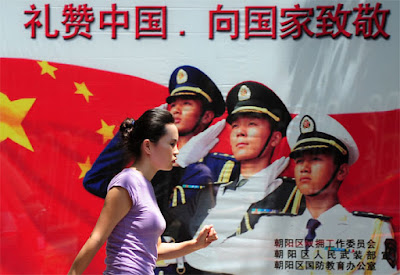
Most observers have attributed China’s recent aggressive diplomatic behavior on matters of trade, the South China Sea (where China essentially demanded that China’s neighbors accept vassal status when China lacks the naval power projection to make good on such demands) and the Korean penninsula to be a direct result of confidence in China’s economic power and status as a “rising power”. Perhaps.  China has been “rising” for a long time. That’s not new. The real novelty is Chinese incompetence in foreign affairs, an area where Chinese leaders have been admirably astute for decades since the “China opening” of the Nixon-Mao meeting. Chinese statesmanship has previously been noteworthy for it’s uber-realistic calculation of power relationships and strategic opportunities.

The reaction of Beijing to the Nobel Peace Prize Committee was hysterical rather than the quiet disdain of a confident great power, an indication that China’s elite remain acutely sensitive regarding their own political legitimacy, or lack thereof ( also evidenced by their  recent centralization of control over China’s vast paramilitary police security troops). It is also highly unusual that China has manuvered itself into a position of friction simultaneously with virtually all other great powers on various issues, while alarming most of its neighboring states; and moreover has done so in a very brief period of time.

Something is amiss at the Central Committee and higher levels of the CCP and government. Either primary attention is being given to internal power struggles related to eventually generational shift of leadership, or a particularly belligerent and parochial faction has increased it’s influence at the expense of better informed and more pragmatic groupings that have steered China in the recent past.

The following are some possibilities:

  • The Chinese leadership will find fewer rather than more opportunities as neighboring nations and distant states act to “Raise the costs” for China, which will in turn feed the Chinese leadership’s sense of paranoia, victimhood and isolation.
  • The view of reality of Chinese leaders will be increasingly subject to what Col. John Boyd termed “mismatches” and they will be easily baited into reaction and overreaction by foreign adversaries and domestic dissidents. Want to send Beijing into a tizzy before an important international conference? Just roll out the red carpet for the Dalai Lama or the President of Taiwan.
  • Habitual overreaction and “hardliner” attitudes in foreign affairs will bleed over into domestic unrest issues with the leadership escalating rather than de-escalating situations of domestic protest over legitimate but basically apolitical grievances over poor local governance and corruption.
  • Dissident groups inside China will eschew overt political protest for covert sabotage, hacking, swarming and systems disruption while minority elements, particularly Muslims and “cults” like Falun Gong will gravitate toward terrorism and criminal enterprises to fund their activities.
  • The senior leadership will reverse course and change back to Chinese diplomatic approaches emphasizing enticing “soft power” that served China well since Deng Xiaoping’s tenure. At home a renewed emphasis will be placed on anti-corruption drives, cultivating nationalism and placating peasantry and underemployed aspirants to middle-class “good life”, urban dwellers.

ADDENDUM:

From East Asia Intel.com:

“Hu and the generals face challenge by Xi and the ‘Gang of Princelings’

by Willy Lam

In theory, the upcoming plenary session of the Chinese Communist Party’s Central Committee is devoted mainly to fine-tuning the country’s Twelfth Five-Year Plan for the years 2011-2015. Personnel changes have not even been included in the publicized agenda of the plenum, which opens on Oct. 15.

However, all eyes are on whether Vice-President Xi Jinping, 57, will get the additional – and crucial – title of vice-chairman of the Central Military Commission (CMC). While Xi is the most senior-ranked Politburo Standing Committee member among politicians born in the 1950s, the power base of the putative “core of the Fifth-Generation leadership” will not be secure until he gets a CMC slot.

….It is almost certain that Xi will succeed Hu as Party General Secretary at the 18th Congress – and that he will take over the supremo’s position of state president in March 2013. However, Hu has indicated to close aides his wish to serve as military chief for one more five-year term beyond 2012.

The 67-year-old Hu has cited the precedent set by ex-president Jiang Zemin at the 16th CCP Congress in 2002, when the latter surprised his colleagues by refusing to quit the CMC despite having retired from the Central Committee and the Politburo. If Hu gets his way, there will be no urgency for Xi to be made CMC vice-chairman this year….”

Hat tip to David M.

ADDENDUM II.

T. Greer takes issue with my analysis and finds a method – authoritarian resilience – in the madness.

The Political Theater of the CCP  

….I hesitate to condemn the Central Committee on the grounds of incompetence. The line between China’s domestic and foreign policies has always been difficult to demarcate and observers risk misinterpreting the message Party policies seek to convey if they have not first identified the audience meant to receive it. That a Western diplomat finds the CCP’s policies hamfisted does not mean all interested parties will reach the same conclusion.

For example, few Chinese consider the centralization of China’s paramilitary police to be a bid for political legitimacy or an attempt to squash an alternate locus of power. To the contrary, it has been hailed as a critical part of President Hu Jintao’s larger drive to eliminate corruption in the countryside. This year local Party officials have been the subject of much criticism in the Chinese press for using the People’s Armed Police and extra-legal security groups to suppress citizens filing petitions against them. Removing local access to the police is not an unusual recourse to such blatant corruption – and is not seen as such by the Chinese people.  Centralization of corrupt elements is business as usual.

….This defense carries little weight in the cold court of international opinion. It was never designed to! The upper echelons of the CCP do not seek the approval of those living outside of China, but those living inside of it. China’s so-called “Victimization Syndrome” and “Cult of the Defense” define popular perceptions of international affairs. Any set of policies that conform to this narrative will quickly gain the support of China’s proudly patriotic populace. Indeed, the CCP’s most recent actions on the international scene have done just that.

Recommended Reading – China Special Edition

Tuesday, February 16th, 2010


Top Billing! Steve ClemonsIf You Could See America Through China’s Eyes

Clemons sheds light on a hardheaded, quasi-official, Chinese analysis of the strategic direction of American power. A must read piece.

Several years ago, I met with the Deputy Director of the Policy Planning staff of China’s Ministry of Foreign Affairs, and I asked him what he was working on — and what China’s grand strategy was.

His reply: “We are trying to figure out how to keep you Americans distracted in small Middle Eastern countries.”

It’s pretty memorable when one can joke and be truthful at the same time. China has had opportunities throughout the world open up to it easily — mostly because of systemic American inattention to much else beyond its war slogs. The Obama administration, which in its first year in office, has managed high level presidential and cabinet level face time with leaders around Asia, Africa, Latin America, and the Middle East has done a lot to correct the impression from the G.W. Bush years that America has completely checked out from the rest of the world — but there still is a sense that American pretensions in the world are more veneer than real.

Now read in full (on the extended page) a short, brilliantly written report titled “Strategic Contraction Replaces Arrogance: Chinese Analysis of the Quadrennial Defense Review” by Li Shuisheng at China’s Academy of Military Science on the Pentagon’s recently released Quadrennial Defense Review.

This is a very sobering “offshore perspective” on American power.

openSecurity (Aziz Hakimi)Af-Pak: what strategic depth?

This is the sole exception to the topical focus on China today. A brutally frank examination of our core problem with Pakistan’s elite.

….General Kayani admitted that Pakistan’s objective of supporting the former Taliban regime in Afghanistan was to gain a ‘strategic depth’ in Afghanistan, which he hoped that now ‘a peaceful and friend Afghanistan’ would provide it.   His comments indicate that Pakistan’s policy makers are still interested in the old policy of gaining strategic depth in Afghanistan, which may influence their approach to Afghanistan and related issues such as fighting the Taliban and participating in regional cooperation.

….Meanwhile, Serajuddin Haqqani, the leader of the network, in an interview with Aljazeera TV claimed the responsibility for the attacks on the heart of Kabul on 18 January.  Afghan Police investigations and arrests following the attack also confirm that the Haqqani network was behind the raid which left 5 killed and 17 injured.

It is also important to note that General Parvez Musharraf as well as General Ashfaq Kayani had described Haqqani network leaders as Pakistan’s “strategic assests”.

Thomas P.M. Barnett –  A Bad Time to Wreck Our Relationship with China 

Dr. Barnett puts the geoeconomics into the geopolitics and security of the Sino-American relationship….

…..But middle-class doubt and vulnerability have now coalesced into populist anger. And in responding to it, the Obama-Biden team seems dangerously intent on re-vectoring a foreign policy anchor of Bush-Cheney — namely, the bilateral relationship with China. Ironically, the Bush administration’s policy toward China was arguably its smartest and most sophisticated endeavor. A century from now, our nation’s interventions in Iraq and Afghanistan will be mere historical footnotes, whereas our decision to accommodate China’s rise to the rank of global superpower will undoubtedly rank as the single most important decision made in this era by any state.

….Such strategic patience, however, is hard for any president to maintain — especially in these days of profound economic angst. Critics predictably claim the White House has given up on human rights, surrendered to authoritarian capitalism, and accepted our nation’s inevitable decline. None of this is true, of course, and yet all these hyperbolic charges carry with them the air of deep-seated grievances: Americans increasingly feel that globalization — which we created, nurtured and defended — is no longer to be trusted. Despite the fact that our share of global GDP has held amazingly steady since 1975 (26.3 percent then, compared to 26.7 percent last year), many Americans continue to assume China’s rise comes at our expense.

HG’s world –  China On The Verge of 4708, But Still a Teen in the Real World

HistoryGuy99 is recently returned from China, which he has visited many times, and reflects judiciously on the contradictions of China’s status as an ancient country but a “young” great power

Minxin PeiThe Real Lessons from the Google-China Spat

….Although recent events might tempt many to tell Google ‘I told you so,’ the company has still garnered sympathy around the world for standing up to Beijing. And anyone who cherishes the wealth of information generated by unfettered Google searches and hates the idea that secret police might have access to the keys to their e-mail boxes should indeed wish Google luck.Yet, regardless of the outcome of this contest between a politically vengeful autocratic government and a technologically savvy US firm, the Google episode will likely remain a crucial moment in China’s relations with the West in general, and with Western companies doing business in China in particular.

Coming Anarchy (Ferguson)A Sobering Look at the Rise of China and Asia 

….The Chinese leadership appears to accept at least a nascent version of this wind of change, as it were and are flexing the new found confidence of an emerging power. China’s belligerence during the Copenhagen Climate Conference, staunch opposition to sanctions on Iran, loud protests of a US/Taiwan arms deal and the subsequent threat of sanctions on US firms selling those weapons suggest a state looking to call attention to its own considerable might. Indeed a recent poll suggested that a majority of Chinese foresee a “cold war” with the United States, suggesting the specter of another global bi-polar century

The Committee of Public Safety –  How to Bugger With the United States ( Hat tip T. Greer)

How China can manipulate America’s distorted political decision-making process for strategic benefit.

TDAXPReview of “Stilwell and the American Expeirence in China, 1911-1945,” by Barbara Tuchman and “The Generalissimo: Chiang Kai-shek and the Struggle for Modern China” by Jay Taylor

Great review by Dan of TDAXP. I too read the Tayor book and second Dan’s recommendation.

Foreign Policy.com (John Lee)Big Trouble With Big China

Trademark FP quickie taxonomic treatment of Sino-American relations.

Foreign Affairs (Yang Yao) – The End of the Beijing Consensus

An optimistic view of China on the path to middle-class political liberalization.

The Glittering EyeSinophobia and China’s time bombs

Two well-considered posts from 2009 and 2005 respectively by Dave Schuler who has been a China-watcher for decades.

SWJ BlogChina’s grand strategy – past, present and future

From 2009 – and with this post, Recommended Reading comes full circle.

That’s it!


Switch to our mobile site