zenpundit.com » geopolitics

Archive for the ‘geopolitics’ Category

1913 Redux

Wednesday, June 24th, 2009


My friend Cheryl Rofer of Whirledview, who has a professional background in nuclear weapons issues, is an advocate of strong diplomatic efforts for nuclear disarmament and, someday, of a world free of nuclear arms ( note to readers: Cheryl is NOT advocating immediate or unilateral nuclear disarmament). While I see room for responsble reductions in nuclear weapons systems, I disagree that this objective – very low or no “legal” nuclear weapons- is a good idea; in fact, I expect that doing so will make great power war possible again, a nightmare we have not seen since 1945.

Cheryl had a very interesting post recently, where she makes an argument that the old world, the one that launched the 20th century’s descent into epic carnage and ideological fury in August 1914, is long gone and that the subsequent changes in political order mitigate the dangers of a revival of great power rivalry and warfare. I am using a sizable excerpt here in order to show the core of Rofer’s argument:

Not 1913

My customary response to this (after batting away their ideas that we are talking about unilateral disarmament or that we might have zero nuclear weapons in the next month or so) has been that the negotiations and concessions necessary to move toward zero nuclear weapons will restructure the world in such a way that it will resemble no world we know or have known.

But Nicholas and Alexandra has given me a new argument: Europe is no longer ruled by a single dysfunctional family.

That’s an exaggeration of the Europe of 1913, which was the problem back then. But no such important grouping of countries is any longer ruled by a single family. And there’s more to it than that: the form of rule is important, and the world has pretty much given up on absolute monarchies. There are still autocracies of various kinds around the world, but they are few.

Many of the rulers of Europe before World War I were related to Queen Victoria. She provided the fateful hemophilia gene that the Tsarevich suffered from. Both Nicholas and Alexandra were related to the British royal family, Alexandra a granddaughter of Victoria. Kaiser Wilhelm was a cousin. King Alfonso of Spain was a cousin by marriage, and there were ties to Greece, Prussia, and Denmark. The members of the family were fabulously wealthy, and, as we have recently seen, the values and interests of the fabulously wealthy are not the same as those of the rest of us.

Nicholas regretted having to go to war against Cousin Willy, but his other duties required it. Russia’s national interest was part of it, but a big part of how he thought of national interest was a pride-duty-upholding-our-sacred-values kind of thing that is more like a family’s sense of who they are than today’s national interests of economic growth or security for citizens.

….Monarchy exacerbated the problems
Most of the countries of Europe were monarchies; now most are democracies. In a monarchy, the monarch is in charge of everything. There may be ministers, but they are advisors who have only as much power as the monarch grants. Britain had been moving away from this model for some time, but Nicholas and Alexandra were hardly alone in believing that only one person can rule. When World War I broke out, Nicholas commanded the troops directly. This left a bit of a vacuum in other spheres, which Alexandra tried to fill, with Rasputin’s help.

Power is that centralized in very few countries today. Heads of government have access to advice from experts in many fields: military, scientific, economic, societal, political. The ballot box and the media remind those heads that accepting advice can be a good idea. None of this implies that decisions will be perfect, but it does mean that big decisions, like going to war, will be thought out and justified in ways that a monarch does not need to.

As I said in the comment section at Whirledview, there are two distinct questions here with Cheryl’s argument:

a) The influence of monarchy in historical period of 1913 in precipitating the civilizational calamity of WWI ( or, if you like a broader view, the 1914-1991 “Long War” between liberal democracy and authoritarian-totalitarian regimes).

b) Emerging strategic parallels with 1913 that could be exacerbated by a nuclear free world.

I will deal with each question in turn.

Europe of 1913 was, I would agree, certainly a much more hierarchical and authoritarian place than it is today. Cheryl is implicitly invoking “Democratic Peace theory” here to explain the warlike tendencies of late imperial Europe that contrast so sharply with the conflict averse, liberal democratic, welfare states that make up the EU. However the historical picture I think is more complicated in that none of the monarchs, not even the nominal autocrat Tsar Nicolas II of Russia, were absolute monarchs in practice.

Nicholas II, on paper, was the most powerful ruler but even so, he was forced to accept the Duma and limits on his previously (theoretically) infinite powers in the Revolution of 1905. Kaiser Wilhelm II was technically the “German Emperor”, sort of a commander-in-chief and presiding officer of a federation of Lander that made up Imperial Germany, and not “Emperor of Germany”. The Kaiser had to deal with an unruly Reichstag filled with socialists, other German monarchs like the King of Bavaria, a Prussian and imperial civil service, a junkers class and a Grossgeneralstab, all of which had various institutional prerogatives that checked the authority of “the All-Highest”. The King of Great Britain retained enough real power to force a pre-war reform of the House of Lords against the will of a majority of parliament, but this was regarded as an extraordinary political event ( George III had regularly exercised powers not far removed from those of President Barack Obama). The government of Austria-Hungary is beyond my expertise, except to say that it’s government was riven by byzantine rules and duplicative bodies. The Young Turks had seized power from Abdul-Hamid II and the new Sultan was a figurehead. France was a republic.

While the monarchs exercised varying degrees of executive power before the Great War, they were a declining legacy component of a modern, evolving, state system, one increasingly animated by an aggressive spirit of brutal nationalism and militarism. The state, not the monarch, is what ran Europe in 1913 and in 1918 nearly all of these crowned rulers were swept away without a trace, like a predatory insect discarding an old shell as it grew larger and stronger. Those monarchs that remained became living flags and tourist attractions. Nationalism is far from dead in 2009 and while the state as a global institution has taken an impressive beating since the end of the Cold War, it retains in most countries impressive powers of coercion and an ability to inflict great harm, even where it cannot make itself be obeyed. Zimbabwe, Iran, Sudan, Burma, to name just a few, have governments that continue to rule barbarically and thumb their noses as the civilized world, despite being loathed by substantial parts of their population or even the vast majority of citizens

The strategic calculus regarding the value of nuclear weapons to a state does not remain unchanged with reductions in nuclear arsenals, the value actually increases in the sense that each nuclear weapon becomes more significant as there are fewer of them. Nuclear weapons become more prestigious and, once the US and Russia move to very low numbers of warheads, have greater military significance to the ayatollahs, military dictators, presidents for life, nationalist demagogues and terrorists who might like to have some. Nuclear weapons are useful as status symbols or as shields to deter intervention while pursuing regional ambitions against non-nuclear neighbors, or even nuclear ones in the case of India and Pakistan.  This strategic value does not disappear with paper agreements to the contrary, and even miserably poor nations like North Korea and Pakistan can build nuclear weapons, if they have the political will to endure the modest inconvenience of becoming a diplomatic outcast.

A world that formally abolishes nuclear weapons, or reduces them to the point where major war appears to be a “survivable” risk even if they are used, creates incentives for states to wage war where previously  the fear of nuclear escalation made statesmen pull back from the brink. Moreover, I do not think we will return to exactly the world of 1913 or 1944. History never repeats itself quite so neatly. No, I think we will see the dystopian worst of both worlds – increasing “bottom-up” chaos of 4GW insurgency ( which is driven by more factors than just the nuclear age) coexisting with a renewed interest of states in pursuing interstate warfare at the top.

Human nature does not change. I agree that democracies are far less inclined, on average to fight one another than are authoritarian states but this average could easily be a product of modern democracy being a rarefied commodity until the last twenty years. We still have many brutal tyrannies on planet Earth and democracies are not incapable of aggression, error or hubris. Athens embarked upon the expedition to Syracuse, Republican Rome was more ferociously expansionistic than its later Emperors and the U.S. went through a Manifest Destiny phase.

These things should give us pause before we become too eager to take nuclear weapons off of the table.

The Kilcullen Doctrine

Friday, May 29th, 2009

Dr. John Nagl, president of CNAS, lead author of The U.S. Army/Marine Corps Counterinsurgency Field Manual, retired lieutenant colonel and top COIN expert, has penned an important review of Accidental Guerrilla by Col. David Kilcullen, in the prestigious British journal RUSI. Unfortunately, at present no link is is available, but my co-author Lexington Green is a subscriber and sent me a copy of the review, which I read last night. I now look forward to reading Kilcullen firsthand and have put Accidental Guerrilla near the top of my summer reading List.

I state that Nagl’s review is important because beyond the descriptive element that is inherent in a review, there is a substantive aspect that amounts to an effective act of policy advocacy. First, an example of Nagl’s descriptions of Kilcullen’s arguments:

We do not face a monolithic horde of jihadis moti vated by a rabid desire to destroy us and our way of life (there are some of these, although Kilcullen prefers to call them takfiris); instead, many of those who fight us do so for conventional reasons like nationalism and honour. Kilcullen illustrates the point with the tale of a special forces A-Team that had the fight of its life one May afternoon in 2006. One American was killed and seven more wounded in a fight that drew local fighters from villages five kilometres away who marched to the sound of the guns – not for any ideological reason, but simply because they wanted to be a part of the excitement. ‘It would have shamed them to stand by and wait it out’, Kilcullen reports

Tribal and even “civilized” rural people, often find ways of making social status distinctions that relate to behaviour and character rather than or in addition to the mere accumulation of material possessions (Col. Pat Lang has a great paper on this subject, “How to Work with Tribesmen“). We can shorthand them as “honor” cultures and they provide a different set of motivations and reactions than, say, those possessed by a CPA in San Francisco or an attorney in Washington, DC. People with “honor” are more obviously “territorial” and quick to defend against perceived slights or intrusions by unwelcome outsiders. This is a mentality that is alien to most modern, urbanized, 21st century westerners but it was not unfamiliar all that long ago, even in 19th and early 20th century, Americans had these traits. Shelby Foote, the Civil War historian, quotes a captured Southern rebel, who responded to a Union officer who asked him, why, if he had no slaves, was he was fighting? “Because you are down here” was the answer.

While relatively short and designed, naturally, to help promote a book by a friend and CNAS colleague, Dr. Nagl has also taken a significant step toward influencing policy by distilling and reframing Dr. Klicullen’s lengthy and detailed observations into a reified and crystallized COIN “doctrine”. A digestible set of memes sized exactly right for the journalistic and governmental elite whose eyes glaze over at the mention of military jargon and who approach national security from a distinctly civilian and political perspective:

There is much first-hand reporting in this book, based on Kilcullen’s [Robert] Kaplan-esque habit of visiti ng places where people want to kill him. After chapters detailing his personal experience in Afghanistan and Iraq, he returns to his doctoral fieldwork in Indonesia, discusses the insurgencies in Thailand and Pakistan and evaluates the complicated plight of radical Islam in Europe. While all of these confl icts are related to each other, they are not the same, and cannot be won based on a simplistic conception like the global War on Terror; instead, the enemy in each small war must be disaggregated from the whole, strategy in each based on local conditions, motivations, and desires. One size does not fit all, and there are many grey areas. A ‘with us or against us’ approach is likely to result in far more people than otherwise being ‘against us’ in these conflicts.

John Boyd would have agreed that isolating our enemies and winning over groups as allies is much preferred to needlessly multiplying our enemies. That paragraph is more or less boilerplate in the COIN community but this RUSI review is aimed not at them but at political decision makers, national security bureaucrats, diplomats and elite media and constituted a necessary set up by Nagl for “The Kilcullen Doctrine” [bullet points are my addition to Nagl’s text, for purposes of emphasis]:

….In direct oppositi on to the ideas that drove American interventi on policy two decades ago, Kilcullen suggests ‘the anti -Powell doctrine’ for counter-insurgency campaigns.

  • First, planners should select the lightest, most indirect and least intrusive form of intervention that will achieve the necessary effect.

  • Second, policy-makers should work by, with, and through partnerships with local government administrators, civil society leaders, and local security forces whenever possible.

  • Third, whenever possible, civilian agencies are preferable to military intervention forces, local nati onals to international forces, and long-term, low-profile engagement to short-term, high-profile intervention.

New doctrines emerge because ideas are articulated at the moment in time when they both fit the circumstances and the intended audience is ready to accept their implications. George Kennan, the father of Containment in 1946-1947 had attempted to give the State Department and the Roosevelt administration essentially the same advice about Soviet Russia in the 1930’s and the reaction of the White House was to order the State Department’s Soviet document collection destroyed and exile critics of Stalin like Kennan from handling Eastern European affairs ( Kennan saved the collection by storing it in his attic). Neither Stalin’s nature nor Kennan’s opinion of the USSR changed much in the next decade, but the willingness of American liberal elites to consider them did, making Containment doctrine a reality.

The post-Cold War, Globalization era elite is in the ready state of mind for a “Kilcullen Doctrine”. They are ready to hear it because systemic uncertainties have made them justifiably skeptical of old prescriptions and they are seeking new perspectives the way the Truman White House invited Kennan’s Long Telegram. This situation is both good and bad in about equal measure.

The good comes from the fact that the Kilcullen Doctrine is operationally sound, at least for specifically handling issues of complex insurgencies. It is also politically astute, in that it encourages statesmen and military leaders to first tinker with minimal measures while listening acutely for feedback instead of charging in like a bull in a china shop, to empower locals rather than engaging in the military keynesianism equivalent of enabling welfare dependency, as the U.S. did in South Vietnam and initially in Iraq. Kilcullen is also a reluctant interventionist, a healthy sentiment, albeit one unlikely to survive in doctrinal form.

The bad is multifaceted. None of these are dealbreakers but all should be “handled” by the COIN advocates of a “Kilcullen Doctrine”:

First, Kilcullen’s three principles are an operational and not a genuinely strategic doctrine. In fairness, no major COIN advocate has ever said otherwise and have often emphasized the point. The problem is that a lot of their intended audience – key civilian decision makers and opinion shapers in their 30’s-50’s often do not understand the difference, except for a minority who have learned from bitter experience. Most of those who have, the Kissingers, Brzezinskis, Shultzes etc. are elder statesmen on the far periphery of policy.

Secondly, this operational doctrine requires a sound national strategy and grand strategy if it is to add real value and not merely be a national security fire extinguisher. Kilcullen may say intervention is unwise but that is really of no help. Absent a grand strategy with broad political acceptance, policy makers, even professed isolationists, will find situational (i.e. domestic political reasons) excuses for intervention on an ad hoc basis. That George W. Bush entered office as a sincere opponent of “nation-building” and proponent of national “humility” should be enough to give anyone pause about a president “winging it” by reacting to events without a grand strategy to frame options and provide coherence from one administration to the next.

Thomas P.M. Barnett, a friend of this blog, has been articulating a visionary grand strategy since 2004 in a series of books, the latest of which is Great Powers: America and the World After Bush, where he essentially models for the readers how a grand strategy is constructed from historical trajectories and economic currents to make the case. Barnett’s themes have a great consilience with most of what COIN advocates would like to see happen, but Dr. Barnett’s public example of intellectual proselytizing and briefing to normal people outside of the beltway is even more important. Operational doctrine is not enough. It is untethered. It will float like a balloon in a political wind. It is crisis management without a destination or sufficient justification for expenditure of blood and treasure. If these blanks are not filled in, they will be filled in by others.
COIN advocates will have to bite the bullet of working on national strategy and grand strategy, building political coalitions, speaking to the public and wading into geoeconomics and the deep political waters of the long view. For a some time, they have had the excuse that as uniformed officers, such questions were above their pay grade – and this was the scrupulously, constitutionally, correct position, so long as that was the case.

That era is swiftly passing and most of these brilliant military intellectuals now have (ret.) in their titles and wear business suits rather than fatigues. COIN is not an end in itself. The horizon is much wider now and we should all be ready to pitch in and help.

ALSO POSTING ON THIS TOPIC:

SWJ Blog –  Weekend Reading and Listening Assignment

Thomas P.M. Barnett – Safranski on Nagl on Kilcullen

The Strategist – Sunday reflection: on “The Accidental Guerrilla”

MountainRunner –Recommended Reading: Kilcullen Doctrine

Abu Muqawama – Dogs and cats, living together. Mass hysteria!

HG’s World – A Brief on the Accidental Guerrilla by Zenpundit

Information Dissemination New Doctrines Without Strategic Foundations

Galrahn is right, I have not quite fleshed things out in my post and could use the help. He’s also clarified that the discussion needs to shift to the “why”, the objectives, with which I was not particularly clear by the use of “strategy” which means different things to different people, even those versed in military affairs.

Pushtunistan Rising?

Tuesday, May 19th, 2009


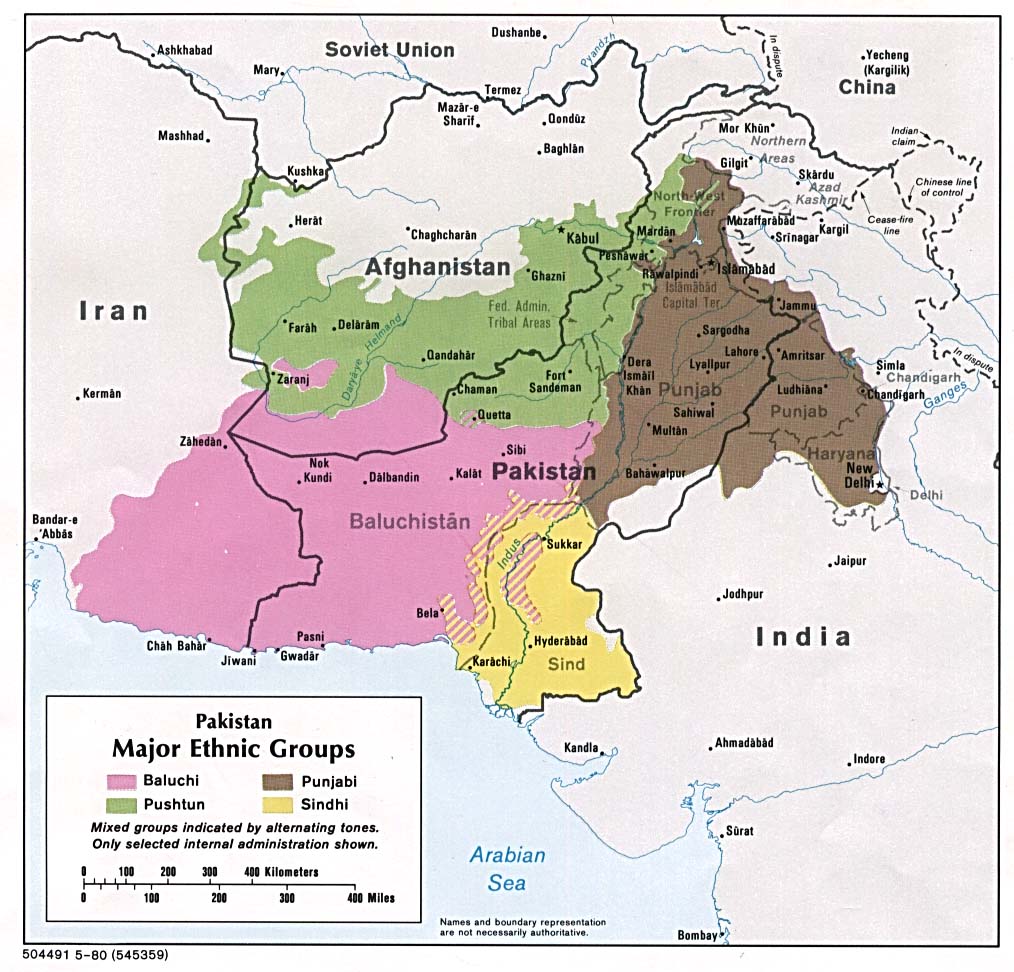
Steve Hynd at Newshoggers made the intriguing suggestion of an independent Pushtun state as a solution to the strategic problems of the Afghanistan-Pakistan region. The Pushtuns, like the Kurds are one of the world’s largest ethnic groups without a state:

The Punjabi and Sindh populations have always regarded the Pashtun as mountain wild men, bandits and reivers. The Pashtun have always regarded their neighbours as prey for their raids. It’s been that way since before the British arrived and shows no sign of abating anytime soon. The Pashtun were only forced at gunpoint into accepting the splitting of their traditional tribal ranges by the Durand Line in 1893. The situation is entirely analogous to the old border reiver clans of the English/Scottish border – another bunch of inter-related hill country wildmen who raided their neighbours irrespective of nationality for over 300 years before finally calming down and accepting imposed nationality. That territorial stramash was only solved by exiling the worst offenders to the American colonies.

….More, with the Pashtun in their own homeland free from outside overlords their reason for supporting the Taliban politically would disappear and the incompatibility between the Taliban’s extreme form of Islam and the Pashtun’s own traditional religious forms would put the two at odds more often than not.

Rather than insisting on fighting the Pashtun, the amswer in Af/Pak may lie in giving them back the independence they once had.

Read the rest here

Sort of like Ralph Peters famous re-drawing of the Mideast map a few years ago, Steve’s suggestion is provocative.The Kurds took decades to get beyond the Talabani-Barzani rivalry and seize the de facto independence that the U.S. invasion of Iraq made possible and “frontier agents”, whether British or from the ISI , have always succeeded in playing off one Pushtun group against another with only the Soviet invasion of Afghanistan in 1979 creating even semi-unity among Pushtuns – and then temporarily. This is the stuff of Pakistani nightmares but a latent sense of Pushtun nationalism lurks in the shadows, with Afghanistan being thought of as a “Greater Pushtunistan”.

Barnett in the House!

Thursday, March 26th, 2009

Dr. Barnett made an important appearance today to testify before the House Armed Services Committee on the future of the U.S. Navy and the global strategic environment it faces:

Tom’s testimony today

I appear before the subcommittee today to provide my professional analysis of the current global security environment and future conflict trends, concentrating on how accurately–in my opinion–America’s naval services address both in their strategic vision and force-structure planning.  As has been the case throughout my two decades of working for, and with, the Department of Navy, current procurement plans portend a “train wreck” between desired fleet size and likely future budget levels dedicated to shipbuilding.  I am neither surprised nor dismayed by this current mismatch, for it reflects the inherent tension between the Department’s continuing desire to maintain some suitable portion of its legacy force and its more recent impulse toward adapting itself to the far more prosaic tasks of integrating globalization’s “frontier areas”–as I like to call them–as part of our nation’s decades-long effort to play bodyguard to the global economy’s advance, as well as defeat its enemies in the “long war against violent extremism” following 9/11.  Right now, this tension is mirrored throughout the Defense Department as a whole:  between what Secretary Gates has defined as the “next-war-itis” crowd (primarily Air Force and Navy) and those left with the ever-growing burdens of the long war–namely, the Army and Marines. 

….As someone who helped write the Department of Navy’s white paper, …From the Sea, in the early 1990s and has spent the last decade arguing that America’s grand strategy should center on fostering globalization’s advance, I greatly welcome the Department’s 2007 Maritime Strategic Concept that stated: 

    United State seapower will be globally postured to secure our homeland and citizens from direct attack and to advance our interests around the world.  As our security and prosperity are inextricably linked with those of others, U.S. maritime forces will be deployed to protect and sustain the peaceful global system comprised of interdependent networks of trade, finance, information, law, people and governance. 

Rather than merely focusing on whatever line-up of rogue powers constitutes today’s most pressing security threats, the Department’s strategic concept locates it operational center of gravity amidst the most pervasive and persistently revolutionary dynamics associated with globalization’s advance around the planet, for it is primarily in those frontier-like regions currently experiencing heightened levels of integration with the global economy (increasingly as the result of Asian economic activity, not Western) that we locate virtually all of the mass violence and instability in the system.   

Moreover, this strategic bias toward globalization’s Gap regions (e.g., a continuous posturing of “credible combat power” in the Western Pacific and the Arabian Gulf/Indian Ocean) and SysAdmin-style operations there makes eminent sense in a time horizon likely to witness the disappearance of the three major-war scenarios that currently justify our nation’s continued funding of our Leviathan force–namely, China-Taiwan, Iran, and North Korea.  First, the Taiwan scenario increasingly bleeds plausibility as that island state seeks a peace treaty with the mainland and proceeds in its course of economic integration with China.  Second, as Iran moves ever closer to achieving an A-to-Z nuclear weapon capability, America finds itself effectively deterred from major war with that regime (even as Israel will likely make a show–largely futile–of delaying this achievement through conventional strikes sometime in the next 12 months).  Meanwhile, the six-party talks on North Korea have effectively demystified any potential great-power war scenarios stemming from that regime’s eventual collapse, as America now focuses largely on the question of “loose nukes” and China fears only that Pyongyang’s political demise might reflect badly on continued “communist” rule in Beijing–hardly the makings of World War III. 

Read the rest here.
 

Tom has probably made the heads of many senior admirals explode today. Though, it must be said, this is unlikely to be the first time that has happened and everything Dr. Barnett said this morning was perfectly consistent with what he’s been saying and writing for years, as he made clear in his statement. It’s more where he was saying it and to whom. Coming down so hard in Congressional testimony in favor of expanding the Navy’s capacity at littoral operations at the expense of capital ship building and submarines is waving a red flag at the “Big War” crowd while executing a taunting, end-zone dance.

Ok, I exaggerated that last part, but from the text, Tom gave a very strong signal to the Committee as to where the Navy should be headed in coming years.

UPDATE!!:

Evidently, Tom also caused the heads of committee members to explode as well. Galrahn was there at the hearing and had this anecdote:

My favorite moment was during Thomas Barnett’s opening statement, which I thought was really good. Dr. Barnett said something along the lines of “I want allies with million man armies and I want them to be ready to kill people,” which is strategically exactly right.

Well, what the audio and video won’t show is the reaction by Maine Congresswoman Chellie Pingree (D), who looked to me like she was about to either feint or have a heart attack when Barnett said that. It was a priceless moment of facial expressions as she struggled to cope with the idea he was expressing. Honestly, I’m still laughing writing about it here. It was only afterward I was reminded that she is co-sponsor in the creation of a new government organization.

The Department of Peace.

Good. The whole concept of a Department of Peace amounts to institutionalizing antiwar activists on the Federal payroll to try and obstruct foreign policy and erode national security for the benefit of unfriendly and undemocratic foreign states. If Bashir Assad and Hugo Chavez want foreign agents to lobby Congress, they can hire K Street lawyers like everyone else; we don’t need to have U.S. taxpayers footing the bill to promote far Left political causes.

Tom also weighed in on his blog on the experience:

Questions from members are extremely specific to their pet causes. I considered that exchange largely to be a showy waste of time.

Only sparks: I raise issue of Navy needing to accept more tactical risk if they want to influence events ashore more, referencing LCS. I get a small lecture about “sons and daughters” from Taylor. I refrain from mentioning my family members now in Iraq, considering that a counter-grandstanding move better avoided.

Instead, I counter with logic of Army-Marine COIN: you accept more risk when you get closer in–plain and simple. The Navy has already perfected its force structure in terms of largely rendering itself casualty-free and irrelevant to the long war, so it’s just a question of “whose sons and daughters” bear the brunt.

Taylor thanks me for a response he clearly had no expectation of triggering.

Then Thompson, who panders a grace bordering on the sublime (decrying costs in aggregate but praising individual systems and platforms), gets pissed when I downplay the intell capture argument offered by Seawolf sub proponents (Oh, to need $2.2B stealthy platforms to spy off Syria’s coast! His example, not mine). He laments that it’s too bad that the American public can’t truly know how value such collection is! This is the classic insider put down: If only you knew the secrets I know! Then you’d not dare to question my porkish logic!

Heh.

The Official Gloom

Friday, March 6th, 2009

The Armed Forces Journal on the economic decline of America.

The author makes too many assumptions regarding China’s resiliency.  The opacity of China’s hybrid, mercantilist-driven, political economy makes estimates of it’s true strengths and weaknesses difficult. We know how many treasury bills China has bought from us but not the real extent of hidden debt, underemployment or inflation. China’s leadership did not vastly increase the size of it’s paramilitary forces in the past decade because they were confident that it would all be smooth sailing ahead.

ADDENDUM:

Chinese premier takes on politics 2.0


Switch to our mobile site
