Book Review: Engaging the Muslim World by Juan Cole
Wednesday, July 8th, 2009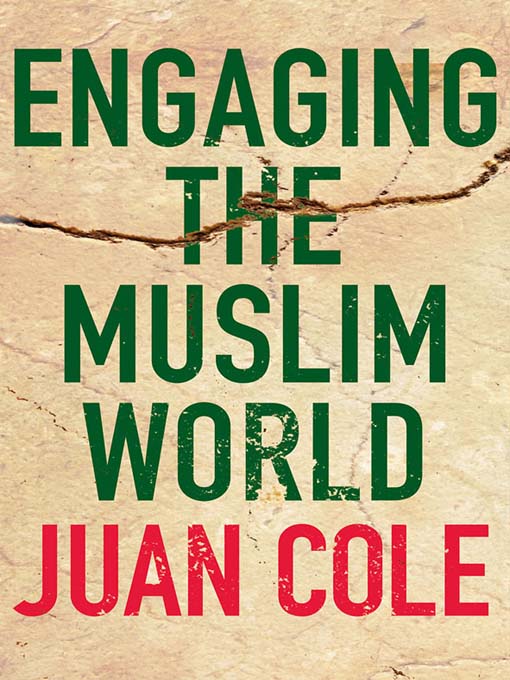
Engaging the Muslim World
I recently finished reading Engaging the Muslim World by Juan Cole, the influential academic, well known liberal-left blogger of Informed Comment, past president of the Middle East Studies Association and occasional media talking head. Cole has written an intriguing book on contemporary foreign policy that is of special interest to those readers concerned with public diplomacy, the Muslim world, terrorism and the domestic politics of American foreign policy, particularly the war in Iraq. I will state straight off that there are arguments in this book presented by Cole that I profoundly disagree with, or, national security related assertions that I consider questionable; but in other instances, when Cole is concentrating on the nuances of the Arab-Muslim world’s political-cultural lens, he is an illuminating and insightful analyst from whom I have learned new things.
Engaging the Muslim World is…well….engaging. I found Cole’s prose flowed smoothly, as if the author was talking to the reader across a table, and I had a hard time putting the book down, albeit I was frequently scribbling furiously in the margins. This is a polemical -policy book written by an academic for a lay audience and the reader’s reaction to Engaging the Muslim World will depend in part on their  own worldview. Liberals will cheer more than they disagree with Cole, while conservatives and supporters of Israel are likely to reject many of the book’s normative assumptions long before they read the conclusions – but Cole also offers some prescriptive advice that center-right COIN and public diplomacy advocates will warmly embrace.
The book is divided into six chapters. The first, “The Struggle for Islamic Oil:The Truth About Energy Independence” which deals with energy markets, the Cold War history of the Mideast, global warming, environmental policy, alternative fuel technologies and globalization, is a necessary effort to concisely account for the geoeconomic importance of Muslim oil producing states and the future of fossil fuel economies. Cole argues – correctly, I suspect – that there will be no short or medium term substitutes for oil and gas until solar power technology is cost-efficient enough (and efficient in a physics sense) to compete with fossil fuels in the marketplace. Not being a scientist or an expert in energy market issues, I am poorly placed by professional background to evaluate Cole’s claims in these areas and will leave those to others.
That said, chapter one remains the odd man out. It smacks of having been compacted by an editor out of two or more chapters and consequently has disparate issues jumbled together with insufficient explanation; as a whole, chapter one fits uncomfortably with the subsequent chapters which flow together naturally and thematically. On the other hand, the topic of oil can hardly be dispensed with either in a geopolitical discussion of the Mideast, so Cole was right to tackle it and the primary problem is really one of sequence, not subject matter.
Chapters two through six are the heart of Engaging the Muslim World, where Juan Cole articulates a theme of “Islam anxiety” permeating Western, particularly American, media and public opinion. Poorly informed about even the most basic information regarding the Muslim world, such as the differences between Shia and Sunnis, secular Baathist nationalists and Islamist radicals, quietists and the politically militant, Arabs and non-Arabs, Cole asserts that Westerners tend to lump Muslims of all shades of political belief, religiousity and nationality into a homogenous, vaguely mysterious but ever dangerous entity. Cole cites as one example, Egypt’s Sunni Muslim Brotherhood, which has foresworn violence and has members who sit in Egypt’s legislature, being lumped uncritically by American commentators with al Qaida and Hezbollah (which is a radical Shiite group).
A better way to understand violent Islamist extremists in relation to normal Muslims, in Cole’s view, would be to see them as analogous to our homegrown, violent, far-Right, white racist underground that produced Timothy McVeigh, who carried out the Oklahoma City bombing or as cult-like movements. While smaller in size than Islamist radicalism, the racist Right shares with violent Islamists the trappings of a fringe, ostracized, quasi-religious, political cult with a conspiratorial worldview that diverges sharply from the nation’s mainstream religious life. Violent Islamists often make themeslves as unpopular with their co-religioinists as do neo-Nazi extremists here, through actions that horrify society, such as the bloody massacre of Western tourists and Egyptian workers at Luxor, Egypt.
Cole’s analogy with cults and racial extremists I think is a useful one. Radical Islamists are difficult to classify on a traditional political spectrum as their political behavior has definite similarities with those of the fascist and communist totalitarians of the 20th century, but will not fit smoothly with either, given Islamist religious extremism and the fanatical atheism or at least radically secular nature of the Bolsheviks and Nazis. The psychological overlap however is certain, something akin to the 19th century Anarchist-terrorists or what Eric Hoffer captured in his classic work, The True Believer
On Israel and Iran, Cole bends over backwards, like a circus sideshow contortionist, to try and explain the lunacy (and Cole admits it is, at best, a crackpot worldview) of Ahmadinejad’s violently antisemitic statements about the Holocaust and Iran’s generally defiant behavior toward the international community while giving Israel no similar benefit of the doubt. Cole argues that Ahmadinejad’s oft-stated “wipe Israel off of the map” is a deliberate mistranslation by the Western media. Ok, possibly so. I do not speak Farsi, so I’ll take Cole’s word here. If it is the case though, Ahmadinejad is well aware of how his repeated statement is being mistranslated by Reuters and AP, yet he keeps using it. Again and again. That is an ominous statement in itself.
This uneveness regarding Iran and Israel will no doubt enrage conservatives and delight progressives, but in fairness to Juan, I must say that despite his partiality toward Iran in his book, as a blogger he was very quick to denounce the obvious stealing of the recent election by Khameini-Ahmadinejad-IRGC and my perception is that Cole views the apocalyptic Mahdist tendency in Twelver Shiism that Ahmadinejad embraces as a kooky deviation from mainstream Shiism. That not just Ahmadinejad holds this belief dear, but also many influential figures in the Iranian security apparatus as well, is in my view, a cause for alarm.
Despite his politics, Cole concludes Engaging the Muslim World with a very pragmatic prescription for American public diplomacy for engaging Arabs and Muslims in a more effective manner than in the past eight or eighteen or eighty years. If I do not agree with every aspect, it is a good deal better than what the State Department and the rest of the USG is doing now:
Once I saw an Iraqi tribal leader interviewed on al-Jazeera. He said. “There is good and bad in America”. I was struck by how pragmatic and realistic his response was, and how different it was from so much of the fundamentalist vigilantee propaganda about the United States posted on radical internet bulletin boards. If Washington could reach out to all Muslims and bring them around to a more nuanced -and clear-view, in which America was not simply demonized, it would be a major accomplishment. The point is not that they should see the West through rose colored glasses, but that they should be willing to see the good and bad.
That would represent a step up by an order of magnitude.




 and Marine corps have suffered enough casualties to have learned it the hard way. And quite honestly, Gates needn’t worry about the defense industry’s willingness to follow the money, because Lockheed Martin and L-3 have been snatching up enough blue-chip companies to prove they can spot the Pentagon’s future funding spigots.

