[ by Charles Cameron — if we omit all mention of the Qur’an, will the jihad perhaps disappear, you think? ]
.
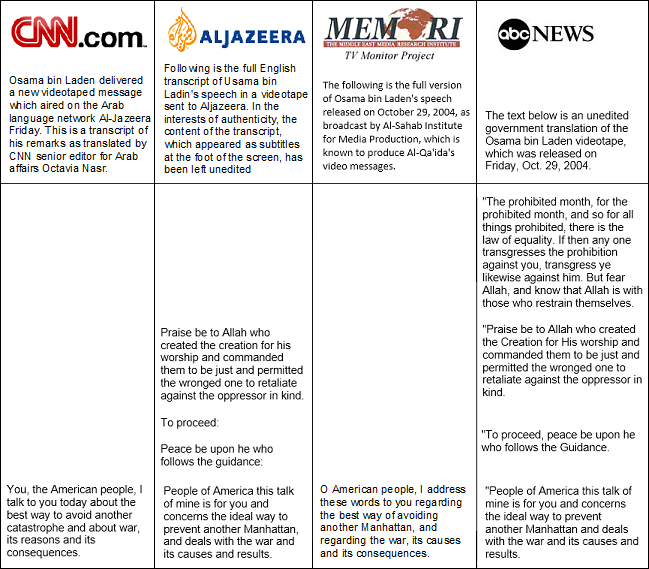
On Friday, Oct. 29, 2004, just before the 2004 US Presidential Election, a videotaped speech by Osama bin Laden was released online and variously reported:
.
.
Being a theologian at heart, I’ve formatted these versions in the style used in comparisons of the Synoptic Gospels, to give you an immediate sense of the differences I’ll be discussing…
**
Just how important was this particular speech by bin Laden?
It was important to bin Laden himself, as it was his first statement after his invitation to the US to convert to Islam. As I have noted before — quoting Michael Scheuer‘s Al-Qaeda’s Completed Warning Cycle – Ready to attack? — bin Laden had been criticized for failing to issue such an invitation:
After 9/11, bin Laden received sharp criticisms from Islamist scholars that dealt with the al-Qaeda chief’s failure to satisfy several religious requirements pertinent to waging war. The critique focused on three items: (1) insufficient warning; (2) failure to offer Americans a chance to convert to Islam; and (3) inadequate religious authorization to kill so many people. Bin Laden accepted these criticisms and in mid-2002 began a series of speeches and actions to remedy the shortcomings and satisfy his Islamist critics before again attacking in the United States.
MEMRI picks up the story here:
The Islamist website Al-Islah explains: “Some people ask ‘what’s new in this tape?’ [The answer is that] this tape is the second of its kind, after the previous tape of the Sheikh [Osama bin Laden], in which he offered a truce to the Europeans a few months ago, and it is a completion of this move, and it brings together the complementary elements of politics and religion, political savvy and force, the sword and justice. The Sheikh reminds the West in this tape of the great Islamic civilization and pure Islamic religion, and of Islamic justice…”
This video is also a significant “first” for bin Laden. In Raymond Ibrahim‘s words in his The Al Qaeda Reader:
This message also marks the first time bin Laden publicly acknowledged his role in the 9/11 strikes; previously he had insisted that he was merely an “inciter” and that it was the Muslim umma in general who had retaliated in defense of their faith.
It was important to the US because of the election four days later. The following exchange occurred on NBCNews’ Meet the Press, Jan 30th, 2005:
MR. RUSSERT: At the Clinton Library dedication on November 18, a few weeks after the election, you were quoted as saying, “It was the Osama bin Laden tape. It scared the voters,” the tape that appeared just a day before the election here. Do you believe that tape is the reason you lost the race?
SEN. KERRY: I believe that 9/11 was the central deciding issue in this race. And the tape–we were rising in the polls up until the last day when the tape appeared. We flat-lined the day the tape appeared and went down on Monday. I think it had an impact
The speech was important, in sum, both to bin Laden himself and to the US electorate: it deserves a close reading.
**
Sadly, however…
Posted, translated transcripts of Al Qaida and other jihadist materials often leave out the salutation and envoi (or other choice bits such as quotes from the Qur’an or Hadith) because they’re too religious or perhaps too Muslim — but when these same pieces of the puzzle are added back into the text, the whole document may cohere to a degree that is otherwise unapparent.
We tend not to “get” religious language. What do Daniel Benjamin and Steven Simon tell us in their book The Age of Sacred Terror?
So much of what was heard from al-Qaeda after the attacks sounded to Americans like gibberish that many chords of the apocalypse were missed.
Our prejudice against alien religious sentiment, or the assumption that it is ritualistic and hence irrelevant, or even worse, “babble” — the term FBI agents used to describe David Koresh‘s religious interpretation of events during the Waco siege — can blindside us to its very real discursive and exegetical power.
That’s the reason I’m offering you this post — years later — as a counter-example of the power of “Sembl thinking” — essentially, the power of pattern recognition as a key to understanding.
**
I read three versions of bin Laden’s videotaped speech of Oct. 29, 2004 at the time: those provided by CNN, MEMRI, and Al Jazeera — one “western secular” source, one with some degree of Israeli association, and one with roots in the Arabic cultures.
CNN cited al-Jazeera as having aired the video, and posted “a transcript of his remarks as translated by CNN senior editor for Arab affairs Octavia Nasr” which, as you can see above or at the link, began, “You, the American people, I talk to you today… “ MEMRI offered The Full Version of Osama bin Laden’s Speech followed by a transcript which began, “O American people, I address these words to you…” And Al Jazeera posted “the full English transcript of Usama bin Ladin’s speech in a videotape sent to Aljazeera” and noted, “In the interests of authenticity, the content of the transcript, which appeared as subtitles at the foot of the screen, has been left unedited” – above a transcript that began:
Praise be to Allah who created the creation for his worship and commanded them to be just and permitted the wronged one to retaliate against the oppressor in kind. To proceed: Peace be upon he who follows the guidance: People of America this talk of mine is for you…
That in itself is interesting — Al-Jazeera has two sentences with religious significance, one of them saying that God “permitted the wronged one to retaliate against the oppressor in kind” — with no mention of them in the MEMRI and CNN accounts.
**
As I read the Al Jazeera version, which seemed to me to be the one most likely to be accurate to bin Laden’s meaning, I came across the phrase:
We want to restore freedom to our Nation and just as you lay waste to our Nation, so shall we lay waste to yours.
There were several other parts of the speech which seemed to make (rhetorical) use of symmetry. There were the comments about “punishing the oppressor in kind” by destroying towers in the US, since towers in the Lebanon had been destroyed (which seems a pretty literal-minded reading of “in like manner”):
And as I looked at those demolished towers in Lebanon, it entered my mind that we should punish the oppressor in kind and that we should destroy towers in America in order that they taste some of what we tasted and so that they be deterred from killing our women and children.
There was a passage pointing up analogies between the Bush dynastic presidencies and similar dynastic rulerships in “our countries”:
… we have found it difficult to deal with the Bush administration in light of the resemblance it bears to the regimes in our countries, half of which are ruled by the military and the other half which are ruled by the sons of kings and presidents. Our experience with them in lengthy and both types are replete with those who are characterized by pride, arrogance, greed and a misappropriation of wealth.
And there was the comment translated in the CNN version:
Your security is not in the hands of [Democratic presidential nominee John] Kerry or Bush or al Qaeda. Your security is in your own hands. Any nation that does not attack us will not be attacked.
Each of these excerpts is couched in an analogical, symmetrical format, but it was the first one that really rang a bell for me — that phrase “just as you lay waste to our Nation, so shall we lay waste to yours” reminded me very strongly of one verse from the Qur’an, which contains the phrase, “And one who attacketh you, attack him in like manner as he attacked you” — the whole verse, Qur’an 2.194, has also been translated thus:
For the prohibited month, and so for all things prohibited, there is the law of equality. If then any one transgresses the prohibition against you, transgress ye likewise against him. But fear Allah, and know that Allah is with those who restrain themselves.
**
Okay, I’d read three versions of bin Laden’s text, and made a mental leap to a Quranic verse — and then I finally ran across ABC’s transcript, which opens with the very verse from the Quran my mind had leaped to.
Here’s where you can find the entire text, which ABC describes as “an unedited government translation of the Osama bin Laden videotape” – presumably from the Foreign Broadcast Information Service (then the FBIS, now the Open Source Center). It is certainly the most complete version I’ve seen:
Full Transcript of Bin Laden Video: ABC News Obtains Complete Text of Bin Laden’s Oct. 29 Video.
I don’t know for sure whether bin Laden used that verse himself (although I’d bet on it), or whether it was “framing matter” added by in the studio by Al-Jazeera (I very much doubt it) — either way, it confirmed my association, and reading the whole speech as a sermonette on that scriptural text gives it, in my view, notable added coherence.
**
Here’s what I wrote after I read the ABC transcript:
I’m particularly interested to note that bin Laden “opens” with the Qur’anic verse which says “for the prohibited month, and so for all things prohibited, there is the law of equality. If then any one transgresses the prohibition against you, transgress ye likewise against him. But fear Allah, and know that Allah is with those who restrain themselves” [Baqara 194].
That’s the central statement of the Islamic view of symmetrical morality in warfare, and prior to reading your full text, I thought I’d detected echoes of it in the OBL text in question — my own analytic process leans heavily on analogy and symmetry — and specifically in the passages I’ve quoted above…
The analogical, symmetrical format is present in each of these excerpts, and indicates how deeply the Qur’anic process runs in bin Laden, even here in a speech which attempts to present that very Qur’anic insight in secular terms to a western audience — explaining the first of the four excerpts above, for instance, with these following words:
No one except a dumb thief plays with the security of others and then makes himself believe he will be secure whereas thinking people when disaster strikes make it their priority to look for its causes in order to prevent it happening again.
and saying again, towards the end of the speech:
you may recall that for every action, there is a reaction.
We do indeed recall that phrase: in its complete form, as given in Isaac Newton‘s memorable Third Law of Motion:
For every action, there is an equal and opposite reaction.
**
For what it’s worth, the Qur’anic verse in question is not present in either Ibrahim’s Al Qaeda Reader, nor in Bruce Lawrence, Messages to the World: the Statements of Osama bin Laden. Ibrahim opens his version with the words, “Praise be to Allah, who created the worlds for his worship…” and Lawrence with, “Peace be upon those who are rightly guided. People of America…”
But no mention of Qur’an 2.194. It has just vanished. Gone. It has been ignored.
Isn’t that pretty much the definition of ignorance?
Words fail me.