zenpundit.com » islamist

Archive for the ‘islamist’ Category

US Foreign Policy, Egypt and the Muslim Brotherhood

Wednesday, January 30th, 2013
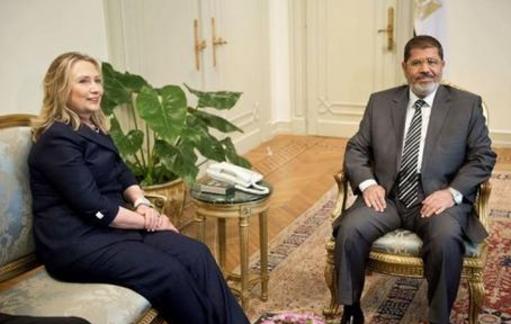
The Obama administration, though they would not characterize it as such nor have much desire to acknowledge it at all, have attempted  a strategic detente with the “moderate” elements of political Islam.

This policy has not been entirely consistent; Syria, for example, is a quagmire the administration has wisely refrained from wading directly into despite the best efforts of R2P advocates to drag us there.  But more importantly, under President Obama the US supported the broad-based Arab Spring popular revolt against US ally, dictator Hosni Mubarak, and pushed the subsequent ascendancy of the Muslim Brotherhood in Egypt and the Libyan revolution against the entirely mad Colonel Gaddafi. These appear to be geopolitical “moves” upon which the Obama administration hopes to build.

I would like to emphasize that there is one legitimate and valid strategic pro to this sub rosa policy; namely, if everything went well, it would provide the United States with powerful triangulation against revolutionary, apocalyptic, radical Islamism as expressed by al Qaida and various Salafi extremist movements. There are reasons, rooted in takfirism, strategy and the politics of lunacy that our terrorist enemies frequently hate and revile the Brotherhood as traitors, apostates or whatever. Isolating the most actively dangerous and violent revolutionary enemies from a large mass of potential allies is, at least, a good strategic goal.

It is also my view, that this “outreach” is as politically sensitive  to the Obama administration as was the China Opening was to Nixon and about which they have been equally opaque and misleading for fear of a domestic backlash. The weird, foot-dragging, dissembling, embittered, kabuki drama inside the Beltway about public statements and intelligence on whether Benghazi was caused by obscure crackpot Islamophobic film makers or a well-orchestrated terrorist attack  is in my view due to a major foreign policy strategy never having been framed in public for what it is. I’m sure people will differ strongly with me on this (which is fine), but I would characterize detente with Islamists as a strategic shift on par with the “Pivot to Asia”.

The downside here is that first, things are not likely to come out well at all, as unfinished revolutions tend to give birth to monsters; and secondly, any detente with “moderate” political Islam is an uncertain gamble based on certain exceptionally optimistic conceptions of not only what the Brotherhood might do, but about it’s very nature.

While the removal of Arab dictators resonated with American values , it was questionable realpolitik while the administration’s de facto support of  Egypt’s Muslim Brotherhood faction over poorly organized secular liberal modernists was an act of realpolitik that required a compromise of the democratic values so recently invoked to justify abandoning Mubarak. This was cynical diplomatic flexibility worthy of Talleyrand.

Unfortunately, the most democratic thing – perhaps the only thing – about Mr. Morsi and his Brotherhood supporters was his election.

The Egyptian people who are subjected now to thuggery from both Morsi’s Islamist stormtroopers and from the security forces of the Egyptian military are less sanguine than are the Brotherhood’s cheerleaders inside the administration. The Egyptian people, in fact, seem to be in revolt against domination by the Muslim Brotherhood’s shadow government.

The first question to ask in assessing if the Obama administration policy here is wise would be “What is the nature of the Muslim Brotherhood?” Americans love to personalize foreign policy, but if  Morsi were to be toppled or die, the Brotherhood will remain what it currently is, the best organized political force in Egypt and one widely influential throughout the Arab world and the West itself.

I am not an expert on the Muslim Brotherhood, nor am I an Arabist by education. Most of us aren’t – a group that I fear includes most of the Obama administration officials involved in shaping this policy. Almost fifty years after King Faisal determined to export Wahhabism, more than thirty years since Khomeini’s Revolution and more than ten years since 9/11 the USG still has less in-house expertise related to Islam than it did about the Soviet Union and Communism a decade after the Berlin Blockade.

Perhaps we all should begin learning more?

Here is an analysis from FPRI; it is extremely critical but it touches on organizational aspects of the Muslim Brotherhood that I have not seen elsewhere (hat tip to David Ronfeldt). Feel free to suggest others, both for and against. The Brotherhood is a very large group with a long history that includes violence , terrorism and subversion on one hand and peacefully representing expressions of pious, middle-class, social conservatism in other places and times:

Lecture Transcript: What Every American Should Know about Egypt’s Muslim Brotherhood, Delivered by Eric Trager 

….Two years ago when I was doing my dissertation fieldwork in Cairo, I sought out interviews with leaders from the Muslim Brotherhood, and I was referred to a man named Muhammad Morsi, now the President of Egypt. At the time, President Mubarak was ill and had gone off to Europe for operations amid a lot of mystery surrounding his health. I asked Muhammad Morsi whether the Muslim Brotherhood would run a presidential candidate if Mubarak died tomorrow. Here is what he said:

[From an audio file played by Trager]

Eric Trager: You don’t see the Muslim Brotherhood nominating a presidential candidate [if Mubarak dies tomorrow]?

Muhammad Morsi: No… because society is not ready… Our society is not ready yet to really defend its worth. We want a society to carry on its responsibilities, and we are part of this society. Another thing, if we are rushing things, then I don’t think that leads to a real stable position.

When he made that statement, I don’t think he was lying, and I don’t think he was being coy. I think that he didn’t expect that he would be faced with this reality in a mere six months. He did not expect that Mubarak would step down six months later and, to be completely honest with you, neither did I. My dissertation was entitled “Egypt: Durable Authoritarianism”—until the revolution.

What did Morsi mean when he said that the Brotherhood was trying to build a society? Let me give you some background on the Muslim Brotherhood. It was founded in 1928 by Hassan al-Banna, who was a schoolteacher in Ismailia. The Muslim Brotherhood’s goal was then—and remains now—to establish an Islamic state in Egypt. The way it pursues this goal is by trying to Islamize Egyptian society. Through social services, education, and the mosque, it sought to make Egyptians more religious and more Islamic as a grassroots strategy for building an Islamic state. That’s very, very different from a strategy that says, “We’re going to run for president, run for the Parliament, and use that power to transform society.” Rather, the Brotherhood says, in effect, “We’re going to Islamize society to build towards power.” It was a long-term strategy; it took them 84 years before they ran for and won the presidency. So Morsi told me in 2010 that the Muslim Brotherhood was not going to run for the presidency because it was not done Islamizing Egyptian society….

Read the rest here.
Mourning the loss of Monte Cassino

Friday, January 18th, 2013

[ by Charles Cameron — destruction of sacred spaces ]
.

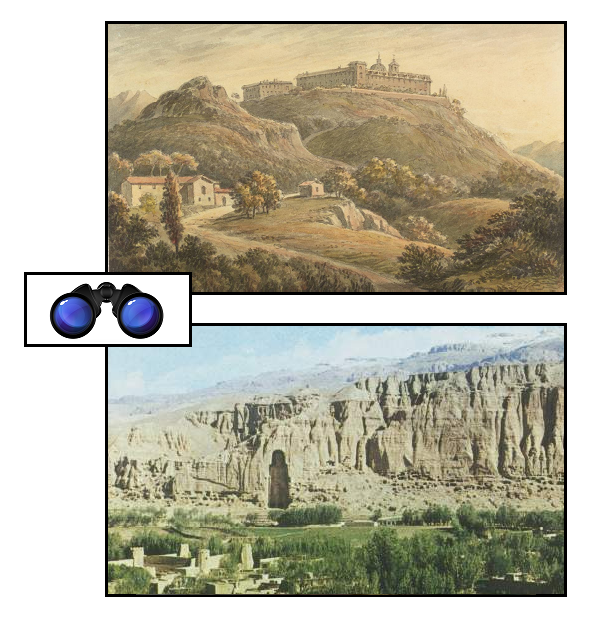
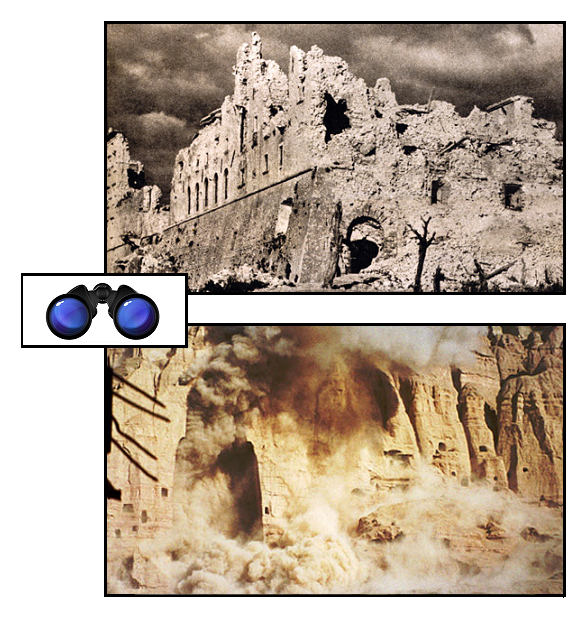
Do we grieve the destruction of the Abbey of Monte Cassino as we grieve the destruction of the Bamiyan Buddhas?

**

With playful and appropriate scholarly tongue-in-cheek, Umberto Eco describes the importance of monasteries — and of the Benedictine Order specifically — in preserving culture, literacy, the arts and sciences through dark ages in his novel, The Name of the Rose:

“Monasterium sine libris,” the abbot recited, pensively, “est sicut civitas sine opibus, castrum sine numeris, coquina sine suppellectili, mensa sine cibis, hortus sine herbis, pratum sine floribus, arbor sine foliis. … And our order, growing up under the double command of work and prayer, was light to the whole known world, depository of knowledge, salvation of an ancient learning that threatened to disappear in fires, sacks, earthquakes, forge of new writing and increase of the ancient. … Mundus senescit. If God has now given our order a mission, it is to oppose this race to the abyss, by preserving, repeating, and defending the treasure of wisdom our fathers entrusted to us.

Monte Cassino is the spiritual home of the Benedictine monastic order. It was here that Saint Benedict of Subiaco built a retreat in 529 CE, here that he wrote his Regula Monachorum or monastic Rule, the central text of western monasticism, and though the monastery had been previously sacked by the Lombards in 585, the Saracens in 884, and the Normans in 1046, it was devastated anew during the Battle of Monte Cassino 1944, an American artillery commander telling his men:

I don’t give a damn about the monastery. I have Catholic gunners in this battery and they’ve already asked me for permission to fire on it…

Harold Bond, in his book Return to Cassino A Memoir of the Fight for Rome, describes the scene as 256 American heavy bombers began dropping 576 tons of munitions on the abbey in waves, in words echoes by the video below:

There was no anti-aircraft fire from the Germans, either, just the drone of the big planes. They were very close now, and the first formation flew in over the abbey, releasing the bombs. We could see them fall, looking at this distance like little black stones, and then the ground all around us shook with gigantic shocks as they exploded. Another formation flew in, and then another, each followed by thunderous detonations. Now where the abbey had been there was only a huge cloud of smoke and dust which concealed the entire hilltop.

**

The bombing appears to have been authorized on the basis of a mistranslation. An intelligence intercept of the question “Ist Abt in Kloster?” — “is the Abbot in the Monastery” — was translated by the US as though Abt was short for Abteil, “Is the HQ in the Abbey?” The recorder answer “Ja” then led to the bombing.

Three days after the bombing, the Abbot was interviewed in person by the commander of XIV Panzer Corps, himself a lay brother of the Benedictine order, and reported:

Until the moment of the destruction of the Monte Cassino abbey there was within the area … neither a German soldier, nor any German weapon, nor any German military installation.

Thankfully, the abbey was restored and reconsecrated in 1964 by Pope Paul VI and remains to this day the mother house of the Order of St. Benedict.

**

I hope to review relevant portions of Peter Caddick-AdamsMonte Cassino: Ten Armies in Hell, available in the UK and due to be released in the US in April 2013, later this year. A review copy has been my source for details of the Battle of Monte Cassino described above.

Image sources, upper pair:

Destruction of the taller Bamiyan Buddha, CNN via Wikipedia
Montecassion destroyed, from Monte Cassino Tour

Image sources, lower pair:

Bamiyan Buddhas, from Random Walks
Monte Cassino by John `Warwick’ Smith, from the Tate

An army in Sham, an army in Yemen, and an army in Iraq

Thursday, November 1st, 2012

[ by Charles Cameron — uh-oh, it’s Mahdi time again.. giving a little wide-angle context, then passing along a hadith of possible current interest — also an aside about an end-times Shiite trinity ]
.

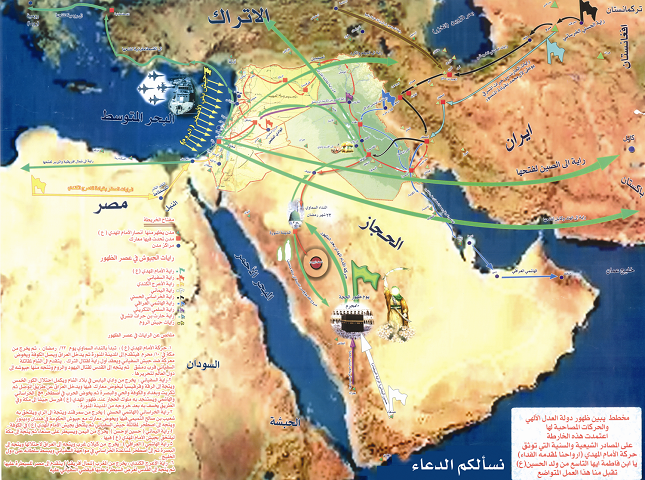
a ShiaChat map of one end times scenario: the Sufyani will attack Iran, black banners come from Khorasan

.

We live, as everyone pretty much agrees, in some place called “here” (although that shifts) at a particular moment called “now” (although that shifts too) in a medium often called “spacetime” in honor of Albert Einstein.

The Game-changing Coming Ones of many religions and sects – and even their secular variants, the Game-changing Coming Ideologies and Leaders) – are situated in another area of the same “spacetime” continuum for their respective believers: next up after “wars and rumors of wars” or “come the revolution” or “when the Mayan Calendar runs out” or “next year in Jerusalem”…
.

When:

My old friend Stephen O’Leary suggests there’s a shifting “window of opportunity” for people who preach “soon comings” – if you warn people that the world will end in a couple of thousand years, or with the heat death of the sun, or even that sea levels are liable to rise precipitously over the next few decades unless remedial action is taken, the view is long-range enough to seriously diminish your impact. Conversely, if you announce the end of the world will occur three minutes from now, nobody has time to get scared or prepared – or to propagate your message.

So “soon coming expectations” generally predict the coming is a little ways around the corner, close enough to matter but no close enough to sell all that you possess and climb Mt Ararat this week.
.

Where:

The “where” is interesting, though. We have news cameras focused 24/7 on the Mount of Olives to catch the Second Coming of Christ, although most observant Jews won’t be expecting that Christianity will be finally vindicated as the true inheritor of Judaism’s mantle there any time soon, and many Muslims expect he’ll descend at one of the minarets of the Umayyad Mosque in Damascus.

And the Mahdi? Two popular points of anticipated arrival are beside the Kaaba in Mecca, or out of the well behind the Jamkaran mosque, not too many miles from Qom.

But Islamic apocalyptic geography doesn’t end with either place – it extends, minimally, from Khorasan (Iran or Afghanistan) to Jerusalem, with a possible side-expedition to India (the Ghazwa-eh-Hind) and with possible tributaries from Africa and who knows where else… and in at least some Shia strands of apocalyptic thinking, the city of Kufa in Iraq will be the Mahdi’s seat of government.
.

And now, the hadith:

All this is simply to provide some context for a specific hadith that my friend Aaron Zelin pointed to me today, as recorded yesterday on the Kavkaz Center webpage:

Hadith about Syria, Iraq and Yemen

Publication time:
30 October 2012, 14:58

Sham – the territory of Syria, Palestine, Jordan and Lebanon

Abdullah ibn Hawalah [Allah's blessings be on him] narrated from the Messenger of Allah (pbuh) that he said:

"Matters will run their course until you become three armies: an army in Sham, an army in Yemen, and an army in Iraq".

Ibn Hawalah said:

"Choose for me, O Messenger of Allah! in case I live to see that day".

The Messenger of Allah (pbuh) said:

"You should go to Sham, for it is the best of Allah's lands, and the best of His slaves will be drawn there!

And if you refuse, then you should go to the Yemen and drink from its wells. For Allah has guaranteed me that He will look after Sham and its people!"

(Imam Ahmad 4/110, Abu Dawud 2483. Authenticated by Imam Abu Hatim, Imam ad-Diya al-Maqdisi, Sheikh al-Albani and Sheikh Shu'aib Al-Arnaut).

Department of Monitoring
Kavkaz Center

.
Further reading:

For more on this, see especially J-P Filiu‘s Apocalypse in Islam, noting in particular his account of “the revelation of Abu Musab al-Suri” (pp. 186-193), including specifically his discussion of “Sham” in a paragraph on p. 189.

*****

And an intriguing aside:

And since were talking Yemen and the greater Sham here, it may be worth noting as an aside, the presence in Islamic apocalyptic traditions of a figure known as the Yemeni — sometimes identified in Iranian Shia apocalyptic as Hezbollah’s Hasan Nasrallah. Filiu writes (p.156) of:

Shaykh Nazrallah’s transformation into the apocalyptic figure of the Yemeni, completing a very political trinity in which Ayatollah Khamenei served as the standard bearer of the Mahdi and Ahmadinejad as the commander of his armies.

Filiu’s book was published in France in 2008, but the same trinity can also be found in the fairly recent video The Coming is Upon Us attributed by Reza Kahlili to circles around Ahmadinejad. I’ve taken this account of the video and the trinity as it reports it from the Counter Jihad Report, because their version succinctly draws together the strands that most concern me here:

A little-noticed documentary titled “The Coming is Upon Us” was produced by Ahmadinejad’s office last year and it lays out the regime’s beliefs and planned path forward, much like Mein Kampf did. And it debunks the notion that the U.S.S.R. and the Iranian regime are equivalent. The film makes the case that the regime’s leaders are the incarnations of specific End Times figures foretold in Islamic eschatology.

Iran is the “nation from the East” that paves the way for the Mahdi’s appearance. Supreme Leader Khamenei is Seyed Khorasani, “the preparer” who comes from Khorasan Province with a black flag and a distinct feature in his right hand. Khamenei’s right hand is paralyzed from an assassination attempt. Khorasani’s commander-in-chief is Shoeib-Ebne Saleh, who the film says is President Ahmadinejad. Hezbollah chief Hassan Nasrallah is the incarnation of Yamani, a commander with a Yemeni ancestry who leads the Mahdi’s army into Mecca.

These three “preparers” wage war against the Antichrist and “the Imposters”-the U.S., Israel and the West’s Arab allies. The film also mentions that a figure named Sofiani will side with Islam’s enemies. Former Iranian Revolutionary Guards officer Reza Kahlili, who leaked the film, told me that the full-length version identifies him as Jordanian King Abdullah II.

The film lists various End Times prophecies that have been fulfilled to argue that the Mahdi’s appearance is near. The 1979 Islamic Revolution in Iran; the invasion of Iraq from the south and subsequent sectarian violence and death of Saddam Hussein; the Houthi rebellion in Yemen; the fall of Egyptian President Hosni Mubarak and the increasing amount of open homosexuality, cross-dressing, adultery and women taking off the hijab are correlated to specific Islamic prophecies.

As to the video’s authenticity and provenance, I can only express my ignorance and keen interest — but whatever the case, it seems likely that the split between Khamenei and Ahmadinejad, together with the latter’s “soon going” from office, renders that particular strain of prophecy moot.

Particular prophetic timelines may fail, and indeed do so repeatedly — the apparatus of apocalyptic hope simply incorporates new figures and events into its calculations, and moves its sense of urgency a little further up along the timeline…

Speaking of Pundita….

Wednesday, October 24th, 2012

She has a post up that skillfully weaves the case of Colonel Tunnell into a much larger, demoralizing, political and policy context:

On the perversion of nonviolence and religious tolerance in service of politics and war 

Two recently published essays, one by Belmont Club’s Richard Fernandez, one by Zenpundit’s Mark Safranski, when taken together reveal a portrait of human evil so horrific that young people and the severely depressed should not be allowed to see it. The rest of us need to contemplate what we have wrought by looking the other way as NATO military commands ordered soldiers in Afghanistan to act like saints in the face of ruthless armed militias and democratic governments promoted the lie that nonviolent resistance could topple dictators.  

In The Limits of Myth, Richard Fernandez amplifies on the theme I presented in On the Taliban shooting of Malala Yousafza: Pakistani human rights activists need to step believing in American fairy tales:

Pundita argues the notion of bloodless resistance has been oversold by the advocates of Mahatma Gandhi and Martin Luther King. It was a convenient alternative narrative to that perennial problem-solving algorithm, war.  By skipping over the War of Independence and the Civil War and emphasizing the Salt March and Selma, Alabama they gave the mistaken impression that resistance was all about speeches and heroic poses.
[…]
But nonviolence is a useful myth she argues, because it gives diplomats an excuse not to act. It makes a virtue of doing nothing by characterizing it as actively breaking the cycle of violence and counseling that eventually the tyrant will die of shame. But not before you die of a bullet.
[…]
The truth is that every resistance movement — even largely nonviolent ones — carries with it the implicit threat of force. The police and army of the regime often switch sides when they see that the cost of dealing with impending storm of popular violence exceeds the cost of turning on the tyrant. They fear force and therefore decline to exercise it.

The idea of consequences was once deeply rooted in the public consciousness. Yahweh thundered. And even Christ came to save us from the fires of hell. But hell there was. The opportunity for nonviolent change was always understood to be the ‘last chance’ prelude to violent consequences.  …  This kind of reasoning is now out of fashion…..

Read the rest here.

New Book: The Outpost by Jake Tapper

Thursday, October 18th, 2012

The Outpost: An Untold Story of American Valor by Jake Tapper

Influential ABC News Senior White House correspondent Jake Tapper has a new book coming out in November entitled The Outpost, about the battle of Outpost Keating in 2009 that the Taliban lost but inflicted high casualties on American troops and led to an ignominious withdrawal. Tapper’s PR folks have sent me an advance review copy, and at first glance, the book uncomfortably reminded me of Sebastian Junger’s WAR.

Sure enough, the site of Combat Outpost Keating in Nuristan is compared by Tapper to Junger’s deadly Korengal valley by page 6.  The xenophobic and remote Nuristanis were the last Afghans to convert to Islam, only by force, in the 1890’s. Their distant kin, the Kalash, are polytheists still.  Great place for an American outpost.

Looks like a gripping story. Will review in the near future.


Switch to our mobile site