zenpundit.com » blogosphere

Archive for the ‘blogosphere’ Category

Formats for civil online debate II — inspired by Hesse’s Bead Game

Tuesday, August 16th, 2011

[ by Charles Cameron — hypertext, rhetoric, glass bead games, civility ]

.

My second attempt at a format for online debate is, as I said, a variant on the “Dart Board” sometimes used for playing my HipBone Games (see, for instance, my solo game War is Sexy, says Dawn).

*

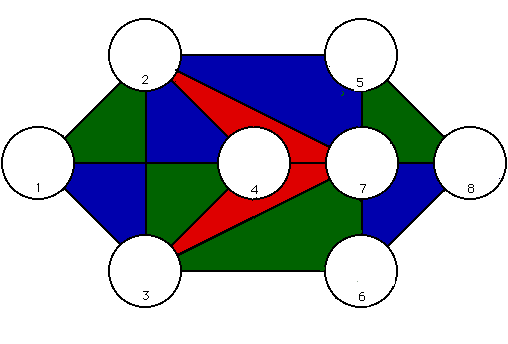
The idea here would be to format a blog post and series of 7 comments by a Querent (the one with the Question) who may also be the Umpire — both roles would be issue-neutral — a Proponent who would propose and support a thesis, and an Antagonist who would oppose it.And I should add, right at the outset, that this is a formal process for the named participants — as a white tie debate at the Oxford Union is a formal process — no matter how raucus the kibitzers may get, and accordingly requires a day or two between moves to allow for consideration, research and preparation.
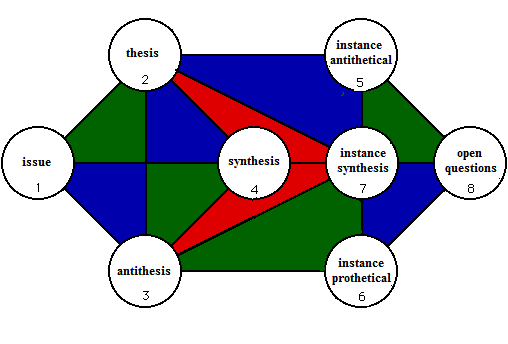
dartbdwhitedebatesetup.png

The Querent makes the first move in the first position on the board, giving it short move title (short enough to be typed on the board graphic in the space currently occupied by the word “issue‘) and a paragraph or so of move content setting forth concisely the issue to be discussed — ideally via an issue neutral anecdote or quote. After each move, the Querent (or a graphically inclined observer) would ideally update and post the game board after inserting the relevant move title.

[ Those who are not among the named participants may of course kibitz at any time… ]

The Proponent next carefully chooses a pithy quote or anecdote, gives it a move title (as above), and posts the move title, the chosen move content (the anecdote or quote selected), the link claimed (setting forth concisely the nature of his or her argument as it relates to the move content of the Querent‘s issue), and if she or he so chooses, a comment (the comments in a HipBone Game are intended for meta-conversations among the various players).

The Antagonist then similarly chooses an anecdote or quote, and posts move title, move content, links claimed — in this case, showing the links with both the issue as stated at position 1 in the Querent’s move, and the thesis as stated in position 2 in the Proponent’s move — and a comment if so desired.

Okay, that’s thesis and antithesis, the Umpire then posts a move title, some move content and links claimed to all three positions in play, with a comment if so desired, in the fourth position (labeled synthesis).

The rule is that whenever playing in a position which links via a board line to one or more previous moves, the links claimed must include explanations of how the move relates to those previous moves.

The Antagonist plays next in position 5 — playing move title, move content, links claimed, comment — providing an instance with which to dispute the thesis, and linking as per the rule just stated to the thesis proposed at position 2 — only!

Since position 5 is only connected to position 2 of those positions in play, no other links should be claimed.

Similarly, the protagonist then plays in position 6, a move which I’ve called the “prothetical” instance without a clue as to whether prothetical is a real word — tho’ I like it — linking only to the antithesis in position 2, which it seeks to refute.

Move 7 is by far the trickiest of the game, and is made by the Umpire, who now has to provide move content that synthesizes the game thus far, explaining links claimed to positions 2, 3, 4, 5 and 6 (ie to the original thesis, antithesis and synthesis, but moving the synthesis to encompass also the two instances)…

But the Umpire can take consolation in the fact that in the final move 8, the Querent gets to raise afresh those questions which remain — now that both sides have had their say, and the Umpire has attempted reconcile them.

*

Three quotes, the first one on debate:

Harmony among conflicting viewpoints, not the victory of one of them, should be the ultimate goal…

— from Bizell & Herzberg, The Rhetorical Tradition, as quoted here

The second moving from debate to dialog:

One way of helping to free these serious blocks in communication would be to carry out discussions in a spirit of free dialogue. Key features of such a dialogue is for each person to be able to hold several points of view, in a sort of active suspension, while treating the ideas of others with something of the care and attention that are given to his or her own. Each participant is not called on to accept or reject particular points of view; rather he or she should attempt to come to understanding of what they mean.

David Bohm, Science Order and Creativity, p 86

And the third, from Buddhist Madhyamika philosophy, moving into the contemplative realm where all answers are seen as the stepping off points for open questions:

I wanted to use one word in Tibetan that I’ve found very useful for myself… and this is the word zöpa.. this translates usually as patience or endurance or tolerance, but there’s this very subtle translation of zöpa, which is the ability to tolerate emptiness basically, which is another ways of saying the ability to tolerate that things don’t exist in one way, that things are so full and infinite and leave you so speechless, and so undefinably grand – and these are just descriptive words, but you have to use some words to communicate, I guess — the ability bear that, that fullness, like we’ve been talking about, not turning away, not turning away.

Elizabeth Mattis-Namgyel, in (if I recall) a Shambhala-sponsored retreat video

*

A blank Dart board, downloadable for your convenience:
dartbdwhitedebateblank.png

Formats for civil online debate I – inspired by the Talmud

Monday, August 15th, 2011

[ by Charles Cameron — hypertext, rhetoric, Talmud, civility ]

.

I have been thinking quite a bit recently about formats for online debate, and posted a comment on Jean Goodwin‘s blog yesterday, in which I commented on the Talmudic page (see R Eliezar Segal‘s excellent hypertext version for an explanation of how it works). It’s a topic that has interested me since before the turn of the millennium, and one I’ve discussed and prototyped a bit in some of Howard Rheingold‘s class forums.

Yesterday in my comment on JG’s blog, I said:

My guiding principle here is that devising suitable forms may well elevate the content poured into them…

I said this because, in my view, constraint facilitates excellence.

*

Part of the key here is captured very nicely in this quote from Jean Toomer:

In this multiple simultaneous world words only dole out one thing at a time.

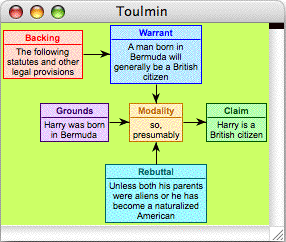
So we need polyphony, we need forms that capture many voices, many points of view, the perspectives of many stakeholders, simultaneously — not a linear progression from premise to conclusion.  And since we’re talking argumentation here, this simultaneity can be captured in a graphical form, as in this diagram based on Toulmin:

toulmin-example.gif

*

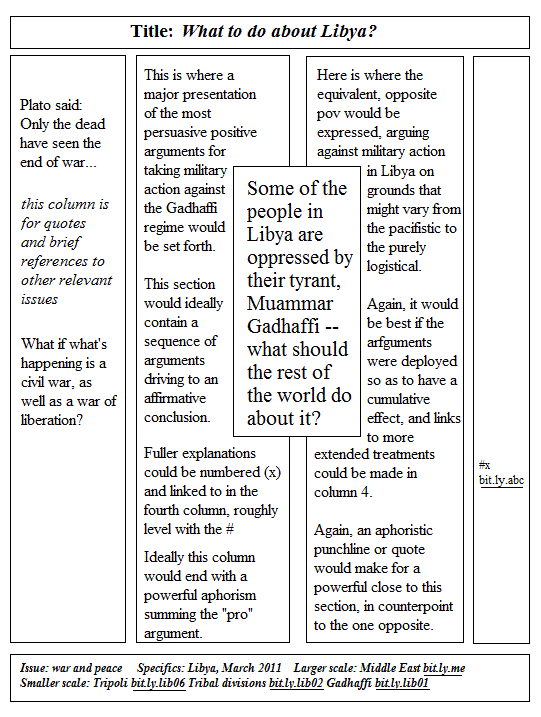
In that spirit, I thought I’d post a couple of my own experimental formats.  The first is based fairly closely on the Talmudic page — and I put it together in March of this year, so things in Libya have moved along a bit since then, though not quite enough as yet:

libyan-talmudsm.gif

My second format is a variant on the “Dart Board” sometimes used for playing my HipBone Games (see, for instance, my solo game War is Sexy, says Dawn).

I shall present it in a follow up post of its own.

*

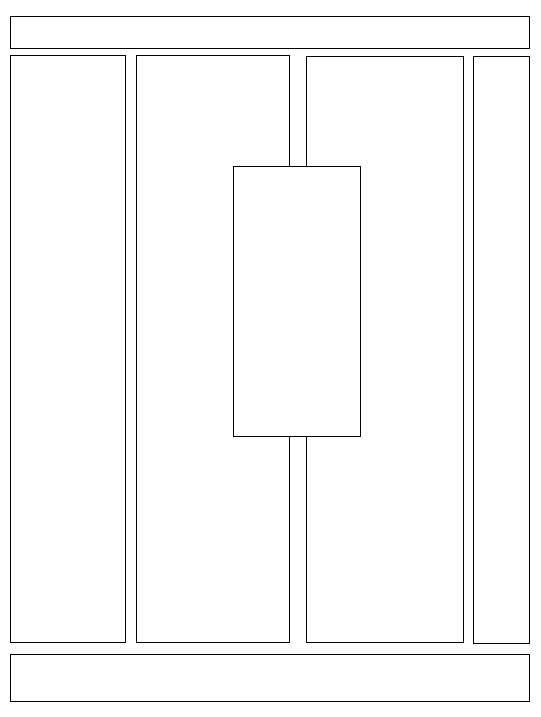
For your convenience, here’s a blank template for the kind of Talmudic debate-page I used above, available for download.  It can be filled with any graphical software that allows text and a choice of fonts & sizes.  I recommend using larger type for the main text, medium for the commentary, and small print for annotations and footnotes:

libyan-talmudsm-blank.png

Johnston, Gorka and the need for specialist knowledges

Wednesday, August 10th, 2011

[ by Charles Cameron — religious knowledge, foreign policy, military ]

.

Dr. Douglas M. Johnston just posted a piece titled Religion a crucial tool in U.S. foreign policy in the Washington Post’s On Faith blog, and in it he quoted Dr. Sebastian Gorka‘s recent testimony to the HASC Subcommittee on Emerging Threats and Capabilities:

It is very difficult, if not impossible, to provide the contextual knowledge we need to understand and defeat our enemy if we rely solely upon anthropologists and social scientists…. Today our multi-disciplinary analysis of the enemy and his doctrine just as much requires — if not more so — the expertise of the regional historian and theologian, the specialist who knows when and how Sunni Islam split from Shia Islam and what the difference is between the Meccan and Medinan verses of the Koran. We should ask ourselves honestly, how many national security practitioners know the answers to these questions, or at least have somewhere to turn to within government to provide them such essential expertise.

I do appreciate that this was written by Dr Gorka for an audience that needs to keep up to speed on many, many topics.  What dismays me here isn’t the idea that “national security practitioners” should know these things — they should indeed, and should certainly also know specialists who know a great deal more — but that the bar is set so low, “a specialist” being, for that audience, someone “who knows when and how Sunni Islam split from Shia Islam and what the difference is between the Meccan and Medinan verses of the Koran”.

Let’s back up a bit.  Here’s a report on the Senate hearing on the appointment of GEN. Dempsey as Chief of Staff of the U.S. Army.

Gen. Martin Dempsey, tapped by the White House to be the next top military officer, acknowledged Tuesday that he and other senior officers failed to grasp the power dynamics among Islamic-based groups in Iraq.

After the U.S. military toppled the Saddam Hussein-led regime there in 2003, a powder keg erupted that was driven, in large part, by centuries-old power struggles and distrust among Iraq’s various Islamic sects.

It took American civilian and military leaders years to adapt and understand these dynamics, which experts say played a major role in both the length and violent nature of the Iraq war.

Driving the lack of understanding was a tendency of the military to “take five minutes to understand” an issue while immediately spending the next “55 minutes trying to solve it,” Dempsey said during his confirmation hearing before the Senate Armed Services Committee.

Those “five minutes to understand” might get you the basic difference between the Meccan and Medinan suras — but a specialist knows a little more than that, as one can gather from comments Dr Timothy Furnish posted just the other day on his MahdiWatch blog, commenting on Dempsey’s remarks:

One might reasonably wonder whether the US military and intelligence community (not to mention the State Department) truly does, finally, realize the importance of sectarian differences in the Islamic world. For example, the Syrian case pitting the pseudo-Shi`i Alawi rulers against the country’s Sunni majority only recently came to Washington’s attention; neither Libya’s history of Sanusiyah Sufi jihad against occupation, nor Mua`amar al-Qadhafi’s heretical Islamic teachings and rule, has been fully considered or acknowledged by the American government; and there are still commanders deploying to and from Afghanistan who seem blissfully ignorant of the fact that that country is 19% Shi`i (and that a substantial subset of that is not Twelver but Sevener, or Isma’ili, Shi`i).

But that’s one paragraph from a single blog post, and Furnish has written a book — has written, as they say, “the book” on Mahdism.  And that’s just one book, you don’t suppose Furnish’s knowledge is limited to what he managed to compress into a few hundred pages, do you?

Furnish is a specialist — that’s why I read and correspond with him.  I’m a generalist with, I hope, some decent insights into what to watch for and who to read for background — but Furnish is a specialist.

And the solution isn’t to add “specialist” to a checklist, find one on LinkedIn and check it off — the solution is widespread, ongoing conversation among specialists, with the help of generalists, across all silos and disciplinary boundaries, of the sort we try to promote here from time to time… until there are enough people, with enough parts of the puzzle, that we don’t get blindsided by our ignorances.

Ignorances, plural.  Knowledges, plural.

*

This just in…  Dr Furnish’s second book — The Caliphate: Threat or Opportunity? — is now available for pre-order. I hope to review it at some point here on ZP.

UBL and Fisk: a quick note on something that caught me eye

Sunday, August 7th, 2011

[ by Charles Cameron — taqiyya, diplomacy, or theology? ]

.

I understand that Robert Fisk is viewed differently by different segments of the public, and hope we won’t get entangled in that discussion here – because I want to quote a story he tells, with an eye for two or three significant details.

The first detail, which you’ll find right at the end of the story, has to do with a leader’s standing when he must “withdraw” in front of his men – in other words, it’s a matter of honor and shame, and Fisk clearly feels that’s a motif of significance in his tale, though we might miss it if we weren’t specifically looking for it…

Here then is the story as Fisk tells it:

19 March 1997. There was a sudden scratching of voices outside the tent, thin and urgent like the soundtrack of an old movie. Then the flap snapped up and Bin Laden walked in, dressed in a turban and green robes. I stood up, half bent under the canvas, and we shook hands, both of us forced by the tarpaulin that touched our heads to greet each other like Ottoman pashas, bowed and looking up into the other’s face. Again, he looked tired, and I had noticed a slight limp when he walked into the tent. His beard was greyer, his face thinner than I remembered it. Yet he was all smiles, almost jovial, placing the rifle which he had carried into the tent on the mattress to his left, insisting on more tea for his guest. For several seconds he looked at the ground. Then he looked at me with an even bigger smile, beneficent and, I thought at once, very disturbing.

“Mr Robert,” he began, and he looked around at the other men in combat jackets and soft brown hats who had crowded into the tent. “Mr Robert, one of our brothers had a dream. He dreamed that you came to us one day on a horse, that you had a beard and that you were a spiritual person. You wore a robe like us. This means you are a true Muslim.” This was terrifying. It was one of the most fearful moments of my life. I understood Bin Laden’s meaning a split second in front of each of his words. Dream. Horse. Beard. Spiritual. Robe. Muslim. The other men in the tent were all nodding and looking at me, some smiling, others silently at the Englishman who had appeared in the dream of the “brother”. I was appalled. It was both a trap and an invitation, and the most dangerous moment to be among the most dangerous men in the world. I could not reject the “dream” lest I suggest Bin Laden was lying. Yet I could not accept its meaning without myself lying, without suggesting that what was clearly intended of me – that I should accept this “dream” as a prophecy and a divine instruction – might be fulfilled. For this man to trust me, a foreigner, to come to them without prejudice, that was one thing. But to imagine that I would join them in their struggle, that I would become one with them, was beyond any possibility. The coven was waiting for a reply.

Was I imagining this? Could this not be just an elaborate, rhetorical way of expressing traditional respect towards a visitor? Was this not merely the attempt of a Muslim to gain an adherent to the faith? Was Bin Laden really trying – let us be frank – to recruit me? I feared he was. And I immediately understood what this might mean. A Westerner, a white man from England, a journalist on a respectable newspaper – not a British convert to Islam of Arab or Asian origin – would be a catch indeed. He would go unsuspected, he could become a government official, join an army, even – as I would contemplate just over four years later – learn to fly an airliner. I had to get out of this, quickly, and I was trying to find an intellectual escape tunnel, working so hard in digging it that my brain was on fire.

“Sheikh Osama,” I began, even before I had decided on my next words. “Sheikh Osama, I am not a Muslim.” There was silence in the tent. “I am a journalist.” No one could dispute that. “And the job of a journalist is to tell the truth.” No one would want to dispute that. “And that is what I intend to do in my life – to tell the truth.” Bin Laden was watching me like a hawk. And he understood. I was declining the offer. In front of his men, it was now Bin Laden’s turn to withdraw, to cover his retreat gracefully. “If you tell the truth, that means you are a good Muslim,” he said. The men in the tent in their combat jackets and beards all nodded at this sagacity. Bin Laden smiled. I was saved.

I’m interested in the honor / shame angle because I have just been reading my friend Richard Landes‘ paper Edward Said and the Culture of Honour and Shame: Orientalism and Our Misperceptions of the Arab-Israeli Conflict and his blog post Game Theory and Social Emotions… I may not always agree with Richard, but he certainly sets me thinking…

The second point of interest here — which I’ve noted before — is the emphasis in the minds of bin Laden and his followers on the prophetic nature of dreams.

It is the third that is, if Fisk is accurate in his recall here, the most interesting – that bin Laden would utter the words “If you tell the truth, that means you are a good Muslim.” Fisk is not threatening him, so this is not an occasion for taqiyya as I understand it – perhaps it is an occasion, as Fisk himself suggests, for diplomacy.

But how does that remark sound as theology in the mode of Ibn Abd al-Wahhab?

New Look at SWJ Blog

Saturday, August 6th, 2011


Congrats to Dave Dilegge, Bill Nagle, Robert Haddick and Mike Few for the bold new look at Small Wars Journal, stil the best site for military and national security affairs on the web!

Users will now need to create an account or, if they are active on the Small Wars Council, there are instructions for resetting your password. Don’t get left out of the discussion.

Here is more from Dave and/or the Editors:

Welcome to SWJ 2.0

…. Site Sections

We are live now with the SWJ Blog and Journal. All posts, articles, and user comments have been migrated into our new system. You can still find feeds of recent activity on our Home page, more recent activity on the main pages of the SWJ Blog and Journal sections.

The Journal and SWJ Blog are now separate features instead of a cross-threaded stream. Search is site-wide and the home page gives a cross-site view, but the archives views within the SWJ Blog and Journal sections are section-specific. We will be evolving out publishing over the next few months to place more commentary and Op-Ed in the SWJ Blog, and the analytical and/or feature length works in the Journal.

The Library section as it exists now is a shadow of its former relevance but a placeholder for future greatness.  We brought the old Reading List and Reference Links pages into the library are outdated and full of dead links, yet they are not completely useless so we didn’t completely destroy them. More below on future changes there.

Almost There Items

All the existing SWJ content has been migrated, but it will take us some time to get some of it out of its legacy format and into the new system.

  • The new system has much better support for guest author bylines and author archives. Over time, we’ll move the author’s byline, bio, etc. in the old content out of the article out of the body content and into the new system. We will reach out to past authors soon to provide info on how to submit any updates you want to provide.
  • The new system will support us publishing Journal Articles fully in-the-system rather than as PDF links. We hope to be doing that within a few weeks. Readers will have the option of generating print-optimized or PDF versions on-the-fly, content will be more searchable, and we’ll be able to offer full length Journal Articles via a Kindle feed. We are not sure how far back into the legacy articles we’ll update things, but we should be rid of PDFs for future articles.
  • We will continue to publish Journal Issues as a PDF.  Our new Journal Issues feature an automatic index of the month’s individual articles, plus the cover, table of contents, and download link for the PDF Journal when it exists for a given month.  The index portion is live now, and we should have the PDFs added within a week or so.  We hope to bring more features into future Journal Issues.
  • The way-back issues of the Journal (2005-2007) are only available here for now, and the articles are only in the PDF.  We will eventually get those articles into the system as individual articles and a complete issue.
  • Of course there are tons of little things that need doing for your usability and our efficiency. Kai zen, and all that.

Coming (Soon?)

As we move in and clean up in our new site, we’ll also be taking advantage of new features.  Look for these developments in the future:

  • We will have a new content section on Latin America where we integrate content published here and from all over. We have a lot of talented people signing on for the effort and we are very excited about this new feature on a hugely important topic.
  • In the next few months we will be changing the way we publish the News, moving from the blog-based Roundup to a more effective and user friendly display. We know that feature is very popular, and we’ll do you justice with it while making it something that is more sustainable for us.
  • Library 2.0 is coming. Instead of updating our dusty old flat files, we’ll be moving the Library into a system that allows for mutliple views, tagging, search, your comments and ratings, editors picks, etc.  That will be rolled out with new News section, and will continue to grow as we do.


Switch to our mobile site