zenpundit.com » africa

Archive for the ‘africa’ Category

Of children, cultural differences, and computers

Saturday, December 15th, 2012

[ by Charles Cameron — kids, computers, creativity and games ]
.

Motorola Xoom tablet

.

It’s quite a triumphant story, with African kids in the foreground and Nicholas Negroponte and MIT playing the role of proud parents pushing them forward from behind…

With 100 million first-grade-aged children worldwide having no access to schooling, the One Laptop Per Child organization is trying something new in two remote Ethiopian villages—simply dropping off tablet computers with preloaded programs and seeing what happens. The goal: to see if illiterate kids with no previous exposure to written words can learn how to read all by themselves, by experimenting with the tablet and its preloaded alphabet-training games, e-books, movies, cartoons, paintings, and other programs. Early observations are encouraging, said Nicholas Negroponte, OLPC’s founder, at MIT Technology Review’s EmTech conference last week.

[ … ]

Earlier this year, OLPC workers dropped off closed boxes containing the tablets, taped shut, with no instruction. “I thought the kids would play with the boxes. Within four minutes, one kid not only opened the box, found the on-off switch … powered it up. Within five days, they were using 47 apps per child, per day. Within two weeks, they were singing ABC songs in the village, and within five months, they had hacked Android,” Negroponte said. “Some idiot in our organization or in the Media Lab had disabled the camera, and they figured out the camera, and had hacked Android.”

That’s a striking story, and it has caught many people’s attention since David Talbot wrote about it in a piece in MIT’s Technology Review in late October, titled Given Tablets but No Teachers, Ethiopian Children Teach Themselves.

**

I’d like to let that sink in — because I don’t want to deny it, in fact I want to share the excitement — but I do, too, want to juxtapose it with something else I read recently, where we’ll see some other African children, and where a different set of questions about their intelligence are in the air.

This quote is from Malcolm Gladwell, in a New Yorker piece titled None of the Above: what IQ can’t tell you about race:

The psychologist Michael Cole and some colleagues once gave members of the Kpelle tribe, in Liberia, a version of the WISC similarities test: they took a basket of food, tools, containers, and clothing and asked the tribesmen to sort them into appropriate categories. To the frustration of the researchers, the Kpelle chose functional pairings. They put a potato and a knife together because a knife is used to cut a potato. “A wise man could only do such-and-such,” they explained. Finally, the researchers asked, “How would a fool do it?” The tribesmen immediately re-sorted the items into the “right” categories. It can be argued that taxonomical categories are a developmental improvement— — that is, that the Kpelle would be more likely to advance, technologically and scientifically, if they started to see the world that way. But to label them less intelligent than Westerners, on the basis of their performance on that test, is merely to state that they have different cognitive preferences and habits. And if I.Q. varies with habits of mind, which can be adopted or discarded in a generation, what, exactly, is all the fuss about?

That one, of course, concerns me deeply — in fact they both do.

**

Look, my work with Cath Styles on the Sembl Game is predicated on the importance of resemblances — so the more cognitive preferences we can marshal by inviting people to make rich and varied links between things — Kpelle-style, western-style, art-style, science-style, you think of it, you name it — the better. But clearly we should also be aware in using and propagating the game that different styles of association exist, and should be explored.

And the first quote? That’s important too, because it shows the eagerness to learn that’s there, innate, before our culturally-acquired habits and assumptions and behaviors inhibit the childlike excitement of discovery, recognition, eureka! and aha!

**

Howard Rheingold once said of community-building digital media such as this blog, “Like all technologies, this medium has its shadow side, and there are ways to abuse it.”

When feeling the thrill of “up” stories like Negroponte’s, it may we wise to ask also what the “down” side might be. And IMO, there’s always room for optimism — but let’s keep it cautious, eh?

The Freeland motif

Tuesday, December 11th, 2012

[ by Charles Cameron — how those first seen as liberators may later be seen as oppressors ]
.

Sir Ian Freeland

Lt-Gen Sir Ian Freeland, GBE KCB DSO

I was reading up on Ian Freeland, the husband of my mother’s first cousin and lifelong best friend, in search of some details on his role in The Troubles in Northern Ireland, and ran across his comment on liberators who become oppressors, which rang a bell or two. That was a couple of days ago, and I found the same basic pattern mentioned in a post today on Gulf News:

FWIW, Ian Freeland’s previous experiences would have been with the Mau Mau in Kenya and in Cyprus during the Makarios days.

**

So the purpose of this post would be to raise the question: how far back can we trace this observation, and what are the memorable examples (a) of people saying it, and (b) of events bearing it out?

The Messianic Mahdist Moebius strip — or maybe Maze?

Monday, October 29th, 2012

[ by Charles Cameron — a quick look at some confusing clashes between messianisms, with specific reference to the MUJAO — also the late Ayatollah Baqir al-Sadr sounding an ecumenical note ]
.

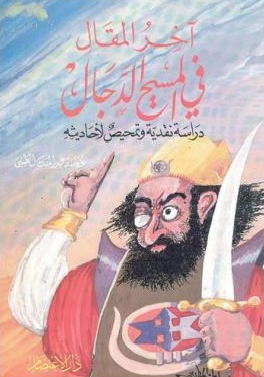
image: Dajjal, from Okasha Abdelmannan al-Tibi's The Whole Truth about the Antichrist

.

Tim Furnish opens his book Holiest Wars: Islamic Mahdis, their Jihads and Osama bin Laden, with the words:

One man’s messiah is another man’s heretic.

What he doesn’t state outright, which is also true, is that all too often that heretic is the anti-Messiah.

**

I use that term “anti-Messiah” deliberately, because in discussing Islamic end times beliefs, the term “Antichrist” is frequently used by both Christians and Muslims to refer to the Muslim “equivalent” of the Christian Antichrist — ie the “deceiving messiah” or Masih al-Dajjal, whose coming at the end of days is predicted in Islamic apocalyptic narratives in negative counterpoint to the coming of the Mahdi, in much the same way that some Christian apocalyptic narratives predict the coming of the Antichrist in negative counterpoint to the return of the Christ.

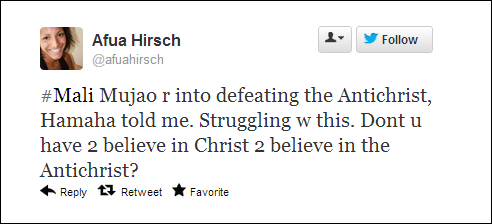
This issue was brought home to me once again today when Aaron Zelin pointed me to this tweet from Afua Hirsch [ @afuahirsch ], West Africa Correspondent for the Guardian:

Frankly, I think that’s a very natural question to raise, and one that has an even more intriguing answer.

**

One other note, which I’ve separated out between asterisks here because I think it’s a crucial one at that:

by Afua Hirsch’s account, Mali’s Movement for Unity and Jihad in West Africa (MUJAO) has the apocalyptic fever…

**

Strange things happen when different views of the end times, as prophesied one way or another in various branches of all three Abrahamic religions, clash.

Here’s where I see the moebius strip effect, whereby apocalyptic figures are turned into their opposites by rival sets of beliefs:

Some Muslims call the Dajjal (literally, “the deceiver”) the Antichrist — here, for instance, is a video clip of Sheikh Imran Hosein, whom I have discussed on Zenpundit before, quoting a hadith or tradition of the Prophet from the Sahih Muslim collection, and using the term “Antichrist” without further comment in his translation of the term Dajjal —

While some Christians call the Mahdi the Antichrist — as does Joel Richardson in his book currently issued under the title The Islamic Antichrist: The Shocking Truth about the Real Nature of the Beast. Reviewing the book in its first edition under its earlier title, Dr David R. Reagan sums Joel’s basic points succinctly:

Joel Richardson in his book Antichrist: Islam’s Awaited Messiah argues that the Mahdi will be the Antichrist of the Bible and that the Muslim Jesus will be be the False Prophet of the Bible who serves the Antichrist and his purposes. Both will be destroyed when the true Jesus returns at the end of the Tribulation.

We were talking about the Sufyani just the other day, right? Here’s a stunner to spin your head a further 180 degrees — the Sufyani as a second (and more dangerous) Dajjal than the Dajjal:

While the great Dajjal focuses on atheism and fights Christianity, the Islam Dajjal, Sufyan, fights Islam, which is the only true religion before Allah, openly. Therefore he is regarded as more frightening.

There’s also a question of one and / or many Antichrists in Christianity, of course — see 1 John 2:18:

Little children, it is the last time: and as ye have heard that antichrist shall come, even now are there many antichrists; whereby we know that it is the last time.

And hey, bear with me, I’m not done yet: members of the Ahmadi school quote a hadith from the Sunan Ibn Majah collection which says:

There is no Mahdi but Jesus son of Mary.

Ibn Majah, however, also has a hadith in which it is stated that at the time of the Mahdi’s advent he will invite the returning Jesus to lead the evening dawn prayer [as quoted here]:

…while their Imaam will have advanced to pray the Fajr prayer with them, Eesa, the son of Mary will descend [at the time of the Fajr prayer]. The Imaam will draw backward so that ‘Eesa would go forward and lead the people in prayer. However, ‘Eesa would put his hand between his shoulders and say to him: “Go forward and pray, as it is for you that the call for the prayer was called, so their Imaam would lead them in prayer.”

**

Confusing?

I think so, unless you are paying close attention.

My own recommendation would be that the phrase “the Islamic Antichrist” should be replaced by “the Islamic equivalent of an Antichrist” when referring to the Dajjal, and “the Mahdi viewed as Antichrist” when referring to the Mahdi.

I know, I know — the chances of changing people’s verbal habits across the board are pretty slender.

But have I made things seem complicated enough?

**

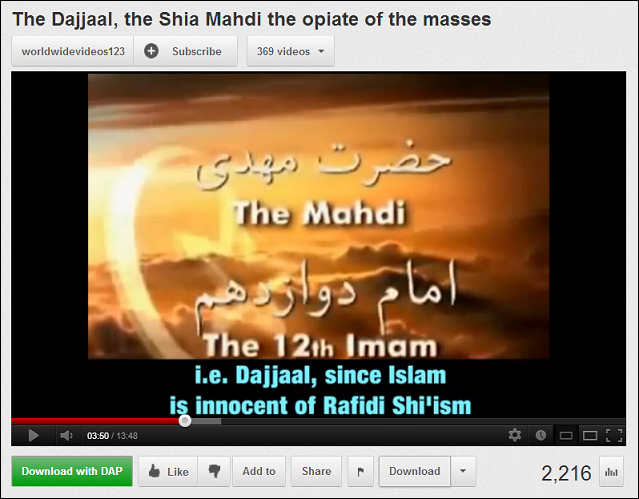
This whose business naturally gets just a tad more complicated once one adds in the Sunni concept — I am not sure how widespread it is, but it would make a fascinating topic for research for someone with the requisite language skills — that the Mahdi of the Shiites will be the Dajjal of the Sunni… as shown in this screen cap of a YouTube video.

[Rafidi means one who has deserted the truth, and is a derogatory term, in this case used by Sunnis to disparage the Shiites.]

Or this one — with its equation of the Shiites with the Jews:

Of course, Christianity too has its share of internecine apocalyptic mud-slinging: Rev. Ian Paisley (long-time leader of the Ulster Unionists and Moderator of the Free Presbyterian Church of Ulster) interrupted Pope John Paul II‘s speech at the European Parliament to denounce him as the Antichrist — while Rev. JD Manning gives Oprah Winfrey that title

**

Everything I have described above is dualistic in nature and sectarian in its specifics. It comes as something of a surprise, then, to find the late Ayatollah Muhammad Baqir al-Sadr quoted as writing:

The Mahdi is not an embodiment of the Islamic belief but he is also the symbol of an aspiration cherished by mankind irrespective of its divergent religious doctrines. He is also the crystallization of an instructive inspiration through which all people, regardless of their religious affiliations, have learnt to await a day when heavenly missions, with all their implications, will achieve their final goal and the tiring march of humanity across history will culminate satisfactory in peace and tranquility. This consciousness of the expected future has not been confined to those who believe in the supernatural phenomenon but has also been reflected in the ideologies and cult which totally deny the existence of what is imperceptible. For example, the dialectical materialism which interprets history on the basis of contradiction believes that a day will come when all contradictions will disappear and complete peace and tranquility will prevail.

The point is made even more clearly in a speech given by the Iranian scholar Muhammad Ali Shumali:

So, our own camp comprises of people who have this understanding: First of all, they are the people who believe in the Ahl al-Bayt. Yet, in our camp it is possible for there to be people who work for the Ahl al-Bayt without knowing the Ahl al-Bayt. This is also something very important. You may have a non-Shia who works for the Ahl al-Bayt better than many Shias. Indeed, you have some Shias that work against the Ahl al-Bayt. You may even have non-Muslims who are working for Imam Mahdi—for the cause of Imam Mahdi, for justice, for many things—and they may not even know who Imam Mahdi is. So it is not that whoever is not a Shia is not in our camp.

and:

I believe that the majority of the people of the world are not against us; it is just our failure to present our ideas and to convince them that what we have is for all mankind. I think in particular, in the case of Imam Mahdi, we must do the same thing: we must not present Imam Mahdi as a saviour for the Shias. Imam Mahdi is not a saviour for [just] the Shias. Imam Mahdi is a saviour for all mankind…

**

And then you see what you yourself see, and believe what you yourself believe.

Of miraculous births and abominations

Friday, September 28th, 2012

[ by Charles Cameron — magical religion, the amnesia of the rationalists, a brief mention of poetry and a touch of Tillich ]
.

As you know, I’m interested in the clashing of worldviews. Yesterday, Teju Cole posted a tweet with a quick mention of apocalypse that caught my eye:

There’s a whole lot going on here, and it takes a neat combo of crabwise and linear thinking to get at it all.

But first, a brief and hopefully unnecessary note to our gentle readers:

Take a look at the tweet above, and if you don’t want to peer more deeply into the murky tabloid worlds of strange births, miracles and abominations that it touches on, don’t read the rest. This post may be gross enough in parts, or so absurd-sounding that you want to drop the whole thing and read something else.

As I see it, it’s also interesting and informative — fascinating even — besides being potentially quease-making. But seriously, if you’d rather skip that kind of thing, please don’t leave right away, just go to the very last section and read the two quotes from Paul Tillich. Thanks.

**

Still with me? Good…

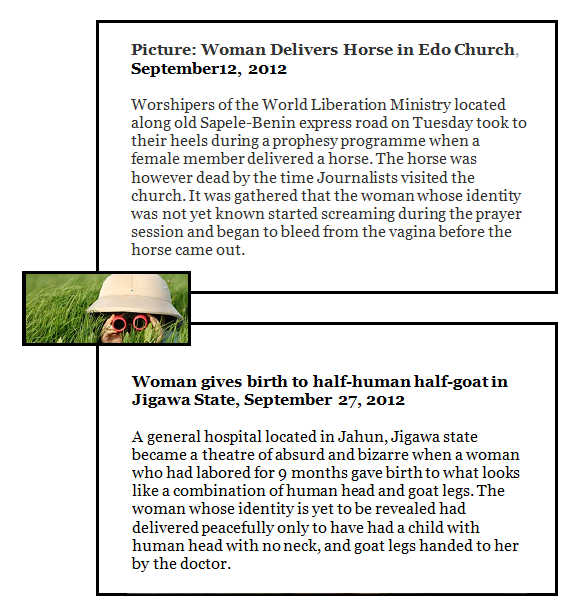
For starters, we can compare these two stories, located about two weeks apart, and described as happening in two Nigerian states: Edo and Jigawa:

It would be easy to dismiss them both as Weekly World News style fabrications, like WWN’s Werewolf Sues Airline Over Flight Delay — but that would miss the point: they’re believed.

**

Restricting ourselves from the moment to half-goat, half-human combos, we can then compare a human birth narrative with a narrative of a goat birth:

The same story? A completely different event? Or human memory, playing its strange tricks?

Note that the two tales are now three years apart, and while one is reportedly from Nigeria, the other is from Zimbabwe.

**

In that last telling, we saw one local explanation for strange — dare I call them paranormal — events of this kind: a curse.

Let’s explore that idea a bit further. The same report quoted above went on to say:

A belief in ghosts is still alive and well in the region and the creature was taken as a sign of evil – perhaps even witchcraft. But local Governor Jason Machaya (56) is sure, that it was a half-man, half-goat hybrid which was the result of bestiality: “A grown man was responsible for this.”

So there’s another possibility. The next paragraph offers yet another:

Doctors, however say that it would be a biological impossibility.

Score one for the scientific worldview.

**

It may be a gossip and conspiracy mag invention, or an old wives’ tale, or the result of a curse, or witchcraft — which could include the local medical tradition — or, as with the horse birth, a miracle — what else?

It could be archetypal…

It could be Pan, the erotic satyr-god of Greek myth and James Stephens‘ delightful tale, The Crock of Gold, or the hideous demon of the occultist Eliphas Levi — the god of the old cult becoming a demon in the new, as they so often do —

— in this case also giving us the portmanteau word pandemonium

**

But there’s one final possibility, and it’s the one that Teju Cole presented us with the first nine of his 140 characters:

end times

I want to give that one time to settle in, because almost all end times predictions involve “signs of the times” that show the world going to hell in a hand-basket, with (eg) family values upended, the sacred profaned, lies usurping truth, and so forth.

I don’t believe this is by any means limited to Islam, but I’ll give an Islamic example as it comes to hand. One of the major signs of the coming of the Qiyama (Last Day, Day of Judgment, Day of Resurrection) is as follows:

After the night of three nights, the following morning the sun will rise in the west. People’s repentance will not be accepted after this incident.

Compare this, from the Christian New Testament, Matthew 24.29:

Immediately after the tribulation of those days shall the sun be darkened, and the moon shall not give her light, and the stars shall fall from heaven, and the powers of the heavens shall be shaken.

**

Women in church giving birth to horses, goats or women giving birth to half-human, half-goats… The story crops up again in Turkey as reported on January 14th, 2010:

A sheep gave birth to a dead lamb with a human-like face. The lamb was born in a village not far from the city of Izmir, Turkey. Erhan Elibol, a vet, performed a caesarean on the animal to take the lamb out, but was horrified to see that the features of the lamb’s snout bore a striking resemblance to a human face. “I’ve seen mutations with cows and sheep before. I’ve seen a one-eyed calf, a two-headed calf, a five-legged calf. But when I saw this youngster I could not believe my eyes. His mother could not deliver him so I had to help the animal,” the 29-year-old veterinary said.

And again with the religious language — the picture accompanying the article carries the caption:

An Abomination of Nature or a Mutation Caused by Blind Industrialization?

Abomination, a word for the utterly unnatural, is another term found in connection with end times thinking. And industrialization? Perhaps that’s one version of the modernist end times…

**

A few things to note here in closing:

Indigenous religious beliefs and practices in many parts of the world include magical aspects that may seem shocking, absurd or distasteful to rational modern western sensibilities. Some of these beliefs and practices are deeply ingrained, and missionary churches have not infrequently carried some of them into their own structures, there being no clear dividing line between “culture” and “religion”. Churches which place an emphasis on miraculous healings as proofs of renewal in the Spirit are particularly prone to this kind of seepage.

The “rational modern western” sensibility I mentioned above, however, is so utterly out of touch with such matters that it treats them as jokes, lampoons them in the tabloids, and otherwise tends to ignore them.

Strongly held beliefs – what I referred to in Waco in Pakistan using Tillich’s term as “ultimate concerns” – are “facts on the ground” that we ignore at our peril.

Poetry — not flabby cherubic verses in greetings cards but the dedicated study of poetic tradition — contains an antidote.

**

Man, like every living being, is concerned about many things, above all about those which condition his very existence, such as food and shelter. But man, in contrast to other living beings, has spiritual concerns – cognitive, aesthetic, social, political. Some of them are urgent, often extremely urgent, and each of them as well as the vital concerns can claim ultimacy for a human life or the life of a group. If it claims ultimacy it demands the total surrender of him who accepts this claim, and it promises total fulfillment even if all other claims have to be subjected to it or rejected in its name.

and again:

It transcends both the drives of the nonrational unconsciousness and the structures of the rational conscious

Both quotes are from chapter 1, What Faith Is, of Paul Tillich‘s Dynamics of Faith.

New Book: Mission Revolution by Jennifer Morrison Taw

Sunday, September 16th, 2012

Mission Revolution: The US Military and Stability Operations by Jennifer Morrison Taw

Columbia University Press just sent me a review copy of Mission Revolution: The US Military and Stability Operations by Jennifer Morrison Taw, an assistant professor of IR/Security Studies at Claremont McKenna College.  Taw has written a very timely book given the looming threat of sequestration – she has investigated and analyzed the institutional and strategic impact of the US having elevated MOOTW (military operations other than war) in 2005 to a DoD mission on par with war-fighting, terming the change a “Revolution”.

[ Parenthetical aside: I recall well Thomas Barnett loudly and persistently calling for the Pentagon to deal with MOOTW by enacting an institutional division of labor between a heavy-duty Leviathan force to handle winning wars and a constabulary System Administration force to win the peace, manage stability, defend the connectivity. Instead, in Iraq and Afghanistan we had one Leviathan force trying to shoehorn in both missions with a shortage of boots, a river of money and a new COIN doctrine. Soon, if budget cuts and force reduction are handled badly we could have one very expensive, poorly structured, force unable to do either mission.]

Thumbing through Mission Revolution, it is critical and well focused take on the spectrum of problems the US has faced in the past ten years trying to make a “whole of government” approach an effective reality in stability operations and counterinsurgency. Taw covers doctrine, training, bureaucratic politics, procurement, policy, grand strategy, mission creep, counterterrorism and foreign policy visions of the civilian leadership, all with generous footnoting.

I am looking forward to reading Mission Revolution and giving it a detailed, in-depth, review in the near future.


Switch to our mobile site