zenpundit.com » economics

Archive for the ‘economics’ Category

Don’t ask me — I’m a Qualit!

Friday, February 8th, 2013

[ by Charles Cameron — Christmas pudding UK circa 1950, math, banks, and moral authority ]
.


.

As I recall, the plum pudding served in our family on Christmas day was not only rich in raisins, sultanas, currants and candied peel, it not only had brandy poured over it and a flame swiftly set to it, it was not only served with brandy butter…

It also had, somewhere within it, a silver coin — I understand these were originally related to coins of healing and the Royal Touch — and one of us, my sister and I, would be the one to find it in our slice. So equality of opportunity was important, both of us wanted to have an equal chance at winning the coveted prize.

Or perhaps I should say, equantity? Because believe me, the quality in each and every slice was just fine.

All this by way of saying that yes, I understand that quantity has its uses.

**

In Recipe for Disaster: The Formula That Killed Wall Street a while back, Felix Salmon proposed the upper (and more colorful) of the two equations below, suggesting that it was the root cause of the financial failure of 2008:

Comes now Chris Arnade blogging on Scientific American for the defense, claiming that The Real—and Simple—Equation That Killed Wall Street was the lower of the two equations (the one in black on white).

**

Arnade writes of Salmon’s Wired article:

It was not the first piece that made this type of argument, but it was the most aggressive. Since then it has been a common theme in the media that mathematics, especially obscure advanced mathematics, is largely responsible for the catastrophe that doomed the world to the last five years of recession and slow growth.

This theme plays on the fallacy that danger always comes from complexity. It’s a fabrication that obscures the real causes, that makes it easier to say, “Hey, it wasn’t my fault, I was blinded by science.”

The reality is much simpler and less sexy. Wall Street killed itself in a time-honored fashion: Cheap money, excessive borrowing, and greed. And yes, there is an equation one can point to and blame. This equation, however, requires nothing more than middle school algebra to understand and is taught to every new Wall Street employee. It is leveraged return.

What is leveraged return? It’s the return on assets using borrowed money.

I am depicted as the fellow with glasses and a squint, squeezed in between the two equations. When I recover from my discombobulation, I will push my glasses up high on my brow and say, Don’t ask me — I’m a Qualit!

**

And now we Anglicans have a new Archbishop who, well, as the Guardian puts it, Archbishop of Canterbury accuses banks of hypocrisy over bonuses:

Two months ago HSBC was also fined a record £1.2bn over allegations of money laundering for Mexican drug barons. Regulators said HSBC had allowed at least $881m of drugs money through its accounts.

Taking evidence from HSBC’s two top bosses – its chief executive, Stuart Gulliver, and chairman, Douglas Flint – the archbishop said: “I’m increasingly baffled at the discussion we are having. What is it essentially about bankers that means they need skin in the game [bonuses]? We don’t give skin in the game to civil servants, to surgeons, to teachers.

“There’s a whole range of people who don’t have that. It seems to me that you are putting huge effort into a values-based organisation and yet at the end of the day, particularly for your most senior staff who are most important as regards setting values and culture, you seem to be saying the only way you can motivate them to any significant extent is with cash.”

The bankers, who said they wanted to turn HSBC into a bank of “courageous integrity”, insisted it was necessary to pay bonuses because they provided incentives that could be clawed back if mistakes were later uncovered.

Don’t you love it? Courageous integrity!

**

As Rochefoucauld said:

Hypocrisy is the homage vice pays to virtue.

It seems it is a small price to pay, quantitatively speaking — a rounding error. From a qualitative perspective however, it is a Faustian price — as Wikipedia (following Britannica) has it, it is:

a situation in which an ambitious person surrenders moral integrity in order to achieve power and success

Ooh — it’s a question of having or surrendering moral integrity about one’s own claim to integrity! A self-referential paradox if ever I saw one…

Christianity (since we’ve just been quoting an Archbishop) sets the matter sub specie aeternitatis in Mark 7.6:

He answered and said unto them, Well hath Esaias prophesied of you hypocrites, as it is written, This people honoureth me with their lips, but their heart is far from me.

A small price, or the ultimate? Quant? or Qualit? The choice is always ours.

**

So you see why I’d rather be a Qualit than a Quant.

But even so, finding that silver coin in my Christmas pudding was pretty special, from a quantish point of view. The brandy butter, more qualitish IMO, was even better.

** ** **

Sources for header:

Qualit logo
Quant logo

Sources for SPECS:

Wired‘s equation
SciAm‘s equation

“Sustaining” your Way to Serfdom as a Grand Strategy

Monday, January 14th, 2013

Friend of the blog, commenter L.C. Rees, likes to point out that one of the most important part of a grand strategy, particularly one that is maintained despite evidence of being a geopolitical failure, are the domestic political effects that work to the advantage of the faction supporting it.  In my view, grand strategy usually has a political or cultural evolutionary component and, human nature being unchanging, Rees’s cynical observation has merit.

Last year, a couple of JCS aides/field grade officers wrote a grossly overpraised paper that was pushed by Anne-Marie Slaughter, Thomas Friedman and assorted worthies, that purported to be about a new grand strategy with which America could navigate the world. Mostly it centered on a preference for an America being run by a vaguely EU-like, technocratic, regime under the rubric of “sustainment”, in which the authors wisely folded in a number of  shibboleths popular with the corporate-liberal upper class who write large donation checks to think tanks or make their living in public policy and academia.

The talk of this nature died down when the election cycle began, but the themes were recently revived by the New America Foundation’s Grand Strategy Project whose director had an op-ed in Foreign Policy to reintroduce this agenda to the chattering classes now that the pesky voters are out of the way until 2014:

A New U.S. Grand Strategy 

….Walkable communities: The first pool of demand is homegrown. American tastes have changed from the splendid isolation of the suburbs to what advocates are calling the “five-minute lifestyle” — work, school, transit, doctors, dining, playgrounds, entertainment all within a five-minute walk of the front door. From 2014 to 2029, baby boomers and their children, the millennial generation, will converge in the housing marketplace — seeking smaller homes in walkable, service-rich, transit-oriented communities. Already, 56 percent of Americans seek this lifestyle in their next housing purchase. That’s roughly three times the demand for such housing after World War II.
If only Bismarck had included some “walkable communities” for Prussia, Europe might have avoided the tragedy of World War I.
.
Incidentally, all of this argument from assertion is unsupported rubbish keyed to a preexisting anti-suburban agenda the Obama administration brought with them into office in 2009. As Joel Kotkin explained:

….Whenever possible, the Clintons expressed empathy with suburban and small-town voters. In contrast, the Obama administration seems almost willfully city-centric. Few top appointees have come from either red states or suburbs; the top echelons of the administration draw almost completely on big city urbanites—most notably from Chicago, New York, Los Angeles, and San Francisco. They sometimes don’t even seem to understand why people move to suburbs.

Many Obama appointees—such as at the Departments of Transportation and of Housing and Urban Development (HUD) and at the Environmental Protection Agency (EPA)—favor a policy agenda that would drive more Americans to live in central cities. And the president himself seems to embrace this approach, declaring in February that “the days of building sprawl” were, in his words, “over.”

Not surprisingly, belief in “smart growth,” a policy that seeks to force densification of communities and returning people to core cities, animates many top administration officials. This includes both HUD Secretary Shaun Donovan and Undersecretary Ron Sims, Transportation undersecretary for policy Roy Kienitz, and the EPA’s John Frece.

Transportation Secretary Ray LaHood revealed the new ideology when he famously declared the administration’s intention to “coerce” Americans out of their cars and into transit. In Congress, the president’s allies, including Minnesota Congressman James Oberstar, have advocated shifting a larger chunk of gas tax funds collected from drivers to rail and other transit.

In addition, the president’s stimulus—with its $8 billion allocation for high-speed rail and proposed giant increases in mass transit—offers little to anyone who lives outside a handful of large metropolitan cores. Economics writer Robert Samuelson, among others, has denounced the high-speed rail idea as “a boondoggle” not well-suited to a huge, multi-centered country like the United States. Green job schemes also seem more suited to boost employment for university researchers and inner-city residents than middle-income suburbanites.

Suburbanites may not yet be conscious of the anti-suburban stance of the Obama team, but perhaps they can read the body language. Administration officials have also started handing out $300 million stimulus-funded grants to cities that follow “smart growth principles.” Grants for cities to adopt “sustainability” oriented development will reward those communities with the proper planning orientation. There is precious little that will benefit suburbanites, such as improved roads or investment in other basic infrastructure.

Kotkin nails it. Mr. Doherty is simply trying to find some national security window dressing for an elite preference that ordinary people will be much easier to manage, monitor and fleece if they are concentrated in high-density urban housing and prevented from voting with their feet by a network of punitive, anti-development, anti-mobility, Federal  regulations. The research paper, if you can call it that, justifying this authoritarian agenda can be found here. Judge for yourself.
.
However, this is no idle pipe dream, it has been done before. The  Japanese pursued a similar national “grand strategy” after WWII with the blessing of Washington to reconstruct defeated Japan: the old, independent,  Japanese business empires called zaibatsu were transformed by SCAP into submissive keiretsu that would take “administrative guidance” from the Ministry of International Trade and Industry and the Ministry of Finance. In return, the keiretsu were heavily subsidized by the government, which kept Japanese “salarymen” to an artificially low “middle-class” standard of living with macroeconomic policies that forced the Japanese to have an extremely high level of savings. A docile work force penned into tiny apartments, governed by a de facto one-party autocracy of the Liberal Democratic Party that kept the rent-farming machinery in place for big business for fifty years. It isn’t a great model, it is not what Walter Lippmann would have called “a good society” but it did work.
.
Mexico under the PRI dictatorship was a more backward version of this paradigm, as was Chicago under Mayor Daley.
.
Now back to our own grand strategy of walkable communitarianism:

…..Every continental-scale economic region must embark on a decisive sustainability strategy without delay. Working within existing norms of the World Trade Organization and the United Nations, America will lead the partnership of major economies to refashion the global economic system around eight or nine economic blocs, each boasting the scale necessary to support mature industrial ecosystems. This will mean promoting and strengthening regional economic blocs such as the Association of Southeast Asian Nations, the Union of South American Nations, the African Union, the Commonwealth of Independent States, and the Organization of Islamic Cooperation.

This part is literally nonsensical.

Say what you want about Osama bin Laden’s powers of rhetoric: he may have failed to convince his fellow Muslims to unite the ummah into a Caliphate but he evidently convinced a lot of people at The New America Foundation that Islam is an economy.

And as aside, why the hell is pushing political unification of South America or Africa under top-heavy, transnational bureaucracies in American interest? It sure isn’t in the interest of poor Africans or campesinos. For that matter, how can Africa unify if a third of their states will be in the OIC? WTF? Does Foreign Policy use editors or is it just a blog?

However, all that was simply geopolitical fantasizing over matters about which the United States has little control and would be unlikely to come off even under the best of circumstances. The next part I suspect is intended much more seriously. It certainly reflects a worldview that is pernicious and apparently more widespread among our elite than we realized, for which they are now testing the waters, to see if their fellow citizens are the herd they imagine us to be and if they can get away with it.

….Just as America would never fight a 21st-century war with Korean War-era weapons, it should not govern today with institutions devised for a bygone era. The Founding Fathers established a constitution that allows for the adaptation of the institutions of government to the knowledge, threats, and opportunities confronting each generation. Americans should make use of that foresight. Under this strategy, the country will adapt the institutions of its federal government to execute this grand strategy and invest in the American people to ensure that they receive the opportunities they need to be informed and engaged citizens. 

This is a tentative call, in milquetoast, coded, language, to find legal stratagems to gut the Bill of Rights and euthanize American democracy, or at least render it comatose, as a mere facade for a new paternalist technocracy that treats citizens as wards or children while we are rent-farmed for the benefit of a small elite. Certainly when we are all marooned in our government-regulated, high-density, housing, disarmed and without private transportation or much disposable income it will be too late for us to raise our voices in protest.  Doherty is correct about one aspect, such a society is probably “sustainable”; feudalism after all lasted more than a thousand years.

In plain English, the strategy of “sustainment” is a long term policy for postmodern serfdom with most of us intended to be walking behind the oxen when we are not wearing the yoke ourselves. Despite the nervous, thin-lipped, smiles and hasty reassurances, these people truly wish us and our children ill.

The good news is that none of this can come to pass without our consent. The U.S. Constitution is both sword and shield, if you are willing to pick it up. Speak, write, organize, litigate and vote out of office would-be authoritarians no matter what party label they wear. The best antidote for our creeping oligarchy is electing and appointing to office a large number of people outside of this exceedingly insular, geographically and intellectually narrow, social circle of graduates of  a handful of universities and last few percentage points of socioeconomic status who have in the last 15 years grabbed control of our government.

Really, we’re Americans – our talent pool is 315 million strong. We can easily do better.

Strategy, Power and Diffusion

Monday, November 19th, 2012

“….and therefore, two kinds of reactions are possible on the defending side, depending whether the attacker is to perish by the sword or by his own exertions.

                                                               – Carl von Clausewitz,  On War

 “Again, if the campaign is protracted, the resources of the State will not be equal to the strain.”

                                                                 – Sun Tzu,  The Art of War 

A recent estimate for the cost of the war in Afghanistan by the Congressional Research Office is $443 billion dollars to occupy and fight a Pakistani-supported insurgency in a primitive country whose annual GDP is a mere $ 27 billion. A  figure that itself inflated by $ 3-4 billion is remittances, $ 4 billion in NGO aid and $14 billion in direct US aid (2010 figure); when you then subtract opium smuggling ($ 4 billion), Afghanistan’s legitimate economic activity may only be a miniscule GDP of  $ 2 – 3 billion.

This does not, of course, include the cost of ten years of lavish bribes for Pakistan, a portion of which was used by the ISI to support the Taliban  killing American and ISAF  soldiers  and Afghan civilians.

This is not a cost-effective or strategic way to run a war. In fact, even for a nation as wealthy as the United States there is nothing in Afghanistan worth such an expenditure of blood and treasure, especially when the bulk of our enemies appear to be based in Pakistan, not Afghanistan. You can approach a strategic problem directly or indirectly but to do so indirectly in the most expensive way logistically possible makes little sense. For example:

….Since the ‘war to end all wars’, however, war has not exactly stood still.  Although the US Defense Logistics Agency rather quaintly describes its mission in terms of a supply chain extending ‘from factory to foxhole’, it is, above all, the mobility of military violence that is central to the conduct of late modern war.  But Creveld is adamant that since 1945 the operational freedom of modern ground forces has not markedly increased, not least because their prized mobility is absolutely dependent on supplies of petrol and gasoline.  Since the end of the Second World War the use of petroleum-based fuels by the US military has soared, and as its stripped-down forces have been expected to do more with less (through technological change and outsourcing) so the fuel expended per soldier has increased by 175 per cent to an average of 22 gallons (83 litres) per day. [viii]  As Obama had US forces ‘surge’ into Afghanistan in 2009 so ISAF’s daily fuel consumption rocketed from two million to over four million litres a day. Given these volumes, it is scarcely surprising that the death-dealing capacities of the US military and its allies should have been tied in knots by ‘umbilical cords’ far more convoluted than Creveld could ever have imagined.

There are three main supply networks to be disentangled in turn.  All of them are ground lines of communication.  Air transportation is extremely, usually prohibitively expensive, and only four airports in Afghanistan are accessible to non-military aircraft, so that until 2011 only 20 per cent of cargo was flown in.  Similarly, onward delivery to combat outposts and forward operating bases has usually only involved airdrops if other options are too dangerous. Still, by the start of 2010 around 30-40 per cent of bases were being supplied by air because the Taliban controlled much of Highway 1, the ring road that loops between Afghanistan’s major cities, and its IED attacks on NATO and Afghan forces were increasingly effective.  The high cost of airdropping pallets of fuel, ammunition, water and supplies has imposed all sorts of fuel economies on the military as it attempts to reduce its carbon footprint – ‘troops have learned to sip, not guzzle’ – but it is still the case that, as one US pilot put it, ‘we’re going to burn a lot of gas to drop a lot of gas’.  According to some estimates it can cost up to $400 a gallon to deliver fuel by air. [ix] 

Neither war nor strategy are a hard science like physics. That said, there are fields of study and investigation that while not being a science are, like physics, inherently about systems or systemic relationships. Economics  and engineering are two such examples, strategy is another.  Because of this similarity, it is often profitable to employ metaphors or analogies from physics to illustrate strategic problems, as Clausewitz famously did in On War with “friction” and “center of gravity“.

Diffusion” might be another analogy for statesmen and soldiers to keep in mind.

Military force, or more broadly, national power marshaled and employed toward a vital objective represents a potent concentration of energy like a red hot iron bar. Thrust deeply into a trough of ice water, the surface of the water yields to the mass and heat of the iron bar in a furious burst of steam and boiling turbulence. Keep the bar submerged and every erg of heat will be sapped out of it by the water and the iron will emerge cold, tempered by the experience and inert. Keep the bar submerged long enough and the water will begin to rust the iron away until nothing is left.

Vast spaces, hostile populaces and deeply impoverished environments are like ice water to the molten heat of an invading power, as we have discovered in Afghanistan.

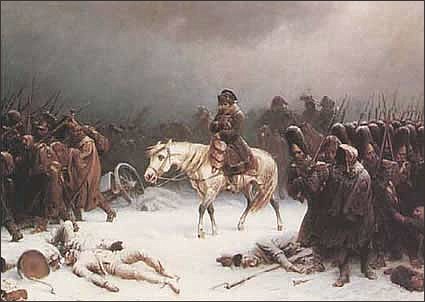
There are already old military maxims that express a warning about the risks of diffusion, notably “Don’t get into a land war in Asia” or “Don’t invade Russia in winter”.  Napoleon Bonaparte marched his vast and fabled Grand Armee of 600,000 men into the endless steppes of Tsar Alexander’s Russia. Everything gave way before Napoleon’s legions, but the Russians were not the Austrians or Prussians, they retreated, savagely burning and destroying as they went:

….Alexander’s proclamation to his people, issued at the time of the French invasion, appealed to these deep seated feelings: Napoleon had come to destroy Russia; the entire nation must rise against ‘this Moloch’ and his ‘legions of slaves’. ‘Let us drive this plague of locusts out! Let us carry the Cross in our hearts and steel in our hands!’ The proclamation was read in all the churches, and the priests supplemented it with embellishments of their own. The Comte de Segur, at this time an aide-de-camp to Napoleon, wrote: ‘They convinced these peasants we were a legion of devils commanded by the Antichrist, infernal spirits, horrible to look upon, and whose very touch defiled”

In Moscow, the city in flames, even Napoleon the Conqueror, the master of Europe, did not have enough men, or material or speed of movement to either digest and rule the immense spaces of Russia or compel Alexander to come to terms:

….Throughout the fall of 1812, Napoleon waited in vain for Alexander’s peace proposals to arrive in the Kremlin. When none came, he made overtures of his own, but Alexander sent no reply. As the days stretched into weeks, Napoleon came to see that he, not Alexander, faced a truly desperate situation, for Russia’s armies grew stronger by the day while his own dwindled from desertions and the ravages of disease. He faced the hopeless prospect of wintering in Russia without adequate food, shelter, or supplies, surrounded by a people so hostile that they burned their grain rather than sell it for French gold. As winter approached, and as the Russian partisans stepped up their attacks on his rear, Napoleon saw that his line of communications, which relied upon a perilously vulnerable corps of couriers who raced from Paris to Moscow in fourteen days, must soon collapse.

Of the Grand Armee, only five thousand returned home from the snowy wastes of Russia alive.

The Wehrmacht did little better. Hitler’s imagined drive to the Urals without a surrender and territorial concession by Stalin was a fantastical ambition. The far-flung distance, roadless mud and icy snow alone were too much for panzer armies and Luftwaffe air wings that proceeded to break down with statistical certainty. Supply lines were too long; gasoline and replacement parts were too few, as were replacements for the men for whom the Eastern Front was a grave. To the dogged resistance of the Red Army, the Germans needlessly added the people’s rage of the Russian partisans by demonstrating to the peasantry that the NKVD held no monopoly on atrocity.  Imperial Japan’s coterminous war in China tells exactly the same unhappy tale.

William Lind and the 4GW school used to like to make the point, regarding your moral and political legitimacy, that ” If you fight the weak, you become weak”. The corollary to that is economic: “If you fight the poor, you become poor”.

Grinding poverty itself  is a tax upon the invading force. There are no resources for your army to comandeer or buy, no skilled manpower to requisition or hire, no infrastructure for them to use. All of that must be imported and built at great expense by the invader whose troops are accustomed to far less spartan environs. The local population is usually malnourished, illiterate, ignorant, suspicious of outsiders and  rife with disease; their living habits and water sources unsanitary and endanger the troops. Caring for the locals, even minimal administration of humanitarian aid, becomes a bureaucratic and logistical burden consuming time and diverting resources away from urgent military needs.

The United States under George Bush the Elder, entered into Somalia, a land beset by violent anarchy and it’s people in the grip of a terrible famine and was driven out shortly thereafter under Bill Clinton. The last scenes there being the emaciated Somali followers of  a two-bit warlord,Mohammed Farah Aidid, gleefully swarming over and looting our military’s former…. garbage dump.

When the enemy has a land so poor that he treasures and makes use of the crap you throw away, the economic spillover of your logistical supply lines will fund his war against you. Used to surviving on bare subsistence, the invader’s presence becomes an economic bonanza for resistance and collaborator alike. Sort of a highly kinetic form of military Keynesianism. The war itself and the occupation become an irreplaceable cornerstone of their economy. They hate you being there, but can’t afford to defeat you and drive you out either – making a “quagmire” irregular conflict their ideal economic equilibrium to maintain.

What lessons can we draw here?

  • Keep your national power concentrated – don’t diffuse it with unmanageable, ill-defined, tasks of unlimited scope
  • Military power is to be used for a clear and articulated policy end with a defined political settlement in mind
  • If a political settlement is impossible because the problem is intractable, avoid involvement.
  • If you cannot avoid getting involved (i.e. -you were attacked) your best option is to engage in a punitive expedition to destroy the war-making capacity of the enemy and impose  ruinous costs and then immediately leave.
  • Keep campaigns short. In operation, military power is a terrible, swift sword and you should sheathe it just as quickly. 
  • Ruling over enemy population is a wasteful, thankless, burden not to be undertaken except in extremis (Reconstruction and occupation of Germany and Japan were in extremis cases).
  • Maximum gains accrue from the most effective use of the smallest possible force in the shortest period of time.
  • Make an army large enough and the enemy will become a secondary or tertiary concern of its leaders.


New Book: The Rise of Siri by Shlok Vaidya

Tuesday, November 13th, 2012

The Rise of Siri by Shlok Vaidya 

Shlok Vaidya has launched his first novel,  dystopian techno-thriller in e-Book format entitled The Rise of Siri.  Having been the recipient of a late draft/early review copy, I can say Shlok on his first time out as a writer of sci-fi has crafted a genuine page turner.

Companion site to the book can be found here –  The Rise of Siri.com

Blending military-security action, politics, emerging tech and high-stakes business enterprise, the plot in The Rise of Siri moves at a rapid pace. I read the novel in two sittings and would have read it straight through in one except I began the book at close to midnight.  Set in a near-future America facing global economic meltdown and societal disintegration,  Apple led by CEO Tim Cook  and ex-operator Aaron Ridgeway, now head of  Apple Security Division, engages in a multi-leveled darwinian struggle of survival in the business, political and even paramilitary realms, racing against geopolitical crisis and market collapse , seeking corporate salvation but becoming in the process, a beacon of hope.

Vaidya’s writing style is sharp and spare and in The Rise of Siri he is blending in the real, the potential with the fictional. Public figures and emerging trends populate the novel; readers of this corner of the blogosphere will recognize themes and ideas that have been and are being debated by futurists and security specialists playing out in the Rise of Siri as Shlok delivers in an action packed format.

Strongly recommended and….fun!

State Failure is the Child of Oligarchy

Sunday, August 12th, 2012

An interesting piece in Democracy Journal by James Kwak:

Failure Is an Option

….Countries differ in their economic success because of their different institutions, the rules influencing how the economy works, and the incentives that motivate people,” write Acemoglu and Robinson. Extractive institutions, whether feudalism in medieval Europe or the use of schoolchildren to harvest cotton in contemporary Uzbekistan, transfer wealth from the masses to elites. In contrast, inclusive institutions—based on property rights, the rule of law, equal provision of public services, and free economic choices—create incentives for citizens to gain skills, make capital investments, and pursue technological innovation, all of which increase productivity and generate wealth. Economic institutions are themselves the products of political processes, which depend on political institutions. These can also be extractive, if they enable an elite to maintain its dominance over society, or inclusive, if many groups have access to the political process. Poverty is not an accident: “[P]oor countries are poor because those who have power make choices that create poverty.” Therefore, Acemoglu and Robinson argue, it is ultimately politics that matters.

The logic of extractive and inclusive institutions explains why growth is not foreordained. Where a cohesive elite can use its political dominance to get rich at the expense of ordinary people, it has no need for markets and free enterprise, which can create political competitors. In addition, because control of the state can be highly lucrative, infighting among contenders for power produces instability and violence. This vicious circle keeps societies poor. In more fortunate countries, pluralistic political institutions prevent any one group from monopolizing resources for itself, while free markets empower a large class of people with an interest in defending the current system against absolutism. This virtuous circle, which first took form in seventeenth-century England, is the secret to economic growth….

Read the rest here. 


Switch to our mobile site

