THE VIRTUAL STATE OF KURDISTAN
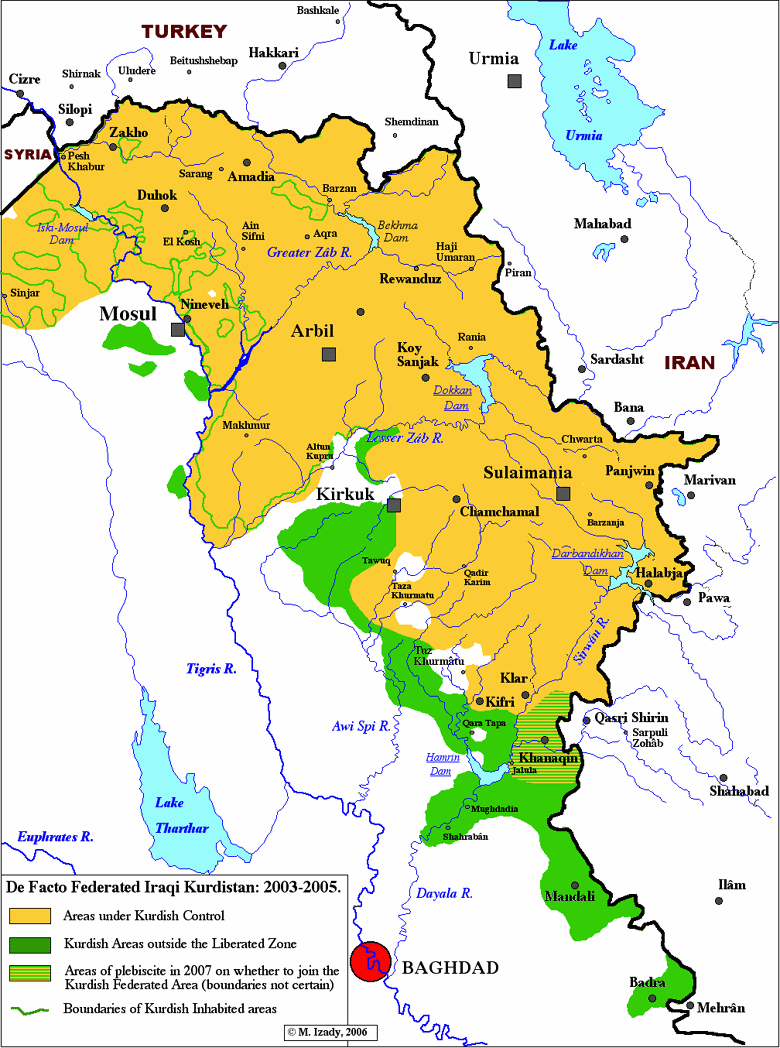
Steve DeAngelis of ERMB has been posting from (and about) Kurdistan in Iraq the past week while on a visit for Enterra Solutions. Collectively, Steve’s posts provide in- depth, on-site, analysis of Kurdistan’s present and future prospects with an emphasis on regional and global economic integration, security and systemic resilience; here they are in chronological order:
1. An Overview of Kurdistan
2. Resilience in Kurdistan
3. 3 days in Iraq from the Syrian/Turkish border to the Iranian border
4. Lessons from the Edge of Globalization: 3 days in Iraq from the Syrian/Turkish Border to the Iranian Border
5. Security in Kurdistan
(There were also several other Iraq-related posts “Interagency Feuding Over Iraq Reconstruction” and ” Coffee for the Troops“)
It would be difficult for me to briefly summarize in a mere paragraph what DeAngelis has impressively written about Kurdistan being on the ” Edge of Globalization” in roughly 6000 words. Therefore, I’m going to pick out a number of select excerpts that give the feel of the sum of Steve’s observations, followed by my commentary:
“We then headed further west to the border crossing checkpoint with Turkey. We entered a small U.S. military post on the border and saw how this border is managed. Completely full trucks, stretching for miles into Turkey loaded with any product you can imagine are seeking to deliver their products to buyers in Iraq. However, on the opposite side of the border another story unfolds. There is a two week wait (yes, I said two weeks!) for trucks coming from Iraq to cross into Turkey. Along the road are makeshift housing facilities equipped with satellite dishes that drivers can use during their two-week wait along a dusty and dirty road that moves trucks from one holding pen to another as they creep up to the border inspection stations in Iraq and then to their equivalent inspection stations in Turkey….
I’d be curious to know how much of this Turkish inefficiency is explicable due to legitimate security issues with the PKK, how much is due to local corruption, understaffing and incompetence and how much is calculated policy on the part of Ankara to choke Kurdish economic growth.
….Virtually all of the trucks crossing back into Turkey from Iraq are completely empty. If there were robust manufacturing and other commercial business operations in Iraq, these trucks would be full of products to be sold in Turkey and to the rest of the world as they transit through Turkey’s ports. The only kind of trucks that do cross fully loaded are 3,000 gallon tankers filled with Iraqi oil destined for a Turkish power generation facility just over the border. The electricity produced by the plant is sold back to the Iraqi’s at western market rates. What this obviously says is that Iraq has the raw materials but does not possess the production capability to turn oil into electricity and as such pays a tremendous financial and strategic price for this lack of capacity. The net result of this border crossing reality is a Current Account trade imbalance of almost 100% between Turkey and Iraq”
Steve is correct that this ad hoc mercantilist trade scenario is problematic for Kurdistan. Historically, nations that are raw commodity exporters, regardless whether it was cotton, rubber, oil, strategic minerals or foodstuffs end up in a unfavorable position vis-a-vis value-added production trading partners or merchant capital states. This applies whether we are discussing Ptolemaic Egypt and ancient Rome or the Gulf states today and the Core.
One caveat on the negative trade balance issue for Kurdistan would be the financial flows of Black Globalization. Lacking orderly markets and effective governance, ordinary Iraqis rely upon the black market for access to desired luxuries as well as necessities such as medicines or spare parts for machinery. Controlling a long border with Turkey, Iran ans Syria gives Kurdish actors the ability to become middlemen in the flow of goods and money which does not show up on the legal balance sheet. Ultimately, Barzani and Talabani’s regional Kurdish government must bring this trade above ground and normalize the economic relationships ( include taxes and customs duties).
“The Peshmerga welcomed U.S. forces and fought side-by-side with them in the effort to overthrow Saddam Hussein. It is estimated that there are between 80,000 and 100,000 active Peshmerga in Kurdistan. As the attached picture of a Peshmerga soldier taken near Dohuk shows (click to enlarge), the Peshmerga are a modern and well-equipped fighting force. The Peshmerga also allow women to serve. This tradition began when the Peshmerga were a guerilla force fighting to make the Kurdish area of Iraq a safe haven. Women also fought alongside coalition forces at the beginning of the current conflict. The attached picture shows female Peshmerga celebrating the fall of Kirkuk. “
The Peshmerga have been a coherent military force(s) far longer than I have been alive. Or Steve Deangelis for that matter. Or probably any of my readers. (The ferocious and mercurial Mustafa Barzani, sire of Massoud Barzani, the Kurdish president and KPD chieftain, was once the darling of American conservatives who hated Henry Kissinger. And long before that, tribal lord Barzani was the protege of… Joseph Stalin ! History has made the Kurds the ultimate realists). Former CIA field operative in Kurdistan Robert Baer put the Peshmerga fighting credibly toe to toe with Saddam Hussein’s best Republican Guard divisions during the 1990’s. That ain’t hay folks. Even in the 1990’s decline the Republican Guard was heavily armed and well-trained, despite being hamstrung by Saddam’s increasing paranoia.
The Peshmerga are perfectly suited for 4GW warfare as they combine tight military discipline, clan networks and strong primary loyalties with concurrent conventional and guerilla warfare skills. They also benefit from American patronage and a leadership that has proven unusually adept at presenting an image and engaging in politics in the international arena.
“Another new friend, Subbas Sircar, who is the regional vice president of AIG for the Middle east, Mediterranean and South Asia, had an interesting morning meeting with local bankers. They are seeking to expand and strengthen local banks as I discussed earlier. This group craved exposure to current international banking best practices, core banking information technology and know-how that would allow them to connect to the global banking industry as well as the training and education that would allow staff members to raise themselves up to a minimal level of maturity so they can foster commerce in their region. This experience with bankers in Sulaimaniyah and in Erbil, along with the telecommunications companies seeking the same capability in their industry, are proof positive of the need for Development-in-a-Box™.”
I think Steve is identifying a critical tipping point for Kurdistan. Leapfrogging the bazaari mentality to create a financial structure that inspires enough confidence to attract and sustain legitimate foreign investment and diversify Kurdish reliance on Turkish capital and American aid would be a milestone. This probably would not mean ” best practices” in the sense of Chase Manhattan so much as ” best enough practices” relative to the region. ” Good enough” is what gets a healthy level of local economic growth going. ” Best” can wait for the day the Republic of Kurdistan applies for admission to the WTO and the EU.
Today, Kurdistan is a nation with a virtual state shepherding its interests. More than Hezbollah in Southern Lebanon, the regional government in Kurdistan is less than Taiwan. But like Taipei, the Barzani-Talabani regional government seeks to negotiate or leverage de jure status and the full sovereignty of statehood over the virulent objections of a powerful neighbor and a nervous American patron. Economic development and integration with other global power centers ( EU, China, India, Japan, Russia) will be the key for the Kurds to create a scenario where Ankara can swallow – however bitterly, even with with ironclad security guarantees – Kurdish independence, because it will be in Turkey’s economic best interests to do so.
LINKS:
“Kurdistan Rebalancing the Middle-East” and “Iraq Travel Guide” by Chirol
“The Kurdistan Problem: Part I “, “The Kurdistan Problem: Part II“, “The Kurdistan Problem: Part III“ by midtowing at ProgressiveHistorians
“Response to Virtual Nations Will Shape World Order or Disorder“ by Adrienne Redd
“The Rise of the Virtual StateWealth and Power in the Coming Century” by Richard Rosecrance
“Market-state vs. Virtual State” by John Robb





