zenpundit.com » games

Archive for the ‘games’ Category

Of children, cultural differences, and computers

Saturday, December 15th, 2012

[ by Charles Cameron — kids, computers, creativity and games ]
.

Motorola Xoom tablet

.

It’s quite a triumphant story, with African kids in the foreground and Nicholas Negroponte and MIT playing the role of proud parents pushing them forward from behind…

With 100 million first-grade-aged children worldwide having no access to schooling, the One Laptop Per Child organization is trying something new in two remote Ethiopian villages—simply dropping off tablet computers with preloaded programs and seeing what happens. The goal: to see if illiterate kids with no previous exposure to written words can learn how to read all by themselves, by experimenting with the tablet and its preloaded alphabet-training games, e-books, movies, cartoons, paintings, and other programs. Early observations are encouraging, said Nicholas Negroponte, OLPC’s founder, at MIT Technology Review’s EmTech conference last week.

[ … ]

Earlier this year, OLPC workers dropped off closed boxes containing the tablets, taped shut, with no instruction. “I thought the kids would play with the boxes. Within four minutes, one kid not only opened the box, found the on-off switch … powered it up. Within five days, they were using 47 apps per child, per day. Within two weeks, they were singing ABC songs in the village, and within five months, they had hacked Android,” Negroponte said. “Some idiot in our organization or in the Media Lab had disabled the camera, and they figured out the camera, and had hacked Android.”

That’s a striking story, and it has caught many people’s attention since David Talbot wrote about it in a piece in MIT’s Technology Review in late October, titled Given Tablets but No Teachers, Ethiopian Children Teach Themselves.

**

I’d like to let that sink in — because I don’t want to deny it, in fact I want to share the excitement — but I do, too, want to juxtapose it with something else I read recently, where we’ll see some other African children, and where a different set of questions about their intelligence are in the air.

This quote is from Malcolm Gladwell, in a New Yorker piece titled None of the Above: what IQ can’t tell you about race:

The psychologist Michael Cole and some colleagues once gave members of the Kpelle tribe, in Liberia, a version of the WISC similarities test: they took a basket of food, tools, containers, and clothing and asked the tribesmen to sort them into appropriate categories. To the frustration of the researchers, the Kpelle chose functional pairings. They put a potato and a knife together because a knife is used to cut a potato. “A wise man could only do such-and-such,” they explained. Finally, the researchers asked, “How would a fool do it?” The tribesmen immediately re-sorted the items into the “right” categories. It can be argued that taxonomical categories are a developmental improvement— — that is, that the Kpelle would be more likely to advance, technologically and scientifically, if they started to see the world that way. But to label them less intelligent than Westerners, on the basis of their performance on that test, is merely to state that they have different cognitive preferences and habits. And if I.Q. varies with habits of mind, which can be adopted or discarded in a generation, what, exactly, is all the fuss about?

That one, of course, concerns me deeply — in fact they both do.

**

Look, my work with Cath Styles on the Sembl Game is predicated on the importance of resemblances — so the more cognitive preferences we can marshal by inviting people to make rich and varied links between things — Kpelle-style, western-style, art-style, science-style, you think of it, you name it — the better. But clearly we should also be aware in using and propagating the game that different styles of association exist, and should be explored.

And the first quote? That’s important too, because it shows the eagerness to learn that’s there, innate, before our culturally-acquired habits and assumptions and behaviors inhibit the childlike excitement of discovery, recognition, eureka! and aha!

**

Howard Rheingold once said of community-building digital media such as this blog, “Like all technologies, this medium has its shadow side, and there are ways to abuse it.”

When feeling the thrill of “up” stories like Negroponte’s, it may we wise to ask also what the “down” side might be. And IMO, there’s always room for optimism — but let’s keep it cautious, eh?
On the HipBone and Sembl games: update

Thursday, November 29th, 2012

[ brief intro by Charles Cameron, then shorter version of Dr. Cath Styles‘ presentation of Sembl at the National Digital Forum in New Zealand, 20 November 2012 ]
.

Charles writes:

I’ve been working for almost twenty years on the development of a playable variant on Hermann Hesse‘s concept of the Glass Bead Game.

It’s an astonishing idea, the GBG — that one could build an architecture of the greatest human ideas across all disciplinary boundaries and media — music, religion, mathematics, the sciences, anthropology, art, psychology, film, theater, literature, history all included — and it has engaged thinkers as subtle as Christopher Alexander, the author of A Pattern Language [See here, p. 74]. Manfred Eigen, Nobel laureate in Chemistry and author of Laws of the Game [see here], and John Holland, the father of genetic algorithms [see here].

Here’s Hesse’s own description of the game as a virtual music of ideas:

All the insights, noble thoughts, and works of art that the human race has produced in its creative eras, all that subsequent periods of scholarly study have reduced to concepts and converted into intellectual values the Glass Bead Game player plays like the organist on an organ. And this organ has attained an almost unimaginable perfection; its manuals and pedals range over the entire intellectual cosmos; its stops are almost beyond number.

My own HipBone Games were an attempt to make a variant of the game that would be simple enough that you could play it on a napkin in a cafe, and has in fact been played online — and more recently, my friend Cath Styles has adapted it for museum play, and introduced the basic concept and our future hopes in a presentation at the National Digital Forum 2012, New Zealand — which you can see very nicely recorded in Mediasite format.

Do take a look — Cath makes a first-rate presentation, and I love the Mediasite tech used to capture it.

Since the slides are shown in a small window concurrently with Cath’s presentation, I’ve edited her presentation for Zenpundit readers, and reproduced many of her slides full-size with some of her commentary below.

**

Sembl, the game of resemblance

Cath speaking:

In its first form, Sembl is an iPad game, called The Museum Game, at the National Museum of Australia. We’ve just released it in beta as a program for visiting groups.

Cath then talks about feedback from children and adults about their experience of playing the game. Some kids homed in on the principle of resemblance, others emphasised the social side of the game. She talks, too, about their teacher, and her observations about the ways the game engaged her kids.

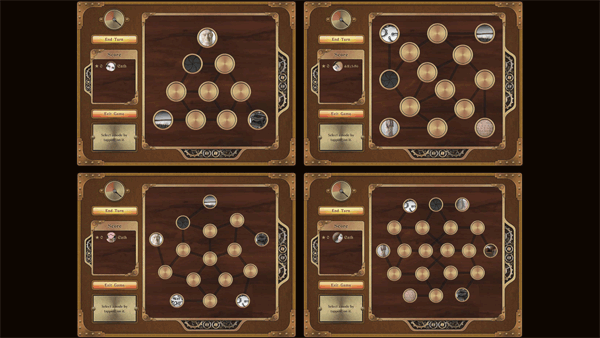
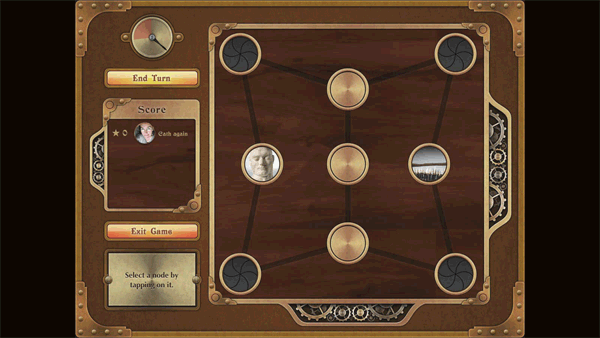
She then shows us various Sembl gameboards for iPad:

Sembl Museum gameboard for four teams of younger players

Four different Sembl Museum gameboards

Cath speaks:

But The Museum Game is just one form of Sembl. The Museum Game is played in real time, on site, and players take photos of physical objects to create nodes on the board.

The next step is to make a web-based form, that you could play at your own pace, and from your own place. Then, Sembl becomes a game-based social learning network, which amplifies the personal value of the game – it becomes social networking with cognitive benefits.

But it’s the bigger picture – of humans as a community – that I most want to explore: Sembl as an engine of networked ideas, or linked data.

Charles notes: I’m skipping the educational part — and the bit about my own role in the game’s development, to get to the core of her presentation as I see it: the cognitive facilitation it provides

Cath again:

Another way of saying this is that the Game provides a structure and impetus for dialogue, between the museum and visitors, between visitors and things, among visitors and between things. And this is not dialogue in the sense of an everyday conversation. It’s deeper than that. It’s a mutual experience of looking both ways, simultaneously.

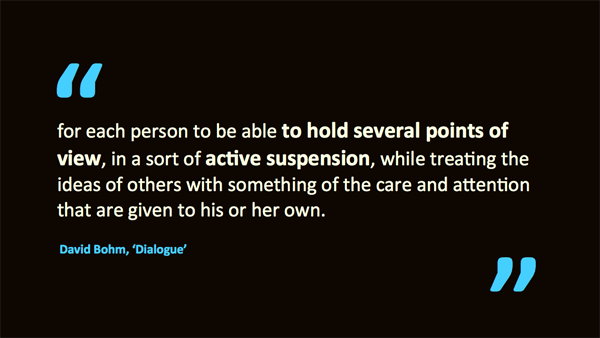
Cath next quotes David Bohm, the eminent quantum physicist:

to hold several points of view in active suspension – quotation of David Bohm

Cath speaks:

For Bohm, dialogue means holding several points of view in active suspension. He regarded this kind of dialogue as critical in order to investigate the crises facing society. He saw it as a way to liberate creativity to find solutions.

Cath then drops in an important topic header:

Toward a game-based social learning network

Cath:

The concept of Sembl, in its deepest sense, is social learning – game-based social learning. In its first instantiation, it is game-based social learning in a museum and – if things turn out as I hope they will – from next year it will be playable at any other exhibiting venue that has the infrastructure and the will to host games – galleries, libraries, botanic gardens, zoos and so on.

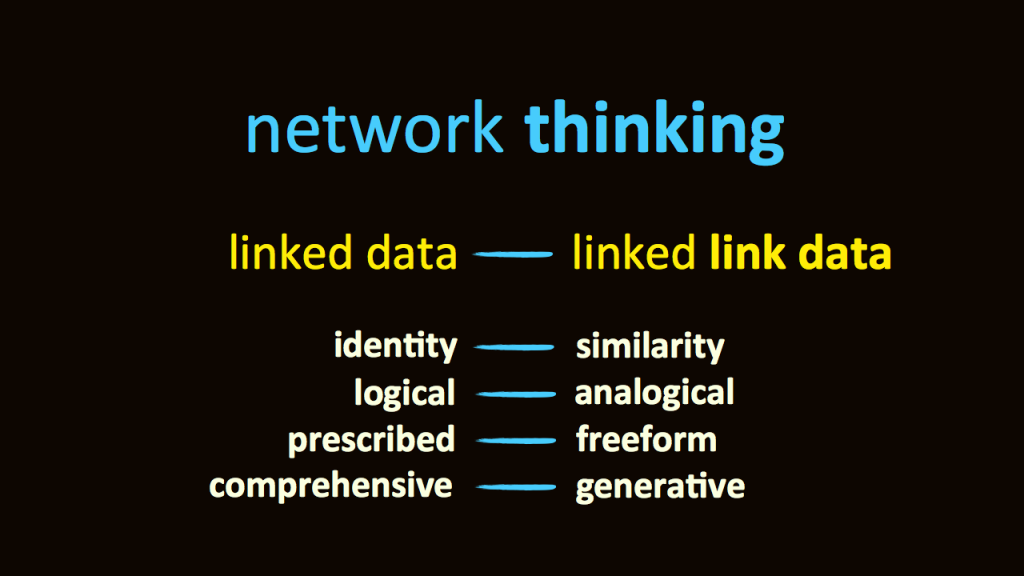
network thinking – how Sembl network links differ from traditional linked data links

A web-based form of Sembl can generate linked data with a difference. It’s linked link data, and quite different to normal linked data.

  • Instead of connections based on what a thing is – sculpture, or wooden, or red – Sembl generates connections based on a mutual resemblance between two things. Which, amazingly enough, is a great way of gaining a sense of what each thing is. And if your interest is to enable joyful journeying through cultural ideas, or serendipitous discovery, this approach just wins…
  • Instead of compiling logical links, Sembl cultivates the analogical.
  • Instead of building and deploying a structured, consistent set of relationships, Sembl revels in personal, imprecise, one-of-a-kind, free association, however crazy.
  • Instead of attempting to create a comprehensive and stable map of language and culture, Sembl links are perpetually generative, celebrating the organic, dynamic quirks of cognitive and natural processes.

But the most important way that Sembl is distinct from other systems of network links is that those who generate the links learn network thinking. Which is a critical faculty in this complex time between times, as many smart people will tell you.

Poets have always known the virtues of analogy as a path to the truth.

Tell all the truth but tell it slant – poem by Emily Dickinson

Sembl promotes dialogic, non-linear thinking, and new forms of coherence.

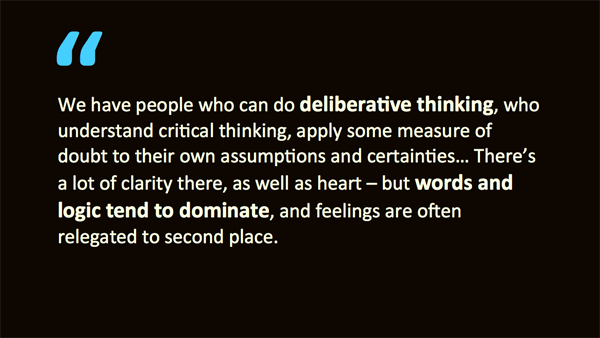
deliberative thinkers – quotation of Charles Cameron

It’s distinct from deliberative thinking, which is rational and causal and logical and linear.

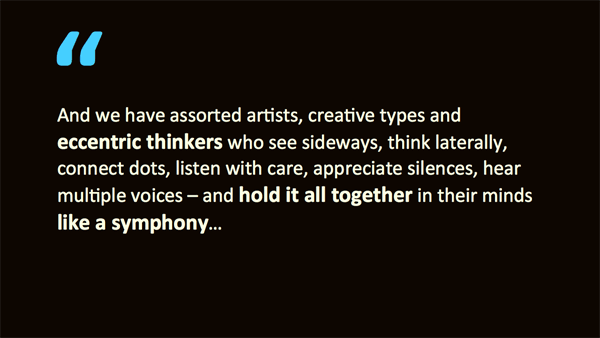
eccentric thinkers – quotation of Charles Cameron

It’s another kind of thinking, which might be informed by rational thought, but its purpose is not singular.

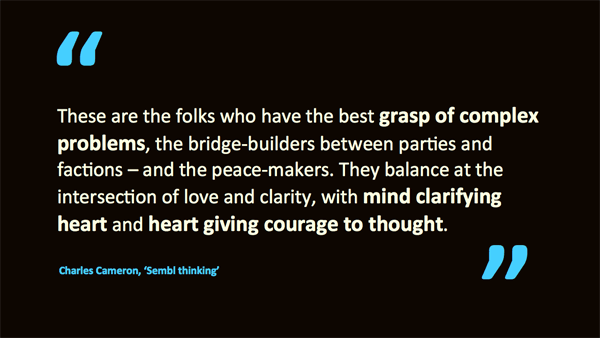
bridge-builders – quotation of Charles Cameron

You might say its purpose is to create – and cohabit – a state of grace, from which ideas simply emerge.

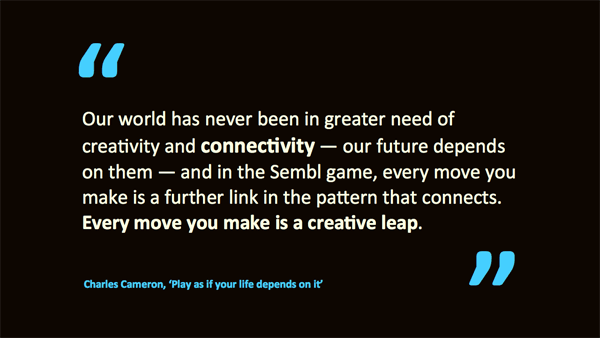
every move you make is a creative leap

If playing Sembl gives us practice in polyphonic thinking, if it helps cultivate connectivity and our capacity to find solutions to local and global problems, it is good value. As Charles says, every move is a creative leap.

Cath concludes:

If you’re interested in working with us to supply content, develop strategy or raise capital, we’re keen to talk.

And I can’t tell you how much I’m anticipating being able to invite everyone to play.

thanks

**

Cath can be reached via Twitter at @cathstyles, and I’m at @hipbonegamer. The Sembl site is at Sembl.net.

Next up: what Sembl has to offer the IC.

Playing a double game

Monday, November 19th, 2012

[ by Charles Cameron — a chess variant exploring the twinned human drives for competition and collaboration ]
.

I posted a neat piece of math the other day, showing how dogs might respond to conditions of combined fear and rage in terms of a catastrophe theory diagram, and Larry Dunbar pointed out in a comment that humans might respond differently in equivalent circumstances depending on whether they had a strategy going into the situation or not…


.

The idea that humans can have an override on such instinctive drives as fear and rage is obviously an important one, and Larry’s comment reminded me of a post I’ve been meaning to make about another “dualism” we humans are subject to…

**

Humans are not IBM machines: they have dual drives, responding to a greater or lesser extent at all times to competitive and collaborative motivations.

I was attempting to capture something of that essential dualism in the simplest possible game format when I devised my story-telling chess variant for Ruth Catlow‘s Rethinking Wargames blog:

My own chess variant, which would require two fairly accomplished story-tellers of roughly equal chess strength to play it, is one in which the game is played as in any chess game, following the usual rules, with the added proviso that at each move, the player should write a fictionalized account of the move, such that the combined narratives of the two players taken together in sequence of moves constitutes a story for publication.

The point is that each player then has two motives in making each move — a chess-winning-motive, and a storytelling-collaborative-motive — and the way they play will thus reflect something that parallels human motivation, with its characteristic mix of survival drive and quest for selfactualization / spirituality.

I’m neither a decent chess-player not a decent writer of fiction, but I believe I’m a first rate conceptual game designer, and that this game concept captures something essential about the human condition in simple form. I offer it as a thought-experiment with “live” game potential.

**

One last thought:

I suspect that this game is in effect a game for exploring the intersection of zero-sum with non-zero-sum games, so playing with the interactions of collaboration and competition should also offer us insight into the interactions of quality and quantity.

**

For more on Ruth Catlow’s work, see her book Artists Re: thinking Games.

Gaming Gandhi

Saturday, November 17th, 2012

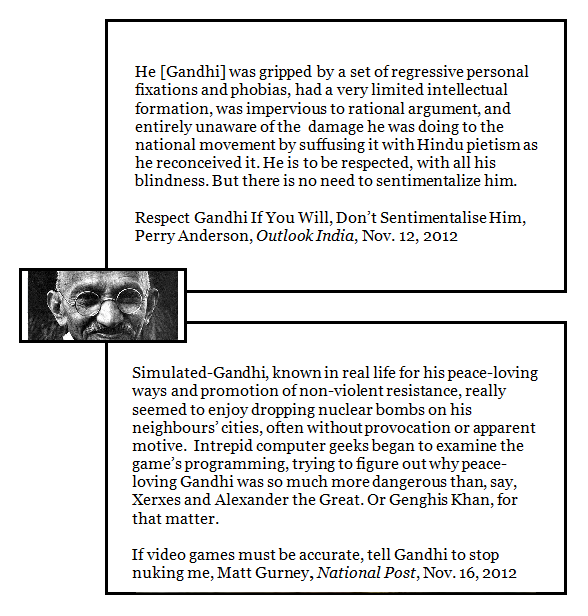
[ by Charles Cameron — two clashing quotes about Gandhi that followed one another in my RSS feed today, funny & strange ]
.


.

Strange, to say the least.

Gandhi was a strategist — as a friend of mine once wrote, “he achieved self determination for the largest number of individuals with the lowest cost in human life” of any rebel known to history —

He managed this feat by holding a position of non-violent non-cooperation, while showing that the ‘civilized’ opponent of the United Kingdom could not live up to its own imposed standards of conduct or law.

And at least some of the time, he was notably unwilling to romanticize himself — he once said:

My nonviolence does not admit of running away from danger and leaving dear ones unprotected. Between violence and cowardly flight, I can only prefer violence to cowardice. I can no more preach nonviolence to a coward than I can tempt a blind man to enjoy healthy scenes. Nonviolence is the summit of bravery. And in my own experience, I have had no difficulty in demonstrating to men trained in the school of violence the superiority of nonviolence. As a coward, which I was for years, I harbored violence. I began to prize nonviolence only when I shed cowardice.

So he’s not the total pacifist he’s sometimes portrayed as.

But nuclear weapons? “Much more dangerous than, say, Xerxes and Alexander the Great. Or Genghis Khan, for that matter”?

Not in India, not back then. In one of Hugh Everett‘s “many worlds”? — perhaps. And in Civ2, the game? — apparently, yes.

**

Quote sources: Outlook India and National Post, with a tip of the hat to Rex Brynen at PAXSims.

A triptych for Jane McGonigal

Thursday, October 18th, 2012

[ by Charles Cameron — on play, games, vertigo and koan — technically this is a ludibrium, a jeu, a jest — a dervish whirl for the mind ]
.


.

I’m joining the conversation Jane McGonigal is leading over on Big Questions Online — our topic is How Might Video Games Be Good for Us? — and she came up with a gem of a quote from Huizinga‘s Homo Ludens which pointed me to two other quotes that are part of the collection I keep in mind, one from Wittgenstein, the other from Roger Caillois.

**

I’ve strung them together here because the way the mind hops and skips from one idea to the next in this series enchants me:


.

There’s more to those three quotes taken together, along with the leaps between them, than there is in keeping them apart. They have, what was it Wittgenstein said? — a family resemblance. They belong together. You could start with the third quote, in fact, and then hop to the first and second, and the effect would be much the same, you could make a ring of them.

**

They spiral so closely in on one another, indeed, as to induce ilynx, vertigo. Let’s keep on spinning.

To my mind, the master of vertigo in our times is Jorge Luis Borges, who uses the word “vertiginous” at least four times in his fictions — my favorite arriving in his story The Circular Ruins, where he writes:

He understood that modeling the incoherent and vertiginous matter of which dreams are composed was the most difficult task that a man could undertake, even though he should penetrate all the enigmas of a superior and inferior order; much more difficult than weaving a rope out of sand or coining the faceless wind.

Blam! — is there anything more vertiginous than paradox, enigma, koan, mystery?

**

In perspective, there’s the vanishing point. In service to others, there’s forgetfulness of self.

**

While we’re on the subject of play, I have a confession to make. Several times on this blog and elsewhere, I have cited the art historian Edgar Wind as saying that Ficino’s motto was “studiossime ludere” and that he translated it “play most assiduously” — Marsilio Ficino being the intellectual hub of Renaissance Florence under the Medici. When I was putting together my initial post to Jane McGonigal for her Big Questions discussion, I wanted to use that quote, but couldn’t quite find it in the source I thought it came from. Well, I’ve been doing some checking since then, and Wind does quote something very similar in his Pagan Mysteries in the Renaissance — but the phrase is “studiosissime ludere”, and what he writes is this —

Serio ludere was a Socratic maxim of Cusanus, Ficino, Pico, Calcagnini — not to mention Bocchi, who introduced the very phrase into the title of his Symbolicae quaestiones: ‘quas serio ludebat’.[1]

which he then footnotes thus (translation coming up shortly):

[1.] cf. Ficino, In parmeniden (Prooemium), Opera, p. 1137: ‘Pythagorae, Socratisque et Platonis mos erat, ubique divina mysteria figuris involucrisque obtegere, … iocari serio, et studiosissime ludere.’

Then there’s Ioan Couliano, another great scholar of Renaisssance thought — and a victim of Ceausescu‘s secret police — in Eros and Magic in the Renaissance, translates for us (pp. 37-38):

Pseudo-Egyptian hieroglyphics, emblems and impresae were wonderfully suited to the playful spirit of Florentine Platonism, to the mysterious and “mystifying” quality Ficino believed it had. “Pythagoras, Socrates, and Plato had the habit of hiding all divine mysteries behind the veil of figurative language to protect their wisdom modestly from the Sophist’s boastfulness, of joking seriously and playing assiduously, iocari serio et studiosissime ludere.” [34] That famous turn of phrase of Ficino’s — translation of a remark by Xenophon concerning the Socratic method — depicts, at bottom, the quintessence of every phantasmic process, whether it be Eros, the Art of Memory, magic, or alchemy — the ludus puerorum, preeminently a game for children. What, indeed, are we doing in any of the above if not playing with phantasms, trying to keep up with their game, which the benevolent unconscious sets up for us? Now, it is not easy to play a game whose rules are not known ahead of time. We must apply ourselves seriously, assiduously, to try and understand and learn them so that the disclosures made to us may not remain unanswered by us.

Couliano footnotes the quote thus:

[34.] Proem. in Platonis Parmenidem (Opera, II, p. 1137). This is simply the Latin translation of an expression Xenophon had used to designate the Socratic method (paizein spoude). On the custom of the “serious games” of Ficino and his contemporaries, see Edgar Wind, Pagan Mysteries in the Renaissance 3d ed. (Oxford, 1980), pp. 236-38.

**

Okay, I was trying to check a Latin tag that I’d obviously been quoting from memory, and things just kept on spinning — and weaving — together.

So where are we now? We’re talking of “playing with phantasms, trying to keep up with their game” (Couliano) — and thus back at that Borges quote, too, with its “incoherent and vertiginous matter of which dreams are composed”…

Which is us.

I mean, “We are such stuff as dreams are made on, and our little life is rounded with a sleep.”

**

Okay. Practical matters. To go along with Witty Wittgenstein and the others on my recommended reading list, here’s an image of McGonigal’s dissertation and book:

The dissertation is available here as a .pdf: the book is available here on Amazon.


Switch to our mobile site