zenpundit.com » Religion

Archive for the ‘Religion’ Category

Of Esther, Israel and Iran, pt. I – Purim

Thursday, March 8th, 2012

[ by Charles Cameron — Purim, the gift of a scroll ]

Today is the Festival of Purim in the year 5772 of the Jewish calendar, and in preparation for the event and in light of current geopolitics, PM Benjamin Netanyahu presented Pres. Barack Obama with a Megillah — a scroll containing the biblical Book of Esther, which it is a mitzvah for Jews to listen to on Purim — only last week.

Today is also International Women’s Day in the year 2012 of the Common Era.

*

Purim is a festive celebration, and while I hope to post follow ups on the tangled topics of scriptural interpretation and prophetic politics in the coming days, I thought it appropriate to open this series of posts with an image of an early Megillah from the Library of Congress (see above), to raise a glass of virtual wine in honor of the dual event, and to wish all ZP readers Chag Purim Sameach.

Of diversity in Islam

Wednesday, March 7th, 2012

[ by Charles Cameron — against either / or thinking — a graphic reminder? ]
.
Islam is “a mosaic, not a monolith”.

Vartan Gregorian, president of the Carnegie Corporation, offered us a 177-page exposition of that theme in a book of that title published by the Brookings Institution (2003), expanding on an earlier and shorter essay of the same title. Of the book-length version, he writes:

Presenting such a wide-angle view in a relatively small space requires the free use of generalizations, summaries, and categorizations that must leave out many nuances of history.

1.

There’s no doubt that some currents within Islam preach a continuing war against “Crusaders and Zionists” — and make no mistake about it, this is a religious movement, claiming its sanction in scripture and its path as submission to the will of God, as indicated by David Martin Jones and MLR Smith in Whose Hearts and Whose Minds? The Curious Case of Global Counter-Insurgency [see Zen’s comments here]:

The process of radicalisation is obviously a complex one. Certainly, the passage to the act of terrorism cannot be reduced solely to religion. Nevertheless, it is somewhat naive, if not perverse, to dismiss it completely. The bombings of the Madrid and London transport systems in March 2004 and July 2005 respectively, and even the 9/11 assaults, are, whatever else, Islamist acts in a Western setting. The view that religion is at best a secondary motive defies the evidence. All the groups that have undertaken high-profile terrorist acts dating from 9/11 and stretching from Bali to Madrid, London and Mumbai have acted in the name of a militant understanding of Islam. Such a pattern of worldwide attacks, exhibiting a profound devotion to a politically religious cause intimates, if nothing else, a religious dimension to jihadism. In fact, to reduce jihadism to individual social pathology attempts to explain away political religion as a social fact. Rather worryingly, it assumes that when a highly motivated jihadist claims to undertake an operation to advance a doctrine, he does not really mean it.

This might seem so obvious as to require no comment — yet Jones and Smith follow this paragraph with a question:

we need to resolve this paradox: why do counterinsurgency theorists exhibit this reluctance to confront the ideological or politically religious dimension of modern insurgency?

— and there are no doubt other segments of the media, intelligence and policy communities of which the same question might be asked.

One aspect of the answer, I believe, lies in the general tendency of post-enlightenment thinkers to “push religion into the background of their story” (Richard Landes‘ words, which I quoted here in a different context a week ago).

2.

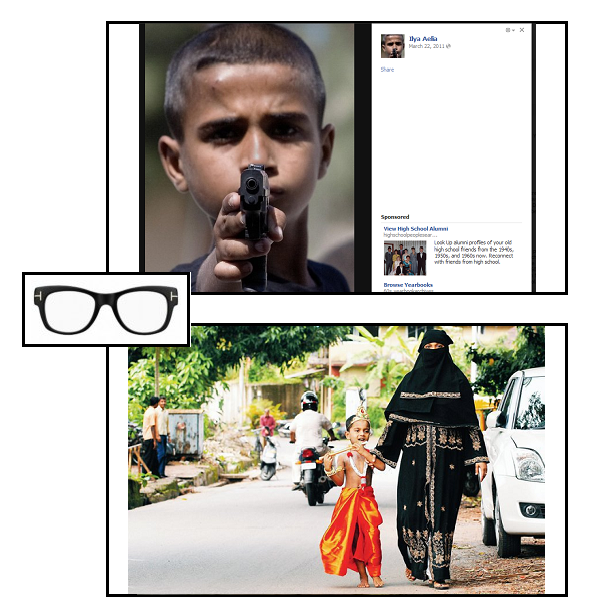
The young man pointing a gun at the viewer on a Facebook page (h/t Internet Hagganah) is the avatar of a net-salafi in Germany whose sequence of avatars looks like this:
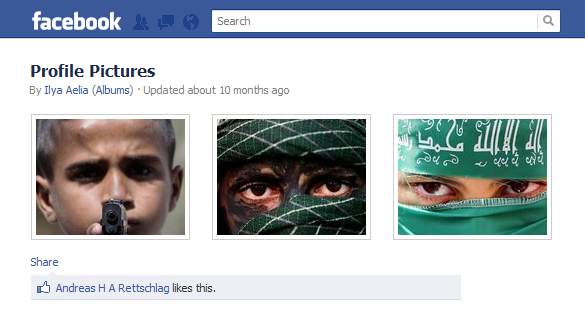
Quintan Wiktorowicz defines a salafi thus:

The term “salafi” is used to denote those who follow the example of the companions (salaf) of the Prophet Mohammed. Salafis believe that because the companions learned about Islam directly from the Prophet, they commanded a pure understanding of the faith.

As he notes in another article:

The Salafi movement (often referred to as the Wahhabis)1 represents a diverse community. All Salafis share a puritanical approach to the religion intended to eschew religious innovation by strictly replicating the model of the Prophet Muhammad. Yet the community is broad enough to include such diverse figures as Osama bin Laden and the Mufti of Saudi Arabia. Individuals and groups within the community reflect varied positions on such important topics as jihad, apostasy, and the priorities of activism. In many cases, scholars claiming the Salafi mantel formulate antipodal juristic positions, leading one to question whether they can even be considered part of the same religious tradition.

The avatar-salafi depicted above sums up his own existence and “aim in life” by pointing a gun at you.

3.

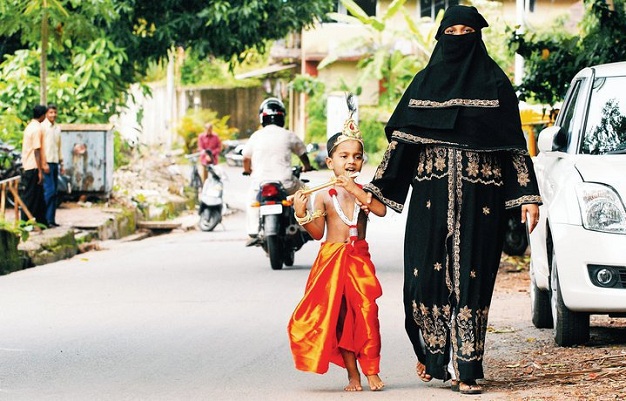
Not so the lady leading a child by the hand in the lower of the two images, from a photo taken in India.

She offers us, in fact, a vividly contrasting picture of Islam to that of the salafi. She, a woman who is clearly observant of the demure dress code given in Qur’an 33.59 and wearing a niqab, is leading by the hand a joyful child arrayed in the finery of Krishna — beloved flute-playing avatar of Vishnu (avatar in its original sense) among her Hindu neighbors.

You might consider the pair of them together as monotheism hand-in-hand with polytheism. But then again, you might see them as peace and delight together, walking hand-in-hand.

You might see them as expressive of the Quranic proclamation (49.13 ):

O people, We have created you from a male and a female and made you into races and tribes so that you may know each other. Surely the most honored of you in the sight of God is the one who is the most righteous of you.

4.

To bring this back to contemporary politics, we may have our views about Islamist politics, and in the context of the changing scene across the Arab world it is worth pondering this recent quote from Rachid Ghannouchi, founder of the Ennahda Party in Tunisia, indicating another significant aspect of the contemporary evolution of Islamist thought:

Freedom is a fundamental principle in Islam, religion can not be forced on believers … Religion is not meant to give us guidance in all areas of industrial management, agricultural innovation, and governance, those subjects require human reason. Religion, however, gives us a code of values and principles.

Islam is not merely diverse, it is self-renewing.

5.

In light of all this, we need a far richer awareness of the mosaic that is Islam that our tendency towards black and white, war or peace, either / or thinking easily allows.

Consider these Quranic verses (35.27-28):

See you not that Allah sends down rain from the sky? With it We then bring out produce of various colors. And in the mountains are tracts white and red, of various shades of color, and black intense in hue. And so amongst men and crawling creatures and cattle, are they of various colors.

Again, the delight in diversity!

Now take another, closer look at those two folks from India:
Beautiful.

Of dust and breath

Tuesday, March 6th, 2012

[ by Charles Cameron — i have a major post, possibly two, on Ezekiel and Esther, Israel and Iran in prep, and zen just posted a major piece on the era of the creepy-state — so don’t mind me, this is just a brief aside on religious devotion, relics, the heart, the skull, the breath ]
.

There’s an eerie beauty to relics — and when I read a BBC news piece today titled Dublin patron saint’s heart stolen, about the theft of a relic of St Laurence from Dublin’s Christ Church cathedral (upper image), while the “contemporary” part of me found it perhaps worth a chuckle and certainly paradoxical —

The thief would have needed metal cutters to prise open the iron bars protecting the wooden heart-shaped box holding St Laurence O’Toole’s heart.

— another part of me was saddened, much as I was saddened some years back by the destruction of the Buddhas of Bamiyan.

I hope Dublin gets its spiritual heart back.

*

And so my mind went back to another relic, and another recent encounter with that eerie beauty — the relic of St Valentine, martyr, which I ran across in a photo by Fr. Lawrence Lew OP (lower image), posted on the saint’s day, February 14th, by Shawn Tribe in the New Liturgical Movement blog, a regular read of mine.

St Valentine, memorialized not by silly cupids (silli putti?) and plump, winged hearts, but by the fellow’s skull…

*

There’s something there about dust — that we are dust, animated by breath until the dust settles…

There’s an eerie beauty to that thought.

A poignant week or so in DoubleQuotes

Friday, December 30th, 2011

[ by Charles Cameron — fictitious peoples (Israelis, Palestinians), approved and disapproved scriptures (Hindu, Falun Gong), religious violence (Afghanistan, Nigeria, Bethlehem) ]
.

So, is there some sort of contest going on between Iranian and American ex-Speakers? Perhaps Elliott Abrams‘s response to Gingrich, quoted in the Washington Post piece, applies equally well to Haddad-Adel?

There was no Jordan or Syria or Iraq, either, so perhaps he would say they are all invented people as well and also have no right to statehood.

Next up…

And okay, what’s the point here? Is it that the Russians want to please both the Chinese and Indian governments — or that they don’t like new scriptures but are okay with old ones? Or is the problem that they haven’t decided yet on a “one size fits all” approach to unOrthodox religions?

Sigh. Next…

This is brutal — and apparently intercontinental.

You might think it’s obvious what the wrong answer is, and who’s doing the killing, in Nigeria. But these things can cut both ways:

Even here, it’s not clear who threw the bomb into the madrasa, although one could hazard a guess…

And even the site of the Nativity is infected. The Guardian’s account of events there this Christmas season is harsh in tone — but consider whose Nativity is supposedly being celebrated…

I’d say the Qur’an offers a better image of Christian monks than that experienced by those Palestinian riot police… who, in the event, although they themselves were also assailed with broom-sticks, declined to arrest anyone because, as Palestinian police lieutenant-colonel Khaled al-Tamimi put it:

Everything is all right and things have returned to normal. No one was arrested because all those involved were men of God.

Still, things could be worse. It was a squabble along similar lines in which nine several Orthodox monks were killed that triggered the Crimean War: details in Raymond Cohen, Conflict and Neglect: Between Ruin and Preservation at the Church of the Nativity — h/t Juan Cole, who also has video of this year’s brouhaha.

*

Et in terra pax hominibus bonae voluntatis.

Book Review: A Terrorist’s Call to Global Jihad

Thursday, December 29th, 2011

A Terrorist’s Call to Global Jihad: Deciphering Abu Musab al-Suri’s Islamic Jihad Manifesto by Jim Lacey (Ed.)

Previously, I read and reviewed Brynjar Lia’s Architect of Global Jihad, about Islamist terrorist and strategist Abu Musab al-Suri. A sometime collaborator with Osama bin Laden and the AQ inner circle, a trainer of terrorists in military tactics in Afghanistan and an advocate of jihadi IO, al-Suri was one of the few minds produced by the radical Islamist movement who thought and wrote about conflict with the West on a strategic level. Before falling into the hands of Pakistani security and eventually, Syria, where al-Suri was wanted by the Assad regime, al-Suri produced a massive 1600 page tome on conducting a terror insurgency,  The Global Islamic Resistance Call, which al-Suri released on to the jihadi darknet.

Jim Lacey has produced an English digest version of al-Suri’s influential magnum opus comprising approximately 10 % of the original  Arabic version, by focusing on the tactical and strategic subjects and excising the rhetorical/ritualistic redundancies common to Islamist discourse and the interminable theological disputation. There are advantages and disadvantages to this approach.

First, Lacey has produced a concise and readable book from a large mass of sometimes convoluted and repetitive theorizing that al-Suri strung together piecemeal, sometimes on the run or in hiding. For those interested in getting to the heart of al-Suri’s nizam la tanzim strategic philosophy, A Terrorist’s Call to Global Jihad is an invaluable resource for strategists, counter-terrorism specialists, tactical operators,  law enforcement and laymen. Secondly, it is also a useful reference for policy people to see through al-Suri’s eyes the internal political and philosophical divisions within the radical jihadi community. al-Suri himself writes very ambivalently about 9/11 as a great blow against America and yet a complete calamity in it’s effects for the “jihadi current” that destroyed everything the Islamist revolutionaries had so painstakingly built, including the Taliban Emirate. Thus a climate was created by the American counter-attack where old methods of struggle were no longer useful and jihadis must adopt radically decentralized operations ( what John Robb terms Open-Source Warfare; indeed it is clear to an informed reader that al-Suri, a wide-ranging intellectual rather than a narrow religious ideologue, was influenced by Western literature on asymmetric warfare, 4GW, Three Block War  and COIN).

The drawback to this approach is more for scholars looking at the deeper psychological and ideological drivers of jihadi policies, strategy and movement politics. The religious questions and obscure Quranic justifications cited by Islamist extremists that are so tedious and repetitive to the Western mind are to the jihadis themselves, of paramount importance in establishing both the credentials of the person making an argument but also the moral certainty of the course of action proposed. al-Suri himself had some exasperation with the degree to which primarily armchair ideologues, by virtue of clever religious rhetoric, could have more influence over the operational decisions of fighting jihadis than men with field experience like himself. By removing these citations, an important piece of the puzzle is missing.

The Musab al-Suri whose voice appears in A Terrorist’s Call to Global Jihad is consistent with the one seen in Lia’s book, dry, sardonic, coldly hateful toward the West and highly critical of the jihadis own mistakes, laden with overtones of pessimism and gloom. al-Suri did not envision a quick victory over the West and wrote his manifesto as a legacy for future generations of Islamist radicals because the current one was nearly spent after the American onslaught and poorly educated in comparison with predecessors like the generation of Sayid Qutb.

Strongly recommended.


Switch to our mobile site