zenpundit.com » scriptures

Archive for the ‘scriptures’ Category

Phineas Priesthood I: Larry McQuilliams

Thursday, December 4th, 2014

[ by Charles Cameron — I call these events where an ancient scripture provides sanction for contmporary brutality Landmines in the Garden — I could write a book about’em ]
.

Larry McQuilliams KSN file photo
Larry McQuilliams. Photo credit: KSN file photo

**

Here’s the main story, as reported by AP on the first of this month:

A Texas man who shot up downtown Austin buildings and tried to the burn the Mexican Consulate before he was gunned down by police harbored extremist right-wing views and appeared to be planning a broader attack against churches and government facilities, law enforcement officials said Monday.

Larry McQuilliams had multiple weapons, hundreds of rounds of ammunition, a water supply and a map of 34 downtown buildings that likely were potential targets in his pre-dawn rampage the day after Thanksgiving, Austin Police Chief Art Acevedo said.

McQuilliams, 49, started his attack on the consulate building and a federal courthouse. He was killed with by a single shot to the chest from a police officer as he shot at police headquarters, Acevedo said. McQuilliams fired about 200 rounds, but no one else was killed or injured.

“The one mistake he made was he came to the Austin police station and we were able to take him out pretty quickly,” Acevedo said, describing McQuilliams, a convicted felon, as a “homegrown, American extremist” and “terrorist.”

McQuilliams’ had rented a van that was parked outside the police station and was loaded with ammunition and propone fuel canisters typically used for camping. McQuilliams tried to use fireworks with the canisters to make crude but ineffective bombs and used some at the Mexican Consulate, causing a fire that was quickly extinguished.

Here’s the part that interests me today:

Also in the van was a copy of “Vigilantes of Christendom,” a 1990 book associated with the Christian Identity movement known as the Phineas Priesthood, which espouses anti-Semitic and racist views. Inside the book was a handwritten note that referred to McQuilliams as a “priest in the fight against anti-God people,” Acevedo said.

**

I have been researching and monitoring the Phineas Priesthood concept for some time now, and have had a major post (or more likely, series) on the topic three-quarters written for a year or so.

It’s a delicate tale to tell, since its origins lie in Jewish scriptures; it features in the celebration of Hanukkah; is found in Christian writers from Origen to Milton; is referenced, as I hope to show, obliquely by Brigham Young; and has been involved in such infamous assassinations as that of Israeli PM Yitzak Rabin and US Civil Reights leader Medgar Evers. It ties in neatly with Louis Beam‘s idea of leaderless resistance. And even Anwar al-Awlaqi can be seen to propose an Islamic variant on the theme.

In follow up posts in this series, I hope to address the Phineas narrative in the Jewish scriptures, in Christian writings, and in terms of the more recent events I mentioned. Since I shall be discussing how the tale of Phineas / Pinchas / Phinehas has been used as offering divine scriptural sanction for acts of religiously-motivated killing, I shall chiefly focus on the negative implications of the tale — it’s use as a buried “landmine” –and since it extends across three millennia, I shall be hard-pressed to catch all of the uses of the tale which might be relevant to my purpose.

Accordingly, I’d like to invite my friends in the Jewish and Christian scholarly communities, in particular, to assist me in the comments section by suggesting alternative ways of reading a story which in its most literal interpretation has been the cause of untimely and hateful deaths.

On distinguishing between radicalism and activism in words

Saturday, November 29th, 2014

[ by Charles Cameron — with an assist from the young Isaac Newton ]
.

This is one of those micro-events that crop up if you frequently read from diverse sources, haphazardly piling one thing atop another:

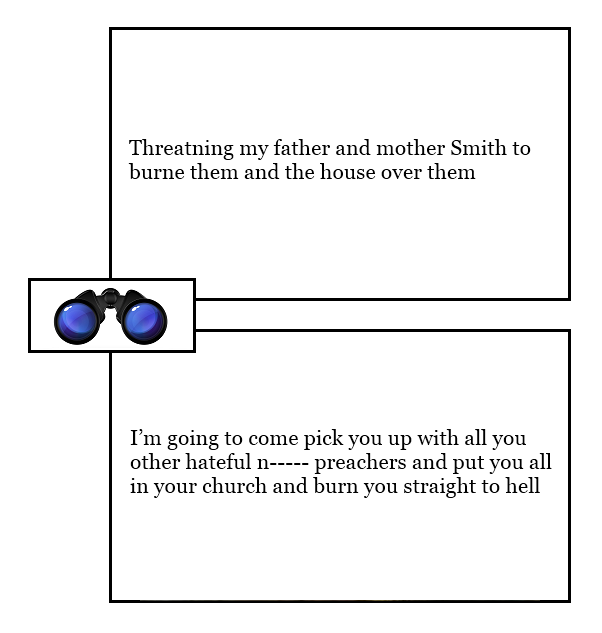
SPEC DQ burne house or church

**

Here’s what I’m thinking. Taken at face value these two statements seem pretty similar: tidy up the archaic spellings in the first, the contemporary ellipsis in the second, and tweet them — you’d have the same basic threat in each case:

I’ll burn you guys and the roof over your heads.

The problem here is fundamental to our times and to the way we handle potential recruits to, and returning fighters from, IS / Daesh

how can you tell the merely radical sounding from those who will in fact put their radical ideas into violent practice?

**

Verbal threats can easily indicate one state of affairs or the other. Consider these facts:

  • Whoever it was that made the threat in the lower panel over the phone to Pastor Carlton Lee of Flood Christian Church in Feruson, someone indeed made good on the church part, setting the cinder block structure ablaze and burning it to the ground on Monday.
  • Whoever it was who threatened to burn his parents’ home over their heads and them with it in the upper panel seems not to have done so, but went on to discover the law of gravitational attraction, write the Philosophiæ Naturalis Principia Mathematica, co-discover the calculus, and hold the presidency of the Royal Society before dying at the over-ripe old age of 84.
  • **

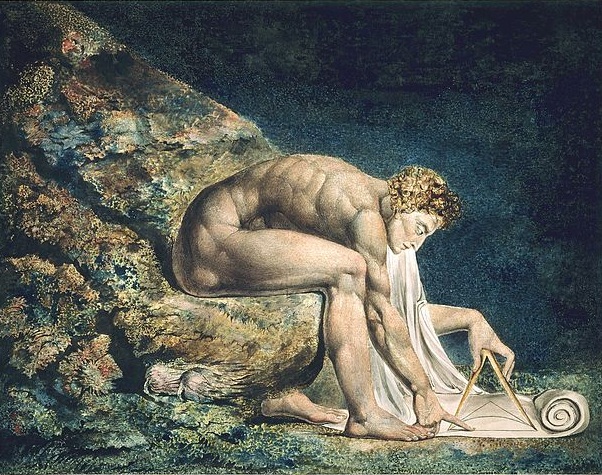
    Newton.

    624px-Newton-WilliamBlake

    Sir Isaac, I mean, Newton. That second quote came from Sir Isaac Newton, alchemist extraordinaire, listing his youthful sins — Newton who, by the way, calculated that the beginning of the reign of Christ would not occur before 2060, writing:

    And the days of short lived Beasts being put for the years of lived [sic] kingdoms, the period of 1260 days, if dated from the complete conquest of the three kings A.C. 800, will end A.C. 2060. It may end later, but I see no reason for its ending sooner. This I mention not to assert when the time of the end shall be, but to put a stop to the rash conjectures of fancifull men who are frequently predicting the time of the end, & by doing so bring the sacred prophesies into discredit as often as their predictions fail. Christ comes as a thief in the night, & it is not for us to know the times & seasons wch God hath put into his own breast.

    **

    So — would you lock up the young Newton and throw away the key? Or track down whoever phoned that threat to the pastor in Ferguson? I wouldn’t send them to Cambridge and expect too much of them ..

    Words can certainly be inflammatory — in some cases they result in flames..

    The Art of Future War?

    Sunday, November 23rd, 2014

    [ by Charles Cameron — coloring outside the lines of the challenge ]
    .

    http://www.desura.com/mods/dune-wars/images/new-soldier-and-infantry-units
    Civ4 Dune mod, “Worm attack”, from Desura

    **

    I’m all in favor of the Atlantic Council‘s Art of Future War Project:

    It is a moment to seek out new voices and ideas from artists who can range much farther out into the future. Artists are adept at making sense of disorder while also having the ability to introduce a compelling chaos into the status quo. In other words, they are ideally suited to exploring the future of warfare. Writers, directors and producers and other artists bring to bear observations derived from wholly different experiences in the creative world. They can ask different kinds of questions that will challenge assumptions and conventional ways of tackling some of today’s toughest national security problems. Importantly, they can also help forge connections with some of most creative people in the public and private sectors who otherwise struggle to find avenues for their best ideas.

    That’s excellent, and as a poet and game designer with a keen interest in war and peace, I hope to contribute.

    **

    Funny, though, their first challenge looks, to my eyes, just a little bit back to the future:

    The Art of Future Warfare project’s first challenge seeks journalistic written accounts akin to a front-page news story describing the outbreak of a future great-power conflict.

    Why would we want to produce something “akin to a front-page news story” at a time when news stories are already more web-page than front-page, and perhaps even tweet before they’re breaking news?

    In any case, the good people at Art of Future War offered some clues to those who might want to take up their challenge, and I took their encouragement seriously —

    The historical creative cues included below are intended to inspire, not bound, creativity.

    **

    Their first clue did indeed inspire me, though not to write anything akin to a front-page news story, “between 1,500 and 2,500 words long”. The clue they gave was the Washington Times lede I’ve reproduced in the upper panel below —

    SPEC DQ slomo death

    while the lower panel contains the quote their clue led me to, by an associative leap of the kind artists are prone to — drawing on the vivid imagery of Peter Brook‘s play, The Mahabharata, which I had the good fortune to see in Los Angeles, a decade or three ago.

    **

    My own leap backwards — to an ancient and indeed originally oral epic, the Mahabharata, rather than to century-old newsprint — won’t win me the challenge, since it doesn’t answer to the rules, nor will it provide useful hints as to what war will look like a decade from now.

    The sage Vyasa, who wrote the Mahabharata at the dictation of the god Ganesh, might have been able to predict the future of war — I certainly cannot.

    What I can do, and hope to have done, is to suggest that the whole of human culture has a bearing on war and how we understand it.

    James Aho‘s Religious Mythology and the Art of War should be on every strategist’s reading list, as should Frank Herbert‘s Dune (see gamer’s mod image at the top of this page), JAB van Buitenen‘s Bhagavadigita in the Mahabharata and Brigadier SK Malik‘s The Qur’anic Concept of War — and Akira Kurasawa‘s Kagemusha on the DVD shelf, too:

    There, I have managed to contribute something useful after all.

    Dabiq issue #5 – Ibrahim challenges Nimrod

    Sunday, November 23rd, 2014

    [ by Charles Cameron — tracing the same tale from Ibrahim challenging Nimrod as quoted in Dabiq back to Midrash Rabbah ]
    .

    I ended my last post, An end times update & the Islamic State, with a DoubleQuote:

    SPEC DQ sunrise west

    Sources:

  • Foreign Policy, In a New Ukraine, the Sun Rises in the West
  • Discovering Islam, Rising of the Sun from the West
  • **

    But then, d’oh, a new issue of Dabiq comes out, and on p 4 there’s a reference to Qur’an 2.258:

    Have you not considered the one who argued with Ibrahim about his Lord [merely] because Allah had given him kingship? When Ibrahim said, “My Lord is the one who gives life and causes death,” he said, “I give life and cause death.” Ibrahim said, “Indeed, Allah brings up the sun from the east, so bring it up from the west.” So the disbeliever was overwhelmed [by astonishment], and Allah does not guide the wrongdoing people [Al-Baqarah: 258].

    What’s that book title? The Sun Also Rises

    **

    That’s quite an intriguing exchange, you know, for Dabiq to be quoting — especially considering that Ibrahim is the caliphal name of al-Baghdadi, that Dabiq preaches the millah Ibrahim, and so forth.

    There’s more to the story, of course.

    The Qur’an 21.51-71 goes into more detail:

    We gave Abraham aforetime his rectitude — for We knew him — when he said to his father and his people, ‘What are these statues unto which you are cleaving?’ They said, ‘We found our fathers serving them.’ He said, ‘Then assuredly you and your fathers have been in manifest error.’ They said, ‘What, hast thou come to us with the truth, or art thou one of those that play?’ He said, ‘Nay, but your Lord is the Lord of the heavens and the earth who originated them, and I am one of those that bear witness thereunto. And, by God, I shall assuredly outwit your idols, after you have gone away turning your backs.’ So he broke them into fragments, all but a great one they had, for haply they would return to it. They said, ‘Who has. done this with our gods? Surely he is one of the evildoers.’ They said, ‘We heard a young man making mention of them, and he was called Abraham.’ They said, ‘Bring him before the people’s eyes; haply they shall bear witness.’ They said, ‘So, art thou the man who did this unto our gods, Abraham?’ He said, ‘No; it was this great one of them that did it. Question them; if they are able to speak!’ So they returned one to another, and they said, ‘Surely it is you who are the evildoers.’ Then they were utterly put to confusion saying, ‘Very well indeed thou knowest these do not speak.’ He said, ‘What, and do you serve, apart from God, that which profits you nothing; neither hurts you? Fie upon you and that you serve apart from God! Do you not understand?’ They said, ‘Burn him, and help your gods, if you would do aught.’ We said, ‘O fire, be coolness and safety for Abraham!’ They desired to outwit him; so We made them the worse losers, and We delivered him, and Lot, unto the land that We had blessed for all beings.

    And behind that telling o the story, there’s the Midrash Rabbah, in which we read [p. 311] that Abraham mocked customers of his father’s idol-manufacturing business, with the result that his father handed him over to the King, Nimrod — himself an idolater:

    Thereupon he seized him and delivered him to Nimrod. ‘Let us worship the fire’ he [Nimrod] proposed. ‘Let us rather worship water’, which extinguishes the fire,’ replied he. ‘Then let us worship water!’ ‘Let us rather worship the clouds which bear the water.’ ‘Then let us worship the clouds!’ ‘Let us rather worship the winds which disperse the clouds’ ‘Then let us worship the wind!’ ‘Let us ratherworship human beings, who withstand the wind.’ ‘You are just bandying words,’ he exclaimed; ‘We will worship naught but the fire. Behold, I will cast you into it, and let your God whom you adore come and save you from it.’ Now Haran was standing there undecided. If Abram is victorious, [thought he], I will say that I am of Abram’s belief, while if Nimrod is victorious I will say that I am on Nimrod’s side. When Abram descended into the fiery furnace and was saved, he [Nimrod] asked him, ‘Of whose belief are you?’ ‘Of Abram’s,’ he replied. Thereupon he seized and cast him into the fire; his inwards were scorched and he died in his father’s presence. Hence it is writteN, AND hARAN DIED IN THE PRESENCE OF (‘AL PENE) HIS FATHER TERAH

    **

    I shall have more to say about Dabiq 5 in further posts — the whole magazine is a bit much to digest at once.

    Jottings 11: self-immolators and suicide bombers?

    Tuesday, February 18th, 2014

    [ by Charles Cameron — on some aspects of religiously motivated suicide, and I’m not clear why I called this one a jotting, since it’s quite long and detailed ]
    .


    .

    I have been taking a couple of online courses on terrorism in recent months, and in one of them I ran across a Foreign Policy article titled Ultimate Sacrifice: What’s the difference between self-immolators and suicide bombers?

    … there is another form of deadly protest that has made a resurgence in recent years. Not only did Tunisian street vendor Mohamed Bouazizi’s fiery suicide ignite the region and inspire subsequent self-immolations in Algeria, Egypt, and Morocco, but a growing number of Tibetans have also set themselves alight to protest Chinese rule in Tibetan region

    It’s an intriguing question, phrased by one of my fellow students as the question, “Can Tibetan Self-immolators be considered “terrorists”?

    **

    I did my “due diligence” research, and came up with some articles worth reading:

  • Tenzin Tharchen, 125 Self-Immonlations: why suicide by fire protests continue in Tibet
  • Tsering Shakya, Self-Immolation, the Changing Language of Protest in Tibet
  • Martin Kovan, Buddhist Self-immolation and Mahayanist Absolute Altruism
  • while my interlocutor offered this one:

  • Jose Cabezon, On The Ethics Of The Tibetan Self-Immolations
  • But you know, the mind has indirect back-channels as well as direct information freeways, and the question seems to have been percolating while I’ve been asleep.

    **

    Sonam Wangyal, Lama Sobha, was the first Tibetan lama to self-immolate, and left a cassette tape in which he explained his motives:

    I am giving away my body as an offering of light to chase away the darkness, to free all beings from suffering, and to lead them — each of whom has been our mother in the past and yet has been led by ignorance to commit immoral acts — to the Amitabha, the Buddha of infinite light. My offering of light is for all living beings, even as insignificant as lice and nits, to dispel their pain and to guide them to the state of enlightenment. I offer this sacrifice as a token of long-life offering to our root guru His Holiness the Dalai Lama and all other spiritual teachers and lamas.

    The full text of Lama Sobha’s message can be found at the bottom of an International Campaign for Tibet page titled Harrowing images and last message from Tibet of first lama to self-immolate — the “harrowing images” themselves are linked to, but not shown.

    **

    The Chinese come close to targeting Tibetan self-immolators as terrorists, using the terms “Splittist”– so often also used of the Dalai Lama — and calling their actions “intentional homicide”. This from the “>Scottish Parliament’s Cross-Party Group on Tibet:

    Nonetheless, the response by the Chinese authorities to self-immolations by Tibetans has been extremely draconian, largely because of an assumption that all protest by Tibetans must be intrinsically “splittist” (that is, secessionist). In particular, it has involved the formulation of new laws that seem to target Tibetans specifically, and the imposition of collective punishments, and the application of the crime of “intentional homicide” to all those aiding, abetting, encouraging or even photographing self-immolations.

    **

    It occurs to me that sacrificing oneself for the benefit of other beings is symbolically enacted in the Tibetan Chöd ritual, in which one symbolically feeds the parts of one’s body to the pretas or hungry demons to satiate them and put them to sleep — and also in some of the Jataka Tales of the previous rebirths of the Shakyamuni Buddha.

    I’m thinking particularly of The Bodhisattva and the Hungry Tigress, and will quote here from Edward Conze‘s telling in Buddhist Scriptures, pp 24-26. On being told that self-sacrifice is difficult, Mahasattva (the future Buddha) replies:

    It is difficult for people like us, who are so fond of our lives and bodies, and who have so little intelligence. It is not difficult at all, however, for others, who are true men, intent on benefitting their fellow-creatures, and who long to sacrifice themselves. Holy men are born of pity and compassion. Whatever the bodies they may get, in heaven or on earth, a hundred times will they undo them, joyful in their hearts, so that the lives of others may be saved.

    His prayer before offering his own body and blood to feed an ailing tigress and her cubs is:

    For the weal of the world I wish to win enlightenment, incomparably wonderful. From deep compassion I now give away my body, so hard to quit, unshaken in my mind. That enlightenment I shall now gain, in which nothing hurts and nothing harms.

    Assuming the Jataka tales made it to Tibet, this one might be a potent influence on potential self-immolators.

    **

    A possible Tamil “comparable” — presumably Hindu rather than Buddhist, culturally if not religiously:

    When young Murugathasan Varnakulasingham (aged 26) committed self-immolation in front of the UN headquarters in Geneva on 19 February 2009 he was protesting against international failures of intervention in the unfolding humanitarian tragedy in northern Sri Lanka, where he believed that large bodies of Tamil people faced extinction by the Sri Lankan government. “The flames over my body will be a torch to guide you through the liberation path,” he wrote in his parting letter.

    There have been a few other protest suicides by Tamils in Tamilnadu and Malaysia, but Varnakulasingham’s altruistic act probably garnered the most attention.

    **

    Further thoughts:

    There’s always Samson, pulling down the pillars that upheld the roof of their temple on the Philistines, once he’d regrown his hair and strength…

    Then the lords of the Philistines gathered them together for to offer a great sacrifice unto Dagon their god, and to rejoice: for they said, Our god hath delivered Samson our enemy into our hand. And when the people saw him, they praised their god: for they said, Our god hath delivered into our hands our enemy, and the destroyer of our country, which slew many of us. And it came to pass, when their hearts were merry, that they said, Call for Samson, that he may make us sport. And they called for Samson out of the prison house; and he made them sport: and they set him between the pillars. And Samson said unto the lad that held him by the hand, Suffer me that I may feel the pillars whereupon the house standeth, that I may lean upon them. Now the house was full of men and women; and all the lords of the Philistines were there; and there were upon the roof about three thousand men and women, that beheld while Samson made sport. And Samson called unto the Lord, and said, O Lord God, remember me, I pray thee, and strengthen me, I pray thee, only this once, O God, that I may be at once avenged of the Philistines for my two eyes. And Samson took hold of the two middle pillars upon which the house stood, and on which it was borne up, of the one with his right hand, and of the other with his left. And Samson said, Let me die with the Philistines. And he bowed himself with all his might; and the house fell upon the lords, and upon all the people that were therein. So the dead which he slew at his death were more than they which he slew in his life.

    — Judges 16.23-30 — not quite self-immolation, not quite suicide bombing, but certainly suicidal warfare with a religious motive.

    Okay, When Christians quote John 15.13:

    Greater love hath no man than this, that a man lay down his life for his friends.

    surely they include in their understanding of that verse, those who throw their bodies on top of grenades to protect their comrades — which would seem in its own way to parallel the teaching of the Jataka Tale.

    **

    Likewise, when Muslims quote the hadith from Sahih Bukhari, Volume 4, Book 52, Number 53, in which the Prophet says:

    Narrated Anas bin Malik:

    The Prophet said, “Nobody who dies and finds good from Allah (in the Hereafter) would wish to come back to this world even if he were given the whole world and whatever is in it, except the martyr who, on seeing the superiority of martyrdom, would like to come back to the world and get killed again (in Allah’s Cause).”

    and from Sahih Muslim, Chapter 28, Book 020, Number 4626:

    It has been narrated on the authority of Abu Huraira that the Messenger of Allah (may peace upon him) said:

    [ … ] By the Being in Whose Hand is Muhammad’s life, if it were not to be too hard upon the Muslims. I would not lag behind any expedition which is going to fight in the cause of Allah. But I do not have abundant means to provide them (the Mujahids) with riding beasts, nor have they (i.e. all of them) abundant means (to provide themselves with all the means of Jihad) so that they could he left behind. By the Being in Whose Hand is Muhammad’s life, I love to fight in the way of Allah and be killed, to fight and again be killed and to fight again and be killed.

    — how close are we to Nathan Hale:

    I only regret that I have but one life to lose for my country

    — and behind that, to Joseph Addison:

    What a pity it is
    That we can die but once to serve our country.

    — that’s from Addison’s now obscure play, Cato, a Tragedy, Act IV, Scene 4

    **

    Of course, the way to stop self-immolations in Tibet is simple — put up a notice:
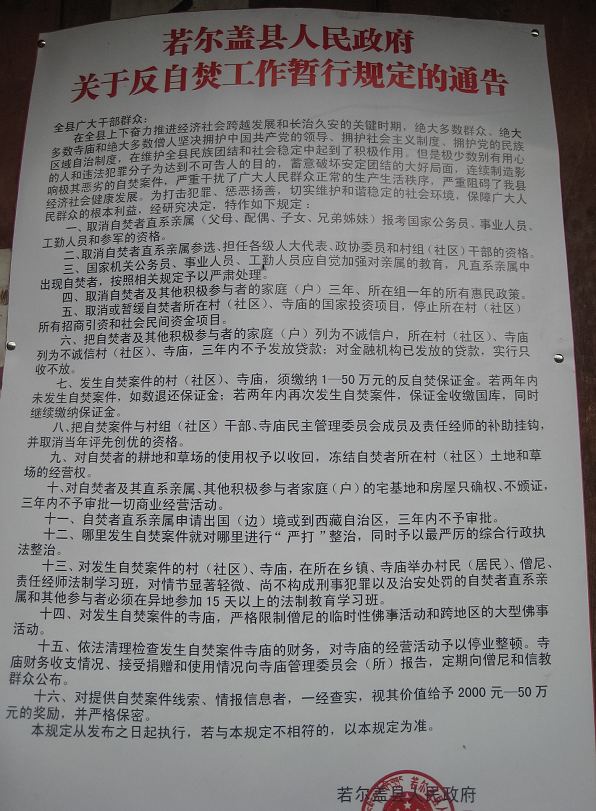
    See also New document sheds light on China’s campaign against self-immolations in Tibet

    Switch to our mobile site