zenpundit.com » scriptures

Archive for the ‘scriptures’ Category

In between Big Bang and Heat Death

Thursday, March 21st, 2013

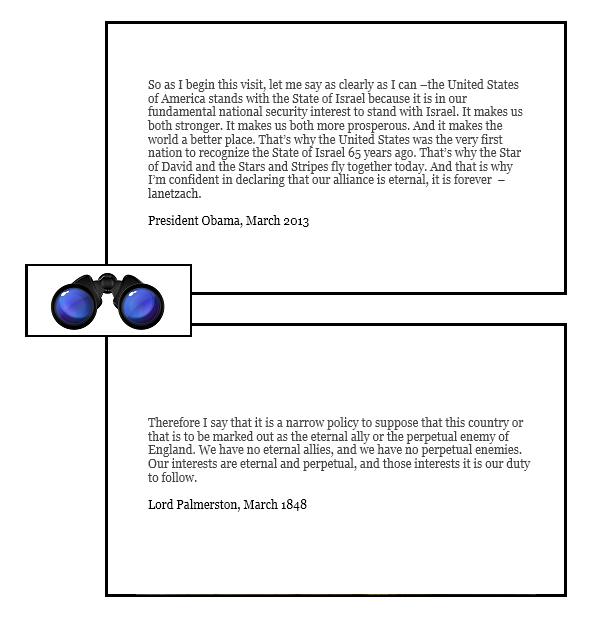
[ by Charles Cameron — a terrific example of the DoubleQuote form, drawing on Obama at Ben Gurion Airport and Palmerston in the House of Commons, and why the form is useful ]
.

Some time in between t-zero and t-aleph-null, some time between the First Day of Creation and Judgment Day, some time in between the Big Bang and the Heat Death of the Universe, there’s a stretch of time known as always.

**

What does juxtaposing the two statements allow us to understand?

  • That times have changed?
  • That what you tell a foreign government is not what you tell your own?
  • That Brits are more understated and Americans more plainspoken?
  • That President Obama is showing specific support for Israel, while Palmerston was expressing the general rule which covers all such utterances?
  • That the word “always” doesn’t necessarily mean “for ever”, “unto the ages of ages” as the Eastern Church has it?
  • Perhaps “for the foreseeable future” would be a better phrase to use, if it didn’t sound so iffy. I’d say it means something closer to “in continuity” than to “in perpetuity”.

    **

    The great thing about DoubleQuotes as a form is that they jump-start you into thinking about samenesses and differences, without demanding which particular implications you will select, thus giving rise to multiple possibilities and enlarging the scope of narrative or discussion.

    And while I’ve sharpened the pairing of quotes — or graphics — into a tool for repeated use, it’s already a habitual form of thinking, as we can see from the fact that these two particular quotes were juxtaposed by Sam Roggeveen in his post, America’s BFF: Obama calls it, in the Lowy Institute’s Interpreter today.

    **

    We naturally pair similars to contrast and compare them: it may be the most basic device that human memory affords us — this reminds me of that.

    Here are a few of my own old favorites…

    **

    You can read Obama’s speech, from which the excerpt above was taken, on this Israel Times page.

    The Hamburg Cell: close reading

    Tuesday, March 5th, 2013

    [ by Charles Cameron — a poorly subtitled movie, the ease of misreading & need for mindfulness in information gathering, a real world problem example, full quotation of one verse from the Qur’an, and changes in teaching the concept of jihad in Saudi ]
    .

    I know, I know: it’s only a movie.

    But it also offers us a glimpse into how easily we humans misread or mishear what’s in front of us. In this case, the film — about the cell in Hamburg that brought us Mohamed Atta, Marwan al-Shehhi, Ramzi bin al-Shibh and Ziad Jarrah — gets the soundtrack right, but is misheard by whoever is doing the subtitles. And so the words “our Prophet, Muhammad Ibn Abdullah” are confused by the subtitle writer with the name of the 9/11 facilitator who is being introduced in white text at that point in the film — giving the seriously mangled transcription “our Prophet, Mohammed bin al-Shibh”…

    Just a minute or two earlier in the film, the Qur’anic verse (9.5, spoken in the Yusuf Ali translation):

    … fight and slay the Pagans wherever ye find them, and seize them, beleaguer them, and lie in wait for them in every stratagem (of war)…

    had been clearly enunciated on the soundtrack, and became:

    Seize them, believe in them, and lie in wait for them, this is strategy in war.

    in the subtitles. Believe in the pagans? Really? In the Qur’an? Or does beleaguer them make just a little more sense?

    **

    I know, I know: it’s only a movie.

    But do you remember the incident I mentioned in January, in a piece on the (needless) bombing of the (historic, not to mention consecrated) Benedictine Abbey of Monte Cassino?

    The bombing appears to have been authorized on the basis of a mistranslation. An intelligence intercept of the question “Ist Abt in Kloster?” — “is the Abbot in the Monastery” — was translated by the US as though Abt was short for Abteil, “Is the HQ in the Abbey?” The recorder answer “Ja” then led to the bombing.

    As it turned out later, “Until the moment of the destruction of the Monte Cassino abbey there was within the area … neither a German soldier, nor any German weapon, nor any German military installation.”

    So here’s my main point:

    It takes extraordinary human diligence to give oneself a decent chance to avoid human error…

    **

    But I’m not done yet.

    For what it is worth, the Qur’anic verse 9.5 cited above begins with a qualification that’s applicable only to the world of the Prophet’s time, in which certain months were considered sacred, and warfare prohibited — not only by the Prophet and his Companions, but by all the surrounding tribes.

    A literal reading of the text, therefore, gives quite a different and more historically focused and geographically circumscribed impression to the one given by the jihadist instructor in the film:

    But when the forbidden months are past, then fight and slay the Pagans wherever ye find them, and seize them, beleaguer them, and lie in wait for them in every stratagem (of war); but if they repent, and establish regular prayers and practise regular charity, then open the way for them: for Allah is Oft-forgiving, Most Merciful.

    **

    It’s worth noting that Saudi Arabia is about to introduce the concept of jihad, properly understood, to younger (“intermediate level”) school children. The article in Arab News today discussing this change is headed:

    Concept of jihad to be made clear to younger students

    and begins:

    In a move likely to be welcomed by parents and educationists, the Ministry of Education has decided to introduce the concept of jihad in Islamic jurisprudence textbooks at the intermediate school level.

    Abdullah Al-Dukhaini, a spokesman for the Education Ministry, told Arab News that the ministry decided to move the teaching of jihad from the high school level to intermediate school because intermediate students are prepared to learn the “correct concept of jihad” before “erroneous concepts” reach them.

    One has to read almost of the bottom of the longish piece, though, to find out what this “correct concept of jihad” might be — here’s their version:

    Al-Dukhaini said the ministry wants to teach students that jihad is only permissible when defending against aggressors, and with the approval of the country’s ruler and parents.

    Textbooks include a warning to pupils that the only one entitled to “raising the banner of Jihad” is the ruler and no one else. No individual Muslim or a Muslim group is permitted to do so.

    Once the appropriate textbooks have been published, it will be interesting to see the various translations offered for the relevant passages and the kinds of interpretation they call forth from different points of the compass…

    **

    h/t for the Saudi education pointer, John Burgess at Crossroads Arabia.
    Of plagues of locusts, then & now?

    Tuesday, February 26th, 2013

    [ by Charles Cameron — the juxtaposition of sacred and secular worldviews, and what happens where they overlap ]
    .

    **

    I’m returning here to an old theme of mine, the juxtaposition of worldviews — in this case, accounting for plagues of locusts in Egypt.

    Such juxtapositions are like Rorschach blots in some ways — they allow each reader to see the items juxtaposed from within their own worldviews, perhaps applauding one and dismissing another, perhaps seeing some virtue in each or none in either — and perhaps arriving at some meta-level understanding which neither one alone would afford.

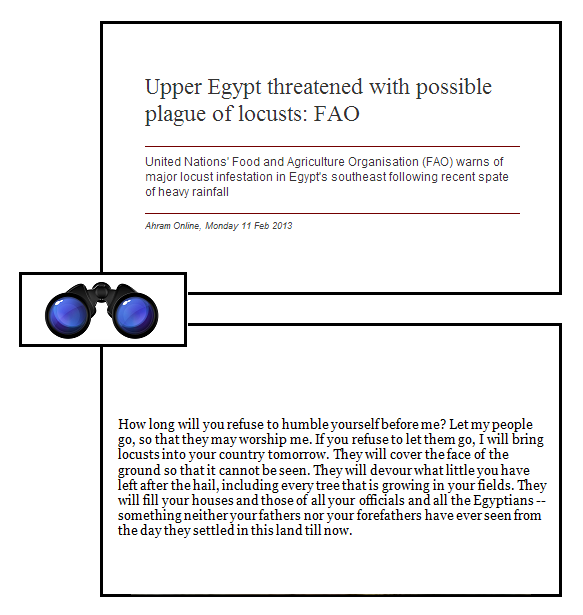
    Is a plague of locusts in Upper Egypt of which the FAO warns in the upper panel above entirely explained in terms of rainfall? Is it pure mental happenstance that Egypt was the site of a Biblical locust plague at the time of the Israelite Exodus [Ex. 10. 3-6]? Is there, perhaps, a message for Egypt vis-a-vis Israel for our own day?

    The answers people give to questions such as these, in which secular and sacred sources address what are putatively similar situations, can influence the way on which they voice themselves and vote — perhaps a good thing, perhaps not.

    **

    For what it’s worth, the plague of locusts is mentioned in the Qur’an in Sura 7.133:

    So We let loose upon them [the Egyptians} the flood and the locusts, the lice and the frogs, the blood, distinct signs; but they waxed proud and were a sinful people.

    **

    In contemplating matters of this sort, it may be valuable to consider the remarks of the Pontifical Biblical Commission in The Interpretation Of The Bible In The Church, 1993/4:

    The basic problem with fundamentalist interpretation of this kind is that, refusing to take into account the historical character of biblical revelation, it makes itself incapable of accepting the full truth of the incarnation itself. As regards relationships with God, fundamentalism seeks to escape any closeness of the divine and the human. It refuses to admit that the inspired word of God has been expressed in human language and that this word has been expressed, under divine inspiration, by human authors possessed of limited capacities and resources. For this reason, it tends to treat the biblical text as if it had been dictated word for word by the Spirit. It fails to recognize that the word of God has been formulated in language and expression conditioned by various periods. It pays no attention to the literary forms and to the human ways of thinking to be found in the biblical texts, many of which are the result of a process extending over long periods of time and bearing the mark of very diverse historical situations.

    Miscik 2004, Gerecht 2013

    Thursday, February 21st, 2013

    [ by Charles Cameron — on the exclusion of worldviews not consonant with grey suits and security clearances ]
    .

    These two persons are likely being polite.

    **

    I’m wondering how any people at State or in the Agency or wherever know what it feels like to be one of the flagellants in Iran during Muharram, in Qom or Masshad perhaps… or at the Jamkaran mosque, and to believe the Mahdi is waiting close by in the wings… or to be in Afghanistan, Sunni, and expecting his army with black banners will sweep down on Jerusalem from Khorasan in accordance with hadith… or in Palestine, reliant on the hadith of the rocks and the trees, certain that Israel will soon fall… in Pakistan, listening to Syed Zaid Zaman Hamid and mentally preparing for the Ghazwa-e-Hind?

    **

    I suppose I’ve been struggling to say this for years:

    The sanction for extremist violence, even to the point of death, is that the cause is just and right. The sanction for messianic violence is that the cause is not only humanly just and right but divinely so — and final, for the entirety of the cosmos, for all Creation.

    **

    Sources:

    Jami Miscik, tesimony, House Intelligence Cttee
    Reuel Marc Gerecht, Spooky Sex

    h/t Nada Bakos

    Further readings on messianisms:

    Mahdi in the wings, Iran
    Khorasan, army with black banners, Afghanistan
    Hadith of the rocks and the trees, Palestine
    Ghazwa-e-Hind, Pakistan

    David Cook, Contemporary Islamic Apocalyptic Literature
    David Cook, Studies in Islamic Apocalyptic
    Timothy Furnish, Holiest Wars
    Gershom Gorenberg, The End of Days
    Anne-Marie Oliver & Paul Steinberg, The Road to Martyr’s Square
    Jean-Pierre Filiu, Apocalypse in Islam
    Syed Saleem Shahzad, Inside al-Qaeda and the Taliban
    Ali Soufan, The Black Banners
    Richard Landes, Heaven on Earth

    Recruitment, poetry and tears

    Thursday, January 31st, 2013

    [ by Charles Cameron — Hegghammer on testing and trusting as precursors to AQ recuitment ]
    .

    I’ve been having trouble finding any of the anasheed Ibn Siqilli was posting on his site, many of which have been taken down — but this one, found in a comment of his on Leah Farrall‘s site, has somehow survived:

    Craftsmanship in search of emotion, in service to the jihad.

    Thomas Hegghammer has a fascinating article out titled The recruiter’s dilemma: Signalling and rebel recruitment tactics from which I’ll only tease you with the bits of special interest to me, viz those that speak to religion (roughly, scripture and ritual), and culture (narrative, music and poetry).

    **

    First, matters clearly involving religious piety and its expressions:

    At the same time, personal piety at the time of recruitment was certainly a necessary condition for joining. Failure to observe any of the basic rituals or engaging in sinful behaviour – by skipping prayers, smoking, or watching Hollywood films – would have constituted a very negative sign. Moreover, even at the far end of the piety spectrum there were small signs that distinguished the extremely pious from the very pious. These signs were not in material objects such as clothes, but rather in body language and habits. QAP martyrdom biographies would highlight the piety of some but not of others, which suggests some variation. Judging from texts and videos, the behaviours that were appreciated included reading the Qur’an at every available spare moment, weeping while reciting the Qur’an, frequent minor pilgrimages (umra) to Mecca, efforts to acquire religious knowledge, etc. However, to observe these signs, recruiters needed to already be in direct contact with the recruit.

    Piety, however, was not enough. Recruiters would also need to see signs of ideological commitment of a more political nature, in particular approval of violent activism.

    Particularly interesting to me here is the sentence, These signs were not in material objects such as clothes, but rather in body language and habits.

    **

    And then, culture…

    To find out whether a person had really been abroad for jihad, recruiters would solicit signs of jihad experience, either by engaging the recruit in conversation, or if in a larger group, steer the conversation toward the topic of foreign jihad fronts. They would presumably look for displays of three types of knowledge, the combination of which would be very hard to acquire for a person who had not been to any of the major battlefronts.

    The first was knowledge of people, places and events specific to the conflict in which the recruit claimed to have taken part. [ more … ]

    The second type of distinctive knowledge was weapons expertise. [ more … ]

    The third type was familiarity with ‘jihad culture’, a set of peculiar practices and artistic expressions that emerged in the Arab Afghan community in the 1980s and developed in subsequent jihad fronts. One important component was anashid, battle hymns sung a capella during training and socializing. A similar component was poetry. Arab fighters in Afghanistan, Bosnia and Chechnya would continuously compose new poems and recite them in the camps. Veterans would be familiar with at least part of this material and would share it during social gatherings in the kingdom. Yet another aspect of jihad culture was the telling of war stories from the time of the Prophet Muhammad and his immediate successors. While some of these stories were part of the basic religious education of most Saudis, it required extra effort to learn many or all of them, and to be able to cite them verbatim, as custom required. In the training camps and the trenches, such stories were told all the time (Nasiri, 2006), so jihad veterans typically knew many more such stories than the average Saudi.

    Of course, non-veterans could acquire some of this knowledge if they wanted to, but to mimic jihad experience, impostors would need to emit large and consistent clusters of correct signs – a considerable challenge.

    I’m reminded of Abdullah Azzam‘s book The signs of Ar-Rahmaan in the Jihad of Afghanistan, which I quoted in an earlier post Of war and miracle: the poetics, spirituality and narratives of jihad.

    **

    Here’s how bad we are at learning the local mores of the various war zones we keep dropping in on, in the words of FPRI’s Adam Garfinkle, in Mali: Understanding the Chessboard, posted recently:

    As the article says, when the Tuareg rebellion in Mali gained steam after the denouement of the Libya caper, greatly stimulated by the return of heavily armed Tuareg brethren from that fight, these three Tuareg commanders defected to the rebels, bringing soldiers, vehicles, ammunition and more to the anti-government side. Anyone who was surprised by this is at the very least a terminal ignoramus. And anyone in the U.S. military who failed to understand the ethnic composition of the country’s politico-military cleavages, such that he let U.S. Special Forces training be lavished on Tuareg commanders, was clearly insufficiently trained to do his job. And believe me, that’s about as nice a way to put that as I can summon.

    How do things like this (still) happen, after what we should have learned from years of dealing with Iraqis and Afghans and others on their home turf? I happen to know someone who teaches in the U.S. military education system, and this person happens to be a field-experienced Harvard Ph.D. in anthropology. This person tries very hard to clear away the thick fog created by the innocent Enlightenment universalism that pervades the American mind—the toxic fog that tries to convince us that all people, everywhere, are basically the same, have the same value hierarchies, the same habits of moral and tactical judgment, and mean the same things by roughly comparable translated words.

    Now imagine how good we’d be at infiltration, getting the anasheed, poetry and stories right…


    Switch to our mobile site