zenpundit.com » Specs

Archive for the ‘Specs’ Category

A triptych for Jane McGonigal

Thursday, October 18th, 2012

[ by Charles Cameron — on play, games, vertigo and koan — technically this is a ludibrium, a jeu, a jest — a dervish whirl for the mind ]
.


.

I’m joining the conversation Jane McGonigal is leading over on Big Questions Online — our topic is How Might Video Games Be Good for Us? — and she came up with a gem of a quote from Huizinga‘s Homo Ludens which pointed me to two other quotes that are part of the collection I keep in mind, one from Wittgenstein, the other from Roger Caillois.

**

I’ve strung them together here because the way the mind hops and skips from one idea to the next in this series enchants me:


.

There’s more to those three quotes taken together, along with the leaps between them, than there is in keeping them apart. They have, what was it Wittgenstein said? — a family resemblance. They belong together. You could start with the third quote, in fact, and then hop to the first and second, and the effect would be much the same, you could make a ring of them.

**

They spiral so closely in on one another, indeed, as to induce ilynx, vertigo. Let’s keep on spinning.

To my mind, the master of vertigo in our times is Jorge Luis Borges, who uses the word “vertiginous” at least four times in his fictions — my favorite arriving in his story The Circular Ruins, where he writes:

He understood that modeling the incoherent and vertiginous matter of which dreams are composed was the most difficult task that a man could undertake, even though he should penetrate all the enigmas of a superior and inferior order; much more difficult than weaving a rope out of sand or coining the faceless wind.

Blam! — is there anything more vertiginous than paradox, enigma, koan, mystery?

**

In perspective, there’s the vanishing point. In service to others, there’s forgetfulness of self.

**

While we’re on the subject of play, I have a confession to make. Several times on this blog and elsewhere, I have cited the art historian Edgar Wind as saying that Ficino’s motto was “studiossime ludere” and that he translated it “play most assiduously” — Marsilio Ficino being the intellectual hub of Renaissance Florence under the Medici. When I was putting together my initial post to Jane McGonigal for her Big Questions discussion, I wanted to use that quote, but couldn’t quite find it in the source I thought it came from. Well, I’ve been doing some checking since then, and Wind does quote something very similar in his Pagan Mysteries in the Renaissance — but the phrase is “studiosissime ludere”, and what he writes is this —

Serio ludere was a Socratic maxim of Cusanus, Ficino, Pico, Calcagnini — not to mention Bocchi, who introduced the very phrase into the title of his Symbolicae quaestiones: ‘quas serio ludebat’.[1]

which he then footnotes thus (translation coming up shortly):

[1.] cf. Ficino, In parmeniden (Prooemium), Opera, p. 1137: ‘Pythagorae, Socratisque et Platonis mos erat, ubique divina mysteria figuris involucrisque obtegere, … iocari serio, et studiosissime ludere.’

Then there’s Ioan Couliano, another great scholar of Renaisssance thought — and a victim of Ceausescu‘s secret police — in Eros and Magic in the Renaissance, translates for us (pp. 37-38):

Pseudo-Egyptian hieroglyphics, emblems and impresae were wonderfully suited to the playful spirit of Florentine Platonism, to the mysterious and “mystifying” quality Ficino believed it had. “Pythagoras, Socrates, and Plato had the habit of hiding all divine mysteries behind the veil of figurative language to protect their wisdom modestly from the Sophist’s boastfulness, of joking seriously and playing assiduously, iocari serio et studiosissime ludere.” [34] That famous turn of phrase of Ficino’s — translation of a remark by Xenophon concerning the Socratic method — depicts, at bottom, the quintessence of every phantasmic process, whether it be Eros, the Art of Memory, magic, or alchemy — the ludus puerorum, preeminently a game for children. What, indeed, are we doing in any of the above if not playing with phantasms, trying to keep up with their game, which the benevolent unconscious sets up for us? Now, it is not easy to play a game whose rules are not known ahead of time. We must apply ourselves seriously, assiduously, to try and understand and learn them so that the disclosures made to us may not remain unanswered by us.

Couliano footnotes the quote thus:

[34.] Proem. in Platonis Parmenidem (Opera, II, p. 1137). This is simply the Latin translation of an expression Xenophon had used to designate the Socratic method (paizein spoude). On the custom of the “serious games” of Ficino and his contemporaries, see Edgar Wind, Pagan Mysteries in the Renaissance 3d ed. (Oxford, 1980), pp. 236-38.

**

Okay, I was trying to check a Latin tag that I’d obviously been quoting from memory, and things just kept on spinning — and weaving — together.

So where are we now? We’re talking of “playing with phantasms, trying to keep up with their game” (Couliano) — and thus back at that Borges quote, too, with its “incoherent and vertiginous matter of which dreams are composed”…

Which is us.

I mean, “We are such stuff as dreams are made on, and our little life is rounded with a sleep.”

**

Okay. Practical matters. To go along with Witty Wittgenstein and the others on my recommended reading list, here’s an image of McGonigal’s dissertation and book:

The dissertation is available here as a .pdf: the book is available here on Amazon.
Apocalypse Revisited, not for the last time

Tuesday, October 9th, 2012

[ by Charles Cameron — Tim Tebow and 666, Charlie Fuqua and stoning disobedient children — addenda to two recent posts ]
.

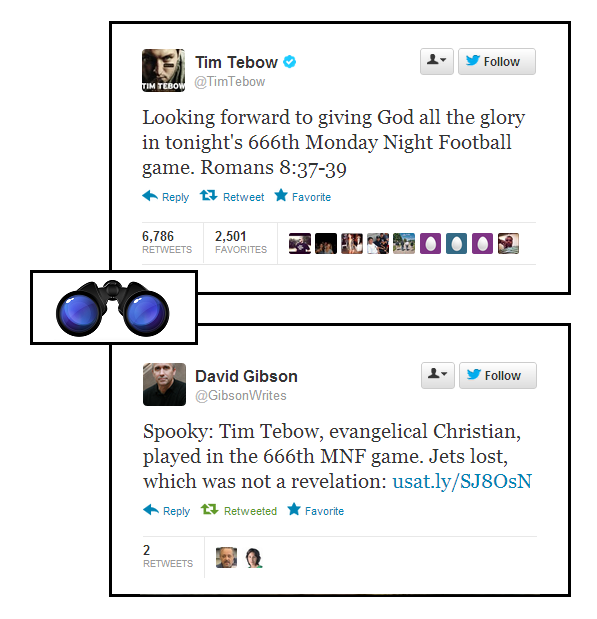
First, the more lighthearted news. Yesterday I featured three footballers prayingTim Tebow was one of them. Today: when prophecy fails on Twitter:

Just look at the retweets for Tebow: his tweet may have been half-tweet, half prediction, half-prayer, all in one forty characters, and his fans were behind it — yet the Jets lost.

At the time of writing, Tebow hasn’t tweeted for 24 hrs.

Permit me an aside, by way of clarification — as someone raised in the UK, I don’t know what “the Jets lost” means, to be honest. My Welsh ex once understood American Football while she was watching a game on hospital TV during a delivery — until the epidural wore off, at which point it went back to being incomprehensible. So that’s as close as I’ve come to understanding it myself — although I played both soccer and rugby in my schooldays.

**

Now onto more serious things. In a comment on another recent post, I mentioned Charlie Fuqua, a Republican candidate for the Arkansas House. I am beginning to think we should have a category to put after the names of such people, as in “candidate Charlie Fuqua (R-Ex)”, to indicate that many on their own team disavow their more extreme pronouncements.

In a post on his Running Chicken blog headed Today in inexplicable religious zealotry, Prof. Ari Kohen quotes the Arkansas Times on Charlie Fuqua, a Republican-side candidate for the Arkansas legislature:

Here’s the key passage from Fuqua’s 2012 book, “God’s Law: The Only Political Solution“:

The maintenance of civil order in society rests on the foundation of family discipline. Therefore, a child who disrespects his parents must be permanently removed from society in a way that gives an example to all other children of the importance of respect for parents. The death penalty for rebellious children is not something to be taken lightly. The guidelines for administering the death penalty to rebellious children are given in Deut 21:18-21:

Deuteronomy 21.18-21 reads:

If a man have a stubborn and rebellious son, which will not obey the voice of his father, or the voice of his mother, and that, when they have chastened him, will not hearken unto them: Then shall his father and his mother lay hold on him, and bring him out unto the elders of his city, and unto the gate of his place; And they shall say unto the elders of his city, This our son is stubborn and rebellious, he will not obey our voice; he is a glutton, and a drunkard. And all the men of his city shall stone him with stones, that he die: so shalt thou put evil away from among you; and all Israel shall hear, and fear.

The Arkansas Times continues:

Fuqua helpfully notes that “This passage does not give parents blanket authority to kill their children.” Rather, parents would have to “follow the proper procedure in order to have the death penalty executed against their children.” Fuqua assures the reader that, in his view, the procedure would “rarely be used.” The threat of death would, however, “be a tremendous incentive for children to give proper respect to their parents.”

**

Here’s where Prof. Kohen, Schlesinger Associate Professor of Political Science and Director of the Forsythe Family Program on Human Rights and Humanitarian Affairs at the University of Nebraska—Lincoln, adds his own informed scholarly input:

The trouble for Fuqua — and anyone else who thinks the Hebrew Bible provides a good template to follow in cases like these — is that he doesn’t actually have any idea what Jewish scholars and religious authorities have been thinking and writing about this particular passage for centuries:

In defining the extent and limitations of the laws of the ben sorer u-moreh, the Talmud (Sanhedrin 71a) states that the child is not considered liable until he has stolen his father’s property in order to acquire a tartimar of meat to eat, and a log of Italian wine to drink. The Halakha places further restrictions upon the ben sorer u-moreh so as to make the application of the law extremely unlikely, if not impossible. The rules only apply with the first three months after the child has reached halakhic manhood; both parents must be living and willing to press charges; neither parent can be deaf, lame, nor missing a limb; they must speak with the same voice and have the same appearance; the boy must steal the meat and wine from his father’s house, yet consume them elsewhere in the company of worthless individuals, in order for him to be convicted. According to the Tosefta Negaim, this law is not in effect in Yerushalayim. (The Meshekh Chokhma suggests that this is due to the continuous eating of so many sacrifices and offerings, as well as ma’aser sheni – the second tithe – within Jerusalem; consumption within the city, since it is performed for mitzva purposes, cannot be considered gluttony.) These are only a few of the numerous restrictions and limitations that apply before a boy can be judged as a ben sorer u-moreh, ensuring that the actual application of the law was extremely rare.

Several Talmudic opinions (Sanhedrin 71), having studied the above limitations, conclude that the case of the ben sorer u-moreh “never occurred and never will occur.” According to them, the sole purpose of having this section in the Torah is to learn the laws and provide a reward for those who do so.

So, in brief, here is my plea to people like Charlie Fuqua:

Stop cherry-picking the Torah to justify all of the terrible things you want people to do to one another; Jews don’t believe that things like this are mandated by the Torah and it’s our book.

**

I very much appreciate Prof. Kohen’s comments, which open a lively window not only on Judaic scripture, interpretation and practice, but also on how scriptures, their literal interpretations by outsiders, and the more skillful and adaptive interpretations of scholars within the traditions can function in the actual shaping of human lives…

When considering the scriptures of any religious tradition, we should bear such examples strongly in mind.

**

Indeed, I have only one qualification to make regarding Prof. Kohen’s post, and offer it as a small gift of thanks.

The one thing I can say that Fuqua is very likely not doing is cherry picking.

It is far more likely that he is a follower of the late RJ Rushdoony, whose massive work The Institutes of Christian Law advocates for the application of what he terms Biblical Law – in its entirety — to American society, and whose Chalcedon Institute published an article in its January 1999 issue on precisely this topic: Rev. William Einwechter‘s Stoning Disobedient Children?:

Deuteronomy 21:18-21 contains what is, perhaps, the most vilified law of the Old Testament. It is widely believed that this law authorizes the stoning of children who disobey their parents. … When this case law, which applies the moral law of the Fifth Commandment to a specific circumstance, is understood it will prove to be “holy, just, and good,” a delight to the heart of God’s true people (Rom. 7:12, 22).

This piece created a bit of a stir, and it was followed shortly thereafter by another Einwechter piece: Stoning Disobedient Children? Revisited.

Both articles seem to have proven unpopular enough that they have been removed from their respective original sites, so I am grateful that the Archive still has them as linked above. I recommend an acquaintance with Rushdoony’s work, and with essays such as these, to anyone interested in the influence of “Biblical Law” on contemporary politics.

**

By way of comparison, the Qur’an, like the Torah, stresses the importance of honoring one’s parents in close conjunction with that of having no god but God. Thus Qur’an 17:23 in the Shakir translation reads:

And your Lord has commanded that you shall not serve (any) but Him, and goodness to your parents. If either or both of them reach old age with you, say not to them (so much as) “Ugh” nor chide them, and speak to them a generous word.

— compare Exodus 20.3-5, 12 — while the hadith reported in Sahih Bukhari, Bk 48, Witness, #822 tells us:

Narrated Abu Bakra:

The Prophet said thrice, “Should I inform you out the greatest of the great sins?” They said, “Yes, O Allah’s Apostle!” He said, “To join others in worship with Allah and to be undutiful to one’s parents.” The Prophet then sat up after he had been reclining (on a pillow) and said, “And I warn you against giving a false witness, and he kept on saying that warning till we thought he would not stop.

To my knowledge, no specific (hudud) punishment for disobedient children is prescribed in the Qur’an.

Of the importance of form in intelligence: I

Wednesday, October 3rd, 2012

[ by Charles Cameron — form as pattern recognition, the form of suicide / martyrdom ops, a format for analysts, first in a series on form in intelligence, and maybe the beginnings of an eccentric thinking manual for analysts ]
.

Bear with me for a paragraph or two, while I try to sort something out.

Form is to content as algebra is to arithmetic: does that work for you? Form is one degree more abstract than content: how about that? I don’t think either of these expressions quite captures what I want to say about form and content, but they may help us think about form. Here’s a form:

It’s pretty clearly a diagram of connections of some sort, but exactly what those connections are is unclear as long as the various boxes in the diagram remain empty.

I could fill it with the names of members of a hippie commune that practiced a flexxible approach to free love over a decade or two, from when the founder bought the farm (in the literal sense of real estate) to the point where the last surviving member bought the farm (metaphorically speaking — the farm in the sky).

Or with the names of elements in the human digestive and energetic system…

I mention the latter, because I came across this particular (empty) diagram on a blog post by a certain Jacques Chester about how people get fat, where it was preceded by the words:

A better diagram for bodyweight control will resemble a great big mess

I won’t tell you where I got the other idea from, if you want to know you’ll just have to fantasize, as I did.

**

At least in this case, form means pattern. The diagram above is a pattern, fill it with appropriate verbal or other content and you’ll give it meaning — which can then be disputed or accepted. But the form, the patterning, is somehow antecedent to any particular content.

Take the last words of each line of Shakespeare‘s Sonnet XCVII and you’ll get:

been, year, seen, everywhere, time, increase, prime, decease, me, fruit, thee, mute, cheer, near.

The rhyme scheme is pretty clear: ABAB CDCD EFEF GG.

That’s a form, and all of Shakespeare’s sonnets follow it. Petrarch‘s sonnets by contrast follow the rhyme scheme ABBA ABBA CDECDE.

**

In my practice of thinking, as a poet and as a practitioner of the open source analysis of scriptural sanctions for religious violence, I find the recognition of forms — pattern recognition — to be my central process.

I think what first really brought this home to me was the similarity of form between two reports of terrorist training activities — each in its own way illustrating the idea that the activity to be performed will begin quite naturally on earth, where training is required, but end quite supernaturally in paradise, where it isn’t:

That one’s pretty obvious, right? I mean, if you’ve seen the first instance you would be pretty likely to remember it if you ran across the second…

And what the form means is pretty clear too — martyrdom ops, suicide ops.

But what if you had a note-pad on your desk — or better, a game format on your computer — that gave you those two boxes, free of specific data, and any time you found a weird or anomalous data-point or image you could scribble it or drag-n-drop it into that form, give it a name for easy retrieval, and keep your eyes peeled for parallels, opposites, similars?

I call that format SPECS, by the way, because it allows you to see two similar ideas stereoscopically, so to speak, and thus gain an extra dimension — neat trick, eh?

What if collecting SPECS was part of your training as an analyst, and you practiced the form a few hundred times and kept 150 mind-blowing examples — as Shakespeare did with his ABAB CDCD EFEF GG sonnets?

**

Why, you’d be training yourself in pattern recognition — formal thinking — horizontal thinking — lateral thinking — analogy — thinking by leaps and bounds.

Inteligence happens in the Intelligence Community, and in the human population as well. I can’t speak to the ways in which animal and plant mimicry, or the artistry of birdsong, correspond to pattern recognition, although that would be a fascinating topic for another post.

What I can say is that analogical, horizontal, cross-disciplinary thinking is in its own away more powerful than logical, rational, vertical, silo-bound thinking.

**

In terms of Intelligence and intelligence, the strategies of linear / vertical thinking are like your fingers: it’s your skill at lateral / horizontal thinking that gives your mind an opposable thumb.

Of miraculous births and abominations

Friday, September 28th, 2012

[ by Charles Cameron — magical religion, the amnesia of the rationalists, a brief mention of poetry and a touch of Tillich ]
.

As you know, I’m interested in the clashing of worldviews. Yesterday, Teju Cole posted a tweet with a quick mention of apocalypse that caught my eye:

There’s a whole lot going on here, and it takes a neat combo of crabwise and linear thinking to get at it all.

But first, a brief and hopefully unnecessary note to our gentle readers:

Take a look at the tweet above, and if you don’t want to peer more deeply into the murky tabloid worlds of strange births, miracles and abominations that it touches on, don’t read the rest. This post may be gross enough in parts, or so absurd-sounding that you want to drop the whole thing and read something else.

As I see it, it’s also interesting and informative — fascinating even — besides being potentially quease-making. But seriously, if you’d rather skip that kind of thing, please don’t leave right away, just go to the very last section and read the two quotes from Paul Tillich. Thanks.

**

Still with me? Good…

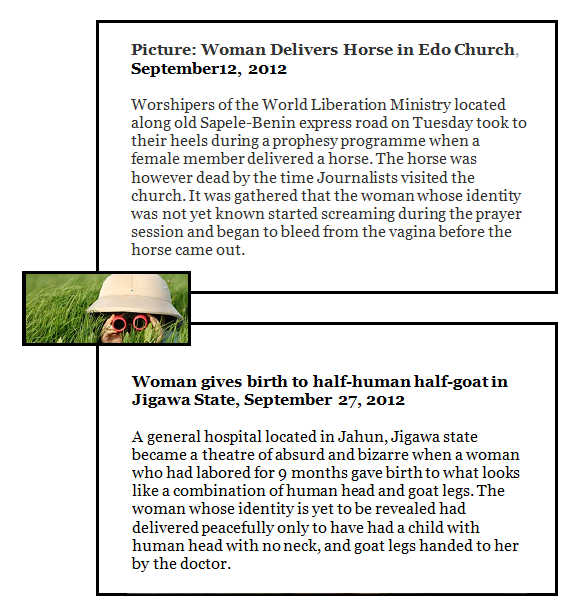
For starters, we can compare these two stories, located about two weeks apart, and described as happening in two Nigerian states: Edo and Jigawa:

It would be easy to dismiss them both as Weekly World News style fabrications, like WWN’s Werewolf Sues Airline Over Flight Delay — but that would miss the point: they’re believed.

**

Restricting ourselves from the moment to half-goat, half-human combos, we can then compare a human birth narrative with a narrative of a goat birth:

The same story? A completely different event? Or human memory, playing its strange tricks?

Note that the two tales are now three years apart, and while one is reportedly from Nigeria, the other is from Zimbabwe.

**

In that last telling, we saw one local explanation for strange — dare I call them paranormal — events of this kind: a curse.

Let’s explore that idea a bit further. The same report quoted above went on to say:

A belief in ghosts is still alive and well in the region and the creature was taken as a sign of evil – perhaps even witchcraft. But local Governor Jason Machaya (56) is sure, that it was a half-man, half-goat hybrid which was the result of bestiality: “A grown man was responsible for this.”

So there’s another possibility. The next paragraph offers yet another:

Doctors, however say that it would be a biological impossibility.

Score one for the scientific worldview.

**

It may be a gossip and conspiracy mag invention, or an old wives’ tale, or the result of a curse, or witchcraft — which could include the local medical tradition — or, as with the horse birth, a miracle — what else?

It could be archetypal…

It could be Pan, the erotic satyr-god of Greek myth and James Stephens‘ delightful tale, The Crock of Gold, or the hideous demon of the occultist Eliphas Levi — the god of the old cult becoming a demon in the new, as they so often do —

— in this case also giving us the portmanteau word pandemonium

**

But there’s one final possibility, and it’s the one that Teju Cole presented us with the first nine of his 140 characters:

end times

I want to give that one time to settle in, because almost all end times predictions involve “signs of the times” that show the world going to hell in a hand-basket, with (eg) family values upended, the sacred profaned, lies usurping truth, and so forth.

I don’t believe this is by any means limited to Islam, but I’ll give an Islamic example as it comes to hand. One of the major signs of the coming of the Qiyama (Last Day, Day of Judgment, Day of Resurrection) is as follows:

After the night of three nights, the following morning the sun will rise in the west. People’s repentance will not be accepted after this incident.

Compare this, from the Christian New Testament, Matthew 24.29:

Immediately after the tribulation of those days shall the sun be darkened, and the moon shall not give her light, and the stars shall fall from heaven, and the powers of the heavens shall be shaken.

**

Women in church giving birth to horses, goats or women giving birth to half-human, half-goats… The story crops up again in Turkey as reported on January 14th, 2010:

A sheep gave birth to a dead lamb with a human-like face. The lamb was born in a village not far from the city of Izmir, Turkey. Erhan Elibol, a vet, performed a caesarean on the animal to take the lamb out, but was horrified to see that the features of the lamb’s snout bore a striking resemblance to a human face. “I’ve seen mutations with cows and sheep before. I’ve seen a one-eyed calf, a two-headed calf, a five-legged calf. But when I saw this youngster I could not believe my eyes. His mother could not deliver him so I had to help the animal,” the 29-year-old veterinary said.

And again with the religious language — the picture accompanying the article carries the caption:

An Abomination of Nature or a Mutation Caused by Blind Industrialization?

Abomination, a word for the utterly unnatural, is another term found in connection with end times thinking. And industrialization? Perhaps that’s one version of the modernist end times…

**

A few things to note here in closing:

Indigenous religious beliefs and practices in many parts of the world include magical aspects that may seem shocking, absurd or distasteful to rational modern western sensibilities. Some of these beliefs and practices are deeply ingrained, and missionary churches have not infrequently carried some of them into their own structures, there being no clear dividing line between “culture” and “religion”. Churches which place an emphasis on miraculous healings as proofs of renewal in the Spirit are particularly prone to this kind of seepage.

The “rational modern western” sensibility I mentioned above, however, is so utterly out of touch with such matters that it treats them as jokes, lampoons them in the tabloids, and otherwise tends to ignore them.

Strongly held beliefs – what I referred to in Waco in Pakistan using Tillich’s term as “ultimate concerns” – are “facts on the ground” that we ignore at our peril.

Poetry — not flabby cherubic verses in greetings cards but the dedicated study of poetic tradition — contains an antidote.

**

Man, like every living being, is concerned about many things, above all about those which condition his very existence, such as food and shelter. But man, in contrast to other living beings, has spiritual concerns – cognitive, aesthetic, social, political. Some of them are urgent, often extremely urgent, and each of them as well as the vital concerns can claim ultimacy for a human life or the life of a group. If it claims ultimacy it demands the total surrender of him who accepts this claim, and it promises total fulfillment even if all other claims have to be subjected to it or rejected in its name.

and again:

It transcends both the drives of the nonrational unconsciousness and the structures of the rational conscious

Both quotes are from chapter 1, What Faith Is, of Paul Tillich‘s Dynamics of Faith.

Of films, riots and hatred II: when islands are the issue

Monday, September 17th, 2012

[ by Charles Cameron — comparative riotology, with sidelong glances at goats and a single mole ]
.


.

It’s not always disrespect for the Prophet that causes people to burn flags and attempt to break into embassies

This week, the disputed sovereignty of some uninhabited islands has done the trick quite nicely in Beijing, where rioters have attempted to breach the Japanese embassy and burned the Japanese flag (upper image, above) in a manner that’s somehow reminiscent of the breaching of the US embassy and corresponding burning of the US flag (lower image) in Cairo .

I imagine that if one was Japanese or Chinese, one might consider the Beijing protests over the ownership of the Senkaku / Diaoyu / Tiaoyutai Islands to be the primary troubling news-story about embassies, rioting and gross breaches of diplomatic protocol this week.

There’s a strange kind of parallax involved here, I think. Or perhaps: what’s in the foreground depends on where you stand.

But that’s not to say there’s an exact equivalence between the situations, just that bearing one in mind may shed some light on the other.

**

I hope to get into the layers and layers of motivation that feed a riot in a subsequent post, but for now I’d just like to point to one similarity between the two situations. In each case, there’s an undertow of strong feeling that surfaces at a certain point — and astonishes us by its force.

In the case of the disputed islands, it may be Chinese feelings about Japanese behavior towards them in World War II that are triggered by Japanese claims on the islands. As China Daily USA says:

Japan has to recognize China’s sovereignty over the Diaoyu Islands and atone for its past aggressions and atrocities, and take measures to punish those Japanese who deny the country’s violent past, in the way that Germany has been doing for decades. Only if Japan does that will China and other Asian countries see it as a normal country. Otherwise, China should prepare for a long-term struggle.

Or as the Israeli Arutz7 puts it:

As

The dispute with Japan is now part of the legacy of World War II and China claims that under the Potsdam Declaration of 1945, Japan was obligated to return all the territories seized illegally.

The above means that the dispute over the islands is now connected to one of the most highly charged issues in Sino-Japanese history, making it a matter of national honor for the Chinese that is not subject to negotiation.

Note here that the question is expressly one of honor.

It is significant, too, that the Chinese can be described as lenient towards their protesters attaching the sovereign embassy of a sovereign nation, just as the Egyptian government has been described as lenient towards their protesters attacking the sovereign embassy of the United States:

In the interim, China has allowed anti-Japanese demonstrators a relative freehand (“Their feelings are perfectly understandable” explained the Chinese Foreign Ministry) and the Japanese Embassy in Beijing has issued warnings to Japanese citizens and businessmen to take precautionary measures.

**

I strongly believe that undertows, as I am calling them here, are among the most important topics for monitoring and analysis — and that the fact that they so often take us by surprtise is a good reason to pay them closer analytic attention.

They surface in dreams, in graffiti, in conspiracy theories, in all the liminal spaces. And they can have game-changing impact: Great Game Changing impact.

That, btw, is why Cass Sunstein‘s paper on conspiracy theories is one we should consider in detail here on ZP one of these days.

**

Of course, as this recent map from the Economist shows

— there are also oil and gas fields nearby.

What drives a crowd to riot and what interests the powers that be may be two very different sides to the same affair.

**

Curious Goat Fact accompaning the above map:

In the 1970s Japanese ultra-rightists took two goats on a 2,000km (1,250-mile) trip southwest from Tokyo to a group of uninhabited rocks near Taiwan called the Senkaku Islands. In the absence of humans willing to live in such a remote outpost, the hardy creatures would be the vanguard of a new push to solidify Japan’s hold over the islets, which are also claimed by China and Taiwan.

Supplementary Mole Fact:

The Senkaku mole is an endangered species.

**

Does comparing Beijing 2012 with Cairo 2012 change the emphasis with which you view recent events in Cairo and elsewhere?

Do you find the analogy between Cairo 2012 (upper panel above) and Tehran 1979 (lower panel) more convincing?

Look, I think the making of analogies is one of the chief ways — if not the chief way — in which we make “instinctive” judgments, which we then back up with appropriately selected data and reasoning. If you like, it’s subject to our own mental version of undertow in terms of what analogies we chose and how strongly we then weigh them — unless we take responsibility for the process, and begin to explore how it actually works in our own minds, and in the public mind…

Analogy is an extremely powerful instrument of thought — and it’s about time we understood it as well as we understand linear logic.


Switch to our mobile site