zenpundit.com » Musings

Archive for the ‘Musings’ Category

Sunday surprise 5: once in a blues moon

Sunday, September 22nd, 2013

[ by Charles Cameron — time for some more surprises, this time in stone and jazz — plus an afterimage of WWI ]
.

First, a master-class in the craft of the blues:

Second, the moon:

And third, because of the violence in Kenya, Pakistan, Syria … get me a globe and I’ll spin it… and because I’ve talked with you before of my friend Heathcote Williams and he mentioned this to his followers today, here are his meditations on World War I, prepared for its centenary next bloody year:

Neither he nor my father ever explained the war to me. It was just something that had happened to them. Something irrational that hung over them. A grisly cloud of spectral blood. A tumor that fogged the psyche. Something in their history that had spoiled both their lives.

And them’s the blues for this week: go well, stay well.

Twitter mixology

Friday, August 23rd, 2013

[ by Charles Cameron — bemused by all you young people ]
.

Kim Kierkegaardashian is exactly the right amount of Kardashian for me to allow into my life. It’s a twitterstream consisting entirely of combination authentic Kardashian soundbites and Kierkegaard quotes, and it’s usually hilarious.

JM Berger‘s tweet, by contrast, sets out one version of an aesthetic principle which seems to underlie much of today’s culture: mixing pop-reference in with serious culture, for serio-popular effect.

Bashar al-Assad‘s supporters do this, aligning their man with Buffy the Vampire Slayer. Salafi jihadists likewise, borrowing footage from the Lord of the Rings. Dan Drezner does it — using zombies to discuss international politics — and wins an Association of American Publishers honorable mention for the 2011 PROSE Award in Government & Politics. Kim Kierkegaardashian does nothing else…

**

Has this sort of hi-lo-brow mixing always happened?

L’homme armé was a French pop song from the 14th or 15th century, its melody used as the basis for Masses by composers from Dufay and Okeghem to Palestrina — and thence to Peter Maxwell Davies in our own times:

The man, the man, the armed man,
The armed man
The armed man should be feared, should be feared.
Everywhere it has been proclaimed
That each man shall arm himself
With a coat of iron mail.

It must be noted that some believe the “armed man” in question is the Archangel Michael. His fight, unlike Kierkegaardashian’s, is neither with God nor man, but directly with the Devil.

**

DoubleQuotes Sources:

  • Kim Kierkegaardashian
  • JM Berger
  • Creativity and Ennui

    Friday, August 16th, 2013

    [Mark Safranski a.k.a. “zen“]

    Creativity is a subject that has  interested me, going back to the days long, long ago when I was an art student. Creativity is only mildly correlated with IQ, but like “intelligence”, the deeper you delve into the study of  creativity and creative thinking the more “creativity” looks like a multifaceted, multidimensional and diverse set of capacities, habits and circumstances than it does a single, universal, characteristic or ability.

    Creativity has been studied from a neuroscientific, psychological, evolutionary,  behavioral, economic and social perspective but what of creativity”s opposite?  What about Ennui?

    From a cognitive perspective, the two may be flip sides of the same coin, note the correlation between highly   creative  people and incidence of depression. It may also be a sign of overuse of certain brain functions, like adrenal exhaustion from an excess of physical and mental stress over a long period of time. Creativity, being in “the flow” is intoxicating but it usually involves peak exertion which accumulates weariness. Exemplary performance in one area can also come at the expense of penalties in another area.

    Or perhaps ennui is the natural, cyclical ebb and flow between generative conceptual fertility and barrenness, the brain preparing itself for the next creative “surge” to come?

    When are you creative and when are you not?

    Of Alice, Angels and Apsaras

    Wednesday, May 15th, 2013

    [ by Charles Cameron — squeezed between the space of astronomers and the paradise of the believers, is there yet room for the dancing play of poetry, music and imagination? ]
    .

    My first question for you today would be — do you believe in Alice?

    And further to that, do you believe in the Red Queen?

    **

    Two things collided to cause me to write this post today. First, Emptywheel opened her blog post on Putin’s outing of an American spy today with a quote from Lewis Carroll:

    ‘I declare it’s marked out just like a large chessboard!’ Alice said at last. ‘There ought to be some men moving about somewhere–and so there are!’ she added in a tone of delight, and her heart began to beat quick with excitement as she went on. ‘It’s a great huge game of chess that’s being played–all over the world -– if this is the world at all, you know. Oh, what fun it is!’

    I can’t really ignore Lewis Carroll when he crops up in my morning feed like that: he’s a Christ Church man and a poet, as I am, and it would be rude of me to ignore him. And besides, what he’s on about here is the world-as-game concept, which is never far from my mind — hence my inclusion of that question about the Red Queen.

    **

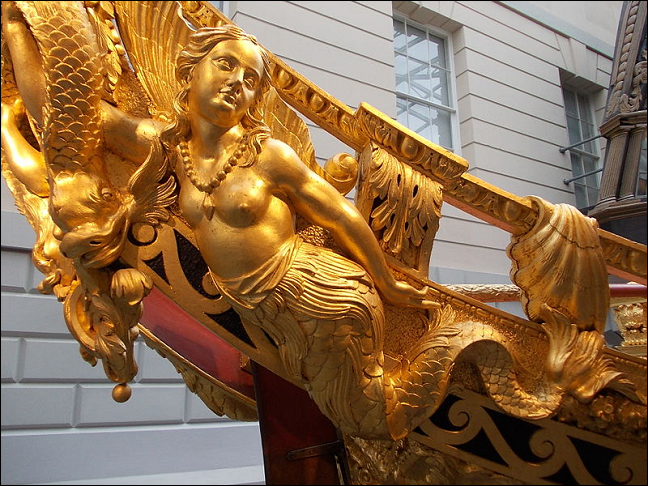
    And second, mermaids.

    .

    It gets more interesting, you see. Because what collided with that first question was a conversation @khanserai aka Humera Khan was having with @mujaahid4life aka Abdallah via Twitter, in which the Harry Potter books were discussed and the topic of unimaginative clerical fatwas on games and works of fiction came up. At which point, Abdallah pointed us all to this now-archived fatwa regarding the permissibility of eating mermaid flesh:

    Ruling on eating mermaids

    A mermaid is a creature that lives in water and looks like a human. As to whether it really exists or it is a mythical being, that is subject to further discussion.

    It says in a footnote in al-Mawsoo’ah al-Fiqhiyyah (5/129): From the modern academic resources that are available to us, it may be understood that the mermaid, which is called Sirène in French, is a mythical creature that is described in fairy tales as having an upper body like a woman and a lower half like a fish.

    See the French Larousse encyclopédique on the word Sirène.

    The encyclopaedia goes on to say: The widespread notion in ancient times was that the wonders and animals of the sea were more and greater than the wonders of dry land, and that there was no kind of animal in the sea that did not have a counterpart on land. This was confirmed by Prof. Muhammad Fareed Wajdi in his encyclopaedia, quoting from modern academic sources. See: Daa’irah Ma’aarif al-Qarn al-‘Ishreen: Bahr – Hayawiyan. End quote.

    Al-Dumayri said in Hayaat al-Haywaan al-Kubra: Mermaid: it resembles a human but it has a tail. Al-Qazweeni said: Someone brought one of them in our time. End quote.

    Many of the fuqaha’ mentioned mermaids and differed on the ruling concerning them. Some of them said that they are permissible (to eat) because of the general meaning of the evidence which says that whatever is in the sea is permissible. This is the view of the Shaafa’is and Hanbalis, and is the view of most of the Maalikis and of Ibn Hazm and others. And some of them regarded it as haraam because it is not a kind of fish. This is the view of the Hanafis and of al-Layth ibn Sa’d.

    Ibn Hazm (may Allaah have mercy on him) said in al-Muhalla (6/50): As for that which lives in the water and cannot live anywhere else, it is all halaal no matter what state it is in, whether it is caught alive and then dies, or it dies in the water and then floats or does not float, whether it was killed by a sea creature or a land animal. It is all halaal to eat, whether it is the pig of the sea (i.e., a dolphin), a mermaid, or a dog of the sea (i.e., shark) and so on. It is halaal to eat, whether it was killed by an idol-worshipper, a Muslim, a kitaabi (Jew or Christian) or it was not killed by anyone.
    What’s outside the box?

    And it goes on… ending, mercifully:

    And Allaah knows best.

    Sometimes I think those might be my favorite words evvah!

    **

    Are mermaids real enough for religious scholarship to address them?

    Is Alice?

    John Daido Loori Roshi, late zen master and abbot of the Mountains and Rivers Order’s Mt Tremper abbey, once gave a teisho using a passage from Alice as his koan:

    Many Zen koans contain references to myths and folktales of ancient India, China, and Japan. Since Westerners generally are not familiar with these stories, koan study without extensive background information is often a frustrating and exasperating process.

    In this dharma discourse, Abbot John Daido Loori fashions a koan, complete with pointer and capping verse, from a classic of children’s literature, Lewis Carroll’s Alice in Wonderland. The koan revolves around Alice’s encounter with a caterpillar who explains the magical properties of a special two-sided mushroom that to Alice’s eyes appears perfectly round. Alice’s struggles with this dilemma make for a stimulating story that mirrors the conflicts and dualities we face in our everyday life.

    You can read it here.

    **

    All of which brings me to the question of the place of deep imagination in a sometimes shallow world.

    Alice, do you believe in her? Mermaids and Macbeth mean something to sailors and theater-folk, respetively. Angels? If angels, then the djinn, too? Christian scripture speaks for the existence of one, the Qur’an of both — is one more probable, more real, perhaps, than the other?
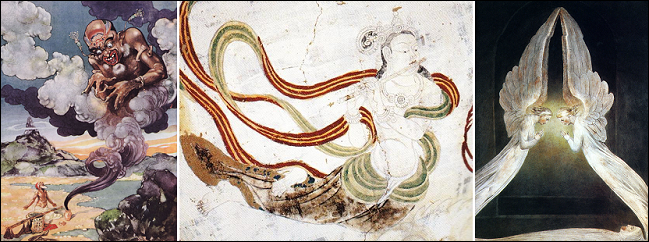
    And what of the gandharvas and apsaras — middle panel — the celestial musicians and airy dancers who move to their music? Is there any poet who can claim never to have sensed them?

    **

    And thus we come to Robert Graves and the muse as he depicts her, in his book The White Goddess, and in many poems such as this:

    In Dedication
    .

    Your broad, high brow is whiter than a leper’s,
    Your eyes are flax-flower blue, blood-red your lips,
    Your hair curls honey-colored to white hips.

    All saints revile you, and all sober men
    Ruled by the God Apollo’s golden mean;
    Yet for me rises even in November
    (Rawest of months) so cruelly new a vision,
    Cerridwen, of your beatific love
    I forget violence and long betrayal,
    Careless of where the next bright bolt might fall.

    **

    But here the waters are getting deeper…

    Hints followed by guesses; and the rest Is prayer, observance, discipline, thought and action

    Monday, May 6th, 2013

    [ by Charles Cameron — you can safely ignore this if you have zero interest in any or all of Bach, Eliot, Christianity and Sufism ]
    .

    It’s Sunday evening here, let’s start with Yehudi Menuhin playing Bach — the great Chaconne:

    **

    This post began to coalesce for me when Dr Alan Godlas, whose web-pages at the University of Georgia offer, among other things, a profound “gateway to Sufism“, gave me his permission to quote a comment he’d made in a private communication:

    Sufis and Muslims need to learn how to recite and listen to the Qur’an (and how to do dhikr and practice Islam and Sufism) at the depth at which Bach wrote this Chaconne and at which it was played by Menuhin.

    **

    That really gets to the heart of the issue of spirituality and beauty — and it brought to mind a comment made by then Cardinal Joseph Ratzinger, now Pope Benedict Emeritus, in his speech at Rimini on The Feeling of Things, the Contemplation of Beauty:

    The encounter with the beautiful can become the wound of the arrow that strikes the heart and in this way opens our eyes, so that later, from this experience, we take the criteria for judgement and can correctly evaluate the arguments. For me an unforgettable experience was the Bach concert that Leonard Bernstein conducted in Munich after the sudden death of Karl Richter. I was sitting next to the Lutheran Bishop Hanselmann. When the last note of one of the great Thomas-Kantor-Cantatas triumphantly faded away, we looked at each other spontaneously and right then we said: “Anyone who has heard this, knows that the faith is true”. The music had such an extraordinary force of reality that we realized, no longer by deduction, but by the impact on our hearts, that it could not have originated from nothingness, but could only have come to be through the power of the Truth that became real in the composer’s inspiration. Isn’t the same thing evident when we allow ourselves to be moved by the icon of the Trinity of Rublëv? In the art of the icons, as in the great Western paintings of the Romanesque and Gothic period, the experience described by Cabasilas, starting with interiority, is visibly portrayed and can be shared.

    **

    John Eliot Gardiner, the great conductor of Bach with whom I apparently spent some of my earlier school-years, offers us an intriguing insight in In Rehearsal with John Eliot Gardiner (Bach Cantata No. 63), immediately after Sara Mingardo‘s deeply devotional rendering of the recitative O selger Tag

    Nota bene: Bei einer andächtigen Musik ist allezeit Gott mit seiner Gnaden Gegenwart. Now I find that very, very significant. That he’s saying wherever there is devotional music, God with his grace is present. Which, from a strict theological point of view is probably heresy, heretical, because it’s saying that music has an equivalent potency to the word of God. And I think that in essence is why Bach is so attractive to us today because he is saying that the very act of music-making and of coming together is, in a sense, an act which invokes the latency, the potency, the potentiality of God’s grace, however you like to define God’s grace; but of a benediction that comes even in a dreadful, overheated studio like Abbey Road where far too many microphones and there’s much too much stuff here in the studio itself, that if one, as a musician, puts oneself in the right frame of mind, then God’s grace can actually come and direct and influence the way we perform his music.

    **

    But I’ve quoted both Benedict and Gardiner on this very topic before, I know, so I’ll move on to the poet TS Eliot, who in Four Quartets tells us:

    For most of us, there is only the unattended
    Moment, the moment in and out of time,
    The distraction fit, lost in a shaft of sunlight,
    The wild thyme unseen, or the winter lightning
    Or the waterfall, or music heard so deeply
    That it is not heard at all, but you are the music
    While the music lasts. These are only hints and guesses,
    Hints followed by guesses; and the rest
    Is prayer, observance, discipline, thought and action.

    **

    I would like to offer three more interpretations of the Bach Chaconne, and one anecdote. The first interpretation is of the entire Solo Violin Partita #2, including the Chaconne, by the young and already great Hilary Hahn. Her rendition of the Chaconne alone is available as a separate YouTube video here:

    There’s also a Busoni piano arrangement, played here by Helene Grimaud — it was, I think, our own J Scott Shipman who introduced me to this stunning performance:

    And even more amazing, perhaps, is the disc called “Morimur” by the Hilliard Ensemble, which you can watch much of on Youtube here, then purchase in full and with a detailed accompanying booklet here

    **

    Finally –since I obviously love the Chaconne — I would like to leave you with the story of a double performance of this same piece by violinist Joshua Bell at L’Enfant Plaza metro in Washington, DC — as told by Washington Post reporter Gene Weingarten — who won a Pulitzer for this article:

    Pearls before Breakfast:

    HE EMERGED FROM THE METRO AT THE L’ENFANT PLAZA STATION AND POSITIONED HIMSELF AGAINST A WALL BESIDE A TRASH BASKET. By most measures, he was nondescript: a youngish white man in jeans, a long-sleeved T-shirt and a Washington Nationals baseball cap. From a small case, he removed a violin. Placing the open case at his feet, he shrewdly threw in a few dollars and pocket change as seed money, swiveled it to face pedestrian traffic, and began to play …

    Go ahead, read it if you haven’t already — it’s quite a story!


    Switch to our mobile site

