zenpundit.com » ideas

Archive for the ‘ideas’ Category

Of Anwar al-Awlaki and Bold Christian Clothing

Monday, January 24th, 2011

[ by Charles Cameron ]

I am, admittedly, very interested in religion, and Christianity has been the mother-lode for me of the imagery, gestures and profound words that can move heart, soul, mind and imagination into a greater depth.

Advertising, on the other hand… well, let’s just say that the best of it plays on imagination, too, but it is generally more of an intrusion upon – via billboards on landscapes, via commercials in movies, or via irritating jingles and catch phrases that subvert my best attempts at quieting the mind – than an experience of the kind of depth that religion at its best can offer.

But if you are interested in religion, and click online in enough of the right places, advertising that has “religious” content will be targeted to you.

*

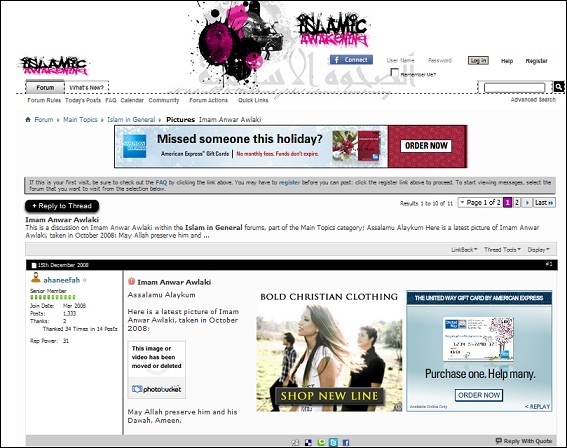
And so it is that I went online this morning to check out something about al-Awlaki on Islamic Awakening, an American jihadist forum, and found myself invited to consider, instead, wearing some “bold Christian clothing”.
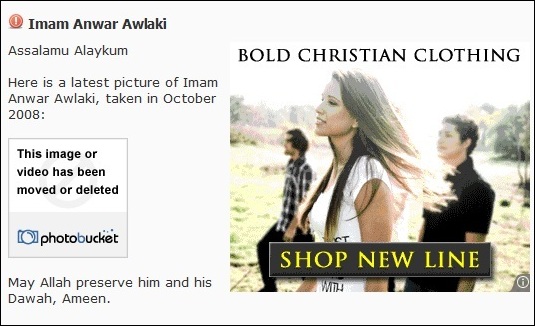
This was while I was researching al-Awlaki, right? the Muslim jihadist preacher?

at:

a site with its own curious graphics…

And looking closer at that logo, isn’t that some sort of triumphalist armored vehicle I see?

*

Well, never averse to a pretty girl, and noticing the one in the Bold Christian ad, I thought I’d taker a look at Bold Christian Clothing to find out what sort of fashion sense was popular among the younger Christian set just now, and found I could obtain t-shirts with such comforting images as these…
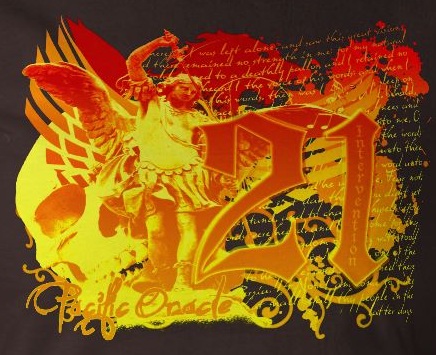
— this one’s symbolic of our relatively new century, I guess…

or this:

which I am praeternaturally fond of since my online moniker is hipbone, with its veiled reference to the Valley of the Dry Bones in that very same chapter 37 of Ezekiel…

and then there’s this masterfully supremacist rendering of a part of the Lord’s Prayer:
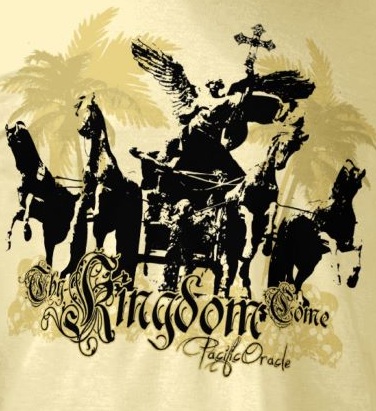
which I must admit isn’t the image of Thy Kingdom Come that springs to mind when I personally hope and pray for heaven on earth.

What exactly is it, you may ask? According to the manufacturer, it’s

The Lord’s Prayer — “Thy Kingdom Come” with an Angel holding the cross, Horses, skulls under the horses, and palm trees (with Shield and Pacific Oracle cross logo added)

It’s also “the softest, smoothest shirt we sell” … “made from combed cotton for your added comfort” and gives “a flattering and stylish fit to virtually any body type”.

I on the other hand think it looks more like a photoshopped variant of the Quadringa statue in London that celebrates Wellington’s victory over Napoleon at Waterloo:

*

In light of all this, I do believe I’ll just wear white – although even that could be misinterpreted, I guess.

Cameron Guest Posts at Jihadology

Monday, January 24th, 2011

Charles Cameron ventures forth to conquer new blogworlds:

GUEST POST: Hitting the Blind-Spot- A Review of Jean-Pierre Filiu’s “Apocalypse in Islam”

Jean-Pierre Filiu’s book, Apocalypse in Islam (University of California Press, 2011) makes a crucially important contribution to our understanding of current events – it illuminates not just one but a cluster of closely-related blind-spots in our current thinking, and it does so with scholarship and verve.

Al-Qaida’s interest in acquiring nuclear weapons – and Iran’s – and the safety of Pakistan’s nuclear materiel – and the situation in Jerusalem – depending how you count ‘em, there are a half dozen or so glaring world problems where one spark in the Mahdist underbrush might transform a critical situation. And yet as Ali Allawi put it in his talk to the Jamestown Foundation on Mahdism in Iraq a few years back, Mahdists ferments still tend to be “below our radar”.

People are always talking about unintended consequences: might I suggest that blind-spots are where unintended consequences come from – and offer some background on apocalyptic, before proceeding to discuss Filiu’s contribution?

We already have a tendency to dismiss religious drivers in considering current events, having concluded in many cases that religion is passé for the serious-minded types who populate diplomatic, military and governmental bureaucracies world-wide – and we are even more reluctant to focus on anyone who talks about the Last Days and Final Judgment, despite the presence of both in the faith statements and scriptures of both Islam and Christianity. We think vaguely of cartoons of bearded and bedraggled men with sandwich boards declaring The End is Nigh, and move along to something more easily understood, something conveniently quantitative like the number of centrifuges unaffected by Stuxnet in Iran, or purely hypothetical, like the association of Taliban and Al Qaida in Afghanistan.

Narcos Over the Border

Friday, January 21st, 2011

Narcos Over the Border: Gangs, Cartels and Mercenaries by Dr. Robert J. Bunker (Ed.)

Just received a review copy courtesy of Dr. Bunker and James Driscoll of Taylor & Francis – could not have arrived at a better time given several research projects in which I am engaged.

The 237 page, heavily footnoted, book is organized into three sections: Organization and Technology Use by the narcos networks, Silver or Lead on their carrot and stick infiltration/intimidation of civil society and the state apparatus, and Response Strategies for the opponents of the cartels. Bunker’s co-authors Matt Begert, Pamela Bunker, Lisa Campbell, Paul Kan, Alberto Melis, Luz Nagle, John Sullivan, Graham Turbiville, Jr., Phil Wiliams and Sarah Womer bring an array of critical perspectives to the table from academia, law enforcement, intelligence, defense and security fields as researchers and practitioners.

Looks good – will get a full review here at a later date, but a work that will definitely of interest to those readers focusing on national security, COIN, 4GW, irregular or Hybrid war, terrorism, transnational organized crime and black globalization.

Quantum COIN

Tuesday, January 18th, 2011


With quantum mechanics being used as a metaphor.

The New Physics: Key to Strengthening COIN by  A. Lawrence Chickering

….At the present time, most of what is being done for COIN is driven by old physics concepts, while many things we ought to be doing are understandable more in terms of the new physics.

One can see the difference between these two concepts in terms of the distinction between helping and empowering.3 The importance of this distinction is implicit in the widely quoted statement that T.E. Lawrence made in 1917 about the importance of empowering people and giving them ownership by letting them do things. -Do not try to do too much with your own hands,? Lawrence wrote.4 -Better the Arabs do it tolerably than that you do it perfectly. . . .?5 Helping is a powerful example of simple, Newtonian causation; it produces -concrete, measurable results,? which are the central concern of most philanthropy and donor programs. Unfortunately, the concrete results it produces are far weaker than the outcomes that result from empowerment and ownership.

Helping? is Newtonian and objective. You build a well, and the -measurable result? is a well. -Empowering? and -ownership? are post-Newtonian and subjective. You cannot -see? empowerment or ownership. These concepts have power when they are felt by people. Following Lawrence‘s statement, empowering and ownership are the key in COIN.

Empowering people, encouraging them to do things for themselves, shows the importance of non-local causation and results based only on probabilities. When a local community becomes empowered, there is no certainty what it will do. They will do things people care about-things they value. If you work in 100 communities, you cannot say what each village will do, but you can predict that some percentage will build wells, and some other percentage will build schools-and so on.

You know that empowering will not produce the -concrete, measurable results? you can get if the -helper? does the work, but when the helper does the work, there will be no community ownership and no sense of responsibility for security or maintenance of the -improvement?. With empowerment and ownership, people will protect a well or school and will maintain it. That explains why the well built by -an Arab? (Lawrence‘s phrase) is worth so much more than one built by -us? (the helpers).

The author has a solid point about top-down, outsider-controlled, hierarchically-organized aid activities cultivating an attitude of dependency, passivity or fatalism in populations that COIN forces are attempting to win over.

If we see symptoms of “welfare dependency” and disengagement from civil society in American neighborhoods with minimal levels of employment, high levels of violent crime and atomized social structures, as partly the product of intervention by social workers, police, state court systems and Federal programs, how much more so is this the case with third-country COIN? With bad people running around with RPG’s and AK-47’s? What would you, the impoverished and unarmed farmer of the village do? Stick out your neck? Or keep your head down?

Announcement: The Ronald Reagan Roundtable at Chicago Boyz

Monday, January 17th, 2011

February 6th 2011 marks the centennial of the birth of America’s 40th president, Ronald Wilson Reagan and it is an appropriate time to reflect on the legacy of a man whose presidency altered the course of his party, his nation and the world. It is no exaggeration to say that events set in motion by the Reagan administration are still unfolding today and the ideas and values championed by Ronald Reagan continue to shape our public policies and frame our political discourse.

Therefore, to commemorate and debate this important legacy, The Ronald Reagan Roundtable, hosted at Chicago Boyz blog will begin February 6th and end on the 16th.

Past Chicago Boyz Roundtables have featured discussions about specific books – On War by Carl von Clausewitz, Science, Strategy and War by Col. Frans Osinga and The Anabasis of Cyrus by Xenophon. They were well-regarded and thought-provoking enterprises. This roundtable will be a little more like the last one on Afghanistan 2050, in that there is no set book to evaluate but a wide-open and free-wheeling discussion of Ronald Reagan, his administration and the historical record.

Contributors will be free to address the topic narrowly or broadly, from Left, Center or Right, in scholarly or polemical tone, with a focus on the present or the past, at whatever length or number of posts they feel is required. Book reviews of the burgeoning number of titles related to Ronald Reagan and his times are also very welcome.

Participants will be encouraged to comment upon one another’s posts and interact with the readers who leave comments but that is not obligatory, contributions can also stand on their own.

Those interested in in joining the Ronald Reagan Roundtable should contact me or Lexington Green and we will make the arrangements with a final “head count” to be announced on or about February 1st

Hope to see you there!

“Do they mean peace, or do they mean we just want to be left in peace? There can be no real peace while one American is dying some place in the world for the rest of us. We’re at war with the most dangerous enemy that has ever faced mankind in his long climb from the swamp to the stars, and it’s been said if we lose that war, and in so doing lose this way of freedom of ours, history will record with the greatest astonishment that those who had the most to lose did the least to prevent its happening. Well I think it’s time we ask ourselves if we still know the freedoms that were intended for us by the Founding Fathers.”
  – Ronald Reagan


Switch to our mobile site