zenpundit.com » foreign policy

Archive for the ‘foreign policy’ Category

COIN may be Dead but 4GW has a New Lease on Life

Monday, December 12th, 2011
As I had predicted, a global recession, budgetary chicken in Congress and national weariness after a decade of war in Afghanistan and Iraq have forced a public rethink of the prominence of counterinsurgency doctrine in America’s military kit.  Colonel Gian Gentile, long the intellectual archenemy of FM 3-24 and the “Surge narrative” has pronounced COIN “dead” and even CNAS, spiritual home of COIN theory inside the Beltway, is now advocating COIN-lite FID (Foreign Internal Defense). As this entire process is being driven by a global economic crisis, there is another aspect to this American inside-baseball policy story.

While COIN as the hyperexpensive, nation-building, FM 3-24 pop-centric version of counterinsurgency is fading away, irregular warfare and terrorism are  here to stay as long as there is human conflict. Moreover, as economic systems are to nation-states as vascular systems are to living beings, we can expect an acceleration of state failure as weak but functional states are forced by decreased revenues to reduce services and diminish their ability to provide security or enforce their laws. The global “habitat” for non-state, transanational and corporate actors is going to grow larger and the zones of civilized order will shrink and come under internal stress in the medium term even in the region that Thomas P.M. Barnett defined as the “Core” of globalization.

The theory of Fourth Generation Warfare is helpful here. Many people in the defense community object to 4GW thinking, arguing that it is a poor historical model because it is overly simplified, the strategic ideas typified by each generation are cherrypicked and are usually present in many historical eras (albeit with much different technology). For example, eminent Clausewitzian strategist Colin Gray writes of 4GW in Another Bloody Century:

….The theory of Fourth Generation Warfare or 4GW merits extended critical attention here for several reasons. It appears to be a very big idea indeed. It’s author [ William S. Lind] and his followers profess to be able to explain how and why warfare has evolved over the past 350 years and onto the future….

….Talented and intellectually brave strategic theorists are in such short supply that I hesitate before drawing a bead on Lind and his grand narrative of succeeding generations of warfare. Nonetheless, there is no avoiding the judgment that 4GW is the rediscovery of the obvious and the familiar. 

4GW theory is not something that can be defended as having sound historical methodology. However, it works well enough as a strategic taxonomy of mindsets and political environments in which war is waged; particularly with the inclusion of the van Creveldian assumptions of state decline, it is a useful tool for looking at warfare in regions of weak, failing and failed states. The same global region Dr. Barnett has termed “the Gap” in his first book, The Pentagon’s New Map.

Tom predicated his geostrategy on the power of globalization being harnessed with judicious use of Core military power to “shrink the Gap” and provide connectivity as an extremely powerful lever to raise up billions of the world’s poor into a more stable, freer and middle-class existence. While that still holds, the flipside is that times of  sharp economic contraction limit the ability of the Core, led by the United States, to intervene robustly, permitting the “bad guys” to make use of connectivity and black globalization for their own purposes. Where the great powers are disunited, disinterested or increasingly in the case of European power projection, disarmed, the Gap could potentially grow.

A new Iraq or Afghanistan sized campaign is not in the American defense budget for at least a decade. Or NATO’s. Hence the newfound interest in cheaper alternatives to massive intervention on the ground, for which the Libyan campaign might charitably be classed as an “experiment” ( where it was not simply bad strategy and negotiated operations) or as a multilateral reprise of Rumsfeldian ideas of transformative, light and fast military force mashed up with Reagan Doctrine proxy warfare, justified under a new ideological theory of R2P.

These are rational policy responses to conditions of parsimony, but it also indicates a coming era of strategic triage rather than grand crusades in using military force to stabilize parts of the global system.  The US and other great power  are going to be more likely to follow Teddy Roosevelt’s advice to “Do what you can, where you are, with what you have” than they are to heed JFK’s call “to pay any price, bear any burden”. The politics of hard times means that we will be minimizing our burdens by replacing, where we can, boots with bots, bullets with bytes and Marines with mercs. Not everywhere, but certainly on the margins of American interests.

Beyond those margins? We will aid and trade with whatever clients can maintain a vestige of civilized order without too much regard to the niceties of  formal state legitimacy. Too many states will be ceding autonomy to subnational and transnational entities on their territory in the next few decades and we will have to abide by that reality if regions of the world become Somalia writ large. What to do? A number of recommendations come to mind:

  • Get our own economic house in order with greater degrees of transparency and adherence to rule of law in our financial sector. Legitimacy and stability, like charity, begins at home.
  • Adopt policies that strengthen the principle of national sovereignty and enhance legitimacy rather than weaken or erode it. This does not mean respecting hollow shells of fake states that are centers of disorder, but respecting legitimate ones that effectively govern their territory
  • Foreign policies that reject oligarchical economic arrangements in favor of encouraging liberalization of authoritarian-autarkic state economies prior to enacting political reforms ( democracy works better the first time on a full stomach).
  • Create a grand strategy board to advise senior policy makers and improve the currently abysmal level of strategic calculation and assessment prior to the US assuming open-ended commitments to intervention
  • Accept that the Laws of War require a realistic updating to deal with the international equivalent of outlaws, an updating that contradicts and rejects the 1970’s era diplomatic effort to privilege irregular combatants over conventional forces.
  • Fighting foreign insurgencies is something best done by primarily by locals, if willing, with our aid and advice. If those with the most to lose are not willing to stand, fight and die then they deserve to lose and the US should either eschew getting involved at all or resolve to secure whatever vital interest that exists there by brute force and make certain that reality is clearly communicated to the world (i.e. Carter Doctrine).  Truly vital interests are rare.
Striking Iran: Two Games and a World – Pt 2

Tuesday, November 15th, 2011

[ by Charles Cameron board game and board-room simulation of an Israeli strike on Iran ]

.

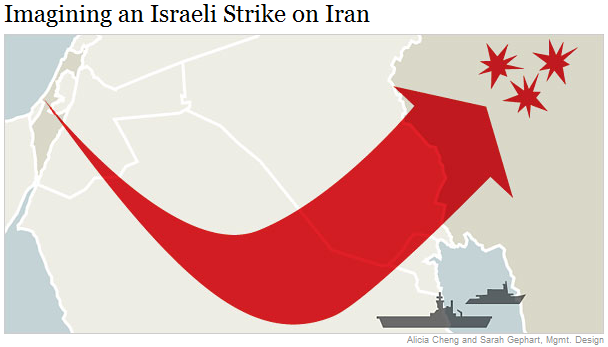
nyt-osiraq.png

[graphic & headline from the New York Times]

[continuing from part I]

5.

Osiraq Redux

Karim Sadjadpour described a very different style of game in Foreign Policy just one day after Michael Peck’s description of Persian Incursion. It was conducted by the Brookings Saban Center, and also written up by Kenneth Pollack in the Center’s Middle East Memo of February 2010, and by David Sanger at the New York Times.

Here is Pollack’s description of the structure of the Brookings game:

The simulation was conducted as a three-move game with three separate country teams. One team represented a hypothetical American National Security Council, a second team represented a hypothetical Israeli cabinet, and a third team represented a hypothetical Iranian Supreme National Security Council.

As a scholar of religion, I would be tempted to add, after the manner of the Athanasian Creed, “Yet there are not three hypotheticals but one hypothetical.”

More:

The U.S. team consisted of approximately ten members, all of whom had served in senior positions in the U.S. government and U.S. military. The Israel team consisted of a half dozen American experts on Israel with close ties to Israeli decision-makers, and who, in some cases, had spent considerable time in Israel. Some members of the Israel team had also served in the U.S. government. The Iran team consisted of a half-dozen American experts on Iran, some of whom had lived and/or traveled extensively in Iran, are of Iranian extraction, and/or had served in the U.S. government with responsibility for Iran.

This game begins with an Israeli strike – that is to say, the strike itself is not what is gamed here: the game is designed to be “a day-long simulation of the diplomatic and military fallout that could result from an Israeli military strike against the Iranian nuclear program.” Again, I will not rehearse nor comment in much detail on what has been reported of play, both in Pollack’s official Brookings report on the game and in Sadjadpour’s account, noting only that the Brookings game features a response from Hizbollah which (as Michael Peck noted) was lacking in the board game.

6.

Differences of style

What interests me is the difference in style between the two games, the two approaches:

  • The emphasis on the initial strike in Persian Incursion focuses that game more tightly on questions of materiel and logistics, while the Brookings game naturally puts greater emphasis on the responses of individuals and groups. And I’d suggest that the structures of the two games in some sense parallels that distinction:
  • The board game is played by two players, typically experienced grognards, wargame hobbyists or designers, often with military backgrounds. Their skill is in decision-making in the context of such games, and Larry Bond has provided them with an exhaustively-researched briefing on the issues he considered salient.
  • The board-room sim is played by a couple of dozen players, each of them already possessing their own highly detailed “takes” on the specific aspects of the game their voices will “represent”.

One might say that Persian Incursion is an entertainment and the Brookings game a high-level albeit informal strategic deliberation — but that comparison fails to account for the detailed research that has gone into PI — and the Harpoon gaming system which underlies it. Both games are serious attempts, at the limit of human imagination, to figure out — to “game” — one specific, now perhaps looming, future.

Taking both games with equal seriousness, then, we can say that both players of PI have Larry Bond and his two associates (in the form of those booklets, maps, target specs and so forth) as their intel resources, whereas the Brookings game features the combined (cooperating and competing) intelligences of the two dozen or so participants.  That’s not quite crowdsourcing, as is the Naval Postgraduate School‘s ongoing MMOWGLI anti-piracy game, but it is polyphonicit allows and attends to a variety of voices…

Of course, if those various voices are selected in such a way that they form too much of a “choir” or “chorus” this advantage is diminished: there’s no great benefit to hearing a dozen or two versions of group-think. And while the individual voices in a group may in fact propose usefully distinct ideas, there’s always the possibility that some key factor or factors will be overlooked, because a single world-view is operating where a true polyphony would require a deeper and richer diversity.

Is Persian Incursion more practical, having a greater emphasis on actual force projection? Is Osiraq Redux more realistic, having a wider set of expertises to draw on?

7.

Omnium gatherum

For the sake of completeness, I should mention that a game not unlike the Brookings game of 2009 was played by a similarly qualified group at the behest of the Atlantic magazine in 2004, as reported by James Fallows. I was particularly intrigued by this piece because Mike Mazaar, with whom I once collaborated briefly, was playing SecDef.

What I’d hope for from ZP’s readers would be some discussion of these two different approaches to gaming, and of gaming itself– along with scenario planning — as a means of exploring possible futures where the impact downstream may be considerable.

The piece of the puzzle that I fear may be missing from both games, as those who know me will have guessed, is the potential influence of messianism — from the Israeli / Judaic, the U.S. / Christian Zionist, and the Iranian / Mahdist sides. But then I generally expect the seriousness of millennial aspirations to be discounted, and try to keep track of those things accordingly myself.

Three puzzle pieces that I would find relevant would be:

(i) the Ayatollah Khamenei‘s fatwa “that the production, stockpiling and use of nuclear weapons are forbidden under Islam and that the Islamic Republic of Iran shall never acquire these weapons”;

(ii) Timothy Furnish‘s observation:

The Leader of the Islamic Republic of Iran, Ayatollah Ali Khamenei has issued the Fatwa My own study of both geopolitics and of Shi`i traditions on the 12th Imam leads me to conclude that the clerical regime does NOT believe in nuking Israel (or anyone else), because while the Mahdi will return at a time of great violence and upheaval, there is no Shi`i teaching that creating such bloodshed would induce Allah to send him. Also, I think the ayatollahs are crazy like foxes, not literally crazy-and they know full-well what would be the Israeli (and perhaps American ) response to any use of nuclear weapons against Israel. The Mahdi would not be happy to return and rule over a radioactive wasteland..

For more detail, see also Furnish’s A Western View on Iran’s WMD Goal: Nuclearizing the Eschaton, or Pre-Stocking the Mahdi’s Arsenal?

and (iii) Benjamin Netanyahu‘s statement in opening the Knesset:

Our policy is guided by two main principles: the first is “if someone comes to kill you, rise up and kill him first,” and the second is “if anyone harms us, his blood is on his own hands.”

The first is “im ba l’hargekha, hashkem l’hargo” — a well-worn phrase that can be found in the Talmud and derives from Exodus; I’m unsure whether the second — “If anyone harms us, his blood is on his own hands” — comes from a Talmudic source, or whether it is an abbreviated restatement of Ezekiel 33 1-9.

8.

Some trivia for good measure…

As Michael Peck points out, the game’s graphic designers write Persian Incursion using a faux-Devanagari script more properly associated with Sanskrit and Hindu sources than Iranian Shi’ism…a minor pity, that.

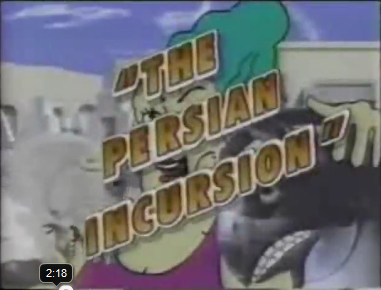
And ha! — I’m left wondering whether the title, Persian Incursion, came to Larry Bond or his crew out of the ethers — or whether someone had been watching…

persian-incursion-carmen-sandiego.png

Where in the World is Carmen Sandiego, Season 5, Episode 39?

GMTA?

Striking Iran: Two Games and a World – Pt 1

Tuesday, November 15th, 2011

[ by Charles Cameron — board game and board-room simulation of an Israeli strike on Iran ]

.

persian-incursion.png

1.

We suppose we can game the world.

It may in fact be the best thing we can do, or the only thing: we guess, guesstimate, estimate the possible outcomes of an act or series of acts — and somehow in there, we hope to match the major trends in the complexity we seek to understand with selected complexities of our own that we build into our games.

And yet as Richard Danzig noted in the opening paragraph of his Driving in the Dark: Ten Propositions About Prediction and National Security which I quoted here yesterday, “whereas routine, short-term predictions are generally right, strategic judgments about future environments are often, one might say predictably, wrong.”

So we have knee-jerk responses, which can suitably be expressed in barks or sound-bites, and we have deliberative inquiry, which requires suitably nuanced exegesis. And our games and simulations are attempts at the deliberative approach.

2.

The chess board:

So the question of an attack on Iranian nuclear facilities is once again in the air, and we would like to be able to peer as far down the chess-board as a Kasparov, computing the counter-move an adversary would make against a friend’s counter-move to the adversaries response to an initial move. Sadly, though, we all too often find ourselves in the bind that a senior US official in Iraq described to Anthony Cordesman a while back, where our best efforts at gaming the situation are “like playing three dimensional chess in the dark while someone is shooting at you.”

Except that my own version of the board may be more accurate:

it’s more like an n-dimensional spider’s web, with multiple gravities, tugs, and tensions – and some of those tensions are in the category of known unknowns that one of your predecessors talked about, some of them unknown unknowns, and some of them literally unknowable – hidden in the hearts of more devious men than you, and known only to God.

3.

So, anyway, we game things out as best we can.

And since the idea of bombing Iran’s nuclear facilities has been in the news of late, so have two attempts to “game” that particular possibility and its sequelae.

What interests me here is not the outcomes envisioned – but the inherent differences between the two games. Let’s take a look.

4.

Persian Incursion.

As Michael Peck — he splashed Persian Incursion into our consciousness with one post on Foreign Policy and another on Danger Room last week, not to mention an interview on NPR – puts it:

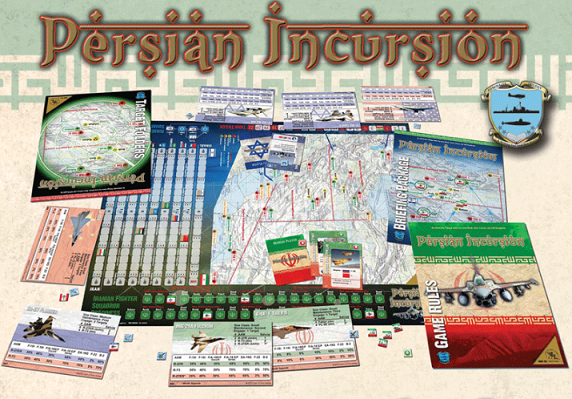
Persian Incursion is basically two games in one. There is a highly detailed military game of a seven-day Israeli air offensive in which Israel plans and executes its strikes while the Iranian air defenses try to stop them. But there is also a political game that unlocks the military aspect. Persian Incursion assumes that an Israeli attack is only possible if one of Iran’s neighbors — Saudi Arabia, Turkey, or a U.S.-influenced Iraq — either publicly or tacitly allows Israeli entry into its airspace for the strike on Iran. (The rules state that though Israel could chance an initial airstrike without an agreement, it would need permission for follow-up attacks.) With that in mind, the game comes with various starting scenarios, such as a super-radical Iran that scares its neighbors into allowing Israeli access, or Turkish support for an Israeli strike (note that the game came out in 2010, before the current Israeli-Turkish spat).

Here’s how Clash of Arms, the publisher, describes the game packet:

Persian Incursion provides comprehensive and detailed information on:

• Orders of battle for the Israeli and Iranian Air Forces and the Iranian Air Defense Force
• Analysis of the Iranian nuclear and oil infrastructure
• Iranian ballistic missiles and Israeli ballistic missile defenses
• Target folders for Iranian nuclear facilities, oil terminals and refineries, and airfields
• Variable starting conditions

Components:

• Rulebook; Briefing Package and Target folders;
• 17 x 22″ Full color map;
• Short Deck of “Super Cards” (4.25 x 6″);
• 2 Full decks of playing cards (110 cards);
• Cardboard counters;
• Box and dice.

Now I am absolutely not the guy you want to ask about the game-play, or about the game’s possible implications for policy analysis. Michael Peck may well be that guy, but even he doesn’t leave the game with a clear sense of how things might play out in real time:

The real question of this exercise, however, is whether an Israeli strike on Iran is a good or bad idea. Persian Incursion’s answer is an unqualified “maybe.” Israel can’t stop Iran from retaliating with missile attacks and terrorism. But it also can’t guarantee complete destruction of Iran’s nuclear program. Perhaps most importantly, the key to victory is winning the public-opinion, political war.

And when you get granular, “public opinion” turns out to mean the interwoven opinions of many, many and diverse people — some influential, some easily influenced, some whose world-view features a rigorous scientism, some a potentially wrathful deity – all of whom are themselves beset by a myriad of doubts, certainties, hopes, fears, bouts of toothache and who knows what else…

Modeling even one of those minds (and associated hearts) would be quite a trick…

So. That’s the “reference library” approach, to use Peck’s term:

Persian Incursion isn’t a novel — it’s a reference library inside a game. The background information included is staggering. Besides the rules book, there is a target folder and a briefing booklet listing the precise dimensions of Iranian nuclear facilities down to the meter…

The gamer has what we’ll assume is a highly accurate representation of the materiel side of things. Morale, at the granular level of a Netanyahu or a Khamenei?

Who can game the workings of a single human mind (and heart)?

[continued in Pt 2]

K2: Kissinger on Kennan

Monday, November 14th, 2011


George F. Kennan: An American Life by John Lewis Gaddis

Former SECSTATE and grand old man of the American foreign policy establishment, Dr. Henry Kissinger, had an outstanding NYT review of the new biography of George Kennan, the father of Containment, by eminent diplomatic historian John Lewis Gaddis:

The Age of Kennan

….George Kennan’s thought suffused American foreign policy on both sides of the intellectual and ideological dividing lines for nearly half a century. Yet the highest position he ever held was ambassador to Moscow for five months in 1952 and to Yugoslavia for two years in the early 1960s. In Washington, he never rose above director of policy planning at the State Department, a position he occupied from 1947 to 1950. Yet his precepts helped shape both the foreign policy of the cold war as well as the arguments of its opponents after he renounced – early on – the application of his maxims.

A brilliant analyst of long-term trends and a singularly gifted prose stylist, Kennan, as a relatively junior Foreign Service officer, served in the entourages of Secretaries of State George C. Marshall and Dean Acheson. His fluency in German and Russian, as well as his knowledge of those countries’ histories and literary traditions, combined with a commanding, if contradictory, personality. Kennan was austere yet could also be convivial, playing his guitar at embassy events; pious but given to love affairs (in the management of which he later instructed his son in writing); endlessly introspective and ultimately remote. He was, a critic once charged, “an impressionist, a poet, not an earthling.”

For all these qualities – and perhaps because of them – Kennan was never vouchsafed the opportunity actually to execute his sensitive and farsighted visions at the highest levels of government. And he blighted his career in government by a tendency to recoil from the implications of his own views. The debate in America between idealism and realism, which continues to this day, played itself out inside Kennan’s soul. Though he often expressed doubt about the ability of his fellow Americans to grasp the complexity of his perceptions, he also reflected in his own person a very American ambivalence about the nature and purpose of foreign policy.

John Lewis Gaddis was George Kennan’s official biographer, a relationship that can contradict and complicate the task of a historian to tell us “like it really was” by growing too close and protective of the subject. On the other hand, Kennan’s unusual longevity and undimmed intellectual brilliance into his tenth decade permitted Gaddis a kind of extensive engagement with Kennan that was exceedingly rare among biographers.

I will be reading this book. Incidentally, Kennan’s own writings, notably his memoirs and his analysis of a totalitarian Soviet regime, Russia and the West under Lenin and Stalin are classics in the field of modern American diplomatic history, alongside books like Dean Acheson’s Present at the Creation. They are still very much worth the time to read.

The Gaddis biography will stir renewed interest and wistful nostalgia for Kennan at a time when the American elite’s capacity to construct or articulate persuasive grand strategies have become deeply suspect. Kennan himself would have shared the popular pessimism, having nursed it himself long before such a mood became fashionable.

ADDENDUM:

Cheryl Rofer weighs in on Kennan at Nuclear Diner

….Although the telegram and article did not deal explicitly with nuclear weapons, they were the basis for the strategy of containing, rather than rolling back, the Soviet Union and thus the arguments in the 1950s against attempting to eliminate the Soviet nuclear capability and in the 1960s against the same sort of move against China. Similar arguments continue today with regard to Iran.  

 Kissinger writes a sketch of Kennan himself and adds some of his own thoughts on diplomacy. The historical context of Kennan’s insights that he presents is worth contemplating in relation to today’s situation. How much of Cold War thinking can be carried into today’s thinking on international affairs, and how should it be slowly abandoned for ideas that fit this newer world better?

Addendum II.

Some fisking of Henry the K. by our friends the Meatballs:

Kissinger refers to Dean Acheson as “the greatest secretary of state of the postwar period.”  False modesty or a ghostwriter?  Gotta be one or the other, but we are leaning towards the former because no Kissinger Associates staffer would risk the repercussions from making a call like that.

Kissinger – the great Balance of Power practitioner – admired that Kennan (at least at times) shared his Metternich-influenced approach:

Stable orders require elements of both power and morality. In a world without equilibrium, the stronger will encounter no restraint, and the weak will find no means of vindication.

(…)

It requires constant recalibration; it is as much an artistic and philosophical as a political enterprise. It implies a willingness to manage nuance and to live with ambiguity. The practitioners of the art must learn to put the attainable in the service of the ultimate and accept the element of compromise inherent in the endeavor. Bismarck defined statesmanship as the art of the possible. Kennan, as a public servant, was exalted above most others for a penetrating analysis that treated each element of international order separately, yet his career was stymied by his periodic rebellion against the need for a reconciliation that could incorporate each element only imperfectly

Jihad for all Seasons: Review of Storming the World Stage (in PRAGATI)

Thursday, November 10th, 2011

Storming the World Stage: The Story of Lashkar-e-Taiba by Stephen Tankel

PRAGATI, India’s National Interest Review magazine has published my review of Dr. Stephen Tankel’s book on Lashkar-e-Taiba, titled Storming the World Stage. The article is not yet online (I will add the link when it is released) but the issue digest PDF version is below:

pragati-issue56-nov2011-communityed.pdf

“Jihad for all seasons”

….Carnegie and RAND scholar Stephen Tankel has endeavored to demystify and deconstruct LeT in his meticulously researched book, Storming The World Stage: The Story of Lashkar-e-Taiba and bring into the light the complex relationships that entwine LeT with the Pakistani state and the subterranean universe of radical jihadi politics.  Conducting extensive interviews with Islamist militants, Western and Indian intelligence officials, Pakistani politicians and ISI officers and buttressing his narrative with sixty-three pages of end-notes, Tankel has produced a portrait of Lashkar-e-Taiba that is accessible to the layman while remaining a methodical work of scholarship.

…. An organisation that, like Hezbollah, is state-sponsored but not controlled, Lashkar-e-Taiba is suited for waging what military analyst Frank Hoffman terms “Hybrid War”, but how LeT would play that role in an Indo-Pakistani War is left to the reader’s inference. LeT also demonstrated in Mumbai a fluid tactical excellence in its use of off-the-shelf technology, small arms and mobility to reap an enormous return-on-investment by attacking soft targets, much along the asymmetric lines advocated by warfare theorist John Robb. Tactics that are a critical threat to any open society by forcing it to take preventive measures which are ruinously expensive and contraindicated to keeping society free and democratic….

Will update post as matters develop.


Switch to our mobile site