zenpundit.com » 2011 » May

Archive for May, 2011

Rapturous times, neh?

Saturday, May 21st, 2011

[ By Charles Cameron — apocalyptic movements, best readings, budget shortfalls, lack of support for scholarship in crucial natsec areas — and with a h/t to Dan from Madison at ChicagoBoyz for the video that triggered this post ]
.
.
What with rapture parties breaking out all over, billboards in Dubai proclaiming The End and thousands of Hmong tribespeople in Vietnam among the believers, this whole sorry business of Harold Camping‘s latest end times prediction is catching plenty of attention. I thought it might be helpful to recommend some of the more interesting and knowledgeable commentary on Camping’s failed prophecy.

*

First, three friends and colleagues of mine from the Center for Millennial Studies at Boston University, about which I will have a further paragraph later:

Richard Landes of BU has a text interview here, and a TV interview here. His forthcoming book, Heaven on Earth, is a monumental [554 pp.] treatment of millenarian movements ranging “from ancient Egypt to modern-day UFO cults and global Jihad” with a focus on “ten widely different case studies, none of which come from Judaism or Christianity” — and “shows that many events typically regarded as secular–including the French Revolution, Marxism, Bolshevism, Nazism-not only contain key millennialist elements, but follow the apocalyptic curve of enthusiastic launch, disappointment and (often catastrophic) re-entry into ‘normal time'”.

Stephen O’Leary of USC wrote up the Harold Camping prediction a couple of days ago on the WSJ “Speakeasy” blog. He’s the rhetorician and communications scholar who co-wrote the first article on religion on the internet, and his specialty as it applies to apocalyptic thinking is doubly relevant: the timing of the end — and the timing of the announcement of the end. His book, Arguing the Apocalypse, is the classic treatment.

Damian Thompson of the Daily Telegraph is a wicked and witty blogger on all things Catholic and much else beside — the normally staid Church Times (UK) once called him a “blood-crazed ferret” and he wears the quote with pride on his blog, where you can also find his comments on Camping. Damian’s book, Waiting for Antichrist, is a masterful treatment of one “expecting” church in London, and has a lot to tell us about the distance between the orthodoxies of its clergy and the various levels of enthusiasm and eclectic beliefs of their congregants.

Three experts, three highly recommended books.

*

Two quick notes for those whose motto is “follow the money” (I prefer “cherchez la femme” myself, but chacun a son gout):

The LA Times has a piece that examines the “worldwide $100-million campaign of caravans and billboards, financed by the sale and swap of TV and radio stations” behind Camping’s more recent prediction (the 1994 version was less widely known).

Well worth reading.

And for those who suspect the man of living “high on the hog” — this quote from the same piece might cause you to rethink the possibility that the man’s sincere (one can be misguided with one’s integrity intact, I’d suggest):

Though his organization has large financial holdings, he drives a 1993 Camry and lives in a modest house.

*

Now back to the Center for Millennial Studies.

While it existed, it was quite simply the world center of apocalyptic, messianic and millenarian studies. CMS conferences brought together a wide range of scholars of different eras and areas, who could together begin to fathom the commonalities and differences — anthropological, theological, psychological, political, local, global, historical, and contemporary — of movements such as the Essenes, the Falun Gong, the Quakers, Nazism, the Muenster Anabaptists, al-Qaida, the Taiping Rebellion, Branch Davidians, the Y2K scare, classic Marxism, Aum Shinrikyo and Heaven’s Gate.

And then the year 2000 came and went, and those who hadn’t followed the work of the CMS and its associates thought it’s all over, no more millennial expectation, we’ve entered the new millennium with barely a hiccup.

Well, guess what. It was at the CMS that David Cook presented early insights from his definitive work on contemporary millennial movements in Islam — and now we have millennial stirrings both on the Shia side (President Ahmadinejad et al) and among the Sunni (AQ theorist Abu Mus’ab Al-Suri devotes the last hundred pages of his treatise on jihad to “signs of the end times”)…

Apocalyptic expectation continues. But Richard Landes’ and Stephen O’Leary’s fine project, the CMS, is no longer with us to bring scholars together to discuss what remains one of the key topics of our times. When Richard’s book comes out, buy it and read it — and see if you don’t see what I mean.

Or read Jean-Pierre Filiu‘s Apocalypse in Islam.  Please. Or Tim Furnish‘s recent paper.

*

And while it may not see Judgment Day or the beginning of the end of the world as predicted, what this week has seen is the end of funding of Fulbright scholarships for doctoral dissertation research abroad.  But then as Abu Muqawama points out:

hey, it’s probably safe to cut funding for these languages. It’s hard to see Iran, Afghanistan, Pakistan or anywhere in the Arabic-speaking world causing issues in terms of U.S. national security interests anytime soon.

Right?

So the CMS isn’t the only significant scholarly venue we’ve lost to terminal lack of vision.

Please Welcome our New Zenpundit Co-Blogger, J. Scott Shipman

Thursday, May 19th, 2011

Late last year, after years of solo blogging, I invited Charles Cameron to become a permanent member of Zenpundit.com. That has worked out so well that I am bringing aboard another blogger who, like Charles, can bring his own insights, interests and considerable expertise in aspects of national security affairs to bear here for the enrichment of the blog and enjoyment of the readers.

 I would like to formally welcome J. Scott Shipman to Zenpundit.com.

To introduce  Scott more fully than the line from previous guest posts…” he is a self-employed consultant, speaker, writer (and now “blogger”), avid reader, autodidact, father, and husband. Scott has a wide variety of interests including; fractal geometry, complexity theory, philosophy, history, management theory, systems theory, cognitive psychology, neurology/neuroeconomics, design theory, literature, international relations, politics, law and legal theory, the ideas of the late Colonel John Boyd, strategy, Calvinist-lite theology, mind maps, geography, fishing for smallmouth bass on the Potomac river, and golf.
Scott is the owner of SHIPMAN Federal Services, Inc., a consulting firm he established in 2004 that specializes in the application of John Boyd’s leadership strategies in the workplace. Scott provides his customers with unique insight on issues of leadership, organizational culture, and strategic planning, using what he calls “an uncommon-common sense approach.”

Previously, Scott served at BAE Systems, which he joined in October 1996. During his years at BAE Systems Scott led the Strategic Planning and Nuclear Safety group, and was integral in the planning of the first two TRIDENT II D5 submarine Backfits. In addition he was Division Head of Integrated Test Programs, with responsibility for shipyard testing and performance analysis of all navy submarine Strategic Weapon Systems, both in the United States and the United Kingdom. Scott was responsible for six other field facilities located adjacent to naval shipyards and naval installations. Scott concluded his service at BAE Systems as Director of Business Development with responsibility for the naval undersea warfare business area. While on active duty, Scott served at sea on the commissioning crew of USS PENNSYLVANIA (SSBN-735) and in USS VON STEUBEN (SSBN-632), and ashore in various commands. In his final tour of active duty Scott served for five years at the On-Site Inspection Agency an arms control inspector and deputy mission commander enforcing the INF and START treaties. In this capacity, Scott traveled throughout the former Soviet Union and the Republic of Korea in support of international arms control agreements and humanitarian missions.
J. Scott is married to his lovely wife and business partner, Kristen. They have four children, two dogs, and two cats and reside in the Commonwealth of Virginia.”

Welcome aboard Scott!

Two Quick Links

Thursday, May 19th, 2011

I have a post up at Chicago Boyz on Pakistan:

Pundita’s Good Advice to the House of Monstrosities that is called Pakistan

Pundita is spot on. If anything, she’s too nice about making her point ( must be mellowing).

I will be more blunt; Pakistan is an unfixable horror show and an enemy of the United States by any rational metric that can be applied. Worse than Iran. North Korea is a toss-up. We need to disentangle ourselves from a nation hell-bent on provoking a nuclear war with it’s giant neighbor, India and that plots terrorism against us with the intent of killing US citizens.

Fabius Maximus has uncovered a satirical gem from the Marine Corps Gazette:

The Attritionist Letters (Archives)

In 1942 the English author, C.S. Lewis published a novel in epistolary style titled “The Screwtape Letters.”  The novel took the form of series of letters of advice from an experienced devil named Screwtape to his young nephew Wormwood. His protégé was having a difficult time in tempting and ruining souls.  The novel is a thinly veiled postulation of faith and morals.  We have had a group of Marines, who I have allowed to remain anonymous, compile epistolary articles they have titled ” The Attritionist Letters.” They write provocatively about what they see as the ongoing clash between maneuver warfare advocates and attritionists.  It is our hope that they will engender a spirited debate over the next several months as we publish their letters.  I do not agree with every thing that they assert, but they also make points that are valid and well worth considering.  One of the most important points I discovered soon after becoming the editor of the Gazette was that you will have the opportunity to publish points that you may or may not agree with and hope that the readers will take up the debate.  

End times in Dubai?

Wednesday, May 18th, 2011

[ by Charles Cameron — May 21st, Y2K, USS Topeka, Harold Camping ]
.
.

_45474_dubai_billboard_.jpg

I’ve been listening to Harold Camping lately, he’s been on my car radio quite a bit and I like the way he handles callers – he’s a courteous old gentleman, firm when he has to be, and very, very certain that the Bible supports his date-setting for Judgment Day just four days from now on May 21st at 6pm in whichever time-zone you happen to be in – foolish the man who straddles two time-zones on that day!

*

Digression: I say that last bit, remembering that as December 31st 1999 slipped into January 1st 2000, the USS Topeka straddled the dateline, equator, hemispheres, seasons and millennia:

Its bow in one year, its stern in another, the USS Topeka marked the new millennium 400 feet beneath the International Date;line in the Pacific ocean. The Pearl Harbor-based navy submarine straddled the line, meaning that at midnight, one end was in 2000 while the other was still in 1999… The 360-foot-long sub, which was 2,100 miles from Honolulu, Hawaii, straddled the Equator at the same time, meaning it was in both the northern and southern hemispheres. Some of the 130 crewmembers were in Winter in the North, while others were in Summer in the South…

*

In any case: this evening Camping mentioned that his representatives had managed to get permission to post some of his end-times billboards in Dubai of all places – see illustration above — and apparently they’d contacted an Emirate bureaucrat while his boss was away from the office, and received official permission. And although the permission was quickly rescinded, that fact in turn led to Arab news-media carrying the message into half a dozen other countries which might not otherwise have been informed. All this, Camping, age 89, assured his listeners, was the work of God, the CEO — and he spelled out just what those letters stand for: Chief Executive Officer.

What a story — this I had to verify! – and it’s true, Gulf News for April 13th carries a story titled ‘End of days’ billboards in Dubai to be removed, says official.

Dubai: A billboard advertisement claiming that May 21, 2011 will be the “judgment day” according to the Bible, and which shocked many and dismayed others, will be removed, a senior official said on Sunday.
.
The large billboards put up on various busy roads of Dubai such as Al Garhoud and Al Jaffiliya, carries the sentence “the great and terrible day, who shall be able to stand”.
.
Marie Sheahan, Media Representative of Family Radio, who is campaigning to put up this advertisement about judgment day, told Gulf News that she and her husband are in town from the United States to advertise and “warn people about it, regardless of nationality, religion or anything else because this will affect everybody”.

*

So… I was listening to Camping on the radio this evening, fascinated as always by the interplay between Camping himself, the true believers and the doubters, when an awful racket assailed my ears – and Camping’s warning that the entire world was about to end was rudely interrupted by a more local and immediate warning that a tornado watch would be in effect just down the road in half an hour…

Oh, the irony!

Which brings up the question of when is an emergency so urgent that it can interrupt another emergency? I mean, should a tornado watch warning interrupt a warning of the end of the world? Does an ambulance have the right of way over a firetruck if they meet at an intersection?

*

new-camping-1994.jpg

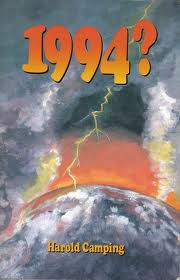
Camping’s book 1994? had a similar theme, but lacked mathematical rigor alas.

This time, he’s double-checked.

Guest Post: Shipman Reviews Dancing in the Glory of Monsters by Jason K. Stearns

Wednesday, May 18th, 2011

J. Scott Shipman, the owner of a boutique consulting firm in the Metro DC area that is putting Col. John Boyd’s ideas into action, is a longtime friend of this blog and an occasional guest-poster.

Book Review:Dancing In The Glory of Monsters, The Collapse of the Congo and the Great War of Africa, Jason K. Stearns

by J. Scott Shipman

Several thoughts come to mind when reflecting on Jason K. Stearns’ epic Dancing In The Glory of Monsters, The Collapse of the Congo and the Great War of Africa, but “dancing” doesn’t figure into any of those thoughts, and monsters are writ large, center stage. And make no mistake; we’re talking fiendishly horrific monsters, almost inhuman, as if drawn from a dictionary definition: “Anything horrible from…wickedness, cruelty or commission of extraordinary or horrible crimes; a vile creature…” So the reader should be advised, some of the stories are very disturbing.

Indeed, Mr. Stearns paints a gut-wrenching portrait of a nation and region ravaged by colonial meddling, venal and brutish politician/military leaders, and centuries old ethic strife all culminating in “many wars in one” beginning in 1996 in Congo (the former Zaire) and including active participation of neighbors Rwanda and Uganda just to name a couple.  In terms of geography, Congo straddles the equator and is the size of Western Europe, or slightly less than one fourth the size of the United States. According to the CIA World Fact Book, the literacy rate is 67% and the mortality rate a surprisingly “high” 54 years for men, and 57 for women; given the slaughter since 1996, my guess would have been a much lower number.

The Congo Wars were largely a by-product of the epic 1994 genocide in Rwanda where in the space of 100 days an estimated 800,000 Rwandans (primarily Tutsis and moderate Hutus) were killed. The killing was “organized by the elite but executed by people.” Stearns says, “…between 175,000 and 210,000 people took part in the butchery, using machetes, nail-studded clubs, hoes, and axes.” The killing was done in public and almost no one was untouched either as “a perpetrator, a victim or witness.” For internal political reasons, this resulted in over one million Hutu refugees/rebels fleeing over the border from Rwanda to Zaire. A massive tug-of-war across the border began with the ailing Zairian president Mobutu Sese Seku providing support to the rebels, and eventually a ten-year struggle within Zaire proper of both the Rwandan civil war and wars to control what became in 1997, Congo.

Dancing With Monsters is divided into three parts. Part 1 ended with the collapse of Mobutu’s government in May 1997. Following a brief respite in the fighting, Congo’s new president Laurent Kabila “fell out with his Rwanda and Ugandan allies” resulting in the second Congo war in August 1998 which “lasted until a peace deal reunified the country in 2003.” But the fighting in the eastern part of the country continues to this day and is considered the third Congo war.

Stearns tells the Congo story based on first person interviews with both perpetrators and victims of extraordinary atrocities, although he focuses more on the perpetrators who “oscillate between these categories.” A perpetrator one day becomes tomorrows victim and vice versa. Stearns has worked the better part of 10 years in the Congo, and is to be commended for the raw physical courage necessary to live, much less interview many of the “monsters” in his revealing book.

Interestingly, Stearns chose to focus on a system “that brought the principal actors to power, limited the choices they could make, and produced chaos and suffering.” That “system” is in a word, a mess. The chaos and suffering are of a kind with no contextual parallel in the modern Western experience. Stearns attempts to provide a context in an excellent introduction that offers insight into the violence, which more often than not, appears maddeningly senseless and consistently brutal. The culture of the region appears to be one where everyone is on the take, where everyone is corrupt simply to survive. To quote one of Stearns’ sources: “”If you don’t bribe a bit and play to people’s prejudices, someone else who does will replace you.” He winked and added, “Even you, if you were thrown into this system you would do the same. Or sink.”” This tone of resignation and an “ends justifies the means” justification permeates the attitudes of the political/military types Stearns interviews; in fact this philosophy colors a good portion of the book, and therein points to a large part of the systemic problem. A quote attributed to another monster, Stalin kept coming to mind: “You can’t make an omelet, without breaking a few eggs.”

From this attitude of resignation, my guess is that perhaps the “system” Stearns has documented is the extreme end result of Che Guevara-style of Soviet Marxist totalitarianism. Guevara himself spent 1965 fighting in the Congo but concluded, “they weren’t ready for revolution.” The Congolese may not have been ready for revolution, but it appears they bought the philosophy hook, line and sinker. This mentality reminded me of a passage from another book of horrors, The Whisperers, by Orlando Figes, where he writes: “she had subordinated her own personality and powers of reason to the collective.” The subordination of reason is pandemic in Congo; a place where mostly ethnically based discrimination and killing is conducted without so much as an apology. Many of Stearns’ political/military leaders spoke of “democracy,” but in my reading I did not get the sense this was anything more than a rhetorical fig leaf to remain in the good graces of the UN and the West, for there has been little in the behaviors of these leaders to suggest a level of seriousness and understanding as to what democracy means; political accountability comes to mind. Meanwhile, the killing continues.

Speaking of democracy, a good portion of the West was and continues to be indifferent to the Congo and the wars. Stearns points out, “the response, as so often in the region, was to throw money at the humanitarian crisis but not to address the political causes.” This sounds accurate. Stearns believes the West should do more, comparing the response to Kosovo in 1999, where “NATO sent 50,000 troops…to Kosovo, a country one-fifth the size of South Kivu“(part of Congo). Many of those interviewed by Stearns agree, but with a twist. In the concluding chapter, Stearns quotes a Rwandan political advisor offering what he called a “typical view” of the US from the region:

“When the United States was attacked on September 11, 2001, you decided to strike back against Afghanistan for harboring the people who carried out the attack. Many innocent civilians died as a result of U.S. military operations. Is that unfortunate? Of course. But how many Americans regret invading Afghanistan? Very few.”

Many Americans regret the extent of our operations in Afghanistan, more with each passing day. In my opinion, this seems to be offering an all-too-typical moral equivalence argument; since innocents die in American wars, our slaughter of innocents is justified. Stearns correctly follows this quote with extension of the Rwandan official’s line of thought:

“This point of view does not allow for moral nuance. Once we have established that the genocidaires are in the Congo, any means will justify the ends of getting rid of them, even if those means are not strictly related to getting rid of genocidaires.”

This official’s argument is as dangerous as the wars he and his neighbors have endured. In delegitimizing any moral nuance his prescription is amoral, or worse, claims an exclusive role defining morality thereby justifying a continuation of the slaughter. I don’t have a solution, but this prescription will yield only more of the same. Political accountability doesn’t pass the buck, or hide behind a general truth that tragedies occur, but rather learns from mistakes made and steadfastly strives to avoid further bloodshed.

In conclusion, I would offer one bit of advice to those who read this important book: use Google Earth or a good atlas; the book has maps, but the maps aren’t sufficient to the level of detail provided in the book. This is a minor nit, but one that can be enhanced through an external source.

Stearns concluded on a note of optimism and confidence in the Congolese people, whom he calls extremely resilient and energetic peoples. One could conclude nothing less from this excellent and truly frightening recounting of their story. Highly recommended.


Switch to our mobile site

