zenpundit.com » 2017

Archive for 2017

On riding a rapidly accelerating world.. in slower motion

Wednesday, March 8th, 2017

[ by Charles Cameron — not by revolution but by centering ]
.

**

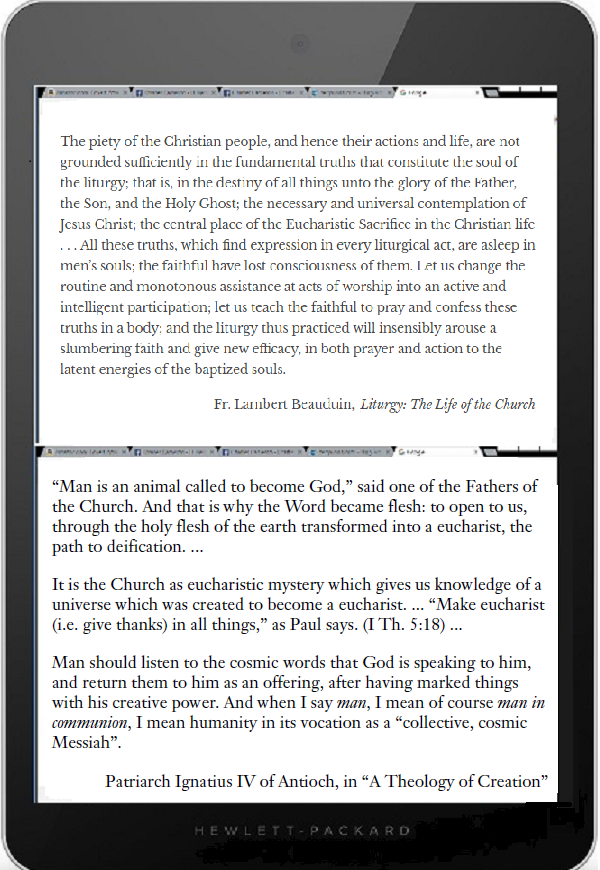
If I might shift the angle from which the current conversation views the world situation — rather than looking for revolution or evolution, might we not hope for transfiguration, theosis?

**

For what it’s worth, I’m under the impression that the translucence of the world can also be found in the Bezels of Wisdom of Ibn Arabi, in the Mountains and Rivers sutra of Dogen, in The Centuries of Thomas Traherne

You never enjoy the world aright, till the Sea itself floweth in your veins, till you are clothed with the heavens, and crowned with the stars: and perceive yourself to be the sole heir of the whole world, and more than so, because men are in it who are every one sole heirs as well as you. Till you can sing and rejoice and delight in God, as misers do in gold, and Kings in sceptres, you never enjoy the world.

Till your spirit filleth the whole world, and the stars are your jewels; till you are as familiar with the ways of God in all Ages as with your walk and table: till you are intimately acquainted with that shady nothing out of which the world was made: till you love men so as to desire their happiness, with a thirst equal to the zeal of your own: till you delight in God for being good to all: you never enjoy the world.

To many of us it seems as though the world is speeding up. The notion is a hopeless paradox — and yet the acceleration itself is both evident and excessive. Both the acceleration and the paradox are solved only in contemplation..

Daveed Gartenstein-Ross in Foreign Affairs #2, more directly to his point

Sunday, March 5th, 2017

[ by Charles Cameron — following up on Daveed Gartenstein-Ross in Foreign Affairs, my oblique analysis and more pertinent to the point he’s making ]
.

Daveed is illustrating a pretty significant pattern with his latest article in Foreign Affairs, The Coming Islamic Culture War, subtitled What the Middle East’s Internet Boom Means for Gay Rights, and More:

These paragraphs:

Today, a new type of discursive space—one that will foster a very different set of ideas—is opening up in the Muslim world. In April 2011, Bahraini human rights activists created one such space when they launched the website Ahwaa, the first online forum for the LGBT community in the Middle East and North Africa (MENA) region. Esra’a al-Shafei, one of the website’s founders, was modest about the site’s ambitions, explaining that Ahwaa was intended “as a support network” for the “LGBTQ community” as well as a resource for those “who want to learn more by interacting with [LGBT] people.”

Although little-noticed at the time, Ahwaa’s seemingly innocuous project was in fact revolutionary. Homosexuality in the MENA region is not only stigmatized but generally criminalized and banished from the public sphere. The creation of an online platform where LGBT people could candidly discuss the issues affecting their lives, such as romantic relationships or the tensions between Islam and gay rights, was thus a direct challenge to deeply inscribed cultural and religious norms. Indeed, Ahwaa heralds a wave of challenging ideas that, fueled by rapidly rising Internet penetration, will soon inundate Muslim-majority countries.

Online communications, by their nature, give marginalized social and political groups a space to organize, mobilize, and ultimately challenge the status quo. In the MENA region, online spaces like Awhaa will give sexual minorities the ability to assert their identity, rights, and place in society. So too will the Internet amplify discourses critical of the Islamic faith, or of religion in general, and solidify the identities of secularists, atheists, and even apostates. The rise of these religion-critical discourses will in turn trigger a backlash from conservative forces who fear an uprooting of traditional beliefs and identities. The coming social tsunami should be visible to anyone who knows what signs to look for.

Into the black swirl of geographical regimes that give no room for questioning — gay, political, religious, or whatever — a white circle of online discussion and possibility blossoms —

Shielded by the relative anonymity of online communications, marginalized individuals of all stripes can discuss intimate and controversial issues. The Internet, furthermore, allows like-minded people from disparate corners of the world to find one another and create virtual communities. An atheist living in rural Egypt, for example, may not know anyone else who shares his views. But when he goes online, he will find millions of people who do.

— and as it blossoms, the black swirl of repressive backlash again threatens it.

**

Likewise, though this does not happen to be Daveed’s point, into the white swirl of western democratic societies a black circle of illiberalism opens — the internet providing a networking space for anti-Semites and other far right groups they would previously lacked —

Today, the Internet is a powerful and virulent platform for anti-Semitism — hate towards Jews that has a direct link to violence, terrorism and the deterioration of civil society. Hitler and the Nazis could never have dreamed of such an engine of hate. [ .. ]

The Internet allows anti-Semites to communicate, collaborate and plot in ways simply not possible in the off-line world.

— and this blossoming extends into the Trump camp, as JM Berger suggested

New developments and new propaganda items are a constant part of the ISIS landscape, whereas content in white nationalist networks tends to be repetitive, with few meaningful changes to the movement’s message, landscape, or political prospects. A notable exception to this is Donald Trump’s presidential candidacy, which has energized white nationalists and provided new talking points and opportunities for engagement. Trump’s candidacy is likely driving some portion of movement’s recent gains on Twitter.

And again likewise, this blossoming begins to be threatened by its own backlash — the blossoming of internet speech within contrary geographical cultural norms cuts both ways. It’s almost apocalyptic — that internet space blossoming can open up cracks in what David Brooks called “the post-World War II international order — the American-led alliances, norms and organizations that bind democracies and preserve global peace” — to which Steve Bannon is vehemently opposed.

Apocalyptic? Whether we’re speaking of Daveed’s “coming Islamic culture wars” or Brooks’ “international order” there are signs of the times to be seen. As Daveed says —

The coming social tsunami should be visible to anyone who knows what signs to look for.

— and in closing —

Regardless of their ultimate outcome, however, signs of the coming Islamic culture wars can already be discerned. Western observers have long overlooked or misinterpreted social trends that have swept through Muslim-majority countries. This is one trend that they cannot afford to miss.

News from left, center and right? this site provides links

Sunday, March 5th, 2017

[ by Charles Cameron — see also post on left, center, right news maps ]
.

I ran across the AllSides site recently. Their aim seems laudable:

Unlike regular news services, AllSides exposes bias and provides multiple angles on the same story so you can quickly get the full picture, not just one slant.

At the moment, their focus is on Obama and the wiretap:

WHITE HOUSE
Obama Denies Wiretap

From the Center
Trump wants congressional probe of claims on Obama, won’t comment further
President Trump called Sunday for a congressional investigation of his claims that predecessor Barack Obama had him wiretapped…
USA Today Bias: Center

From the Right
The Obama Camp’s Disingenuous Denials on FISA Surveillance of Trump
President Trump’s early Saturday morning tweeting has exploded to the forefront an uncovered scandal I’ve been talking about since…
Guest Writer – Right Bias: Lean Right

From the Left
Obama Refutes Allegation That He Wiretapped Trump Tower During Campaign
U.S. President Donald Trump accused predecessor Barack Obama on Saturday of wiretapping him during the late stages of the 2016…
Huffington Post Bias: Left

They also feature a host of topics you can explore, such as the environment — and there you can find not only relevant news, but also:

  • Think Tanks from the LEFT
  • Think Tanks from the CENTER
  • Think Tanks from the RIGHT
  • Those pages in turn will take you to:

  • The Environmental Defense Fund
  • The Council on Environmental Quality
  • Brookings Institution
  • World Wildlife Fund
  • The Cato Institute
  • The Heritage Foundation
  • Are Zenpundit readers already familiar with this site? Does it strike you as fair and balanced? Do you know of other sites that serve the same or a related purpose? Any other comments?

    News from left, center and right? two maps to guide us

    Sunday, March 5th, 2017

    [ by Charles Cameron — see also post on left, center, right news links ]
    .

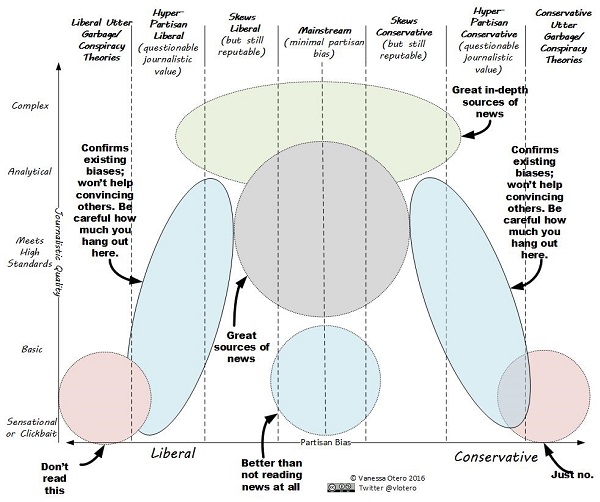
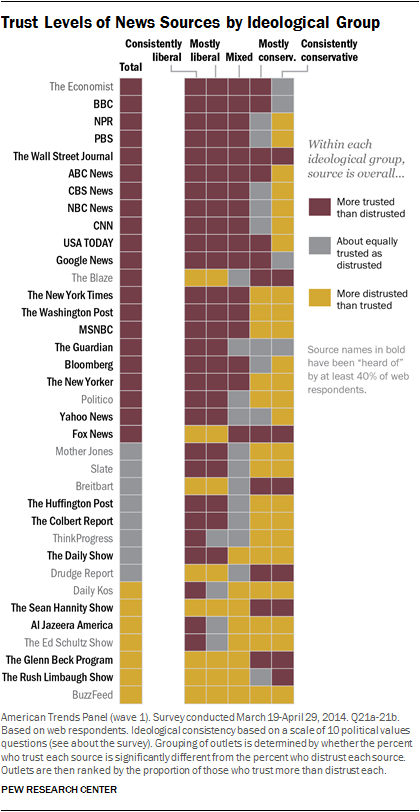
    To complement a post in this series which provided links to left, center and right news sources, here are two maps to help you sort right from center from left, a response to one of them from InfoWars, and a blank map you can fill in with your own sense of what goes where — or with noughts and crosses if you prefer, or for that matter, moves in a HipBone Game on a weird Venn-diagram influenced board…

    **

    The first map comes from Vanessa Otero:

    InfoWars didn’t like its positioning as “garbage” on Otero’s chart, and responded in Alternate Reality: Viral Propaganda Chart Demonizes Independent Media — subtitled Chart exemplifies dying dinosaur media’s extreme liberal bias:

    Otero also offers a blank format for do it yourself mapping:

    **

    Pew is, at least theoretically, non-partisan, although they too presumably have an Overton window. The below may, accordingly, seem to you more accurate than Otero’s chart above — but please note, this one dates from 2014:

    What do you think?

    Flight paths in simulation and reality

    Sunday, March 5th, 2017

    [ by Charles Cameron — once again, one thing reminds me of another ]
    .

    OTOH, in reality:

    OTOH, in simulation:

    **

    The simple excellence of rulesets in agent-based modeling is wonderfully demonstrated by the way the eye can “recognize” the movements on a flock of birds or a school of fish in Craig Reynoldsboids — rulesets notably simpler than the explanations for flocking behavior previously suggested by biologists.

    Metacognitive question: what’s the cognitive means by which we humans can “see” that the boid simulation is a sufficiently accurate representation of birds flocking and fishes schooling to account for them? — and ditto for birds flocking and fishes schooling, how do we “see” them as naturally equivalent? — and ditto for those birds flocking and fishes schooling and our earlier biological accounts of their behaviors? —

    With a hypothesis, we can test by finding predictable or disconfirmative instances beyond those on which the hypothesis is suggested.. but when the similarity is visually perceived?


    Switch to our mobile site