zenpundit.com » Uncategorized

Archive for the ‘Uncategorized’ Category

Mattis and Kim: mirrors have consequences

Friday, April 21st, 2017

[ by Charles Cameron — the current nuclear standoff, with a coda on silver beech and copper birch ]
.
**

I spend a fair amount of time suggesting that formal characteristics found in events are frequently worth special note, and mirroring is a good example. Here, in Why Mattis versus Kim Jong-Un Will End Badly for Us All, War on tnhe Rocks indicates the potential (and potent) peril of mirroring in the context of our latest Korean adventure:

Inadvertent war in Korea is more likely now than at any point in recent history. Whereas a second Korean war has always been possible, clashing U.S. and North Korean “theories of victory” — beliefs about what it takes to successfully coerce and control escalation — now make it plausible, even probable.

Patterns of bluster and brinkmanship have of course long characterized affairs on the Korean Peninsula. For “Korea watchers,” there’s a perverse comfort in the predictability of a situation that, to the uninitiated, sometimes looks anything but stable.

So on some level, the rhythm of recent saber-rattling between the Trump administration and North Korea recalls the perverse comfort of typical Korea policy. On a recent visit to South Korea, Vice President Mike Pence cited U.S. attacks in Syria and Afghanistan as indications of U.S. resolve against North Korea. This statement followed numerous officials confirming that the administration is contemplating preventive strikes against the North, and a recent policy review on North Korea yielding one overarching imperative: “maximum pressure.” North Korea’s rhetoric and posturing has been no less confrontational and no less familiar. As Pence departed Alaska for South Korea, North Korea attempted a submarine-launched ballistic missile test that failed. Upon news that a U.S. carrier group was headed to its neighborhood, North Korea responded that “a thermonuclear war may break out at any moment” and that it’s “ready to react to any mode of war desired by the U.S.”

These words and deeds themselves are more heated than usual, but unremarkable in the context of all that’s come before. North Korea routinely threatens war, often summoning images of a future mushroom cloud. The United States routinely dispatches aircraft carriers, bombers, and other strategic military assets in hopes of signaling resolve while actually registering little more than displeasure with North Korean behavior. The notion of “maximum pressure,” moreover, only differs from the approach of past U.S. presidents in the ambiguous adjective “maximum.” Pressure is the historical mean of U.S. policy toward North Korea. My concern is not with these observable dynamics to date, but rather with what lies beneath them, and what may be coming soon as a consequence.

It’s getting harder to ignore that the Pentagon, under Secretary Jim Mattis, may have a coercive theory of victory that largely mirrors that of North Korea under Kim Jong-Un. The danger is in the fundamental incompatibility of these disturbingly similar sets of strategic beliefs.

**

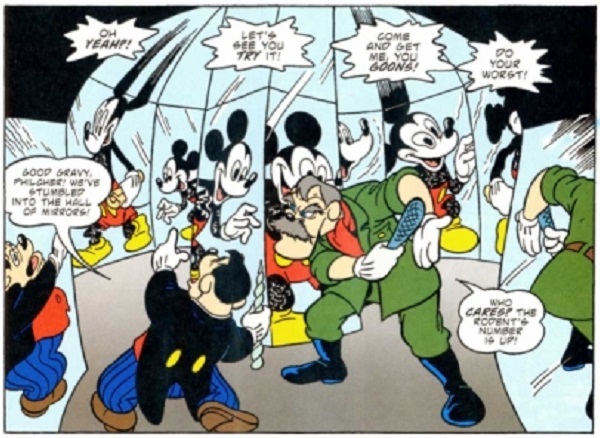
Smoke and the hall of mirrors, a digression:

An excellent place for final confrontations with heroes, the Hall Of Mirrors wins high marks for ease of use. All you have to do is lure your victim inside by dashing in yourself, and then cackle with glee as they find you reflected back not once but a thousand times… When you have had your fun, seal the exits and fill the cramped space with some kind of liquid. Plain water works as well as anything, but why not add food dye for color. Or, for a touch of whimsy, use a sickeningly sweet fruit punch.

Neil Zawacki, How to Be a Villain, in TV Tropes: Hall of Mirrors
**

Mirroring sets up an echo chamber — consider the myth of Narcissus** — which is also a sort of ping-pong game and a feedback machine —
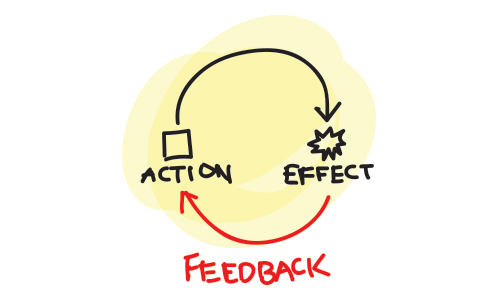
and hence a magnifier or an accelerator. It can allm too easily howl out of control, with — in this case — nuclear consequences.

** Narcissus sees his reflection, Echo echos his voice back to him, thus the myth encompasses a parallelism between visual and aural self-perceptions in a wonderful act of inter-media symmetry.

**

Form is the decorative act of the creative mind, adding to meaning by the use of devices of art in the way the materials of the art are deployed — as when the poet notes (specifically) beech and birch trees in a wood, delighted by the verbal felicity between the two words, or Coppola matches helicopter rotors against the blades of a hotel room fan in the beginning of Apocalypse Now.

And then the delight triples with the addition of a metallic match:
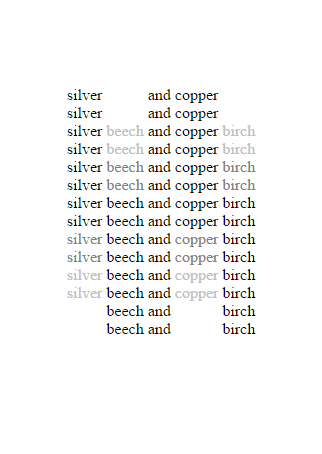
But again, I digress..

**
JM Berger’s latest, 1

Friday, April 21st, 2017

[ by Charles Cameron — JM’s sustained attack on Christian Identity and ISIS ]
.

JM on his latest piece:

I’ve kept those first three tweets in Twitter form becaue they include graphics. JM’s series continues on twitter, but here I’m reformatting it as regular prose for ease of reading:

The paper is first in a series aiming to develop a framework to study extremism as a phenomenon crossing ideological boundaries.

The framework I’m presenting is derived from a grounded theory approach, using Christian Identity as a starting point. The paper traces how Christian Identity emerged from a non-extremist precursor, and what that says about identity and group radicalization. It also offers new (and probably controversial) definitions of extremism and radicalization, seeking to address a serious gap in consensus. Finally, it offers some ideas for counter-messaging and deradicalization derived from the framework.

The next in the series will apply the framework to ISIS propaganda with concrete notes on how the framework informs counter-messaging. I’m ultimately asking what ISIS has in common with Christian Identity, and what that tells us about each and both.

An important approach, IMO.

**

JM Berger’s latest, 2 will present his accompanying overview of recent work in the field.

Keeping it pop in natsec and politics

Friday, April 21st, 2017

[ by Charles Cameron –0 a DoubleTweet from Foreign Affairs deputy managing editor Justin Vogt ]
.

Halal Dunkin’ Donuts in Karachi..

and Ted Nugent gets a private tour of the White House from President Trump — with Kid Rock and Sarah Palin:

“He gave us a wonderful personal tour of every room and talked about the origins of every carpet and every painting — there was a Monet — and then we had dinner,” said Mr. Nugent, who has referred to former President Barack Obama as a “mongrel” and to Hillary Clinton with an array of unflattering epithets.

Talmud meets the Gridiron

Friday, April 21st, 2017

[ by Charles Cameron — they meet in the American war movie exploring the use of drones, Good Kill ]
.

A quick example of Talmud-to-movie translation:

Lest we forget:

Ha-Ba le-Horgekha Hashkem le-Horgo is a teaching of increasing popularity among Israelis. Taken from the Babylonian Talmud, Sanhedrin 72:1, its most precise translation is: ‘If someone comes to kill you, get up early to kill him first.’ It seems that every online newspaper Comment section will include this sentence when discussing Israeli aggression: the Gaza offensive? ‘Kill him first’. The Second Lebanon War? ‘Kill him fi rst’ again. A Google search for the expression ‘kill him first’ and ‘flotilla’ yields more than 4,200 Hebrew results, confi rming the centrality of this narrative. This convenient license to kill extends beyond the online community to Israeli decision makers and politicians. Following the Second Lebanon War, Ehud Yatom, a Likud MK, explained the asymmetrical death toll of 44 Israeli civilians and 1,191 Lebanese civilians with the same trump card:

‘and if someone comes to kill you, get up early to kill him fi rst.’ It has been used by Minister of Strategic Affairs Moshe Ya’alon when addressing university students about their military reserve service and by Minister of Public Security Avi Dichter when lecturing about IDF strategy. It was also the explanation provided by Minister of Minorities Avishai Braverman for the assassination of a Hamas leader in Dubai. Even Ayoub Kara, a Druze MK from Likud, has used it. When asked about the Iranian nuclear plan Kara showed little originality: ‘I think an attack on Iran will be justifi ed’, he said, ‘since if someone comes to kill you, get up early to kill him first.’

Jewish Quarterly, Kill Him First

Similarly:

Several days before the horror of September 11, 2001, Israel’s Foreign Minister Shimon Peres spoke to Conservative rabbis in an international conference call. Responding to a concern expressed about Israel’s policy of preemptive targeted killings of suspected terrorist leaders and the inevitable collateral damage, Mr. Peres defended the practice, citing an oft-quoted rabbinic legal dictum, “Im ba l’hargekha, hashkem l’hargo,” “If someone comes to kill you, rise up and kill him (first).”

American Jewish Committee, If Someone Comes to Kill You, Rise Up and Kill Him First

And further:

Our policy is guided by two main principles: the first is “if someone comes to kill you, rise up and kill him first,” and the second is “if anyone harms us, his blood is on his own hands.”

PM Netanyahu, Opening of Knesset winter session, 2011

And by way of contrast with New Testament teaching:

There is nothing righteous in turning the other cheek. We are not supposed to passively accept death, but rather to fight and survive.

Times of Israel, Torah for Today: What does the Torah say about… self-defence

Muslim does not equal Terrorist

Friday, April 21st, 2017

[ by Charles Cameron — witting or unwitting, there’s a blatant inability to make this simple distinction ]
.

The sane alternative:


Sheikh Ahmadou Bamba and His Holiness the Dalai
Lama are two role models for our century.

**

There’s an interesting conflation of Islam and Terrorism in a post titled 2 Faces of Islam: Why All Muslims Benefit from Terrorism from Freedom Outpost:

While many Muslims are just as horrified by terrorism as the rest of us are, all Muslims nevertheless benefit from Islam. This is because both peaceful and violent Muslims tend to share two important goals: (1) the conversion of non-Muslims to Islam, and (2) the silencing of critics of Islam. Since terrorism helps achieve these goals, all Muslims benefit from Islam.

This would make sense — I’m not saying I’d agree with it, merely that it would have a logical form to it that wouldn’t make me go cross-eyed — if it read [note: this paragraph edited in light of comment below]:

While many Muslims are just as horrified by terrorism as the rest of us are, all Muslims nevertheless benefit from terrorism. This is because both peaceful and violent Muslims tend to share two important goals: (1) the conversion of non-Muslims to Islam, and (2) the silencing of critics of Islam. Since terrorism helps achieve these goals, all Muslims benefit from terrorism.

But no: under a caption that tells us 2 Faces of Islam: Why All Muslims Benefit from Terrorism, it twice states all Muslims nevertheless benefit from Islam.

The conflation is evident, Islam and Terrorism are interchangeable in the writer’s mind, and that interoperability is liable to find an echo in — or seep diasastrously into — the reader’s mind, too.

**

The actual relation between Islam and contemporary Islamist terrorism is neither “Islam is a religion of no terrorism (aka peace)” nor “Islam is a religion of terrorism (aka war)”. To get at a couple of the major nuances here, the Meccan Cantos and the Medinan cantos of the Quran suggest very different readings of what the religion was originally all about, and how it adapted to violent hostility; and in terms of contemporary Islam, not all Muslims are Salafist, and not all Salafists are jihadist fighters, but some of them most definitely and ruthlessly are.

In addition, Islam needs to be considered both scripturally — the usual western critique — and culturally, by which I mean how Islamic belief plays out in cultural practice across time and space — a far subtler matter. SH Nasr‘s The Study Quran is a prime guide to the former, and Shahab Ahmed‘s What Is Islam?
The Importance of Being Islamic the towering work to digest in understanding the latter.

A useful corrective to the “Islam is a religion of war” perspective can be found in the lives and works of two proniment Muslim proponents and practitioners of nonviolence, Sheikh Amadou Bamba, founder of the Muridiyya or Mourides, and Badshah Khan, Gandhi‘s Muslim friend.

For context around the Mourides, and in constrast with the Wahhabis of the Levanty, see Why are there so few Islamists in West Africa? A dialogue between Shadi Hamid and Andrew Lebovich.

The inability to distinguish Muslim from Terrorist, and the violence that follows it, can truly be described as Islamophobia.

**

Image:

  • Sheikh Aly N’Daw, Choice, Liberty and Love: Consciousness in Action

  • Switch to our mobile site

