zenpundit.com » Uncategorized

Archive for the ‘Uncategorized’ Category

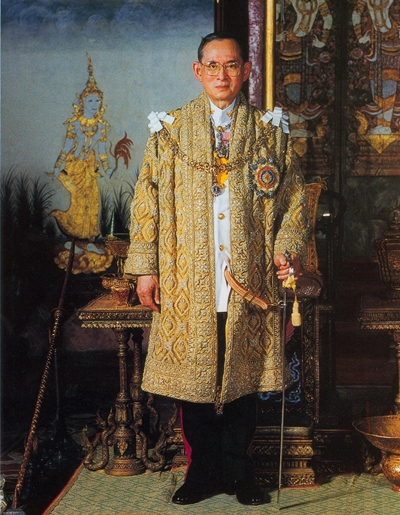
Michael Yon on the death of Thailand’s King Bhumibol

Thursday, October 13th, 2016

[ by Charles Cameron ]
.

king-bhumibol

**

Michael Yon on Facebook, and (illustrated) on his journal page under the heading Rivers of tears flow tonight:

On one level, there is not much to say other than that one of the greatest leaders in history graced us for so long. He is the Father of Thailand. He was a champion of peace, freedom, and prosperity, and a good friend to America and to American people. His Majesty is loved by many Americans.

Americans normally do not like Kings, but King Bhumibol is a great exception. Those who studied him grew to respect him, then to like him, and finally to share in the love for the King of Kings. The love for His Majesty is so immense that it could fill the Gulf of Thailand.

Thais are among freest people on earth, thanks to His Majesty. He brought his millions of sons and daughters very far, and he taught lessons and brought inspiration to foreigners such as me.

He was a musician, and good, and his photography was excellent. Highly educated, he visited every corner of this great country, into the deepest jungles to help villagers, into the mountains, out to the islands, down the rivers. He went everywhere. His Majesty was a man of the people. He wanted to see with his own eyes, and he did.

Finally his body has worn out. We wish his body had lived to 110 but his body wore out. He spent it working for Thailand. But this is not the end. Only his body is gone. His Majesty is more alive now than ever before.

Strangely perhaps, since I only knew of him from a smattering of press accounts, I too am moved to tears by the death of this man and monarch. May he rest in peace.

Visual for verbal, a perfect match

Wednesday, October 12th, 2016

[ by Charles Cameron — one picture is worth one paragraph, both perfect ]
.

I’ve paired the Annie Dillard paragraph in the upper panel below with an impressively similar paragraph from Haniel Long and a gorgeous slow motion video — now I’d like to pair it with a design in the style of native artwork from the Pacific Northwest, which as far as I can determine is the work of one Mark Gauti:

annie-dillard-art

The image is titled Eagle and Dog Salmon. It gives me pleasure to set these two (figuratively) side by side.

Twice lucky, or thrice? On dodging nuclear fireballs

Wednesday, October 12th, 2016

[ by Charles Cameron — two Russian secular saints — and an Australian ]
.

It seems we’ve been lucky twice —

saved-twice

Read their two stories, and weep.

**

27 October 1962

Thank you Vasili Arkhipov, the man who stopped nuclear war

If you were born before 27 October 1962, Vasili Alexandrovich Arkhipov saved your life. It was the most dangerous day in history. An American spy plane had been shot down over Cuba while another U2 had got lost and strayed into Soviet airspace. As these dramas ratcheted tensions beyond breaking point, an American destroyer, the USS Beale, began to drop depth charges on the B-59, a Soviet submarine armed with a nuclear weapon.

The captain of the B-59, Valentin Savitsky, had no way of knowing that the depth charges were non-lethal “practice” rounds intended as warning shots to force the B-59 to surface. The Beale was joined by other US destroyers who piled in to pummel the submerged B-59 with more explosives. The exhausted Savitsky assumed that his submarine was doomed and that world war three had broken out. He ordered the B-59’s ten kiloton nuclear torpedo to be prepared for firing. Its target was the USS Randolf, the giant aircraft carrier leading the task force.

If the B-59’s torpedo had vaporised the Randolf, the nuclear clouds would quickly have spread from sea to land. The first targets would have been Moscow, London, the airbases of East Anglia and troop concentrations in Germany. The next wave of bombs would have wiped out “economic targets”, a euphemism for civilian populations – more than half the UK population would have died. Meanwhile, the Pentagon’s SIOP, Single Integrated Operational Plan – a doomsday scenario that echoed Dr Strangelove’s orgiastic Götterdämmerung – would have hurled 5,500 nuclear weapons against a thousand targets, including ones in non-belligerent states such as Albania and China. [ .. ]

The decision not to start world war three was not taken in the Kremlin or the White House, but in the sweltering control room of a submarine. The launch of the B-59’s nuclear torpedo required the consent of all three senior officers aboard. Arkhipov was alone in refusing permission. It is certain that Arkhipov’s reputation was a key factor in the control room debate. The previous year the young officer had exposed himself to severe radiation in order to save a submarine with an overheating reactor.

**

September 26, 1983

The Man Who Saved the World by Doing Absolutely Nothing

It was September 26, 1983. Stanislav Petrov, a lieutenant colonel in the Soviet Air Defence Forces, was on duty at Serpukhov-15, a secret bunker outside Moscow. His job: to monitor Oko, the Soviet Union’s early-warning system for nuclear attack. And then to pass along any alerts to his superiors. It was just after midnight when the alarm bells began sounding. One of the system’s satellites had detected that the United States had launched five ballistic missiles. And they were heading toward the USSR. Electronic maps flashed; bells screamed; reports streamed in. A back-lit red screen flashed the word ‘LAUNCH.'”

That the U.S. would be lobbing missiles toward its Soviet counterpart would not, of course, have been out of the question at that particular point in human history. Three weeks earlier, Russians had shot down a South Korean airliner that had wandered into Soviet air space. NATO had responded with a show of military exercises. The Cold War, even in the early ’80s, continued apace; the threat of nuclear engagement still hovered over the stretch of land and sea that fell between Washington and Moscow.

Petrov, however, had a hunch — “a funny feeling in my gut,” he would later recall — that the alarm ringing through the bunker was a false one. It was an intuition that was based on common sense: The alarm indicated that only five missiles were headed toward the USSR. Had the U.S. actually been launching a nuclear attack, however, Petrov figured, it would be extensive — much more, certainly, than five. Soviet ground radar, meanwhile, had failed to pick up corroborative evidence of incoming missiles — even after several minutes had elapsed. The larger matter, however, was that Petrov didn’t fully trust the accuracy of the Soviet technology when it came to bomb-detection. He would later describe the alert system as “raw.”

But what would you do? You’re alone in a bunker, and alarms are screaming, and lights are flashing, and you have your training, and you have your intuition, and you have two choices: follow protocol or trust your gut. Either way, the world is counting on you to make the right call.

Petrov trusted himself. He reported the satellite’s detection to his superiors — but, crucially, as a false alarm. And then, as Wired puts it, “he hoped to hell he was right.”

He was, of course. The U.S. had not attacked the Soviets. It was a false alarm. One that, had it not been treated as such, may have prompted a retaliatory nuclear attack on the U.S. and its NATO allies. Which would have then prompted … well, you can guess what it would have prompted.

**

Oh, and the Australian. I came by this topic via an article about this man, Professor Des Bell:
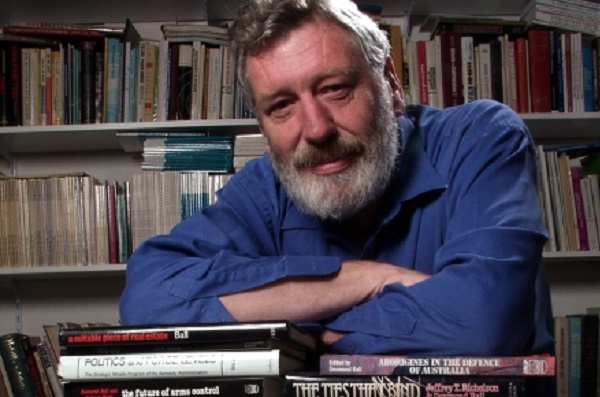
des-ball

A strategist with books — he’s the sort of chap this blog thrives on! And he, too, seems to have saved us from a fiery furnace of our own devising:

Des Ball: the man who saved the world

THAT America could launch a limited nuclear strike against Russia was a fashionable belief in US strategic theory of the 1970s. Policymakers thought that if Cold War tensions boiled over, they could hit selected Soviet targets in a way that controlled further escalation and forced Moscow to back down.

It took the iconoclastic Australian security scholar Des Ball to point out that the theory was bunkum. In his influential essays of the early 1980s, Ball argued that reasoned strategic theory was likely to go out the window once the missiles started flying.

Among the first targets would be the other side’s command and control centres – its eyes and ears. Once blinded, a superpower – consisting of real people responding with human instincts – would not distinguish a ”controlled” strike from a full-scale attack and would retaliate with everything it had.

Thrice lucky? I prefer to call it grace.
Heart Line — a response to Bill Benzon

Wednesday, October 12th, 2016

[ by Charles Cameron — design fascination — including a Mimbres rabbit with a supernova at its feet ]
.

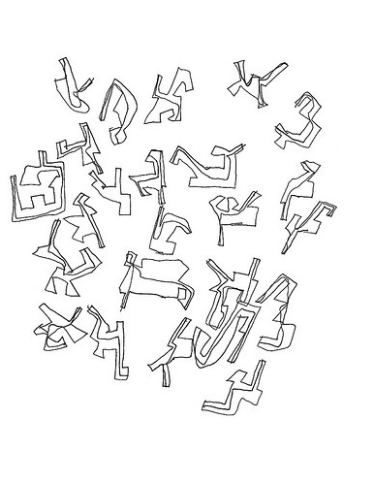
Bill Benzon has been blogging a remarkable series of posts on Jamie Bérubé‘s drawings as recorded in the online illustrations to Michael Bérubé‘s book, Life As Jamie Knows It: An Exceptional Child Grows Up.

**

I wanted to respond to Bill’s latest, Jamie’s Investigations, Part 5: Biomorphs, Geometry and Topology, which included this illustration:

berube-benzon-5-biomorphs

and these comments, which I’ve edited lightly for clarity and simplicity:

I emailed Mark Changizi, a theoretical neuroscientist who has done work on letterforms. He has been making a general argument that culture re-purposes, harnesses (his term), perceptual capacities our ancestors developed for living in the natural world. One of his arguments is that the forms used in writing systems, whether Latinate or Chinese (for example), are those that happened to be useful in perceiving creatures in the natural world, such as plant and animal forms. I told him that Jamie’s forms looked like “tree branches and such.” He replied that they looked like people. His wife, an artist, thought so as well, and also: “This is like early human art.”

You’ll see why that-all interests me — letters and life forms — below.

And then:

Yes, each is a convex polygon; each has several ‘limbs’. And each has a single interior line that goes from one side, through the interior space, to another side. The line never goes outside the polygon .. Why those lines? I don’t know what’s on Jamie’s mind as he draws those lines, but I’m guessing that he’s interested in the fact that, given the relative complexity of these figures and the variety among them, in every case he can draw such a line.

**

Two thoughts cross my mind.

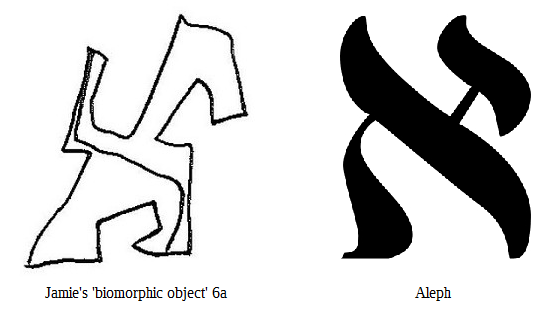
The first is that one of these forms, Benzon’s Biomorphic Objects 6a, bears a striking resemblance to the letter aleph, with which the Hebrew alphabet — or better, alephbeth — begins:

berube-benzon-5-biomorph-6a-aleph

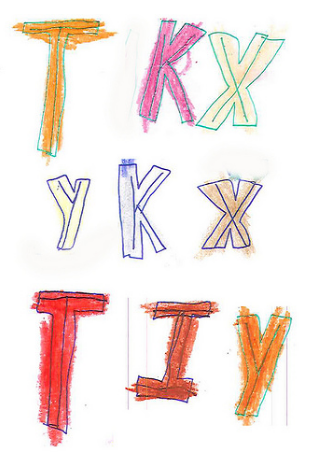
There may be some connection there, I’m not sure — though Jamie also has a keen interest in alphabetic forms, as illustrated here:

berube-benzon-5-letterforms

**

But it’s my second point that interests me more.

These “biomorphic objects” with “single interior line that goes from one side, through the interior space, to another side” remind me of nothing so much as the Native American style of representing animals with a “heart line” — best illustrated, perhaps, by this Acoma Pueblo Polychrome Olla with Heartline Deer:

The image comment notes:

One generally associates the use of heartline deer with pottery from Zuni Pueblo and that is most likely the origin. The fact that it appears on Acoma Pueblo pottery has been explained in a number of fashions by a number of contemporary Acoma potters. Deer designs have been documented on Acoma pottery as early as 1880, but those deer do not feature heartline elements. Some potters at Acoma have indicated that Lucy Lewis was the first Acoma potter to produce heartline deer on Acoma pottery. She did this around 1950 at the encouragement of Gallup, New Mexico Indian art dealer Katie Noe. Lewis did not use it until gaining permission from Zuni to do so. Other potters at Acoma have stated that the heartline deer is a traditional Acoma design; however, there is no documented example to prove this. Even if the heartline deer motif is not of Acoma origin, potters at Acoma have expressed that it does have meaning for them. It is said to represent life and it has a spiritual connection to deer and going hunting for deer.

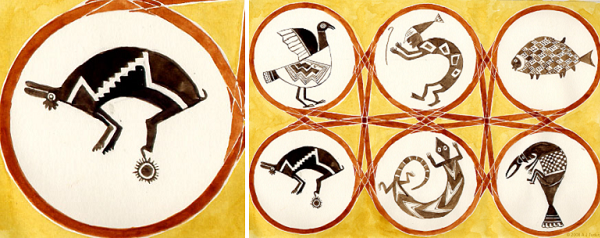
Here’s a “heartline bear” from David and Jean Villasenor‘s book, Indian Designs:

bear-heartline

And here’s an equivalent Mimbres design for a rabbit with heartline, in which the line passes completely through the body from one side to the other, as in Jamie’s biomorphs:

mimbres-rabbit

Again, the comment is interesting — it cites a 1990 New York Times article, Star Explosion of 1054 Is Seen in Indian Bowl:

When the prehistoric Mimbres Indians of New Mexico looked at the moon, they saw in its surface shading not the “man in the moon” but a “rabbit in the moon.” For them, as for other early Meso-American people, the rabbit came to symbolize the moon in their religion and art.

On the morning of July 5, 1054, the Mimbres Indians arose to find a bright new object shining in the Eastern sky, close to the crescent moon. The object remained visible in daylight for many days. One observer recorded the strange apparition with a black and white painting of a rabbit curled into a crescent shape with a small sunburst at the tip of one foot.

And so the Indians of the Southwestern United States left what archeologists and astronomers call the most unambiguous evidence ever found that people in the Western Hemisphere observed with awe and some sophistication the exploding star, or supernova, that created the Crab nebula.

That would be the sunburst right at the rabbit’s feet!

**

Posts in Bill’s series thus far:

  • Jamie’s Investigations, Part 1: Emergence
  • Jamie’s Investigations, Part 2: On Discovering Jamie’s Principle
  • Jamie’s Investigations, Part 3: Towers of Color
  • Jamie’s Investigations, Part 4: Concentrics, Letters, and the Problem of Composition
  • Jamie’s Investigations, Part 5: Biomorphs, Geometry and Topology
  • My previous comment on #1 in the series:

  • On the felicities of graph-based game-board design: nine
  • Electoral religion 2016

    Wednesday, October 12th, 2016

    [ by Charles Cameron — remembering the Ted Cruz Christ / Antichrist (and Obama ditto) rhetoric from an earlier post ]
    .

    Dismal, both of them:

    tablet-dq-electoral-religion

    Sources:

  • NBC News, Trump Calls Clinton ‘The Devil’
  • NYT Magazine, I’m the Last Thing Standing Between You and the Apocalypse
  • **

    I could be wrong, but I somehow doubt that either Trump or Clinton is using the terms “devil” or “apocalypse” (respectively) in their literal religious meanings here.

    For that I’m thankful.

    But then..

    In contrast to the two posts I’ve linked to above, these two below appear to me to be making overtly and deliberately religious appeals with respect to the current election.

  • Alex Jones, InfoWars, Hillary Clinton: Demonic Warmonger
  • Andy Crouch, Christianity Today, Speak Truth to Trump
  • I’ve included the InfoWars video clip because it makes it very clear that Alex Jones, at least, claims he is being “Biblical” — his own word — when he calls Hillary Clinton demonic — and the Christianity Today piece because it represents a distinguished Evangelical response to the general tendency of Evangelical Christians to support Donald Trump‘s candidacy.

    In somewhat related news, I am saddened to report that Christianity Today‘s literary magazine Books & Culture will close at the end of the year. John Wilson, the editor, is a long time and valued friend from Pasadena bookstore days — see his kind words about the late Bill Tunilla, the bookman who introduced us, in this Letter from the Editor.


    Switch to our mobile site