zenpundit.com » Uncategorized

Archive for the ‘Uncategorized’ Category

Okay this re North Korea this morning from WotR

Wednesday, February 14th, 2018

[ by Charles Cameron — from Korea hands vs nuclear wonks ]
.

Okay, the title of this piece intrigued me: Korea hands vs nuclear wonksVan Jackson at War on the Rocks today.

Okay, I mostly like wonks, but hands have on-the-ground awareness that beats the hell out of book-footnoted research and chat with like-mindedd others, so to my mind, Korea hands would naturally beat nuclear wonks (Cheryl Rofer and friends explicitly excepted), no contest. Anyway, neat, interest-grabbing title. I therefore clicked to see the piece, and while my own opinion was not affirmed, I found this:

I ranted about this a bit on twitter over the weekend, but what we’re witnessing is an open split between the United States and South Korea over North Korea policy. It’s not the first time; this happened in the early years of the George W. Bush administration too. Both sides have an interest in papering over differences in public, but the rift is there. The question is why.

Nuclear scholars see the emerging differences in the alliance as strategic “decoupling”—North Korea’s growing nuke threat is leading South Korea to search for security by other means because U.S. reliability shrinks as U.S. territory falls within range of North Korean missiles. South Korea would be hard-pressed to have faith that Trump would be willing to let Seattle eat a nuke in exchange for Seoul not eating one.

But Korea scholars see a more familiar pattern in the current divergences between South Korea’s President Moon Jae-in and President Trump. The breakdown of the U.S.-Korea alliance in 2002 and 2003 was about as bad as it’s ever been, it was due entirely to the politics (on both sides) of North Korea policy, and it was years before North Korea had a functional nuke.

So we all see a fissure opening up between allies, but what’s the best explanation for it? If the nuclear scholars are right, and the fissure is a function of North Korea’s growing nukes, then the alliance is in big trouble, because the nuke problem is on-trend to get worse not better.

If the Korea scholars are right, then the alliance is in a bad place but the situation is recoverable. South Korea’s president is just being a political opportunist, in this interpretation, and once the domestic mood in the South shifts against him (or North Korea), then the alliance will be in a better place.

Either way, we’re effectively out of the nuclear crisis from last year. It would take a major miscalculation or act of violence by someone to bring the crisis roaring back. Unfortunately, that’s entirely plausible.

**

Two points-of-view — the view from two points, two perspectives — distinct but not necessarily opposed, ie capable of binocular vision, if the balance between the two lenses is adjusted to the perceiver’s taste.

Binocular vision, adjusted to balance the inputs from the two lenses, is — if nothing else — an opportunity for dialectic, or for the HipBone approach (stereophany — see Meditations for Game Players, vii).

Binocular — stereoscopic — dialectic vision is a central aspect of my interest in polyphony, the capacity to hear twwo or more points of view at once. F Scott Fitzgerald once said, much to my delight:

The test of a first-rate intelligence is the ability to hold two opposed ideas in mind at the same time and still retain the ability to function.

Then there’s Sir Lawrence Freedman, in The Meaning of Strategy, Part II: The Objectives:

For Beaufre, strategy was the “the art of the dialectic of two opposing wills using force to resolve their dispute.”

Strategy! Dialectic! Stereophany!

**

And now, back to N Korea and Van Jackson with all that in mind..

I’ve taken into account two viewpoints in my “binocular” discussion here — but Jackson offers a third possibility at the very end of his piece:

Either way, we’re effectively out of the nuclear crisis from last year. It would take a major miscalculation or act of violence by someone to bring the crisis roaring back. Unfortunately, that’s entirely plausible.

Ack!

WHat do you think, Zen, Scott, Tanner, Cheryl, Michael??
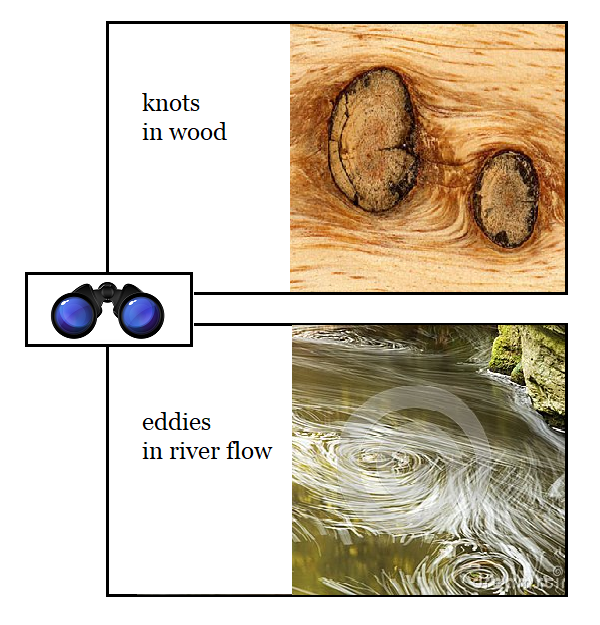
Patterns: knots in wood, eddies in river flow

Wednesday, February 14th, 2018

[ by Charles Cameron — Gen Mattis gives Pres Trump pause ]
.

Reporting that Secretary Mattis influenced President Trump regarding the number of troops in Afghanistan, WaPo made a remarkable comment that caught my eye:

In the end, Trump decided to nearly double the size of the force in Afghanistan to 15,000 troops. In announcing his decision, Trump said he was acting against his “original instinct.”

That last remark, with President Trump admitting that he’s acted “against” his celebrated flow of instinctural utterances, struck me as pretty much unique in my reading — and as akin to a pattern I’ve long had an interest in: that of knots in wood and eddies in flowing water.

**

The point about eddies that interests me is that they represent a reversal of flow within a larger flow-stream. And the point about Trump is that if he goes against a previously unbroken (or seldom broken) flow of some particular behavior, that’s something we should take special note of.

**

From here on in this post, I’m exploring matters of pattern, with no necessary relationship to Trump or natsec.

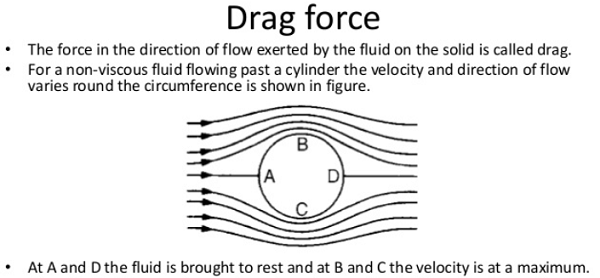
I’ve long thought of eddies as equivalent to knots in wood: now I’m not so sure — I’m learning, or at least I hope so. Eddies are commonly caused by some upstream perturbation — a rock in mid-stream, for instance, or the arrival of a flowing source in an otherwise calm body of water. It may be that the heart of a knot is some such “rock in mid-stream” in wood, in which case this “drag force” diagram may give us a better picture of the knot and eddy:

Knots in wood commonly have a vertical (oblique) dimension, as when they represent the formation of a branch or twig that’s oblique to the main trunk or branch..

**

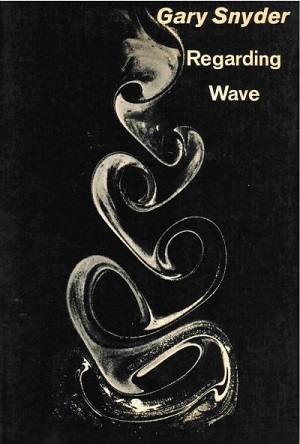
In all this, we are getting close to the Karman Vortex Street which may be familiar from the cover of Gary Snyder‘s (wonderful) poetry book, Regarding Wave (a study of Snyder’s book covers would be a study in a variety of natural patterns):

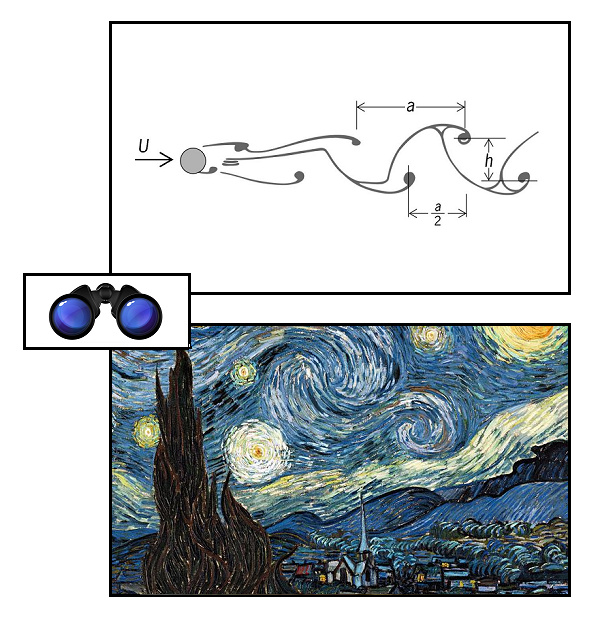
or from my own favorite DoubleQuote, between the Karman Vortex Street (here represented diagrammatically) and Van Gogh’s night sky:

Ah, from wood and flowing water to the sky.

**

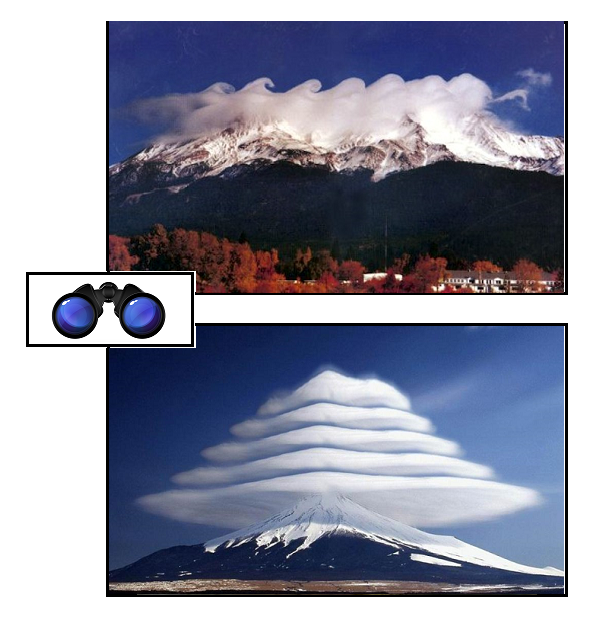
Okay, as I said, this is my learning curve this am, and I am humbled to add one more DQ to this small collection, this one featuring a Vortex like Kelvin-Helmholtz cloud formation (upper image, below):

and a lenticular cloud formation (lower image, above).

Clouds.

**

And (liquid) water.

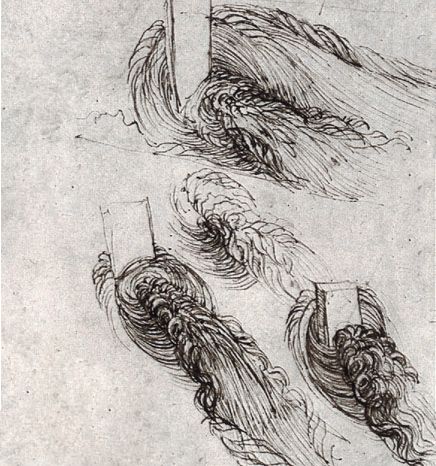
Hey, in his far subtler and more complex way, Leonardo was a keen observer of these phenomena of flow and eddy too:

From the great Atlantic ocean to the wide Pacific shore – Sunday surprise

Monday, February 12th, 2018

[ by Charles Cameron — with an itch to ride the rails ]
.

For your evening entertainment..

Easst to West, that the Wabash Cannonball, North to South, the City of New Orleans, sung by Johnny Cash and Arlo Guthrie respectively.

Sunday surprise — the demonic and the sanctified, illuminated

Monday, February 12th, 2018

[ by Charles Cameron — may you and I play always among the vertues and against the vices ]
.

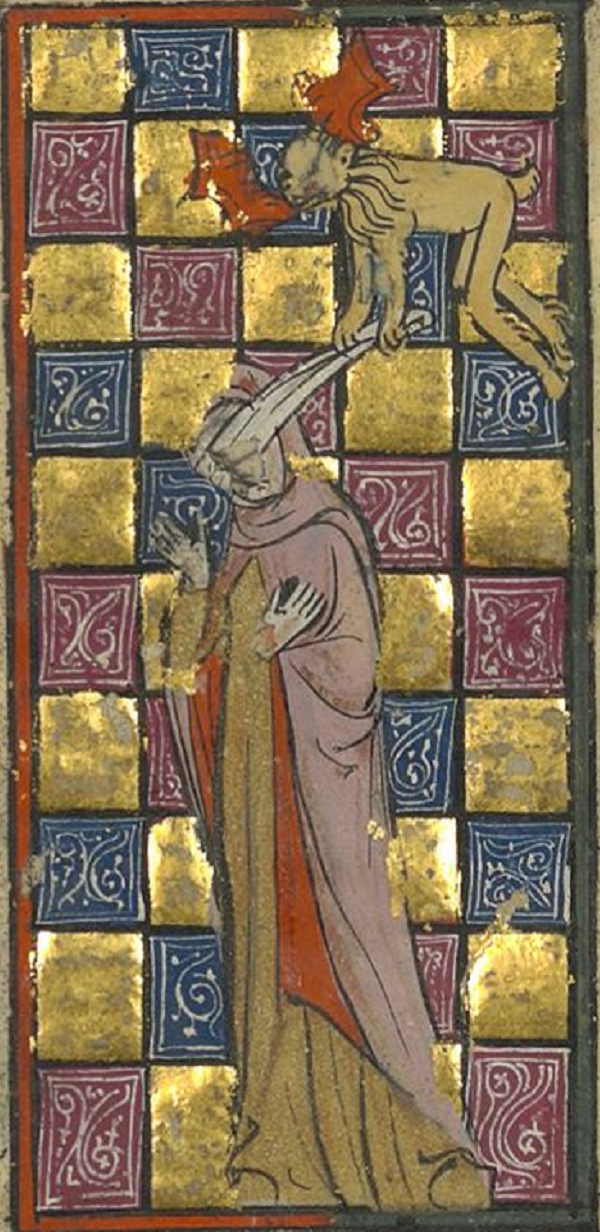
That we may discern the distance between the demonic and the sanctified, and play accordingly:

**

I’m curious about the elongated chess board on which our demon slaughters the very mind of the prayerful monk.

Emily?

**

Sources:

  • Emily Steiner, Twitter
  • Elizabeth Biggs, Twitter
  • The monk prays (above, sanctified), the devil slays the monk (below, demonic)

    **

    Ha!

    It is four hundred years since Caxton published this book. We may be sure that so pains»taking a man did the best he could with the spelling. The alphabet he employed was inadequate to represent the sounds of the English language, and he had no other guide than the spelling of the scribes, who represented, as well as they could, the pronunciations in use in the several counties in which they lived. In the course of two hundred and fifty years, coming down to the days of Addison and Pope, a considerable degree of uniformity had been obtained, both in pronunciation, by means of travel, and in spelling, by the desire of printers to have a standard orthography for each word, in order to save themselves the trouble of thinking and comparing various orthographies.

    That’s from The Game of the Chesse: a Moral Treatise on the Duties of Life … Reprinted which I ran across while searching (via the keywords “moral” and “chesse” for this quote:

    Meantime, the king and queen, for recreation’s sake, began to play together. It looked not unlike chesse, only it had other laws, for it was the vertues and vices one against another, where it might be ingeniously discovered with what plots the vices lay in wait for the vertues, and how to re-encounter them again. This was so properly and artificially performed that it were to be wished that we had the like game too.

    That’s from The Chymical Marriage of Johann Valentin Andreae, first published in 1616, translated into English by Ezechiel Foxcroft in 1690.

    Pray, play most assiduously.

    Of the ever-expanding reach of science, macroscopic version

    Sunday, February 11th, 2018

    [ by Charles Cameron — I imagine there’s a microscopic version, too ]
    ,

    Here’s an illustration of our Sun’s family tree (sadly scaled down in upper image, below) —

    — and here (pleasantly blown up in lower image, above) is an image of the first planets discovered outside our milky way

    **

    From New Scientist on the sun’s family tree as imaged above::

    The coloured circles on this chart represent 21 stars whose chemical compositions have been compared with that of our sun, and each other’s. This elemental DNA shows that three groups, marked in red, pink and yellow, deserve their own branches on the family tree. Taken together with their age and behaviour, these similarities can be used to infer the secrets of the stars’ origins.

    Poster and more details at https://drive.google.com/file/d/12nrya5PqauRX_3TAfKrPuz7fQUHKom78/view.

    For the first planets discovered beyond our milky way?

    Image of the gravitational lens RX J1131-1231 galaxy with the lens galaxy at the center and four lensed background quasars. It is estimated that there are trillions of planets in the center elliptical galaxy in this image,

    NBC, The First Planets Beyond The Milky Way May Have Been Discovered

    See also:

    DoubleQuote!

    **

    As I said in brackets at the very top of this post, I imagine there’s a microscopic version of this macro expanding scientific vision too — but do the arts and humanities have an expanding introscopic equivalent?


    Switch to our mobile site