zenpundit.com » ISIS

Archive for the ‘ISIS’ Category

Of human and inhumane circles

Thursday, May 14th, 2015

[ by Charles Cameron — infernal and celestial geometries ]
.

It is well known that the Platonic “ideal” circle is not to be found in the “real” world of people and things, since it would be composed of an infinte number of non-dimensional points. Human and inhumane circles, however, are another matter.

SPEC DQ circles

The upper circle shows spectators who gathered around the mangled body of an alleged homosexual, thrown from the roof of a seven-storey building by members of the Islamic State, and stoned the still breathing victim to death.

The lower circle is intended as a counter-weight to the atrocity shown above it. It is the Zen master Hakuin’s enso or zen brush-and-ink circle, perfect in its imperfection, its human spontaneity, and certainly not in the Platonic “ideal” sense.

**

The Topological Musings blog quotes Plato from The Republic, deftly avoiding any mention of circles…

And do you not also know that they (mathematicians) further make use of the visible forms and talk about them, though they are not thinking of them but of those things of which they are a likeness, pursuing their inquiry for the sake of the square as such and the diagonal as such, and not for the sake of the image of it which they draw?… The very things which they mold and draw, … they treat in their turn as only images, but what they really seek is to get sight of those realities which can be seen only by the mind.

**

Three circles: the utterly inhumane, the perfectly imperfect, and the impossible.

For a “transgressive” study of the issue of homosexuality and the seventh circle of Dante’s Inferno, see John Boswell‘s Dante and the Sodomites, in Dante Studies, No. 112 (1994), pp. 63-76. What exactly “transgressive” means, I have yet to understand. I do however, personally, abhor people throwing other people off high buildings and / or stoning them to death.

Role reversal — well, not quite

Sunday, May 10th, 2015

[ by Charles Cameron — an astute PR move, i think — but still a slaughter of captives ]
.

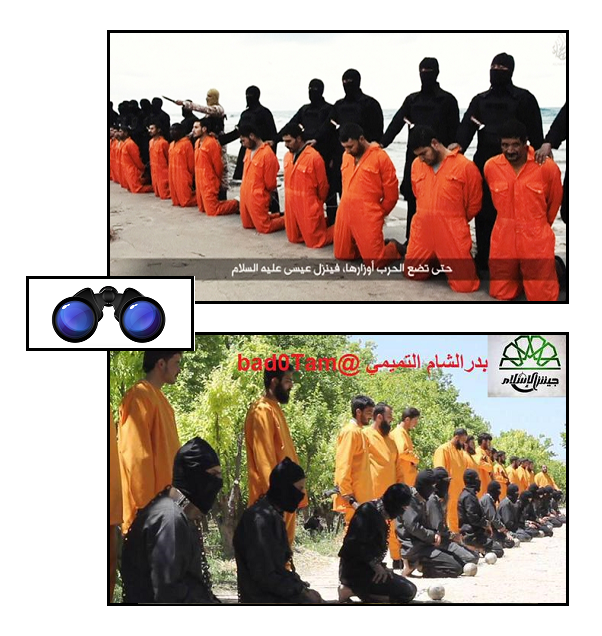
It’s usually the men in balack (IS) who execute the men in orange (Copts) — upper panel, below — but this time there has been a reversal of the color code, with the men in orange (Jaysh a-Islam) executing the men in black (IS) — lower panel.

SPEC DQ role reversal

I think the Jaysh’s choice of orange jumpsuits on this occasion was likely in deliberate and ironic commentary on the IS images, as indeed the IS choice was a deliberate choice echoing the jumpsuits of Guantanamo.

Note, though, that those executed in the upper panel were Christians, while the Jaysh is a Muslim outfit giving IS a taste of its own medicine. The Coptic Christians, by contrast, have been remarkably forgiving, treating the e=xecution of their own as a cause for gratitude at the faithfuoness of their martyrs.

More on Stern & Berger’s ISIS: State of Terror

Friday, May 8th, 2015

[ by Charles Cameron — hey, I recommend Stern’s earlier Terror in the Name of God and JM’s Jihad Joe, too ]
.

Jessica Stern & JM Berger have a very clever title for their book — which is one of many things I didn’t get to address in my Pragati review, because there’s really a great deal to be said about IS and about the book. Let’s take a look at that title:

**

ISIS: State of Terror is a triple pun really, since their book is about:

  • the specifically “state building” aspect of the Islamic State as a caliphal movement expansive across geography and concerned with hospitals, roads, policing, and how tight your jeans are
  • the state of mind we call terror, which can be understood either positively as mentioned in the Qur’anic account of the battle of Badr or negatively as the attempt to persuade by selective brutality and its generalized implications
  • an overview of IS that’s essentially a “State of the Union” style summation of where we are, how we got there and where to proceed
  • For some reason I am seeing in threes today, a trait shared by Trinitarians of course, but also by CS Peirce and George Boole.

    **

    Okay. The Islamic State really “exists” on three braided levels:

  • as a military and political entity with peronnel, materiel, logistics, strategic aims, victories, losses — largely stuff that can be viewed by satellite or televised, largely physical, quantifiable, though with its own mental drivers — and in this sense the Baathist military minds are the force-multipliers
  • as a digital and virtual entity with “cool” computer graphics, net-savvy virality, a Naji-derived approach to war as public relations and so forth. Here, the graphics, video and net mavens are the force multipliers. And if anyone is still in doubt as to whether “virtual reality” is real, please note that IS’ virtual reality brings real human bodies half way around the world to their deaths.
  • and as a religious and eschatological entity with its own central “Dabiq” hadith — and an appeal to all the hope frustrated by all the world’s perceived injustices, taking (i) the adventurous, rebellious spirit with its naive idealism (ii) via net connectivity and virtuoso virality (iii) through and past the milpol driver and its practicalities into (iv) the enhanced divine sanction of the Great Final War of Good (brutally) ascendant over Evil. Ironic, I know, but substantially true, and there’s a sort of Moebius twist in there that brings Good to mean Evil and Evil to mean Good — Goorge Orwell would have grimly understood.
  • My point here being that to understand IS we need both “physical” and “metaphysical” eyes, and a healthy dose of online virtual savvy too. And that’s why Jessica Stern & JM Berger‘s book is an invaluable guide: it looks closely into all three realms.

    **

    Interestingly enough, to me at least, I see my focus on Islamist apocalyptic has gone through three phases, each one having its own cluster of traditions / ahadith:

  • I began with Hamas and the Gharqad Tree traditions
  • I moved on to Al-Qaida and the traditions about the black banners from Khorasan, and
  • with the Islamic State came Dabiq the magazine and the Dabiq traditions.
  • On the horizon, still, the traditions about the Ghazwa-e-Hind. Keep your eyes peeled.

    My Pragati review of Stern & Berger’s ISIS: State of Terror

    Thursday, May 7th, 2015

    [ by Charles Cameron — in which the Islamic State is nicely viewed through the lens of WB Yeats ]
    .

    My review of Jessica Stern & JM Berger‘s book, ISIS: State of Terror, just came out in tbe Takshashila Institution‘s magazine, Pragati. Here’s a teaser..

    **

    Things fall apart, the centre cannot hold,
    Mere anarchy is loosed upon the world.
    The blood-dimmed tide is loosed, and everywhere
    The ceremony of innocence is drowned;
    The best lack all conviction, while the worst
    Are filled with passionate intensity.

    WB Yeats, The Second Coming

    In the closing pages of ISIS: the State of Terror, Jessica Stern and JM Berger quote Yeats’ celebrated poem and comment: “It is hard to imagine a terrible avatar of passionate intensity more purified than the ISIS. More than even al Qaeda, the first terror of the twenty-first century, ISIS exists as an outlet for the worst — the most base an horrific impulses of humanity, dressed in fanatic pretexts of religiosity that have been gutted of all nuance and complexity. And yet, if we lay claim to the role of ‘best’, then Yeats condemns us as well, and rightly so. It is difficult to detect a trace of conviction in the world’s attitude toward the Syrian civil war and the events that followed in Iraq…”

    Stern and Berger suggest that in Yeats’ poem, “the reality of the world is distilled to the razor-sharp essence that the best poetry provides”. Indeed the poem and their comments on it, captures the essence of both their book and of the situation we find ourselves in.

    Yeats in his poem writes “The blood-dimmed tide is loosed”. It would be hard to find a more apt description for the IS’ video of the twenty-one Coptic Christians beheaded on the Libyan shores of the Mediterranean, their blood mingling with the tide, than these few words written a century earlier. Yeats writes “The worst are filled with passionate intensity”. This intensity is something we need to come to terms with. And how better explain the increasing sectarianism in the Middle East, than with the simple words, “The centre cannot hold?” Finally, Yeats’ vision is an overtly apocalyptic one, as the poem’s title, The Second Coming, eloquently testifies.

    In understanding that intensity, three words describe the major strands with respect to the ISIS: barbaric, viral, and eschatological. The barbaric nature of IS behavior is not a spontaneous eruption, but a calculated move away from al Qaeda’s more subdued approach, premised on Abu Bakr al-Naji’s book, The Management of Savagery, which describes, according to its subtitle, “the most critical stage through which the Ummah will pass”. Al-Zarqawi, the leader of Al Qaeda in Iraq and the revered forerunner of today’s Islamic State, was heavily influenced by Naji’s tract, as is IS to this day, as Stern and Berger make clear. Indeed, to quote a phrase from within the book, their book itself might have been subtitled The Marketing of Savagery.

    **

    To read the whole review, please visit the review on Pragati.

    Boston: Apocalyptic Hopes, Millennial Dreams and Global Jihad

    Sunday, April 19th, 2015

    [ by Charles Cameron — “The now defunct Center for Millennial Studies at Boston University (1996-2003) brings to the public one final conference on apocalyptic beliefs” ]
    .

    If this was a movie, I’d say the speakers at this conference were a “stellar cast”! Will McCants, Graeme Wood, Cole Bunzel, Timothy Furnish, David Cook, JM Berger, Husain Haqqani.. Paul Berman and Ayaan Hirsi Ali..

    I participated in several of the old Center for Millennial Studies conferences that Richard Landes organized around the turn of the millennium, and they were intense academic highlights for me. I thought it very short-sighted when CMS funding was cut after the turn of the year 2000, agreeing with Dr Landes that millenarianism was unlikely to go away any time soon — and AQ, and IS even more so, have more than proven his point — hence this “final” conference.

    If you can attend, by all means do — highly recommended. I’m delighted to have been invited to attend myself, and hope to keep Zenpundit readers well informed.

    **

    Apocalyptic Hopes, Millennial Dreams and Global Jihad: May 3-4, 2015, Boston University

    Sponsored by the BU History Department and Scholars for Peace in the Middle East

    Most Westerners associate the terms apocalyptic and millennial (millenarian) with Christian beliefs about the endtime. Few even know that Muhammad began his career as an apocalyptic prophet predicting the imminent Last Judgment. And yet, for the last thirty years, a wide-ranging group of militants, both Sunni and Shi’i, both in coordination and independently, have, under the apocalyptic belief that now is the time, pursued the millennial goal of spreading Dar al Islam to the entire world. In a manner entirely in keeping with apocalyptic beliefs, but utterly counter-intuitive to outsiders, these Jihadis see the Western-driven transformation of the world as a vehicle for their millennial beliefs, or, to paraphrase Eusebius on the relationship between the Roman Empire and Christianity: Praeparatio Califatae.

    The apocalyptic scenario whereby this global conquest takes place differs from active transformative (the West shall be conquered by Da’wa [summons]) to active cataclysmic (bloody conquest). Western experts have until quite recently, for a wide range of reasons, ignored this dimension of the problem. And yet, understanding the nature of global Jihad in terms of the dynamics of apocalyptic millennial groups may provide an important understanding, both to their motivations, methods, as well as their responses to the inevitable disappointments that await all such believers. The now defunct Center for Millennial Studies at Boston University (1996-2003) brings to the public one final conference on apocalyptic beliefs, co-sponsored by the BU History Department and Scholars for Peace in the Middle East (SPME).

    **

    Schedule:

    *All events will take place in the Stone Science Building (645 Commonwealth Ave), room B50

    Sunday, May 3

    10:00-12:00 Introduction:

    1. Richard Landes, “Globalization as a Millennial Praeparatio Califatae: A Problematic Discussion
    2. William McCants, Brookings Institute: “ISIS and the Absent Mahdi: Studies in Cognitive Dissonance and Apocalyptic Jazz”
    3. Graeme Wood, Yale University, Atlantic Monthly: “On the Resistance to seeing Global Jihad as Apocalyptic Movement”

    12:00-1:30 Break for Lunch

    1:30-3:30 Panel II: The Millennial Goal: Global Caliphate

    1. Cole Bunzel, Yale U.: ISIS: From Paper State to Caliphate: Hotwiring the Millennium
    2. Timothy Furnish, Independent Scholar: “Varieties of Transformative (non-violent) Jihadi Millennialism
    3. Jeffrey Bale: Monterey Institute of International Studies, “The Persistence of Western ‘Mirror Imaging’ and Ideological Double Standards: Refusing to Take Islamist Ideology Seriously

    4:00-5:30 Panel III: Case Studies in Apocalyptic Jihad

    1. David Cook, Rice University: “ISIS and Boko Haram: Profiles in Apocalyptic Jihad”
    2. JM Berger, Brookings Institute, “The role of communications Technology in mediating apocalyptic communities”
    3. Mehdi Khalaji, Washington Institute of Near East Policy: “Apocalyptic Revolutionary Politics in Iran”

    Monday, May 4

    10:0-12:00 Panel IV: Conspiracy Theory and Apocalyptic Genocide

    1. Itamar Marcus, Palestinian Media Watch, “Anti-Semitism, Conspiracy Theory and Apocalyptic Global Jihad”
    2. Charles Small, “Ideology and Antisemitism: Random Acts or a Core Element of the Reactionary Islamist Global Jihad?”
    3. Richard Landes, BU, “Active Cataclysmic Apocalyptic Scenarios, Demonizing and Megadeath: Taiping, Communists, Nazis, and Jihadis.”
    Comments: David Redles, Michael Barkun

    12:00-1:30 Break for Lunch

    1:30-4:00 Final Panel Discussion

    Paul Berman, Independent Scholar
    Ayaan Hirsi Ali, Independent Scholar
    Jessica Stern, Harvard University
    Husain Haqqani, Hudson Institute
    Charles Strozier, John Jay College
    Brenda Brasher, Tulane University

    **

    Selected Work

    Ayaan Hirsi Ali
    Read “Those Who Love Death: Islam’s Fatal Focus on the Afterlife” from Heretic (2015) Here

    Jeffrey Bale
    Read “Islamism and Totalitarianism” (2009) Here
    Read “Political Correctness and the Undermining of Counterterrorism” (2013) Here

    J.M Berger
    Read “The ISIS Twitter Consensus” (2015) Here
    Professor Berger’s latest book, coauthored with Jessica Stern, ISIS: State of Terror, can be purchased Here

    Paul Berman
    Read “Why is the Islamist Death Cult So Appealing?” (2015) Here

    Cole Bunzel
    Read “From Paper State to Caliphate: The Ideology of the Islamic State” (2015) Here

    Medhi Khalaji
    Read “Apocalyptic Politics: On the Rationality of Iranian Policy” (2008) Here

    Richard Landes
    Read “Enraged Millennials” from Heaven on Earth: The Varieties of the Millennial Experience (2011) Here

    William McCants
    Read “The Sectarian Apocalypse” (2014) Here

    Jessica Stern
    Read “The Coming Final Battle” from ISIS: State of Terror (2015) Here

    Charles Strozier
    Professor Strozier’s book, The Fundamentalist Mindset can be purchased Here

    Graeme Wood
    Read “What ISIS Really Wants” (2015) Here


    Switch to our mobile site