zenpundit.com » framing

Archive for the ‘framing’ Category

Two horrors, one suggestion, and a very great poem

Thursday, May 5th, 2011

[ by Charles Cameron ]
*
.
I like the idea of seven generations as a timeline to work with: it’s mid-range, and it confers a sort of limited immortality on the world around me, without being too bothered about me and my personal survival. On the other hand, it’s an “over the horizon” kind of thinking, and I once heard the suggestion that when in a four-and-a-half tatami room, I should confine myself to four-and-a-half tatami thinking.

So.

An alternative approach is to leave everything else out of a given picture, and concentrate on what happens to children.

I’m not suggesting “seven generation”, “four-and-a-half tatami”, or “children only” thinking should be the only approaches we take, just that they may add valuable insight…

*

In which spirit: Forget, for a moment, enmity: here are two horrors…

quo-child-impact.jpg

*

These two things have struck me as particularly horrible in my browsing over the last few days. The first – assuming the Guardian is quoting the Pakistani intelligence official correctly, and that the official knows what he’s talking about – is the sort of thing we might not, as the saying goes, “wish on our worst enemy” – but it happened to our enemy’s child, a girl, twelve years old:

Osama bin Laden’s 12-year-old daughter watched as her father was shot dead by American special forces, a senior Pakistani intelligence official has told the Guardian.

The girl, who was found at the scene of the raid by Pakistani security services, is being cared for at a military hospital having been wounded in the attack. She has been questioned about the sequence of events during the raid on Sunday night.

No blame, as the saying goes – but for that child, it’s a double tragedy.

And the second?

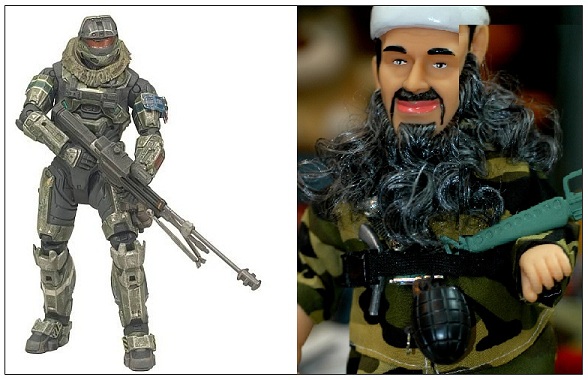
I know how excited my own sons get when a new action-figure toy from the Halo line arrives in the household – so I dread to think how a toy like this might turn younger minds, as yet perhaps innocent of violence and hatred, towards the “heroism” of jihad…
halo-ubl.jpg

[ Jun Noble 3 action figure from Amazon – OBL action figure from Foreign Policy slideshow ]

*

It is childhood I am grieving:

Leaves, like the things of man, you
With your fresh thoughts care for, can you?
Ah! as the heart grows older
It will come to such sights colder
By & by, nor spare a sigh…

Gerard Manley Hopkins SJ, from his poem Spring and Fall, to a young child
On jihadist succession and strategy [money quote]

Wednesday, May 4th, 2011

[ by Charles Cameron ]

.

Here’s an early indicator of jihadist strategic thinking from Sheikh Husain b. Mahmoud on the Ansar forums — Leah F calls him “a very influential figure, and not only in the virtual world” — via Aaron Zelin‘s fine collection & collation of jihadist source materials on his Jihadology blog (link to safe-for-download English version):

I call all the Mujahideen of the world and all their supporters, to prevent their tears from flowing and to keep their rage to themselves, so that it can act as a volcano which explodes at its proper time. We do not want sporadic operations of vengeance. Rather, we want special operations which are properly planned out, with wisdom and patience, so that it can bear its fruit, and make America forget the attacks on Washington and New York, and say goodbye to the good old days. This is an extremely important matter, as individual and random operations of vengeance usually have negative effects, and as crying and showing ones sadness brings joy to the enemies of Allah. It is incumbent upon the leaders of Jihad to rearrange their cards and announce a successor to Sheikh Usama, may Allah have mercy on him, and then start to plan the coming stages with experience, looking into what is in the greater interest of the Ummah.

To be read in the context of Leah Farrall‘s excellent piece Wanted: Charismatic Terror Mastermind – Some Travel Required in Foreign Affairs yesterday.

On “occultation” (ghayba) and bin Laden

Wednesday, May 4th, 2011

[ by Charles Cameron ]

.

Dr. Timothy Furnish, the author of Holiest Wars: Islamic Mahdis, their Jihads and Osama bin Laden and a keen student of both Shi’ite and Sunni Mahdism, proposed on Twitter yesterday:

Without UBL’s body (or at least pix) claims will come soon that UBL merely “occulted” (like 12th Imam), not dead, and will return.

*

It might be thought that occultation (ghayba) was a Shi’ite concept, extremely unlikely to be espoused by the Sunni (and indeed Salafist) followers of bin Laden.

What exactly is meant by the term “occultation”?

Gershom Scholem in his definitive study of the Jewish heretical messiah-claimant (and eventual Muslim convert) Sabbatai Sevi quotes Elias Bickerman‘s “study of the ideas of occultation in early Christianity and in the cult of the apotheosis of the Roman emperors”, in which the hero “by the grace of God, is liberated from death at the very moment of death, and is removed to Paradise, Heaven, or a distant land where he continues to live in the body.” (Scholem, Sabbatai Sevi: The Mystical Messiah, 1626-1676, p. 923)

Scholem uses the term “occultation” to describe the belief of Sevi’s followers after his death in a way which illustrates comparable beliefs among both Christians and Shi’ite Muslims (p. 314):

In itself the doctrine of occultation could also point to Shi’ite Muslim influence. In the theology of the more radical Shi’ite groups the doctrine of the the occultation of the imam was widely accepted. But in the historical context of Sabbatai’s biography before his apostasy, such Shi’ite influence would seem highly improbable. The messiah — according to Sabbatai’s and Nathan’s teaching — will, then, not die, but will be translated to higher worlds. The idea would agree well with what we know of Sabbatai’s illuminations and the concomitant psychological experiences of exaltation and ascensions to the celestial lights. It is not impossible that conversations with Christians suggested to Sabbatai the very congenial idea of the messiah’s transfiguration.

And notes of this Jewish variant (p. 923):

The Sabbatian doctrine of occultation was not borrowed from other systems but — as happens more often in the history of religions — is the result of similar structures of faith.

More recently, some followers of the late Lubavitcher rebbe have proposed that he is “hidden” and will return… See, for instance:

Since the Third of Tammuz, we are no longer able to physically see the Rebbe King Moshiach. The Rebbe remains physically alive just as before, it is only to our eyes that he is concealed. Therefore, we call this a day of concealment, and many refer to this as the “last test.”
.
— from the brochure “Chasidim Proclaim to the Lubavitcher Rebbe: Long Live our Master, our Teacher, our Rebbe King Moshiach Forever and Ever” as quoted by Rabbi Chaim Dov Keller

*

That’s the sort of background I’d want to have, before dismissing Tim Furnish’s suggestion out of hand. The Qur’an, after all, states at 3.169:

Think not of those who are slain in Allah’s way as dead. Nay, they live, finding their sustenance in the presence of their Lord…

Having said that, it is also true that the Prophet himself treats the notion of his own return as a metaphysical “wish” rather than a realistic possibility, in the hadith attested in both Bukhari and Muslim:

I wish that I could be killed in the Path of Allah, then be brought back to life, then be killed, then be brought back to life, then be killed.

It will be instructive to watch how the narratives of bin Laden’s death and/or continuing life develop.

Towards a Pattern Language for CT?

Tuesday, May 3rd, 2011

[ by Charles Cameron ]

.

Okay, someone wasn’t reading his Sherlock Holmes

quo-obl-and-holmes.gif

Consider this a very minor contribution to the ongoing discussion of the benefits of a liberal arts education in connecting analytic dots (or avoiding those who connect them).

*

Refs:

Wikipedia, Pattern Language (background), and Christopher Alexander, A Pattern Language (one of the very great books).

The DARPA arts

Friday, April 29th, 2011

[ by Charles Cameron ]

.

Blog-friend Cameron Schaefer has a piece up at Small Wars Journal today in which he quotes Boyd (writing that his approach “incorporated science, but more closely approximated the often chaotic, creative impulses of art”) and Mahan (“art, out of materials which it finds about, creates new forms in endless variety”), and concludes:

Approaching strategy in an indirect fashion, as more of an art than science may make some uneasy, specifically those who find safe haven in the concreteness of checklists and formulas. Yet, the nature of strategy reflects the nature of the world. It is infinitely complex, it is always changing and it is filled with humans that often do irrational things. Literature (see Charles Hill) and psychology have as much of a place at the strategy table as military history… as do mathematics, physics, political science and technology. So, when asking, “what must one study to be a great strategist?” the answer seems to be, “everything else.”

Okay, so that (and Hill‘s work, which Zen reviewed recently) gives us the significance of the arts in strategic thinking which, one hopes, is practiced before going in to battle, and may indeed give one second thoughts about it…

*

Literature and the arts are also important after battle, though – and the US Military and DARPA have clearly been thinking about that side of things:

quodarpa-arts1.gif

Sources: ComicsPlays

Poetry? meh… Sophocles? Chlanna nan con thigibh a so’s gheibh sibh feoil!

*

Lionel Tiger and Robin Fox in The Imperial Animal characterize modern health care as the “bureaucratization of mercy” and propose that for comparison, we set it beside:

the Greek ideal of the hospital as the place with the best food, the finest furnishings and paintings, and the most skilled musicians and comedians.

The greatest healing center in ancient Greece was the Asclepion at Epidavros / Epidaurus, which housed an amphitheater that could seat more than ten thousand people for dramatic and musical performances without amplification.

At Epidavros, patients would be healed by watching those same dramas of Sophocles to which the US Army is now turning for therapeutic relief in Guantanamo — for as Tiger and Fox (what a pair of names) go on to argue:

It is not the healthy, but the sick who most vitally needed such agreeable and re-creative stimuli; and the resources the community had were most beneficially and sanely used in helping them ease their personal disarray and feel encouraged by this display of their community’s careful concern.

*

It’s also interesting to note that the graphic novel Silver Shields mentioned in Axe‘s piece as a precursor to DARPA’s “Online Graphic Novel/Sequential Art Authoring Tools for Therapeutic Storytelling” project is “set during the ancient Greek invasion of Afghanistan more than two millenniums ago” as a metaphor for America’s current situation…


Switch to our mobile site